

You've probably walked past a giant chess set in a park or hotel lobby and felt that irresistible urge to move one of those enormous pieces. There's something genuinely captivating about chess when it's scaled up to life-size proportions. Giant chess isn't just a novelty attraction, though. It's a brilliant way to experience the game from a completely fresh perspective, combining physical activity with the mental workout that makes chess so rewarding. Whether you're a beginner learning the basics or an intermediate player looking to deepen your understanding, playing on an oversized board can reveal patterns and strategies you might miss on a traditional set.
What Makes Giant Chess Different From Regular Chess
The rules haven't changed, but everything else has. When you're standing on a massive chessboard looking at pieces that reach your waist or chest, the game takes on a whole new dimension.
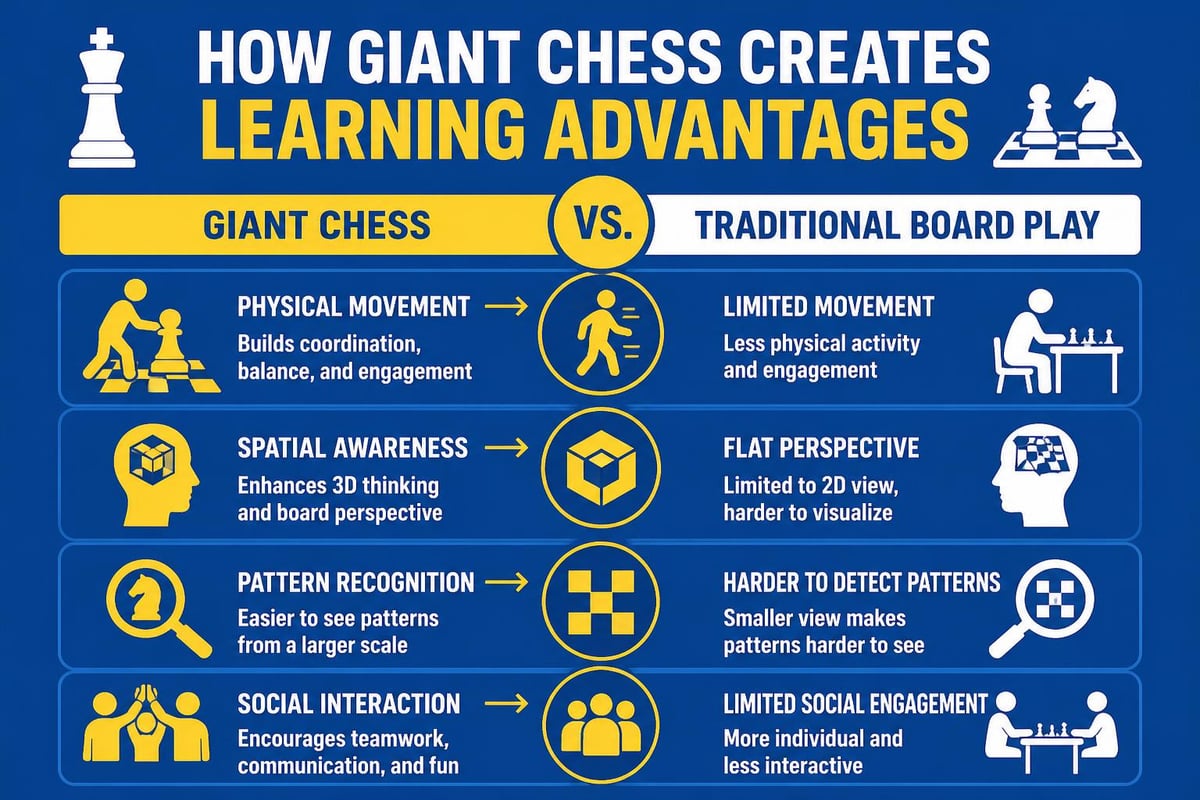
The Physical Element
Giant chess transforms a sedentary activity into something active. You'll find yourself walking around the board, circling positions to view them from different angles, and physically moving pieces that might weigh several kilograms. This physical engagement changes how you think about the game.
Key differences you'll notice:
- You experience the board from multiple perspectives as you move
- The physical act of moving pieces creates stronger memory associations
- You'll naturally slow down, giving yourself more time to think
- The spectacle attracts onlookers, adding a social element to your game
According to research on giant chess in educational settings, students who played on oversized boards showed increased engagement and better retention of chess concepts. The physical movement seemed to reinforce strategic thinking in ways that sitting still couldn't achieve.
Visualisation at a Different Scale
When pieces are 30 centimetres or larger, you see the board differently. Patterns become clearer. The relationships between pieces feel more tangible. If you've struggled with playing the game of chess and visualising moves ahead, giant chess might be exactly what you need.
The spatial relationships that define chess strategy become impossible to ignore. A knight fork isn't just an abstract concept when you're standing between two pieces that tower over you. The long diagonals that make bishops powerful stretch out before you like highways across the board.
Where Can You Play Giant Chess
You don't need to own a set to enjoy this experience. Giant chess sets are appearing in more locations every year, from public parks to hotels to libraries.
Public Spaces and Parks
Many cities have installed permanent outdoor sets in parks and public squares. These sets typically feature pieces ranging from 20 to 90 centimetres tall, crafted from weather-resistant materials. MegaChess explains the appeal of these installations for community engagement and outdoor recreation.
Some notable locations include:
- City centres with pedestrianised zones
- Seafront promenades and boardwalks
- University campuses and student unions
- Resort hotels and holiday destinations
- Community centres and public libraries
Your local library might even offer a giant chess set you can borrow for events or outdoor play.
Indoor Venues
Indoor giant chess sets offer year-round play regardless of weather. You'll find these in:
- Hotel lobbies and conference centres
- Shopping centres and entertainment complexes
- Educational facilities and after-school clubs
- Chess clubs with dedicated teaching spaces

Learning Benefits of Giant Chess
Have you ever wondered why concepts stick better when you're physically engaged? There's solid educational theory behind using giant chess as a learning tool.
Enhanced Pattern Recognition
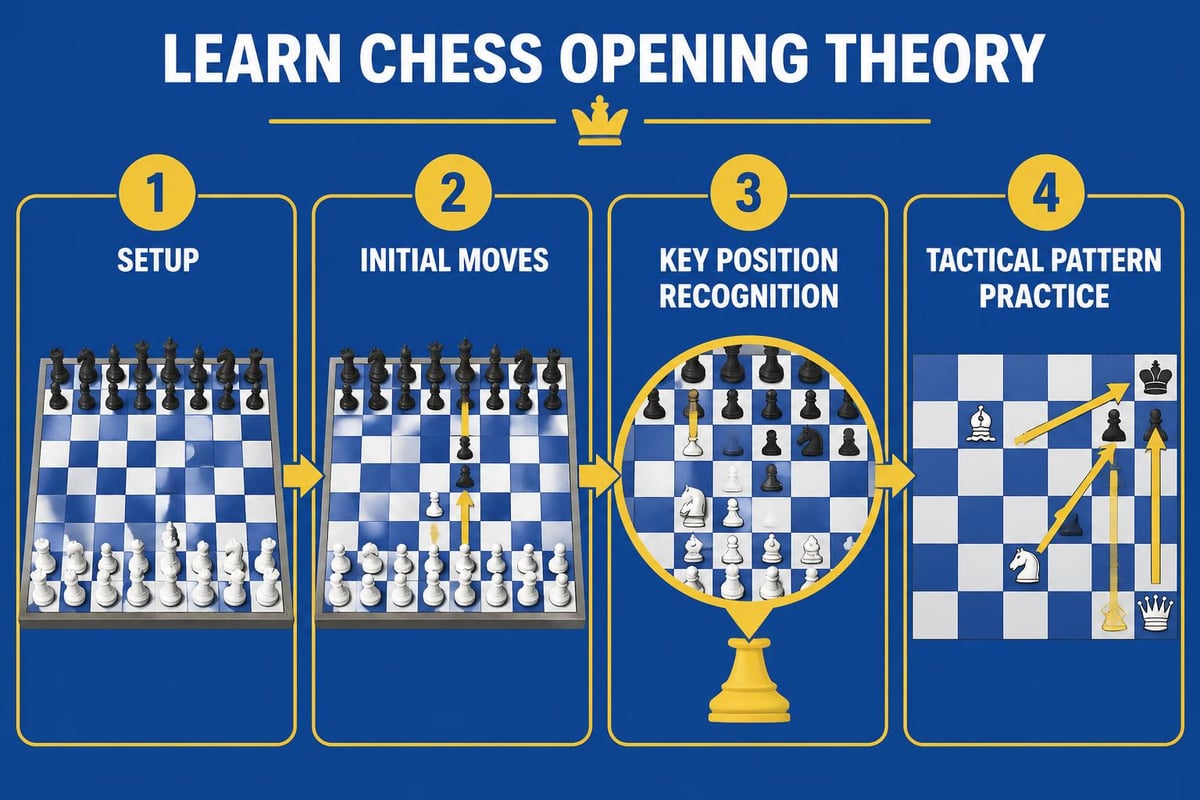
Chess is fundamentally about recognising patterns. The London System, Sicilian Defense, and other chess openings all follow recognisable patterns. When you play giant chess, these patterns become physically embedded in your memory.
| Learning Aspect | Traditional Chess | Giant Chess |
|---|---|---|
| Piece relationships | Abstract visualization | Physical spacing visible |
| Board geometry | Mentally calculated | Experientially understood |
| Opening patterns | Memorised moves | Spatial movement memory |
| Tactical motifs | Studied positions | Walked-through scenarios |
Slowed-Down Decision Making
The physical effort of moving large pieces naturally creates pauses. This slower pace benefits developing players enormously. You can't rush through moves when each piece requires deliberate effort to relocate.
This built-in thinking time helps you:
- Evaluate positions more thoroughly
- Consider opponent responses before moving
- Develop calculation discipline
- Build systematic thinking habits
Social Learning Opportunities
Giant chess naturally attracts attention. When you play in public spaces, you'll often gather spectators who offer comments, ask questions, or want to learn. This social dimension creates unexpected learning opportunities.
You might find yourself explaining why you chose a particular move, which reinforces your own understanding. Or a spectator might suggest an alternative you hadn't considered. These interactions transform chess from a solitary pursuit into a collaborative learning experience.
Strategic Tips for Giant Chess Play
The fundamentals remain the same, but giant chess rewards certain approaches that might not be as obvious on a standard board.
Use the Physical Space to Your Advantage
Walk around the entire board before making critical decisions. View the position from your opponent's perspective literally, not just figuratively. This physical movement often reveals tactical opportunities you'd miss from a single viewpoint.
Practical movement strategies:
- Circle the board after your opponent moves
- Stand behind threatening pieces to visualise their power
- Walk along files and ranks to spot weaknesses
- Position yourself at key squares to imagine piece placement
Focus on Fundamental Principles
Giant chess is brilliant for reinforcing chess fundamentals. The enlarged scale makes basic principles impossible to ignore:
- Control the centre: Those central squares look genuinely commanding when you're standing on them
- Develop your pieces: The journey from back rank to active squares feels significant
- King safety: An exposed king looks truly vulnerable on an oversized board
- Piece coordination: Harmonious piece placement becomes visually obvious
If you're working on mastering chess openings, practising them on a giant set can solidify your understanding of why certain moves work.
Teach and Learn Simultaneously
Giant chess is an exceptional teaching tool. If you're learning chess yourself, teaching someone else on a giant board will deepen your own understanding remarkably.
Consider working through these teaching exercises:
- Demonstrate basic checkmate patterns (king and queen, king and rook)
- Show how knights move through a physical path demonstration
- Illustrate pawn structure concepts by arranging pawn chains
- Practice endgame techniques with just a few pieces
Choosing a Giant Chess Set
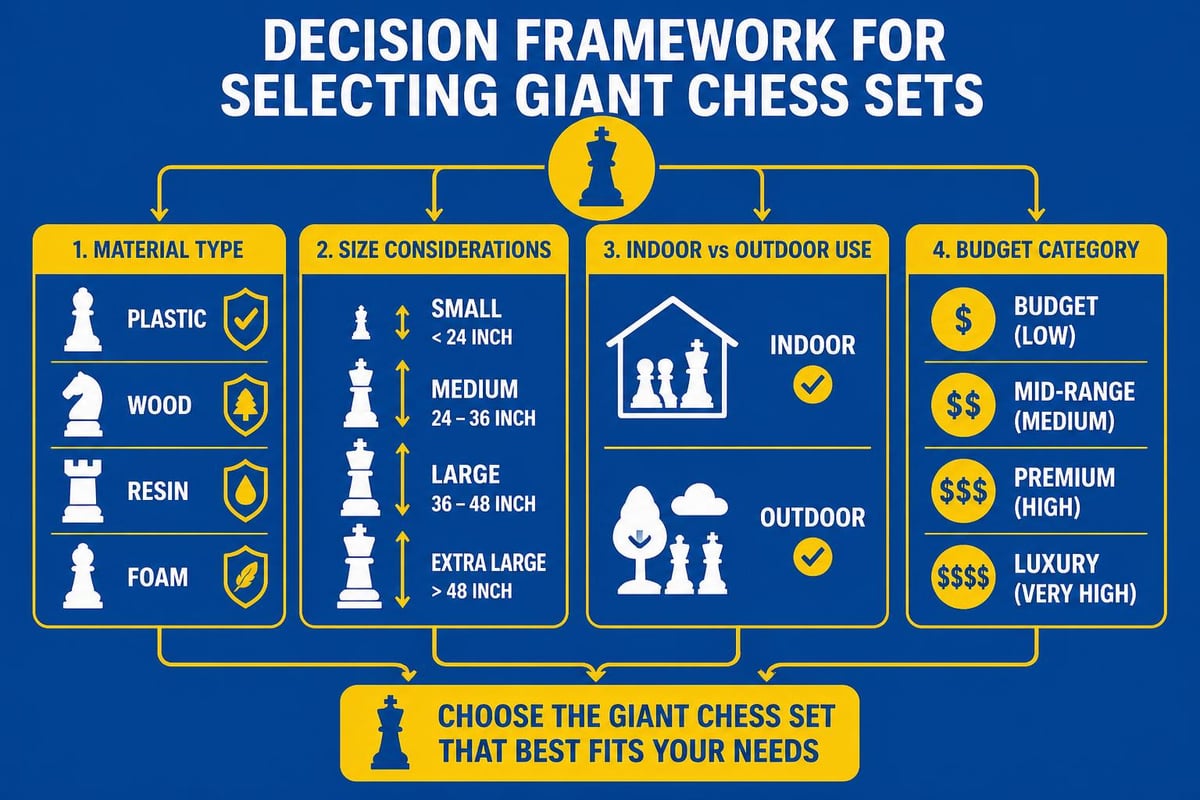
Thinking about purchasing your own set? The market offers various options depending on your needs and budget.
Material Considerations
Most quality giant chess sets come in three main materials:
| Material | Pros | Cons | Best For |
|---|---|---|---|
| Plastic | Lightweight, affordable, weather-resistant | Less aesthetic appeal, can blow over in wind | Schools, temporary events |
| Wood | Beautiful craftsmanship, substantial weight, premium feel | Requires maintenance, higher cost, weather considerations | Permanent installations, indoor use |
| Resin/Composite | Durable, weather-proof, moderate weight | Mid-range aesthetics | Year-round outdoor use |
Specialist manufacturers offer handcrafted wooden sets that double as garden sculptures. European suppliers provide sets designed for both aesthetic appeal and functional play.
Size Selection
Giant chess sets typically range from 20cm pieces (with a 3m x 3m board) to truly massive 90cm pieces requiring a 7.5m x 7.5m playing area.
For most purposes, medium-sized sets (40-50cm pieces) offer the best balance:
- Large enough for visual impact and physical engagement
- Small enough for reasonable storage and transport
- Suitable for both adult and child players
- Fit in standard garden or patio spaces
Durability Features
If you're planning outdoor use, look for sets with these features:
- UV-resistant finishes to prevent colour fading
- Weighted bases to resist wind (crucial for taller pieces)
- Water-resistant materials for year-round exposure
- Easy-clean surfaces that won't stain or discolour
Sets designed for outdoor durability can withstand years of exposure whilst maintaining their appearance and functionality.
Giant Chess in Chess Education
How might oversized pieces transform your approach to learning chess theory? The connection between physical space and conceptual understanding runs deeper than you might think.
Opening Preparation Becomes Tangible
When you're physically walking through an opening sequence on a giant board, the moves embed themselves differently in memory. The London System, for example, becomes a physical journey rather than abstract notation.
You experience the development sequence bodily:
- Physically place the d-pawn on d4
- Walk the bishop to f4, feeling the diagonal control
- Position the knight on f3, experiencing piece coordination
- Castle kingside, creating the physical safety of the king
This kinaesthetic learning complements traditional study methods brilliantly. When you sit down at a tournament board later, your muscle memory recalls the spatial relationships you experienced at full scale.
Tactical Training Enhanced
Tactical motifs like pins, forks, and skewers become strikingly obvious on giant boards. The physical geometry makes threats impossible to miss.
Try these tactical exercises on a giant set:
- Fork recognition: Stand at the knight's position and identify which pieces it attacks
- Pin awareness: Walk the line from attacker through pinned piece to valuable piece behind
- Discovered attacks: Physically move the screening piece and observe the revealed threat
- Back rank mates: Experience the trapped king's lack of escape squares
Tournament Preparation
Whilst you'll compete on standard boards, practicing on giant chess builds transferable skills. The visualization abilities you develop by walking around positions translate directly to calculating variations whilst sitting still.
Many chess educators now incorporate giant chess sessions into their coaching programmes. The variety keeps learning fresh and addresses different learning styles. If you typically study from chess resources like books and videos, adding physical giant chess sessions creates a balanced learning approach.
Making Giant Chess Part of Your Improvement Plan
How can you integrate this unique format into your regular chess practice? It doesn't need to replace your current routine, just complement it.
Weekly Practice Structure
Consider this balanced approach:
Standard chess sessions (3-4 times per week):
- Online play and tactics training
- Opening study with cheat sheets
- Endgame practice
- Game analysis
Giant chess sessions (once per week):
- Review your weekly games on the giant board
- Practice specific opening lines physically
- Work through tactical positions at scale
- Play casual games focusing on pattern recognition
Combining Resources for Maximum Learning
The most effective chess improvement combines multiple learning methods. Your opening toolkits and puzzle practice work brilliantly alongside giant chess sessions.
Here's how they complement each other:
- Study an opening variation from your cheat sheets
- Practice it on a giant board to embed the patterns
- Test it in online games
- Review the games on the giant board to spot improvements
Community and Social Play
Giant chess's appeal extends beyond individual improvement. It's a gateway to building chess communities.
Organise giant chess events in your area:
- Park meetups: Arrange regular sessions at local giant chess installations
- Teaching sessions: Offer free lessons to beginners using the oversized set
- Simultaneous exhibitions: A strong player takes on multiple opponents
- Themed tournaments: Rapid games or specific opening practice events
These social connections make chess improvement more enjoyable and sustainable. You'll stay motivated when chess is both a mental challenge and a social activity.
The Psychology of Giant Chess
Why does playing with oversized pieces feel so different psychologically? The scale shift affects your relationship with the game in subtle but significant ways.
Reduced Performance Anxiety
When chess feels like play rather than serious competition, you'll often perform better. Giant chess creates this playful atmosphere naturally. The spectacle and physical comedy of moving large pieces lightens the mood.
This relaxed state actually benefits your chess:
- You're more creative with move choices
- You're willing to try new ideas without fear
- You learn from mistakes without harsh self-criticism
- You remember positions better due to positive associations
Increased Engagement and Focus
The novelty of giant chess commands attention. When you're playing at life size, distractions fade. Your phone in your pocket seems irrelevant when you're standing in the middle of a chess position.
This natural focus training transfers back to standard chess. After experiencing deep concentration on a giant board, you'll find it easier to achieve that state at a regular board too.
Giant chess offers something truly special: it transforms the abstract complexity of chess into a physical, social, and memorable experience that reinforces the strategic principles you're working to master. Whether you encounter it at a public park, your local library, or invest in a set for your school or community, this scaled-up version of the royal game provides learning benefits that complement traditional study beautifully. If you're ready to deepen your chess understanding through proven resources, Chess Cheat Sheets offers comprehensive guides, opening toolkits, and puzzle collections designed to accelerate your improvement without overwhelming study time, perfect for reinforcing the patterns and strategies you'll experience firsthand on those magnificent oversized boards.


