

Are you ready to elevate your chess game in 2026 with a proven strategy? The london system opening has become a trusted favorite for players of all levels, offering both reliability and flexibility. In this guide, you’ll discover how to master the london system opening step by step, from setup basics to advanced strategies. Whether you’re a club player or aiming for grandmaster success, you’ll learn how to handle every response and avoid common traps. Dive in and unlock the secrets to consistent results with the london system opening—your new weapon for chess improvement.

Understanding the London System: Origins, Philosophy, and Popularity
If you have ever wondered why the london system opening is everywhere these days, you are not alone. This chess opening, once seen as merely solid, has a story that stretches back over a century and continues to shape modern chess.

Historical Evolution and Notable Players
The london system opening first made waves at the 1922 London Congress, offering a new way for White to avoid deep, theoretical battles. Back then, the system was often overlooked in favor of more dynamic choices. However, it quickly earned respect for its reliability.
As the decades rolled on, the opening saw a transformation. In recent years, chess legends like Magnus Carlsen and Gata Kamsky have adopted it at the highest level. Their successes, including memorable games like Kamsky vs. Shankland (2014) and Carlsen vs. Ding Liren (2020), have showcased the london system opening’s potential for both slow, strategic play and sudden attacks.
Originally labeled as “solid but dull,” the opening’s reputation shifted dramatically. Thanks to its flexibility, players discovered how it could unleash creative, aggressive plans. The fact that it is called a “system opening” means you can use the same setup against a wide range of Black responses, making it perfect for anyone who values consistency.
Its popularity has surged, especially online. Statistics from major chess platforms show a considerable increase in the number of games featuring the london system opening over the past decade. Both club players and professionals praise its practical value, with many citing its ability to simplify learning and reduce time spent memorizing theory. For a deeper dive into its rich background and notable players, check out the London System's Historical Evolution.
The Core Philosophy of the London System
At its heart, the london system opening is all about universality and simplicity. Unlike openings that demand endless memorization, this setup works against nearly every Black defense. That means you can spend less time studying and more time playing.
You will often hear players describe it as “plug-and-play,” and for good reason. The move sequence—like developing your bishop before locking in the pawns—lets you sidestep many early traps. Compared to something like the Queen’s Gambit, the london system opening asks for less theory and more understanding.
Solid does not have to mean passive, though. While it is tough for Black to break through your structure, you can still launch powerful attacks, especially with moves like e4 or a kingside push. This balance between safety and aggression is why so many busy players, from students to professionals, stick with the london system opening.
The opening reduces the number of early pitfalls, letting you focus on actual chess instead of memorizing lines. Whether you are new to chess or looking for a reliable weapon at the club or tournament level, the london system opening’s philosophy is about giving you confidence, flexibility, and a fighting chance in every game.
Step-by-Step: Building the London System Setup
Ready to demystify the london system opening? Let’s break it down so you can play it confidently, move by move. This section walks you through the setup, key middlegame plans, and practical resources to help you master the london system opening for every opponent you face.
Chronological Move Order & Setup Fundamentals
The heart of the london system opening is its repeatable setup. Your first moves usually go like this:
1. d4     d5
2. Nf3    Nf6
3. Bf4
Some players flip the order, starting with 1.d4 and 2.Bf4, especially if they want to avoid early ...Nf6 or certain move orders. Both are solid, but 2.Nf3 is the most common at club level.
Ideal Pawn Structure and Piece Placement:
- Pawns on d4, e3, c3 form a solid triangle.
- Bishop comes out to f4 before e3 is played.
- Knights land on f3 and d2.
- Bishop goes to d3 or sometimes e2.
- h3 is played to keep Black’s bishop or knight from pinning on g4.
- Castle kingside for safety.
Here’s a simple table to compare the main move orders:
| Move Order | Pros | Cons |
|---|---|---|
| 1.d4 2.Nf3 3.Bf4 | Safe, flexible, avoids traps | Allows early ...Bf5 from Black |
| 1.d4 2.Bf4 3.Nf3 | Avoids some lines, less theory | Black can try early ...c5, ...Qb6 |
Key Principles for the london system opening:
- Develop pieces harmoniously, don’t rush pawn tension.
- Get the dark-squared bishop outside the pawn chain before playing e3.
- Support your center with c3 and e3.
- Avoid moving the bishop inside the pawn chain (like Bc1-e2 after e3) unless necessary.
Common Mistakes to Avoid:
- Locking the bishop behind pawns (e.g., playing e3 too early).
- Forgetting c3, which helps support the center and blunts Black’s pressure.
- Overlooking move order tricks that let Black play ...Qb6 and attack b2.
Move Order Tricks:
If Black plays an early ...c5 or ...Qb6, consider Qb3 to defend b2, or play c3 before e3. Always be alert for subtle differences in move order that can affect the structure.
Want a deeper breakdown of these move orders and typical lines? Check out this London System chess opening guide for diagrams, traps to avoid, and practical tips.
Typical Plans and Middlegame Themes
Once you’ve completed your london system opening setup, your plans depend on Black’s responses. Still, some classic strategies pop up in almost every game.
- e4 Break: A big goal is to prepare the e4 pawn break. This grabs space and opens lines for attack.
- Kingside Attack: If Black castles kingside, look for ideas like Ne5, f4, and sometimes launching pawns with h4–h5.
- Central Control: Use your pawn triangle and well-placed pieces to dominate the center and restrict Black.
- Flexible Piece Play: h3 (to stop ...Ng4), Qe2 (preparing e4 or connecting rooks), and Rfe1 are moves that keep your options open.
Let’s say you’ve reached this position after ten moves:
1.d4 d5 2.Nf3 Nf6 3.Bf4 c5 4.e3 Nc6 5.c3 e6 6.Nbd2 Bd6 7.Bg3 O-O 8.Bd3 b6 9.O-O Bb7 10.Qe2
From here, White can look to play e4, move a knight to e5, and start probing for weaknesses. Watching model games will help you see how these plans come together.
Adapting to Black’s Choices:
If Black fianchettos with ...g6 and ...Bg7, keep your bishop flexible, sometimes rerouting it to e2. When Black goes for early ...c5 and ...Qb6, defend b2 with Qb3 or play c3 first.
Streamline Your London System Learning with Visual Resources
Learning the london system opening doesn’t have to be overwhelming. If you’re a visual learner, Chess Cheat Sheets offers plug-and-play resources that turn complex theory into quick-reference guides.

With visual cheat sheets, you’ll see the core move orders, key plans, and common pitfalls at a glance. These tools help you avoid the most frequent mistakes and build confidence in your setup.
You can grab free samples and even get lifetime access to all their opening toolkits. For busy players, this is a shortcut to making the london system opening second nature.

Navigating Key Variations and Black’s Main Defenses
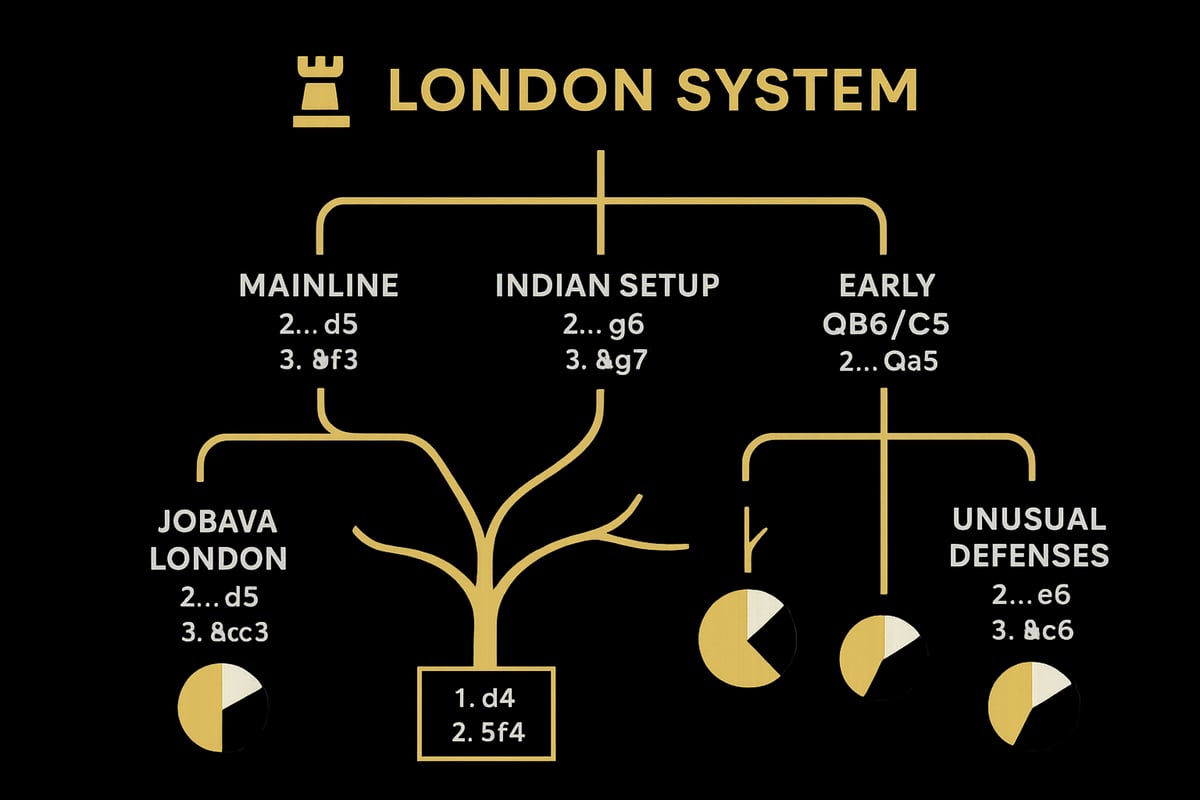
If you want to get real results from the london system opening, you need to know how to handle Black’s main defenses. Each response from Black can steer the game in a new direction, so let’s break down the key branches and explore the strategies that will keep you ahead.
Mainline London System and Its Strategic Nuances
The mainline london system opening starts with 1.d4 d5 2.Nf3 Nf6 3.Bf4 c5 4.e3 Nc6 5.c3 e6 6.Bd3 Be7 7.Nbd2 O-O 8.h3 b6 9.O-O Bb7 10.Qe2. This setup gives White a solid center and flexible development.
One of the main strategic ideas is to prepare the e4 break at the right moment. You should also watch for chances to launch a kingside attack, especially after moves like Ne5 and f4.
A common plan is to double rooks on the e-file, play Qe2, and keep your bishop on d3 aiming at h7. Avoid developing your bishop inside the pawn chain, and remember that harmonious piece coordination is key in the london system opening.
Typical middlegame themes include:
- Expanding in the center with e4.
- Building pressure on the kingside.
- Using the c3 and e3 pawns to restrict Black’s counterplay.
Facing the Indian Setup (...g6 and ...Bg7)
When Black plays 1.d4 Nf6 2.Bf4 g6 3.Nf3 Bg7 4.e3 d6, you face the so-called Indian Setup. The london system opening remains flexible here, but you need to adjust your plans.
In this variation, it’s often best to avoid trading your dark-squared bishop for Black’s fianchettoed bishop. Consider playing Bf4–e2 and castling early. This keeps your bishop as a valuable attacking piece later in the middlegame.
Statistically, games in this setup are balanced, but White keeps a slight edge due to the solid pawn structure and potential for a quick e4 break.
Tips for this line:
- Hold back on c3 until Black commits their pawns.
- Don’t rush h3 unless necessary.
- Focus on development, not material gains.
The Jobava London: A Sharp Alternative
The Jobava London is a dynamic twist on the london system opening: 1.d4 Nf6 2.Nc3 d5 3.Bf4. By developing the knight to c3 early, you open up aggressive possibilities, especially if Black is unprepared.
This version is less about slow buildup and more about taking the initiative. You’ll often see kingside pawn storms or quick piece sacrifices. If you want to learn more about how the Jobava London compares to the classical system, check out this Introduction to the London and Jobava London Systems for a deeper dive.
Common plans include:
- Rapid kingside attacks.
- Sacrificing a pawn for open lines.
- Surprising your opponent with offbeat move orders.
While the Jobava can catch opponents off guard, be mindful of early tactics against your c3 knight and keep an eye on the center. The london system opening in this form rewards boldness and creativity.
Dealing with Early ...Qb6 and ...c5 Pressure
One of the trickiest responses to the london system opening is when Black plays an early ...Qb6, targeting your b2 pawn. The main line goes 1.d4 d5 2.Nf3 Nf6 3.Bf4 c5 4.e3 Nc6 5.c3 Qb6.
To defend, many players respond with 6.Qb3, leading to 6...c4 7.Qxb6 axb6. Now, White should focus on controlling the center and using the open a-file for rook activity.
Key points to remember:
- Don’t rush pawn moves that weaken your queenside.
- Be precise with move orders to avoid doubled pawns.
- After the queens are traded, shift your attention to piece activity and central breaks.
Mastering this line will help you make the most of the london system opening even when Black applies early pressure.
Other Important Defenses: Early ...e6, ...Nc6, and Unusual Setups
Sometimes Black chooses early ...e6, ...Nc6, or other offbeat setups to sidestep your preparation. The good news is the london system opening can adapt to almost anything.
For early ...e6, stick to your standard setup and watch for a quick c5. Against ...Nc6, be cautious about the timing of c3 and e3, and don’t allow Black to disrupt your pawn structure.
In unusual lines, focus on:
- Completing development before launching attacks.
- Avoiding unnecessary pawn moves.
- Staying alert for tactical surprises.
The london system opening’s strength is its flexibility. As long as you stick to solid principles and stay alert, you’ll be ready for whatever Black throws your way.
Strategic Pros and Cons: When (and Why) to Choose the London System
Choosing an opening can shape your entire chess journey. If you’re searching for a setup that offers both reliability and flexibility, the london system opening deserves your attention. Let’s break down the main reasons players gravitate toward it, what to watch out for, and how to decide if it’s the right fit for your style.

Advantages of the London System
The london system opening stands out for its blend of simplicity and power. One major advantage is its solid pawn structure. With pawns on d4, e3, and c3, your position becomes tough to break, especially for less experienced opponents.
Another perk is its universal applicability. You can play the london system opening against almost any Black setup, making it a true “plug-and-play” option. This means less time spent memorizing endless theory and more time focusing on understanding plans.
Let’s look at some quick data:
| Opening | Theory Needed | Flexibility | Win Rate (White) | Popularity |
|---|---|---|---|---|
| London System | Low | High | 52% | Growing |
| Colle | Low | Medium | 50% | Moderate |
| Torre Attack | Medium | Medium | 49% | Niche |
| Queen’s Gambit | High | High | 54% | High |
For club players and those short on study time, the london system opening offers a practical edge. Even grandmasters like Magnus Carlsen have relied on it in critical games.
Limitations and Potential Drawbacks
While the london system opening is solid, some players find it a bit too safe if played passively. If you’re not careful, your position can become cramped, and you might struggle to launch a sharp attack. Critics sometimes call it “boring,” especially when White avoids ambitious plans.
Another potential drawback is predictability. If your opponents know you always choose the london system opening, they may prepare specific countermeasures. Also, compared to sharp openings, immediate tactical fireworks are less common unless you actively seek them out.
However, you can counter these issues by injecting aggressive ideas, like pushing e4 at the right moment or aiming for a kingside attack. For a detailed breakdown of these pros and cons, check out this Pros and Cons of the London System article.
Who Should Play the London System?
So, is the london system opening right for you? It’s ideal if you want reliable results, minimal memorization, and flexible plans. If you enjoy structure and prefer to steer games into familiar waters, this opening is a great pick.
Here’s a quick comparison:
| Player Type | Best Fit Opening | Why? |
|---|---|---|
| Busy Adult | London System | Low theory, flexible setups |
| Attacker | Queen’s Gambit, Jobava | More direct tactics |
| Positional Player | London System, Colle | Solid structure, easy plans |
| Surprise Seeker | Torre, offbeat systems | Unusual positions |
Compared to the Colle or Torre, the london system opening gives you more flexibility and applies to a wider range of Black defenses. If you want to explore other options, this Chess openings overview and tips guide can help you find your perfect match.
Ultimately, the london system opening is a tool that rewards consistency and understanding. If you value practical results and want an opening that stands the test of time, it’s definitely worth adding to your repertoire.
Practical Training: Drills, Model Games, and Improvement Tips for 2026
If you want to get the most out of the london system opening in 2026, you need more than just a memorized move order. Real progress comes from hands-on practice, learning from masters, and building habits that translate into better results at the board. Let’s break down how you can turn your study time into real chess improvement.
Studying Model Games and Typical Tactics
Start by diving into model games played by experts who make the london system opening look effortless. Watching how players like Magnus Carlsen and Gata Kamsky handle the setup gives you a blueprint for success. For instance, Carlsen’s win over Ding Liren in 2020 and Kamsky’s victory against Shankland in 2014 highlight both solid and aggressive plans.
When you review these games, pay special attention to recurring tactical ideas. Look for moments where White uses the Bxh7+ sacrifice or prepares the e4 break at just the right time. These themes appear again and again in practical play.
It helps to annotate games or pause at critical moments to ask, “What would I do here?” This active approach builds pattern recognition and tactical sharpness for your own london system opening battles.
Drills and Practice Routines
Once you’ve seen the ideas in action, it’s time to drill. Practicing move orders against different Black setups helps you avoid traps and stay flexible. Set up positions and run through your development until the moves feel automatic.
Tactical puzzles are another cornerstone of improvement. Solving puzzles based on the london system opening helps you spot threats and opportunities faster. For a curated collection, check out these London System chess opening puzzles designed specifically to reinforce the typical tactical motifs you’ll face.
Try these practice routines:
- Rehearse main lines and side variations with a training partner or engine.
- Use chess clocks to simulate rapid or blitz conditions.
- Mix in puzzle rushes focused on london system opening positions.
The more you drill, the more confident you’ll feel in real games.
Adapting the London System for Online and OTB Play in 2026
Chess is evolving, and so is the way we train. Whether you’re playing the london system opening in a fast-paced online blitz or a long over-the-board tournament, you’ll need to tweak your approach.
Online play rewards quick pattern recognition and a solid grasp of typical plans. Blitz and rapid games often hinge on who can execute the setup with fewer mistakes. Practice your lines until they’re second nature, so you don’t get caught off guard by early surprises.
For OTB events, focus on understanding underlying strategies, not just memorizing moves. Take time to review your games and spot recurring mistakes. Remember, the london system opening is popular at all levels, so expect prepared opponents and try to keep your plans flexible.
Avoiding Common Mistakes and Overcoming Plateaus
Every chess player hits plateaus, especially when learning a universal opening like the london system opening. The key is to identify and fix your most frequent mistakes.
Watch out for these pitfalls:
- Developing your dark-squared bishop inside the pawn chain
- Forgetting to play c3 or e3 in the setup
- Rushing the e4 break without proper support
- Ignoring Black’s queenside counterplay
To break through plateaus, review your losses and look for patterns. Are you missing tactics? Is your piece coordination off? Take notes, focus on one improvement at a time, and revisit model games for inspiration.
Short, focused practice sessions are better than cramming. Consistency is your best friend on the road to london system opening mastery.
Resources for Continued Mastery
To keep progressing, you need the right tools. There are excellent books, courses, and online platforms dedicated to the london system opening. Following top practitioners and studying their games will keep your ideas fresh.
Here’s a quick guide to resources:
- Books: “Win with the London System” by Sverre Johnsen, “Play the London System” by Cyrus Lakdawala
- Video courses on major chess platforms
- Puzzle collections and annotated databases
- Online communities and forums for live discussion
For deeper insight, you can study how champions approach the opening. This analysis of Magnus Carlsen's Mastery of the London System offers a look at how world-class preparation and creativity come together.
Stay curious, practice regularly, and engage with fellow london system opening enthusiasts. Your improvement in 2026 will be the result of steady, thoughtful effort.
So, now that you’ve seen how the London System can simplify your chess prep and supercharge your confidence on the board, why not take the next step? If you’re like me, sometimes it’s those little reminders and visual cues that make all the difference—especially when you want to avoid information overload and actually remember your plans during a real game. If you’re ready to stop second guessing your openings and start playing with clarity, I’d really encourage you to Start Improving Your Openings. It’s a smart way to turn what you’ve learned into real, practical results—let’s make your 2026 chess season your best yet!


