

You've probably wondered whether you can actually improve at chess without spending hundreds of pounds on private coaching, haven't you? The good news is that free chess coaching has evolved dramatically over the past few years, and in 2026, you've got access to resources that rival paid options. Whether you're stuck at 1200 ELO or pushing towards 1800, the combination of AI-powered analysis, interactive platforms, and structured training methods means you can boost your rating without opening your wallet. Let's explore the landscape of free chess coaching and how you can use these tools to transform your game.
Why Free Chess Coaching Works in 2026
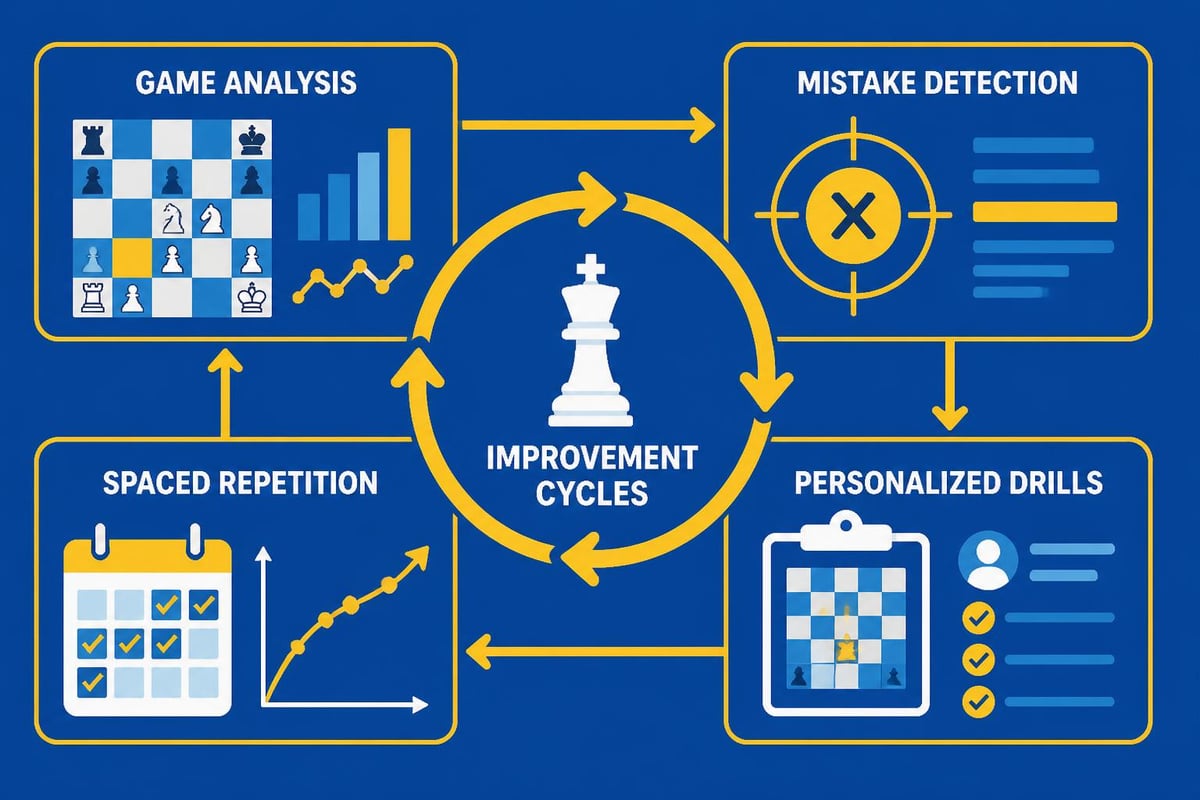
The chess education landscape has shifted massively. Traditional coaching used to mean finding a local chess master willing to teach you, paying £30-50 per hour, and hoping their teaching style matched your learning preferences. Now? You've got sophisticated AI engines that can analyse thousands of your games, identify patterns in your mistakes, and create personalised training plans.
Free chess coaching platforms have become genuinely effective because they leverage technology in ways human coaches simply can't. They can track every move you make across hundreds of games, spot weaknesses you didn't know existed, and drill you on specific positions until they become second nature.
The Technology Behind Modern Free Coaching
Here's what makes contemporary free chess coaching so powerful:
- AI-driven analysis that processes positions faster than any human
- Spaced repetition systems borrowed from language learning apps
- Pattern recognition training that builds your tactical vision
- Opening databases with millions of master games to study
- Real-time feedback during practice sessions
The shift towards AI hasn't eliminated the need for understanding chess principles, though. You still need to grasp why certain moves work, which is where platforms like AI Chess Teacher excel by providing move-by-move explanations using GPT-4 technology.
Top Free Chess Coaching Platforms You Should Try
Let's get specific about where you should invest your time. Not all free platforms are created equal, and knowing which ones deliver the most value for your skill level can save you months of unfocused practice.
Opening Training Specialists
If you're like most improving players, you've probably got a handful of openings you play regularly but don't truly understand. Free Chess Trainer addresses this brilliantly with its browser-based spaced repetition system. You practice opening lines until they're burned into your memory, and the platform intelligently shows you positions you're struggling with more frequently.
The beauty of dedicated opening practice is that it builds confidence from move one. When you understand the best openings for black or master specific systems, you enter the middlegame with a positional advantage rather than already being on the back foot.
Comprehensive Training Ecosystems
Some platforms try to do everything, and a few actually succeed. DawgChess offers an impressive suite with 25,000 puzzles, annotated master games, and Stockfish 17 analysis. The advantage of these all-in-one platforms is consistency. You're not jumping between different interfaces or creating multiple accounts.
Similarly, AnkouChess creates a structured improvement cycle by combining opening training, tactical puzzles, AI practice, and game analysis. This holistic approach mirrors what you'd get from a structured coaching programme, except it adapts to your pace and schedule.
| Platform | Best For | Key Feature | Skill Level |
|---|---|---|---|
| Free Chess Trainer | Opening memorisation | Spaced repetition | Beginner-Advanced |
| DawgChess | Comprehensive training | 25,000+ puzzles | All levels |
| AnkouChess | Structured learning | Complete improvement cycle | Beginner-Intermediate |
| AI Chess Teacher | Understanding moves | GPT-4 explanations | Intermediate-Advanced |
How to Structure Your Free Chess Coaching Programme
Having access to brilliant tools means nothing if you don't use them systematically. You wouldn't expect to improve at the gym by randomly trying different machines each day, would you? The same principle applies to chess training.
Create a Weekly Training Schedule
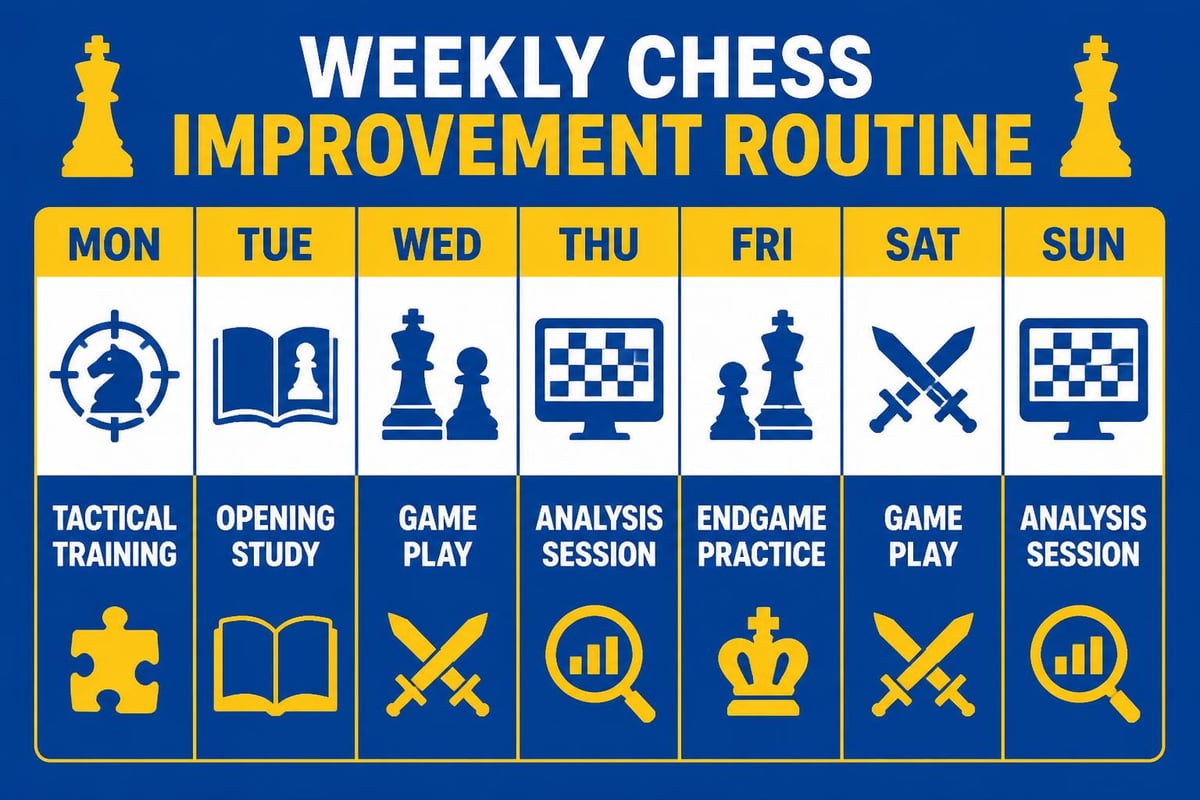
Here's a realistic framework that combines different aspects of free chess coaching:
- Monday: Tactical puzzles (30 minutes) - Focus on pattern recognition
- Tuesday: Opening practice (30 minutes) - Review one opening system
- Wednesday: Play 2-3 slow games (60-90 minutes)
- Thursday: Analyse Wednesday's games with AI (45 minutes)
- Friday: Endgame training (30 minutes)
- Weekend: Watch instructional content and play casual games
The key is consistency over intensity. Training for 30 minutes daily will yield better results than cramming three hours on Sunday and doing nothing the rest of the week.
Tracking Your Progress
ChessMentor AI excels at this by using Stockfish to analyse your games, detect error patterns, and deliver coaching reports. When you're getting free chess coaching, you need to be your own accountability partner. Set specific goals like "reduce blunders from 3 per game to 1" or "increase accuracy from 75% to 80%."
The Role of AI in Free Chess Coaching
Let's talk about the elephant in the room. Can an AI actually coach you as effectively as a human? The answer is nuanced. AI provides certain advantages that humans can't match, but it also has limitations.
What AI Does Better Than Human Coaches
AI never gets tired of showing you the same position for the hundredth time. It doesn't judge you for making the same mistake repeatedly. Platforms like PlayChessAI explain moves in plain English and help you think like grandmasters through game simulations. This patience and consistency is invaluable for drilling fundamentals.
AI also spots patterns across your entire game history. A human coach might review 5-10 of your recent games in a session. AI can analyse hundreds and tell you that you consistently struggle with rook endgames or frequently miss backward moves from knights.
Where Human Insight Still Matters
That said, AI sometimes struggles with explaining the why behind strategic plans. It can tell you a move is good, but connecting that move to broader chess principles or psychological aspects of competition requires human understanding. This is why combining free chess coaching platforms with occasional human input (even from stronger club players) creates the best results.

Maximising Free Resources Without Feeling Overwhelmed
The paradox of choice is real. With so many free chess coaching options available, you might feel paralysed about where to start. How do you avoid analysis paralysis and actually improve?
Start With One Platform
Pick a single comprehensive platform and commit to it for 30 days. Chessflo offers interactive lessons, practice puzzles, and AI analysis in one place, making it an excellent starting point. Master its features before exploring alternatives.
This focused approach prevents you from surface-level sampling multiple platforms without gaining depth in any of them. Think of it like learning an opening - you're better off knowing the London System inside out than having superficial knowledge of ten different openings.
Supplement With Targeted Resources
Once you've established your primary training platform, add specific resources for weak areas. If you're struggling with endgames, find a dedicated endgame trainer. If your tactical vision needs work, incorporate puzzle rushes into your routine.
- For opening preparation: Use spaced repetition trainers
- For tactical sharpness: Complete daily puzzle sets
- For strategic understanding: Review annotated master games
- For weakness identification: Run regular AI analysis on your games
Combining Free Coaching With Self-Study Materials
Free chess coaching platforms work brilliantly when paired with quality study materials. You've probably seen players who complete thousands of puzzles but don't improve because they're not building a conceptual framework. How do you avoid this trap?
Building a Study Library
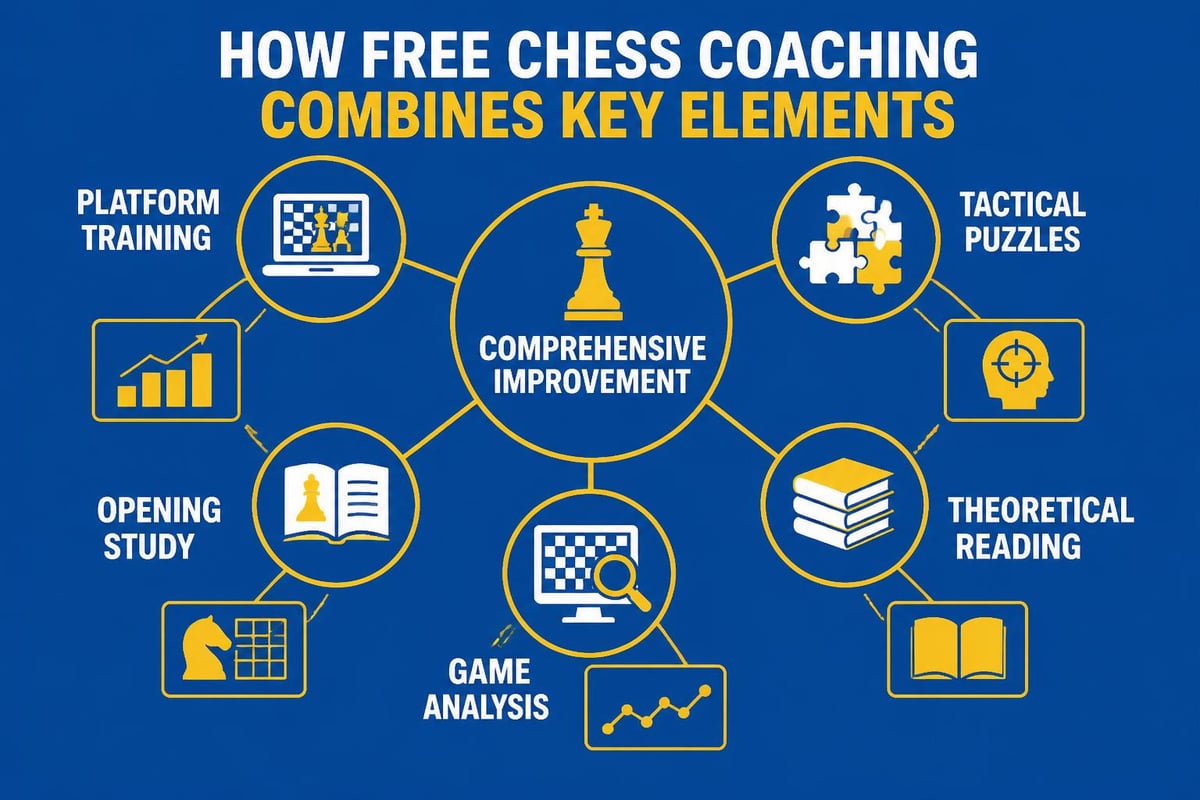
While coaching platforms provide practice, you need resources that teach principles. Fortunately, there are excellent free chess books in PDF format available online covering everything from basic tactics to advanced strategy.
The combination of structured coaching and theoretical knowledge creates synergy. When Chess Gym shows you a tactical pattern, and you've read about that pattern in a book, the learning sticks far better than either resource alone.
Understanding What Different Openings Offer
Part of effective self-study involves understanding the strategic ideas behind your openings. You might use free chess coaching to memorise the moves of the Queen's Gambit, but do you understand its pros and cons? Do you know when to accept the gambit and when to decline it?
This deeper understanding transforms your opening knowledge from mere memorisation to genuine comprehension. It's the difference between following a recipe and understanding cooking principles.
Common Mistakes When Using Free Chess Coaching
You'd think that free resources would mean more experimentation and less pressure, but I've noticed players making specific mistakes that undermine their progress. Let's address these head-on.
Hopping Between Platforms Too Frequently
The grass always looks greener, doesn't it? You start with one platform, see someone recommend another, and suddenly you're creating your fifth account this month. This platform-hopping prevents you from developing depth. Each system has its own method, and you need time to adapt to it.
Commit to a platform for at least one month before evaluating alternatives. Track specific metrics like your puzzle rating or game accuracy. If you're genuinely not improving after dedicated use, then consider switching.
Ignoring Game Analysis
Playing games is fun. Analysing them is work. But here's the truth - you'll learn more from deeply analysing three losses than from playing twenty games without review. Free chess coaching platforms offer sophisticated analysis tools, yet many players ignore them completely.
Set a rule: for every game you play, spend at least half that time reviewing it. If you play a 30-minute game, invest 15 minutes in analysis. This ratio ensures you're actually learning from your mistakes rather than repeating them.
Focusing Only on Tactics
Tactics are important, absolutely. They're also the most immediately satisfying aspect of training because you solve a puzzle and get instant feedback. But chess isn't just tactics. Players who only train tactics often reach a plateau around 1400-1500 because they lack positional understanding.
Balance your training across these areas:
- Tactics (40% of training time)
- Opening preparation (25% of training time)
- Endgame study (20% of training time)
- Strategic/positional play (15% of training time)
Making Free Chess Coaching Work for Your Schedule
Let's be realistic. You've got work, family, other commitments. You can't spend four hours daily on chess. How do you make meaningful progress with limited time?
The Minimum Effective Dose
Research in skill acquisition suggests that 20-30 minutes of focused daily practice beats sporadic longer sessions. If you can only manage 20 minutes per day, that's enough to see steady improvement over six months.
Here's what 20 focused minutes looks like:
- 5 minutes: Warm up with quick tactical puzzles
- 10 minutes: Study one specific position or opening line deeply
- 5 minutes: Review one critical position from your recent games
This approach leverages the spacing effect - your brain consolidates learning better with regular short sessions than infrequent marathons.
Mobile Training During Dead Time
Most free chess coaching platforms work brilliantly on mobile. Those 15 minutes waiting for an appointment? Perfect for puzzle training. Your commute on the bus? Ideal for reviewing opening lines. This opportunistic training accumulates significantly over weeks.
Advanced Techniques for Free Chess Coaching Users
Once you've mastered the basics of using these platforms, there are sophisticated techniques that accelerate improvement further.
Creating Custom Training Positions
Many platforms allow you to set up custom positions. Use this feature to drill specific weaknesses. Did you consistently miss knight forks in your last five games? Create a mini-database of knight fork puzzles and drill them until the pattern becomes automatic.
| Training Focus | Time Investment | Expected Improvement Timeline |
|---|---|---|
| Tactical pattern recognition | 20 min/day | 2-3 months |
| Opening repertoire | 15 min/day | 1-2 months |
| Endgame technique | 15 min/day | 3-4 months |
| Game analysis skills | 30 min/3 games per week | 1-2 months |
Tracking Performance Metrics
The best free chess coaching platforms provide detailed statistics. Go beyond just your rating. Track:
- Average centipawn loss per game
- Accuracy percentage in different game phases
- Blunder frequency over rolling 20-game periods
- Opening success rates for each system you play
When you measure these metrics monthly, you'll spot improvement even when your rating plateaus (which happens to everyone periodically).
Leveraging Community Features
While the coaching itself is free and often AI-driven, many platforms have active communities. Engage with them. Ask questions about positions you don't understand. Share your games for feedback. This human element complements the AI coaching beautifully.
Building Long-term Chess Improvement Habits
Free chess coaching gives you the tools, but sustainable improvement requires building solid habits. How do you ensure you're still training consistently six months from now?
Connect Training to Enjoyment
If you hate endgame study, you won't stick with it regardless of how beneficial it is. Find aspects of chess you genuinely enjoy and use them as anchors. Love tactics? Start every session with puzzles, then transition to less exciting but necessary training.
The goal is creating a routine that's sustainable, not optimal. A "pretty good" training plan you actually follow beats a perfect plan you abandon after three weeks.
Setting Milestone Rewards
Give yourself non-chess rewards for chess milestones. Reach 1500 rating? Treat yourself to a nice dinner. Complete 1000 puzzles? Buy that book you've been wanting. These external rewards help maintain motivation during plateaus.
You might also consider what opening Magnus Carlsen uses for inspiration when you need a motivation boost. Studying how elite players approach the game can reignite your passion for improvement.
Integrating Multiple Free Resources Effectively
You don't have to pick just one free chess coaching platform. The trick is using multiple resources strategically without overwhelming yourself.
The Three-Platform System
Consider this framework: one platform for tactical training, one for opening study, and one for game analysis. For example, you might use puzzle-focused platforms for tactics, a spaced repetition system for openings, and an AI analysis tool for reviewing games.
This division prevents feature overload while ensuring you're covering all improvement bases. Each platform serves a specific purpose in your chess development ecosystem.
Weekly Review Sessions
Every Sunday evening (or whatever day works for you), spend 20 minutes reviewing your week in chess. Which platform helped most? Where did you struggle? What patterns emerged in your games? This meta-analysis of your training keeps you adaptable and prevents stagnation.
If you're looking for additional structured guidance, exploring resources on the best website to learn chess can provide complementary insights to your free coaching journey.
Free chess coaching has genuinely democratised chess improvement, giving you access to world-class training tools without financial barriers. The key is choosing platforms that match your learning style, committing to consistent practice, and balancing different types of training. When you combine these free resources with quality study materials, you create a comprehensive improvement system that rivals paid coaching. Ready to take your game to the next level? Chess Cheat Sheets offers streamlined guides, opening cheat sheets, and puzzle collections that complement your free coaching perfectly, helping you master positions faster without overwhelming study sessions.


