

You've probably wondered whether you really need to spend money to get better at chess. The good news? You absolutely don't. The world of free chess has exploded over the past decade, and in 2026, the quality and quantity of no-cost resources available to players is frankly astonishing. Whether you're just learning how the pieces move or you're a club player looking to sharpen your tactics, there's a wealth of platforms, tools, and training materials waiting for you that won't cost you a single penny. Let's explore how you can build a complete chess education entirely for free.

The Golden Age of Free Chess Platforms
Think about this for a moment: two decades ago, serious chess training meant buying books, hiring coaches, or joining expensive clubs. Today, you can access world-class instruction, play against opponents globally, and analyse your games with powerful engines without opening your wallet.
The transformation has been remarkable. Chess.com and Lichess.org have democratised chess in ways that would have seemed impossible in the pre-internet era. Both platforms offer completely free accounts with no hidden costs or paywalls blocking essential features.
What Makes a Great Free Chess Platform?
When you're evaluating where to spend your time (even if you're not spending money), you should consider several factors:
- Playing options: Can you play blitz, rapid, classical, and correspondence games?
- Training tools: Does the platform offer puzzles, lessons, and analysis boards?
- Community features: Are there forums, clubs, and social elements?
- Mobile accessibility: Can you practice on your phone during your commute?
- No artificial limitations: Does the free version actually let you improve, or is it just a teaser?
The best platforms tick all these boxes. They understand that a thriving free community actually benefits everyone, including those who eventually choose to upgrade to premium features.
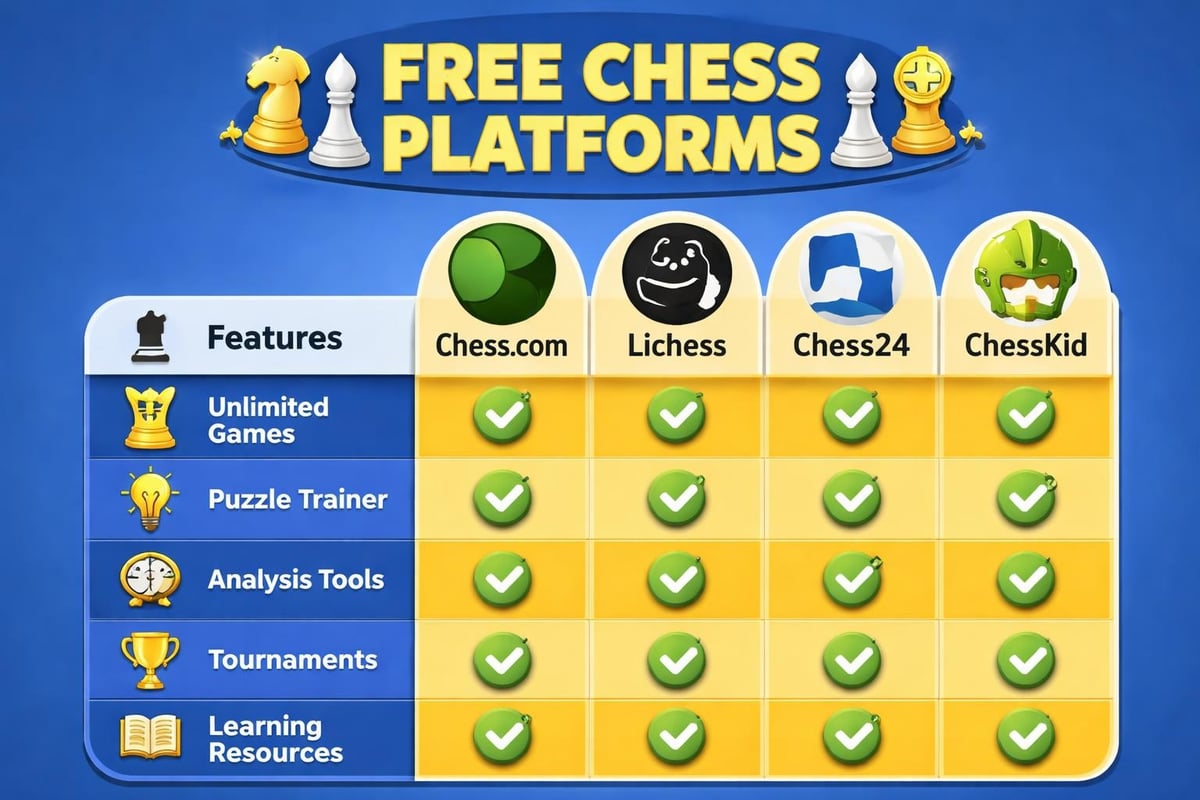
Unlimited Games: The Foundation of Improvement
Here's something every improving player learns eventually: you need to play lots of games. Reading theory and solving puzzles matters, but nothing replaces actual competitive experience against human opponents.
The beauty of free chess in 2026 is that you can play unlimited games. On Lichess.org, there's literally no cap on how many games you can play, what time controls you can use, or how many tournaments you can enter. Zero. This is huge for your development.
| Platform | Daily Games Limit | Time Controls | Rated Games | Casual Games |
|---|---|---|---|---|
| Lichess | Unlimited | All formats | Yes | Yes |
| Chess.com Free | Unlimited | All formats | Yes | Yes |
| FICS | Unlimited | All formats | Yes | Yes |
You might be wondering: why would platforms offer this for free? The answer varies. Lichess operates as a non-profit funded by donations, whilst Chess.com uses a freemium model where basic features remain free forever. Either way, you benefit.
Finding the Right Time Control for Your Goals
When you're playing free chess online, choosing your time control matters more than you might think. Bullet chess (under 3 minutes) is thrilling but can reinforce bad habits. Classical games (15+ minutes) build deep understanding but require significant time investment.
For most improving players, rapid chess (10-15 minutes) offers the sweet spot. You have enough time to think through your moves without games dragging on for hours. Blitz (3-5 minutes) works brilliantly for pattern recognition and opening practice.
Tactical Training That Won't Cost You Anything
Let's talk about puzzles. If you're serious about improvement, you've probably heard that tactical training is absolutely essential. And you know what? It's completely true. Tactics account for the vast majority of decisive moments in amateur games.
The good news is that Chess.com offers an extensive collection of free puzzles that adapts to your level. So does Lichess with their puzzle trainer. Both platforms use rating systems that ensure you're always working at the edge of your ability.
How to Maximise Free Puzzle Training
Here's how I'd approach it if I were starting fresh today:
- Do puzzles daily: Even just 10-15 minutes creates compound improvement over months
- Don't guess: Take your time to calculate lines completely before moving
- Review mistakes: When you get one wrong, understand why the correct move works
- Mix themes: Don't just drill forks; work on pins, skewers, deflection, and interference
- Track progress: Both platforms show your puzzle rating, which should climb steadily
The comprehensive puzzle collections available through various sources mean you could literally train for years without repeating positions. That's the power of computer-generated content combined with human curation.
Analysis Tools: Your Free Chess Coach
Want to know the secret that separates players who improve from those who stagnate? It's simple: they analyse their games. Every single one of them.
Previously, this required expensive software or a strong coach. Now, you can use the free analysis board on Lichess or Chess.com's analysis feature to get instant computer evaluations of your games.
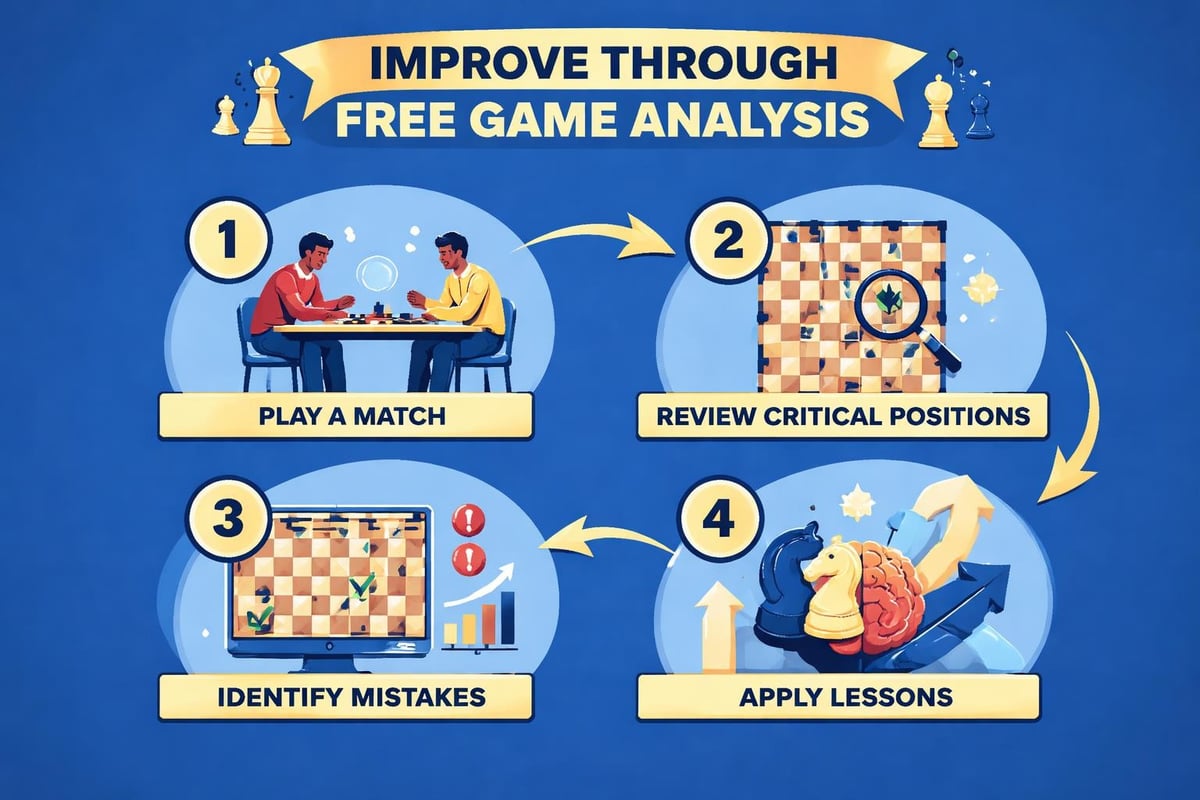
The Three-Step Analysis Process
When you finish a game, especially a loss, here's what you should do:
First, play through the game without the engine. Try to identify where you felt uncomfortable or made decisions you weren't confident about. Write these moments down.
Second, turn on the computer analysis. Look for the biggest evaluation swings. These are your critical mistakes. Don't obsess over small inaccuracies; focus on the blunders and mistakes that changed the game's outcome.
Third, try to understand why the computer's suggestion works better than your move. This is where real learning happens. It's not enough to see that Nf6 was better than Nd7; you need to grasp the strategic or tactical justification.
The collaborative study features on Lichess let you save these analyses and build a personal database of instructive positions. This is genuinely professional-level functionality available completely free.

Learning Resources: From Zero to Hero
Remember when chess education meant buying expensive book sets? Those days are gone. The amount of high-quality instructional content available for free in 2026 is genuinely overwhelming.
Chess.com's free lessons library covers everything from absolute beginner material to intermediate strategic concepts. You'll find video lessons, interactive courses, and articles on virtually every aspect of the game.
Building Your Free Chess Curriculum
If you're starting out or returning after a break, here's a structured approach using entirely free resources:
- Month 1-2: Master basic tactics (forks, pins, skewers) through puzzle training
- Month 3-4: Learn 2-3 solid openings as White and responses as Black
- Month 5-6: Study basic endgames (king and pawn, rook endgames)
- Month 7-8: Develop strategic understanding through annotated games
- Month 9-12: Integrate everything through competitive play and analysis
The best websites to learn chess offer structured pathways through this material. You can also explore free online chess courses that organise content into digestible learning modules.
Opening Preparation Without Breaking the Bank
One area where players often feel they need to spend money is opening preparation. After all, professional databases and opening books can cost hundreds of pounds, right?
Well, yes and no. Whilst premium resources exist, you can build a solid opening repertoire using entirely free tools. The key is being smart about your choices.
Choosing Your Free Opening Repertoire
Rather than trying to learn every opening under the sun, pick a focused repertoire:
As White: Choose one main opening system (like the Italian Game or London System) and stick with it for at least 100 games. The Italian Game guide shows how mastering one opening deeply beats knowing ten openings superficially.
As Black against 1.e4: Learn one reliable defence. The Caro-Kann Defense or Scandinavian Defense both offer solid, relatively straightforward systems.
As Black against 1.d4: Again, one main response. The Queen's Gambit Declined or King's Indian Defense give you fighting chances without requiring encyclopaedic knowledge.
| Opening | Complexity | Free Resources | Suitable For |
|---|---|---|---|
| Italian Game | Low-Medium | Abundant | All levels |
| London System | Low | Abundant | Beginners/Intermediate |
| Caro-Kann | Medium | Good | Intermediate |
| Sicilian Defense | High | Abundant | Ambitious players |
You can study these openings through free video content, the opening explorer on Lichess, and by reviewing master games in your chosen lines. The comprehensive chess resources available online mean you're never stuck without guidance.
Community and Competition: The Social Side of Free Chess
Chess might seem like a solitary pursuit, but it's actually deeply social. One of the brilliant aspects of free chess platforms is the community features they offer.
You can join clubs based on your interests, rating range, or location. Many clubs organise free tournaments, themed events, and team matches. This adds a layer of motivation and enjoyment beyond just grinding rating points.
Tournament Play Without Entry Fees
The Free Internet Chess Server has been offering free tournament play since 1995, and the tradition continues strong today. You can participate in titled Tuesday events, arena tournaments, Swiss tournaments, and more.
These competitions give you:
- Experience playing under pressure
- Exposure to different playing styles
- Benchmarks for measuring improvement
- Recognition through tournament victories and titles
The best part? There's literally no cost to enter. You can play in dozens of tournaments per month if you have the time and inclination.
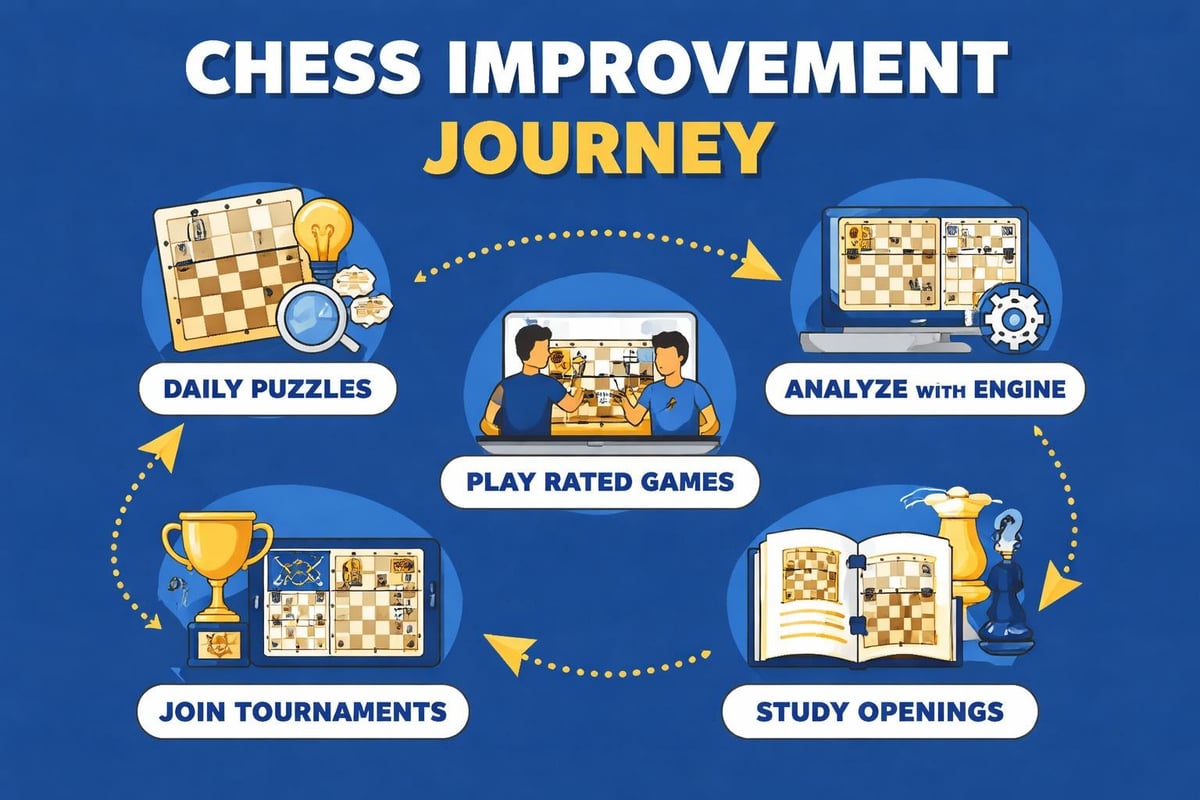
Mobile Apps: Free Chess in Your Pocket
We're living in 2026, which means your chess improvement happens wherever you are. Both major platforms offer excellent mobile apps that mirror their desktop functionality.
The mobile experience has become genuinely good. You can:
- Play full games with proper piece movement and premoves
- Solve puzzles during your commute or lunch break
- Watch educational videos whilst relaxing
- Review and analyse your games anywhere
- Participate in tournaments on the go
This accessibility means you can genuinely integrate chess improvement into small pockets of time throughout your day. Those 15 minutes waiting for an appointment? Perfect for five quick puzzles.
Advanced Free Tools for Serious Improvement
Once you've mastered the basics, free chess resources continue to serve you well. Here are some advanced features you might not know about:
Opening books and databases: Lichess provides a complete opening explorer showing master games, computer evaluations, and popularity statistics for every position. This is professional-level data available to everyone.
Engine analysis: Both platforms offer cloud-based Stockfish analysis. You can analyse positions to enormous depth without needing a powerful computer.
Training modes: Coordinate trainers, blindfold chess, piece identification games, and more help develop specific skills.
Streamers and content creators: Thousands of chess streamers broadcast free educational content on Twitch and YouTube. You can watch titled players explain their thought process in real-time.
Creating a Personalised Training Plan
The wealth of free chess resources can actually be overwhelming. Here's how to create focus:
- Assess your current weaknesses honestly (tactics? endgames? time management?)
- Allocate specific time to addressing each weakness
- Use different free tools for different purposes (puzzles for tactics, game analysis for strategy)
- Track your progress through rating changes and puzzle accuracy
- Adjust your plan monthly based on results
The chess tools available today make this kind of structured training accessible to everyone, not just those who can afford expensive coaching.
The Truth About Free vs Paid Resources
Let's be honest for a moment. Paid chess resources do exist, and some of them offer value. Premium memberships provide features like unlimited puzzles from specific themes, deeper computer analysis, and ad-free experiences.
But here's the key question: do you need them to improve?
For the vast majority of players, especially those rated below 2000, the answer is a resounding no. The free chess resources available in 2026 are more than sufficient to reach expert level. Many titled players have trained exclusively using free platforms and resources.
The limitation is rarely the tools; it's usually consistency, focused practice, and genuine engagement with the material. You could have the most expensive chess software in the world and still not improve if you're not putting in deliberate practice.
Making the Most of Your Free Chess Resources
So you've got access to unlimited games, millions of puzzles, powerful analysis engines, and comprehensive educational content. How do you actually turn this into rapid improvement?
The secret is structure. Here's a sample weekly schedule using entirely free resources:
Monday: 30 minutes of tactical puzzles (15 minutes), play 2-3 rapid games (45 minutes)
Tuesday: Analyse yesterday's games thoroughly (30 minutes), study one opening position deeply (30 minutes)
Wednesday: 20 puzzles focusing on a specific tactical theme (20 minutes), watch an educational video (30 minutes)
Thursday: Play a longer classical game (60 minutes), quick review afterwards (15 minutes)
Friday: Mixed puzzles (20 minutes), play blitz games for fun and pattern recognition (40 minutes)
Weekend: Participate in a free tournament (2-3 hours), study an instructive master game (30 minutes)
This gives you roughly 9-10 hours of chess per week, all using free resources. Maintain this consistently for six months, and you'll see significant improvement.
Building Long-Term Chess Skills for Free
The journey in chess is measured in years, not weeks. That's actually good news for free chess enthusiasts, because the sustainability of free resources means you can maintain a consistent practice schedule indefinitely.
Unlike paid subscriptions that you might cancel when money gets tight, free platforms will always be there. This consistency is crucial for long-term development. Chess improvement comes from steady, regular practice over extended periods, not from intensive bursts followed by breaks.
Consider how your chess study evolves:
- Beginner phase (0-1200): Focus on basic tactics and piece development
- Intermediate phase (1200-1600): Deepen opening knowledge, improve endgame technique
- Advanced phase (1600-2000): Refine strategic understanding, eliminate blunders
- Expert phase (2000+): Specialise in specific openings, master complex endgames
Free resources support you through every stage of this journey. The platforms grow with you, offering appropriate challenges at each level.
The world of free chess in 2026 offers everything you need to transform from beginner to strong club player without spending a penny. From unlimited games and tactical puzzles to powerful analysis tools and comprehensive lessons, the barriers to chess improvement have never been lower. Of course, having the right study materials organised efficiently can accelerate your progress even further, which is where Chess Cheat Sheets comes in with streamlined guides and resources designed to help you master openings and key concepts without overwhelming study time. Whether you're using free online platforms or supplementing with focused guides, your chess journey is limited only by your dedication and consistency.


