

If you've ever watched a strong chess player confidently navigate the opening moves, you might wonder how they memorise all those variations. The secret isn't just memorisation, it's systematic preparation. That's where ChessBase openings come into play. This powerful software has revolutionised how players study, prepare, and master opening theory since its inception, and in 2026, it's become even more essential for anyone serious about improving their game.
Whether you're a club player aiming to reach 1800 or an ambitious intermediate player wanting to compete at higher levels, understanding how to leverage chessbase openings can transform your preparation routine. Let's explore how this tool works and why it's become the industry standard for opening study.
What Makes ChessBase Openings Different
ChessBase isn't just another database, it's a comprehensive ecosystem for chess study. When we talk about chessbase openings, we're referring to the entire suite of tools designed to help you understand, analyse, and master opening theory.
Traditional opening study might involve reading books or watching videos. That's valuable, but it's passive. ChessBase flips this model by making your study active and data-driven.
Key features that set ChessBase apart:
- Access to millions of master games organised by opening variation
- Statistical analysis showing which moves score best at your level
- Opening reports that track theoretical developments
- Built-in engines for tactical verification
- Cloud synchronisation for studying anywhere
The ChessBase 26 introduces features like Elo-specific Opening Reports and Monte Carlo Analysis, enhancing opening preparation for players at all levels. This means you're not just learning what grandmasters play, you're discovering what actually works at your rating.
Understanding the Database Structure
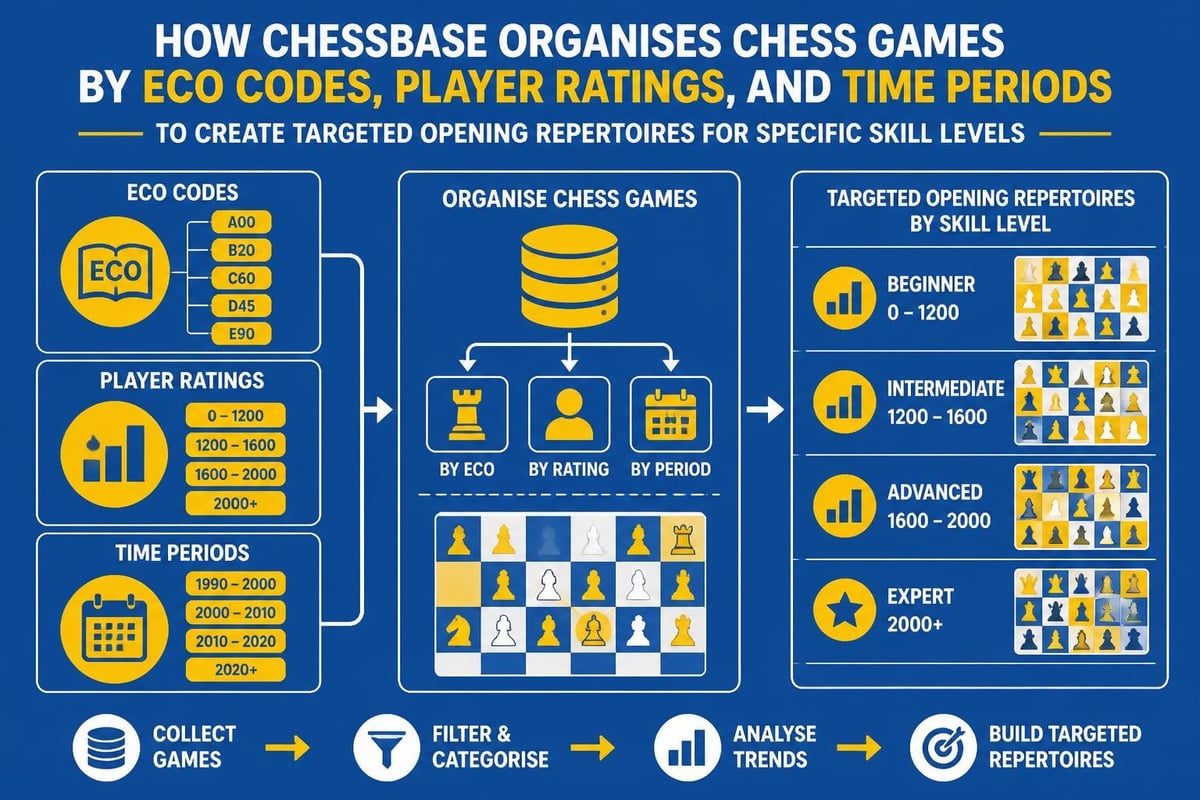
At its core, ChessBase organises millions of games by ECO codes (Encyclopaedia of Chess Openings). When you search for the Sicilian Defence or the London System, you're instantly accessing decades of high-level games.
But here's what makes it powerful: you can filter these games by player rating, year played, and result. Want to see how 1600-rated players handle the King's Indian Defence? You can do that. Curious about recent trends in the Queen's Gambit? The database shows you.
Building Your Opening Repertoire with ChessBase
Creating a solid repertoire might seem overwhelming when you're starting out. There are thousands of possible opening lines, and trying to learn everything is a recipe for confusion. ChessBase openings tools help you build systematically.
The Three-Step Repertoire Method
Step 1: Choose Your Main Lines
Start by identifying which openings suit your style. Aggressive player? Maybe the King's Gambit or Sicilian Dragon interests you. Prefer solid positions? The London System or Caro-Kann might be your weapons.
Use the database to explore games in your chosen openings. Watch how strong players handle typical middlegame positions that arise. This gives you a feel for whether the opening matches your preferences.
Step 2: Create an Opening Book
ChessBase's Opening Report feature offers comprehensive insights into specific opening lines, including historical development and statistical analysis. This tool generates a tree of variations showing which moves are most popular and most successful.
Here's how to use it effectively:
- Navigate to your chosen opening position
- Generate an opening report for your rating range
- Study the recommended variations
- Add critical positions to your training database
- Review and update monthly as theory evolves
Step 3: Train Your Lines
Knowledge without practice is useless. The Openings Trainer in ChessBase Account helps players organise and drill their opening repertoire effectively.
Set up training sessions where the software quizzes you on your repertoire. It's like having flashcards, but for chess positions. This repetition embeds the moves in your muscle memory.
Analysing Specific Opening Families
Different openings require different study approaches. Let's break down how to use chessbase openings tools for major opening categories.
| Opening Type | Study Focus | Key ChessBase Features |
|---|---|---|
| Open Games (1.e4 e5) | Tactical awareness | Game search, tactical analysis |
| Semi-Open Games | Imbalanced positions | Statistical analysis, model games |
| Closed Games | Strategic plans | Annotated games, structure search |
| Indian Defences | Pawn structures | Position search, plan analysis |
Mastering Open Games
If you're studying openings like the Italian Game or the Scotch, you'll want to focus on tactical patterns. These positions often explode into complications quickly.
"Openings #1: The Open Games" is a ChessBase tutorial covering fundamental open game openings, complete with videos and exercises. It's perfect for players who want structured learning alongside database exploration.
When working with these sharp lines, use the engine analysis feature to verify tactics. But don't just memorise engine moves. Understand why certain moves work tactically.
Semi-Open Complexity
Semi-Open Games, including the Sicilian and French Defenses, provide structured learning materials that complement database study. These openings often lead to asymmetrical pawn structures where both sides play for different advantages.
For the Sicilian Defence specifically, you might want to check out dedicated resources. Our Sicilian Defense guide offers quick reference material that pairs well with deeper ChessBase analysis.
The beauty of using ChessBase for semi-open games is seeing how positional compensation works. When Black accepts a worse pawn structure for piece activity, the database shows you concrete examples of this dynamic in action.
Advanced ChessBase Techniques
Once you're comfortable with basic database searches and opening reports, these advanced techniques will elevate your preparation to the next level.
Creating Custom Opening Books
Did you know you can create and manage opening books in ChessBase, aiding in systematic opening preparation? This feature is invaluable if you're preparing for specific opponents.
Here's the workflow:
- Download your opponent's games from online databases
- Import them into ChessBase
- Generate a report showing their opening preferences
- Identify weaknesses or uncommon lines they play
- Prepare surprises in those specific variations
This level of preparation was once reserved for titled players. Now anyone can do it.
Using the Reference Database
The reference database contains millions of high-quality games. But simply scrolling through games isn't efficient. Instead, use these filters:
- Average Elo filter: Set it to 2400+ for top-level theory, or match your own rating for practical ideas
- Date range: Recent games (last 2-3 years) show current trends
- Result filter: Study wins by your colour to see successful plans
You'll notice patterns emerging. Certain move orders appear repeatedly. Specific pawn breaks happen at similar moments. These patterns become your strategic understanding.
Monte Carlo Tree Search Analysis
New in recent ChessBase versions, Monte Carlo analysis simulates thousands of possible game continuations from a position. This helps identify which opening lines are objectively best and which are just trendy.
For players building a long-term repertoire, this matters. You don't want to invest months learning an opening that's been refuted by recent analysis.

Integrating ChessBase with Your Study Routine
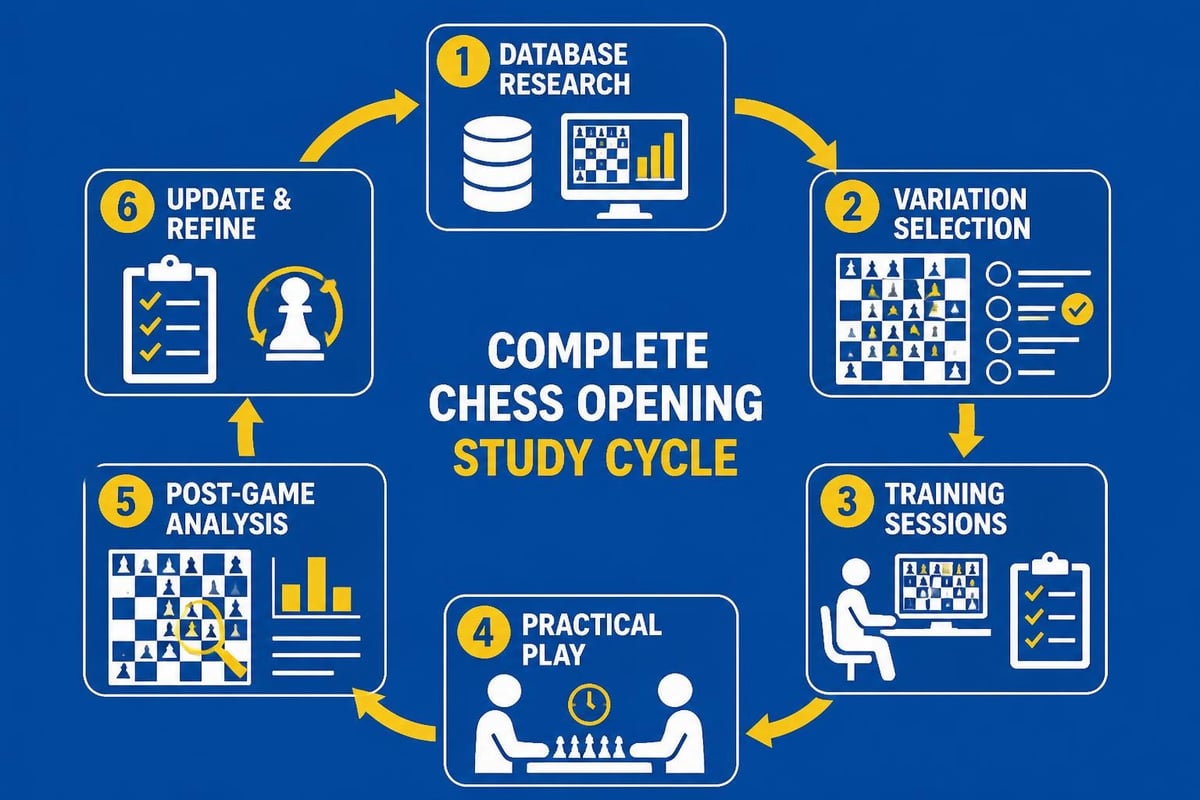
Owning ChessBase openings software doesn't automatically improve your chess. You need a structured approach to extract maximum value.
Weekly Study Schedule
Monday - Repertoire Review (30 minutes) Open your training database and run through your main lines. Update any positions where you've forgotten the key moves.
Wednesday - New Variation Study (45 minutes) Pick one variation from your repertoire that needs expansion. Use the opening report to explore sidelines. Add critical positions to your training queue.
Friday - Model Games (60 minutes) Play through 2-3 complete games in your openings. Don't just click through moves-pause and predict what the player will do next. This builds pattern recognition.
Sunday - Practical Testing (variable) Play games online using your prepared openings. After each game, analyse it in ChessBase, comparing your moves to database recommendations.
Tracking Your Progress
ChessBase allows you to annotate games and positions with your own notes. Use this feature to create a learning journal.
When you lose with your prepared opening, document what went wrong:
- Did you forget the theory?
- Was there a gap in your preparation?
- Did you misunderstand the resulting position?
This self-reflection, supported by database analysis, accelerates improvement faster than passive study ever could.
Comparing ChessBase to Alternative Methods
You might wonder if chessbase openings tools are worth the investment compared to free alternatives or traditional study methods.
| Method | Depth | Accessibility | Cost | Best For |
|---|---|---|---|---|
| ChessBase | Very High | Moderate learning curve | £150-200 | Serious improvers |
| Free databases | Medium | Easy | Free | Casual study |
| Opening books | High (limited scope) | Easy | £15-30 per book | Specific openings |
| Video courses | Medium | Very easy | £20-100 | Visual learners |
Research analysing chess opening complexity using data from online communities demonstrates that systematic database study produces measurable rating gains.
For most club players aiming to reach expert level, ChessBase represents excellent value. You're essentially getting access to the same preparation tools professionals use.
However, it's not the only resource you need. Understanding chess opening fundamentals through accessible guides complements database work perfectly.
Common Mistakes When Using ChessBase Openings
Even with powerful tools, players often stumble. Avoid these pitfalls:
Over-Preparation Syndrome
Some players spend hours memorising 20-move theoretical lines whilst neglecting basic tactics and endgames. Your opponent at club level probably won't follow theory past move 10.
Focus on understanding typical structures and plans rather than rote memorisation. When studying a chessbase openings report, prioritise the first 8-10 moves deeply, then understand thematic ideas for what follows.
Ignoring Your Rating Range
Studying what Magnus Carlsen plays is entertaining but not necessarily useful. The Opening Encyclopedia 2026 provides extensive coverage, but you need to filter for your level.
Set your opening reports to show games from players rated 200 points above and below your current rating. This sweet spot shows you realistic goals whilst keeping content challenging.
Static Repertoire Thinking
Chess theory evolves constantly. An opening that was solid last year might have a new refutation today. Schedule monthly repertoire reviews where you check for theoretical updates in your main lines.
ChessBase makes this easy with date-filtered searches. Check games from the last 3 months in your critical variations.
Practical Opening Selection Strategies
Choosing which openings to add to your repertoire is crucial. ChessBase openings data can guide these decisions objectively rather than relying on subjective preferences alone.
The 60/40 Rule
Your repertoire should be roughly 60% solid, reliable openings and 40% sharper, more tactical lines. This balance lets you adapt to opponents and tournament situations.
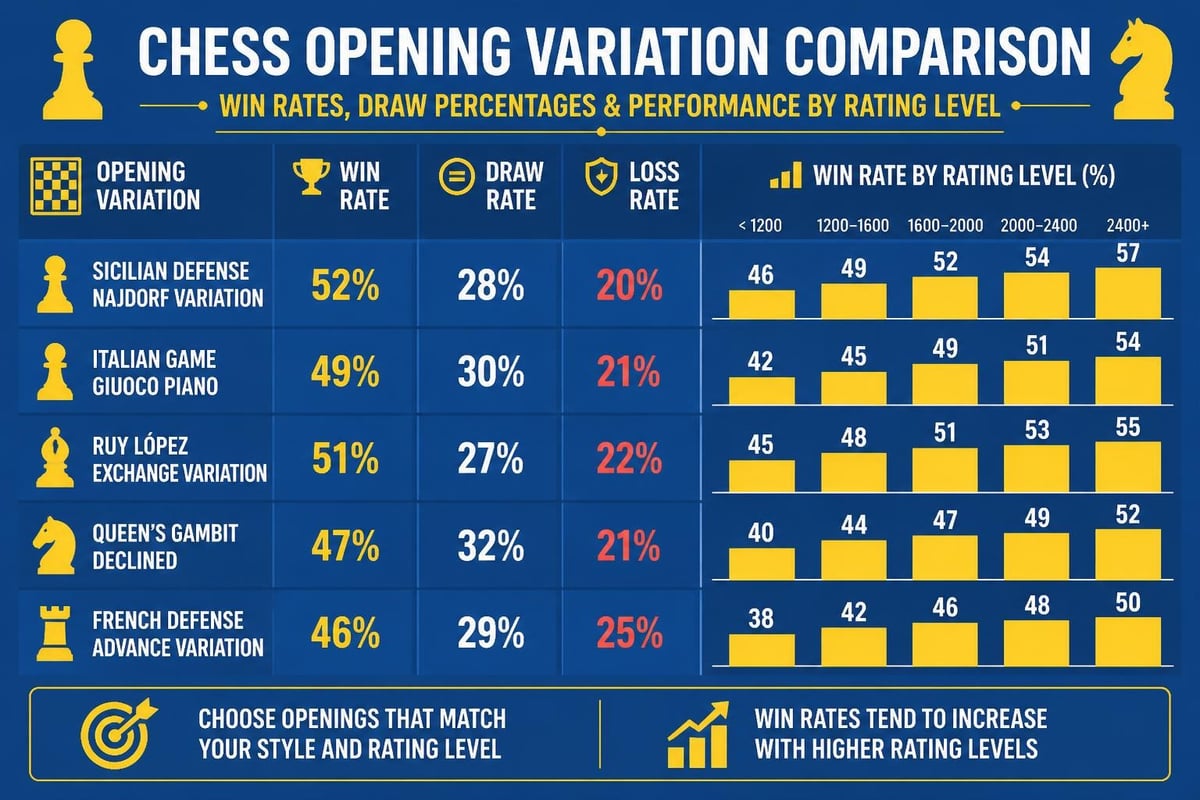
Use the database statistics to verify reliability. An opening scoring 52-54% for your colour across thousands of games is solid. Something scoring 56%+ might be sharper but potentially riskier.
Complementary Systems
Consider how your openings fit together. If you play the aggressive King's Gambit with White, maybe balance this with a solid system against 1...e5 like the Italian Game.
Similarly, understanding chess master levels helps you set realistic repertoire goals based on your current strength and improvement trajectory.
Time Investment Analysis
Some openings require massive theoretical knowledge. The Najdorf Sicilian, for instance, has dozens of critical variations. Others, like the London System, are more system-based with fewer forced lines.
Early in your chess journey, system openings might serve you better. As you improve and have more study time, you can add theoretically demanding options.
If you're exploring free online chess courses to supplement your ChessBase work, look for ones that teach opening principles rather than just variations.
Maximising Value from Your ChessBase Investment
ChessBase openings tools represent a significant investment for most club players. Here's how to ensure you're getting full value.
Cloud Integration Benefits
Modern ChessBase versions sync with cloud storage, meaning you can study your repertoire on your tablet during your commute or review games on your phone during lunch breaks.
Set up your databases once, then access them everywhere. This flexibility dramatically increases your effective study time.
Community Resources
The ChessBase user community shares opening surveys, annotated games, and training materials. Explore these free resources within the software ecosystem.
Many strong players publish their opening files, giving you insight into how masters organise their preparation.
Integration with Your Cheat Sheets
Physical reference materials still have value. Our chess opening guides and cheat sheets complement ChessBase study by providing quick over-the-board references.
You can't bring your laptop to a tournament game, but you can review a cheat sheet during your preparation time. Use ChessBase for deep home study and cheat sheets for tournament prep and quick reviews.
Specialised Opening Categories Worth Exploring
Some opening families deserve special attention because of their unique characteristics and ChessBase study opportunities.
Gambit Openings
Gambits sacrifice material for rapid development or attacking chances. Studying these in ChessBase reveals whether the compensation is real or illusory.
The database will show you concrete statistics: does the King's Gambit actually score well at your level? What about the Evans Gambit or Benko Gambit?
For the Benko Gambit specifically, combining database analysis with structured guides gives you both statistical backing and practical understanding.
Hypermodern Openings
Openings like the Grünfeld Defence or Alekhine's Defence follow hypermodern principles, allowing White central pawns before counterattacking.
These require understanding dynamic piece play rather than memorising moves. ChessBase's position search feature helps you study typical pawn structures that arise, teaching you the strategic patterns that matter.
Flank Openings
Systems starting with 1.Nf3, 1.c4, or 1.b3 often transpose into various structures. ChessBase's move-order features help you map these transpositions, ensuring you're not surprised by different move orders reaching familiar positions.
Keeping Your Opening Knowledge Fresh
Information decays over time. Without regular review, even well-studied openings fade from memory. ChessBase openings tools include features specifically designed to combat this.
Spaced Repetition Training
The training database feature lets you mark positions for review. The software prompts you to solve these positions at increasing intervals, using spaced repetition to cement knowledge.
Create training positions from your critical variations. Review them weekly at first, then monthly as they become ingrained.
Game Analysis Integration
After every game you play, analyse it using ChessBase. Compare your opening play to the database recommendations. This immediate feedback loop is incredibly powerful.
You'll quickly identify recurring mistakes. Maybe you consistently forget a key move on move 8 in your favourite variation. That specific weakness becomes your next study priority.
Tournament Preparation Protocols
Before important tournaments, run through your entire repertoire in training mode. This refreshes your memory and builds confidence.
Check for recent theoretical developments in your main lines. Nothing feels worse than getting surprised by a novelty you could have known about if you'd checked the latest games.
ChessBase openings tools have fundamentally changed how players at all levels approach opening preparation, making professional-level analysis accessible to club players. The combination of massive databases, powerful analytical tools, and systematic training features creates a complete ecosystem for improvement. If you want to complement your ChessBase study with practical, streamlined reference materials, Chess Cheat Sheets offers expertly designed guides that distil complex opening theory into accessible formats perfect for quick review and over-the-board use.


