

Ever found yourself frozen in thought during a chess game, only to realise you've burned through precious minutes? You're not alone. Time management in chess can be just as crucial as knowing your openings or endgame theory. That's where the chess timer comes in-a tool that transforms chess from a leisurely pastime into a dynamic, pressure-filled contest where every second counts. Whether you're preparing for your first tournament or looking to sharpen your rapid game skills, understanding how to work with time constraints will elevate your play significantly.
What Exactly Is a Chess Timer?
A chess timer is more than just a stopwatch for board games. It's a sophisticated timing device that tracks how much time each player uses during a match, ensuring fairness and adding a thrilling dimension to competition.
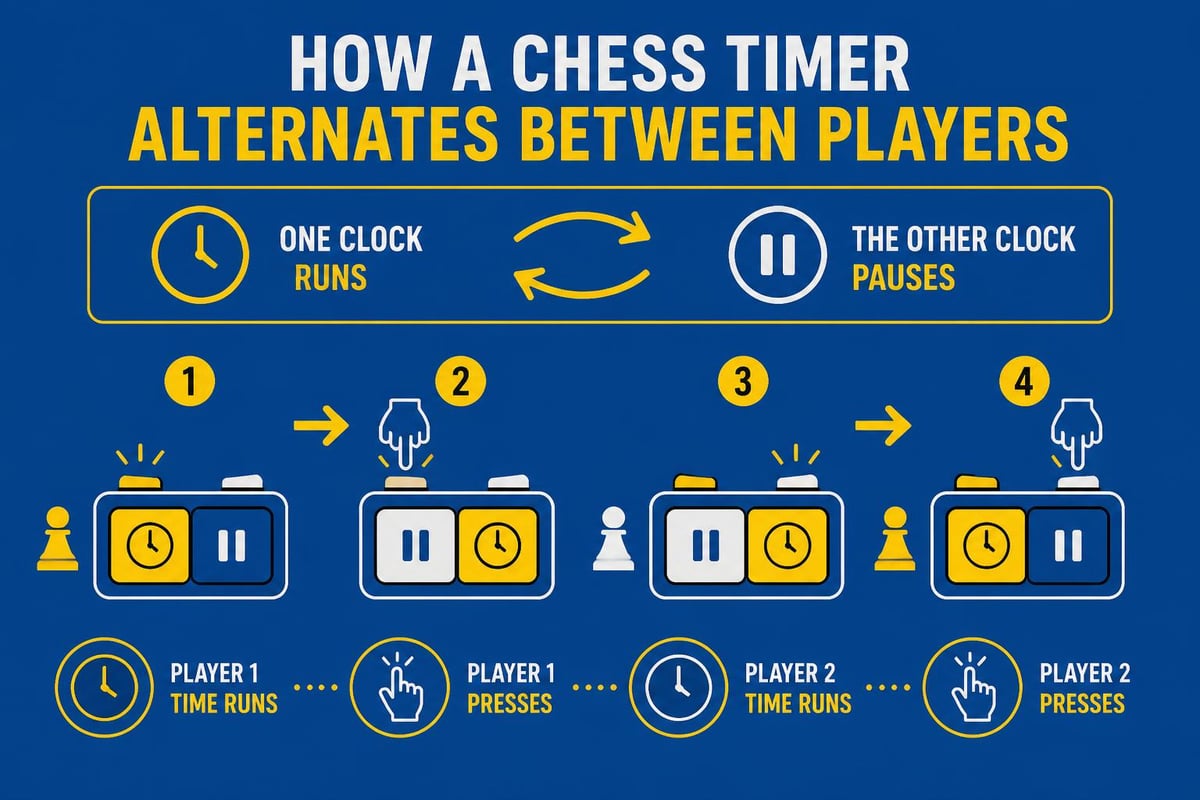
Think of it as your opponent when you're not playing the board. The clock forces you to balance deep calculation with practical decision-making. Unlike a regular timer that simply counts down, chess clocks are designed specifically for turn-based games, pausing one player's time whilst the other's runs.
The Basic Mechanics
Here's how it works in practice:
- Press your button after making your move
- Your clock stops, your opponent's starts
- Time accumulates throughout the game
- Flag falls when you run out of time
The beauty lies in its simplicity. Each player gets an allocated amount of time for the entire game, and they must complete all their moves before their time expires. Run out of time, and you lose-regardless of your position on the board.
Types of Chess Timers You'll Encounter
Not all chess timers are created equal. The evolution from mechanical devices to digital precision has given players several options, each with distinct advantages.
| Timer Type | Best For | Key Features | Price Range |
|---|---|---|---|
| Analogue Mechanical | Traditional play, beginners | Simple operation, no batteries, classic aesthetic | £20-£60 |
| Digital Basic | Club play, home practice | Accurate timing, multiple time controls, affordable | £15-£40 |
| Digital Advanced | Tournament play, serious players | Delay, increment, pre-programmed settings, clear display | £40-£150 |
| Electronic Touch-Sensitive | Professional tournaments | Sensitive touch response, FIDE approved, multiple modes | £80-£200 |
Analogue clocks offer that satisfying mechanical click and require no batteries, but they're less precise and don't support modern time control features. The history of chess clocks shows how these mechanical marvels dominated competitive play for over a century.
Digital timers have become the standard in 2026, offering incredible flexibility. They can handle increment (adding seconds after each move), delay (grace period before time starts), and various pre-programmed time controls. For serious players, they're indispensable.
Understanding Time Controls
Different formats demand different strategies. The time control dictates the entire character of your game, influencing everything from your opening preparation to your endgame technique.
Classical Time Control
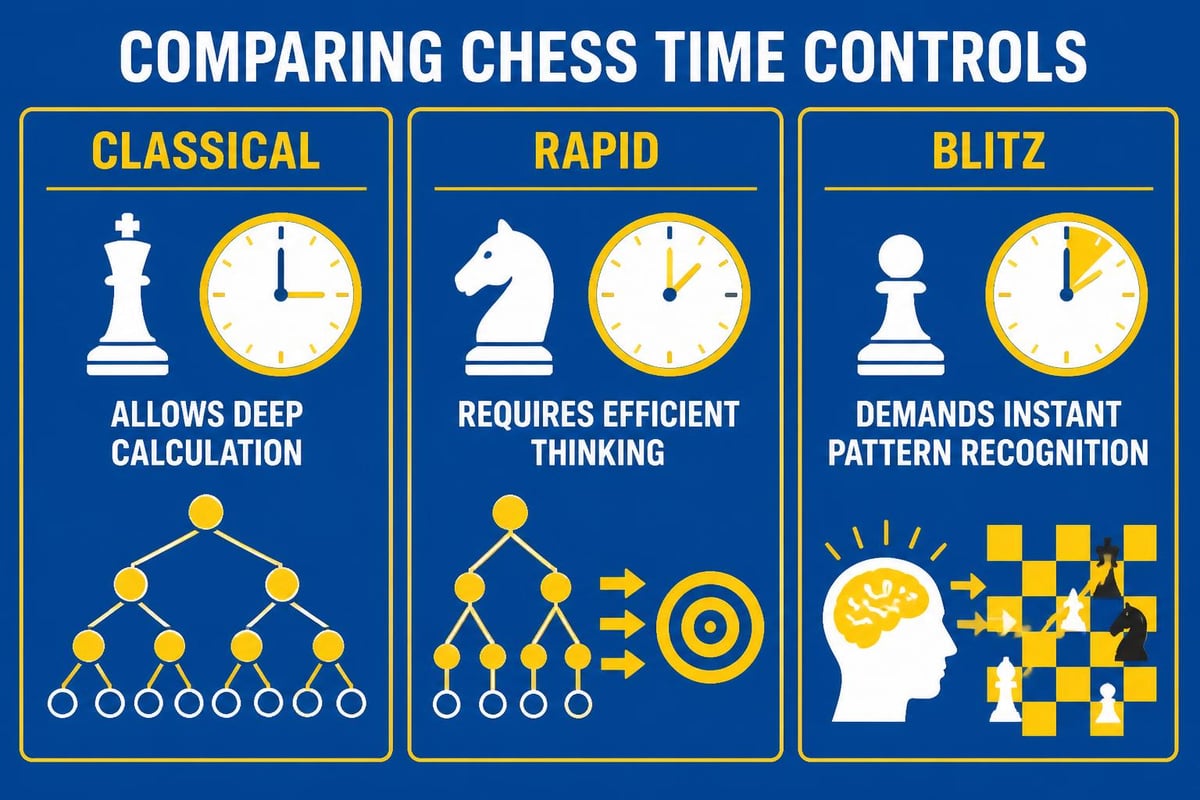
This is chess in its most traditional form. Games typically feature controls like 90 minutes for the first 40 moves, then 30 minutes for the rest of the game, often with a 30-second increment per move. You've got time to think, calculate, and truly wrestle with complex positions.
When you're playing classical chess, you can employ the strategic principles you've studied. Those intricate variations you've learned from advanced chess books actually become practical-you have time to recall and apply them.
Rapid Chess
Typically 15-25 minutes per player, rapid chess strikes a balance. You need to think quickly but still have enough time for meaningful calculation. This format has exploded in popularity, especially online, because it offers competitive depth without the multi-hour commitment.
Blitz and Bullet
Here's where things get intense:
- Blitz: 3-5 minutes per side
- Bullet: 1-2 minutes per side
- Hyper-bullet: Under 1 minute
These formats reward pattern recognition, intuition, and quick decision-making over deep calculation. Your knowledge of common chess openings becomes crucial because you need to navigate the opening phase almost automatically.
Different time controls fundamentally change how you approach the game. A position that deserves 10 minutes of thought in classical chess might only warrant 10 seconds in blitz.
How to Actually Use a Chess Timer
Sounds simple, right? Press the button after your move. But there's genuine technique involved in clock management that separates experienced players from newcomers.
Setting Up Your Clock
Before you start, you'll need to configure your chess timer properly:
- Set the time control according to your game format
- Configure increment or delay if applicable
- Test both buttons to ensure they're working
- Position the clock where both players can reach it comfortably
- Determine who starts and ensure their clock is active
Operating a chess clock might seem straightforward, but tournament players know that proper setup prevents disputes later.
During the Game
Your relationship with the clock evolves throughout the match. In the opening, you should be moving relatively quickly-this isn't where you want to burn time. If you've prepared your openings properly (perhaps using resources like our Sicilian Defense guide), you can navigate the first 10-15 moves efficiently.
The middlegame is where time investment pays dividends. Complex tactical positions deserve careful scrutiny. But here's the crucial skill: knowing when to calculate and when to trust your intuition.
In the endgame, time pressure often becomes the deciding factor. Even technically winning positions can slip away if you're down to seconds on your clock.
Time Management Strategies
Want to know the secret that club players often miss? It's not about thinking faster-it's about thinking smarter.
Build a Time Bank Early
Move quickly and confidently in the opening. If you're playing the King's Indian Defense or following principles from our Italian Game guide, you should know the first dozen moves without deep thought. This banks time for later complications.
Allocate Time Proportionally
Here's a rough framework that works well:
- Opening (moves 1-10): 5-10% of your time
- Early middlegame (moves 11-20): 20-25% of your time
- Critical middlegame (moves 21-30): 35-40% of your time
- Endgame (move 31+): 25-30% of your time
- Reserve: 5-10% as emergency buffer
These percentages shift based on the position, of course, but they provide a mental framework for pacing yourself.
Recognise Critical Moments
Not all moves are created equal. Some positions have one forcing continuation that's clearly best. Others present genuine crossroads where your decision shapes the entire game's character. Learn to identify these critical moments and invest your time accordingly.

Tournament Standards and Etiquette
If you're stepping into competitive play, understanding tournament standards for chess clocks keeps you from making embarrassing mistakes.
The Rules You Must Know
Press with the same hand you moved with. This prevents a sneaky technique where players hover their hand over the clock whilst still deciding their move. Tournament directors enforce this strictly.
Don't slam the clock. Yes, we've all seen dramatic films where players hammer the clock button. In reality, this can damage equipment and constitutes poor sportsmanship. A firm but controlled press suffices.
The flag determines the outcome. If your flag falls (time expires) during a game, you lose-even if you're about to deliver checkmate. The only exception is if your opponent has insufficient material to mate (say, a lone king).
| Situation | Outcome |
|---|---|
| Your flag falls, opponent has mating material | You lose |
| Your flag falls, opponent has only king | Draw |
| Your flag falls, but opponent's fell first | Opponent loses |
| Both flags down, unclear who fell first | Arbiter decides or draw |
Common Clock Violations
- Stopping the clock illegally (touching it without moving)
- Starting opponent's clock before they've moved
- Adjusting time settings mid-game
- Preventing opponent from pressing the clock
These violations can result in warnings, time penalties, or even forfeiture, depending on severity and intent.
Teaching Time Management to Beginners
If you're introducing someone to timed chess, or you're new to clocks yourself, start gradually. Don't throw a complete beginner into a 5-minute blitz game and expect them to thrive.
Beginner-friendly approaches suggest starting with generous time controls-perhaps 30 minutes per side with no increment. This removes time pressure whilst building clock awareness.
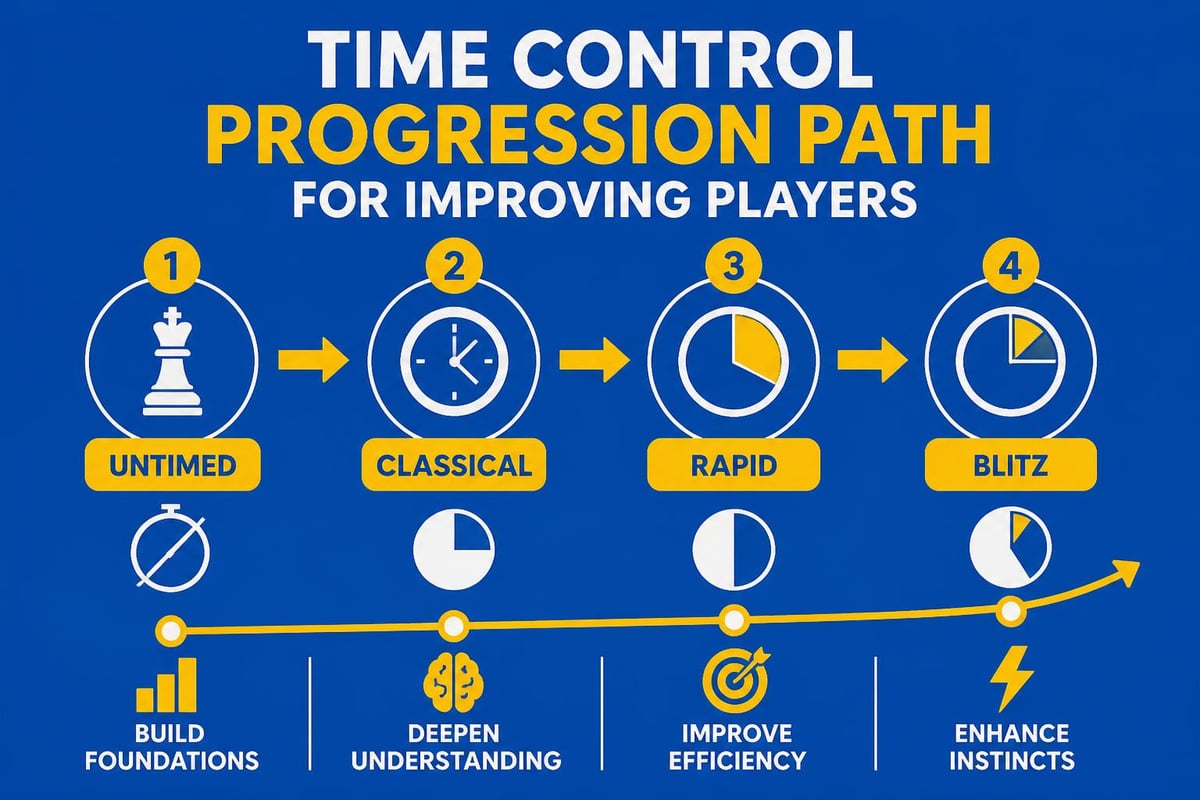
Progressive Training Method
- Start untimed to learn the basics
- Add extremely generous time (45+ minutes)
- Reduce to classical controls (25-30 minutes)
- Try rapid (15 minutes) when comfortable
- Experiment with blitz only after mastering rapid
This progression mirrors how you'd learn any skill-building fundamentals before adding pressure. Just as you wouldn't study best openings for Black before understanding basic piece development, you shouldn't rush into speed chess before developing solid play under classical conditions.
Digital Features Worth Having
Modern digital chess timers pack impressive functionality. If you're investing in equipment for serious practice, certain features prove invaluable.
Increment and Delay
Increment adds a set number of seconds to your clock after each move (common in online chess). Make your move in a 5+3 game, and you get three seconds added back. This prevents positions from becoming pure time scrambles.
Delay (also called the Bronstein delay) gives you a grace period before your main time starts counting down. In a game with 5-second delay, you have five seconds to make your move without touching your main time bank.
Both features make chess fairer and reduce the likelihood of losing won positions purely on time. They're particularly valuable for endgames where you know the winning technique but need time to execute accurately.
Pre-Programmed Time Controls
Quality digital timers come loaded with common tournament time controls. Instead of manually setting 90 minutes plus 30-second increment, you select "FIDE Standard" and you're ready. This eliminates setup errors that can void tournament games.
Move Counter
Some advanced clocks track move numbers, helpful for time controls that add time after move 40. You'll know exactly when you reach the time control without counting manually.
Practical Tips for Clock Management
Let's get practical. What actually works when you're sitting across the board with time ticking away?
Write down your time periodically. After your opponent's 10th, 20th, and 30th moves, jot down how much time you have remaining. This creates awareness and helps you adjust pacing.
Use opponent's time wisely. When they're thinking, you should be too-but differently. Anticipate their likely moves and calculate responses. This "thinking on their time" effectively doubles your available thinking time.
Never pre-move in serious games. Unlike online chess where pre-moving (queuing your next move before your opponent moves) is standard in bullet, over-the-board chess requires you to press your clock only after making your move on the board. Hovering over the clock whilst still deciding is both illegal and poor form.
Practice with a clock regularly. Time management is a skill that improves with experience. Even casual home games benefit from clock usage. You'll develop an internal sense of pacing that serves you well in tournaments.
How Time Pressure Affects Decision-Making
Here's something fascinating about chess psychology: time pressure doesn't just reduce the quality of moves-it fundamentally changes how we think about positions.
Research shows that under severe time pressure, players shift from calculation-based thinking to pattern recognition. This isn't necessarily bad. Strong players have internalised thousands of patterns that guide them accurately even when they can't calculate precisely.
But it does mean your training should emphasise pattern recognition. This is where puzzle practice becomes crucial. The more tactical patterns you've solved, the more accurately your intuition performs under time pressure.
The Time Trouble Trap
We've all been there-down to 30 seconds with 15 moves until the time control. Panic sets in. Moves that should take two seconds now take five because you're stressed about the clock itself.
The paradox of time trouble: Obsessing about the clock wastes more time than it saves. When you're low on time, focus exclusively on the position. Trust that your hand will find the clock automatically.
Choosing Your First Chess Timer
Shopping for a chess timer in 2026? Here's what actually matters beyond marketing hype.
For beginners and casual players: A basic digital clock with simple controls works perfectly. Look for clear displays, reliable buttons, and standard time controls. Expect to spend £20-£35. Fancy features you won't use just complicate operation.
For club players: Invest in a mid-range digital timer (£40-£70) with increment and delay capabilities. Ensure it has multiple pre-programmed settings and a clear display visible from both sides of the board. Brands approved by national chess federations offer reliability.
For tournament players: FIDE-approved clocks (£80-£150) provide the features and reliability required for serious competition. Touch-sensitive operation, extensive customisation, and rock-solid reliability justify the investment.
Don't forget that many players now transition between over-the-board and online play. Websites for learning chess often include built-in timers for practice, letting you develop time management skills without purchasing physical equipment immediately.
Advanced Clock Strategies
Once you've mastered basic clock management, subtle techniques separate strong players from masters.
Strategic time investment: In complex positions, consider spending an extra two or three minutes ensuring you choose the right plan. A small time investment now can simplify the position, saving time later when you can execute your plan quickly.
Psychological pressure: If your opponent is low on time and you're comfortable, don't rush. Make solid moves at a measured pace. The sound of your confident clock-pressing can rattle an opponent who's already stressed.
Flag-hanging positions: In theoretically drawn endgames where you're higher on time, avoid premature draw offers. Your opponent might blunder under time pressure. Conversely, if you're lower on time in a drawish position, offer the draw-don't give them the chance to pressure you.
Mastering the chess timer transforms you from a casual player into a serious competitor, teaching you to balance depth of thought with practical time constraints. Whether you're navigating the opening phase efficiently or calculating critical middlegame tactics, your relationship with the clock shapes every game you play. Ready to accelerate your chess improvement beyond just time management? Chess Cheat Sheets offers comprehensive guides on openings, tactics, and endgames that help you play faster and smarter, building the pattern recognition that makes every second count.


