

Have you ever wondered how top players sharpen their minds and spot winning moves in seconds? The secret often lies in chess piece puzzles, a powerful tool gaining popularity among beginners and masters alike.
This guide gives you a clear, step-by-step plan to master these puzzles, helping you unlock tactical vision and boost your confidence at any level.
You will discover the building blocks, puzzle types, solving techniques, advanced strategies, and essential resources needed to transform your chess journey for 2026. Ready to level up your game? Let’s dive in.

Understanding Chess Piece Puzzles: The Foundation
Chess piece puzzles are more than just clever exercises—they are your secret weapon for rapid improvement in the game. Ever wondered why top players recommend them for all levels? At their core, chess piece puzzles are carefully designed challenges that focus on specific pieces or positions, helping you sharpen your tactical vision and decision-making skills.
You might be thinking, what makes these puzzles so powerful? The answer lies in the way they train your brain. Solving chess piece puzzles regularly boosts pattern recognition, calculation speed, and mental flexibility. Studies show that this kind of targeted practice can even enhance your problem-solving abilities outside the chessboard, making you a better thinker in everyday life.
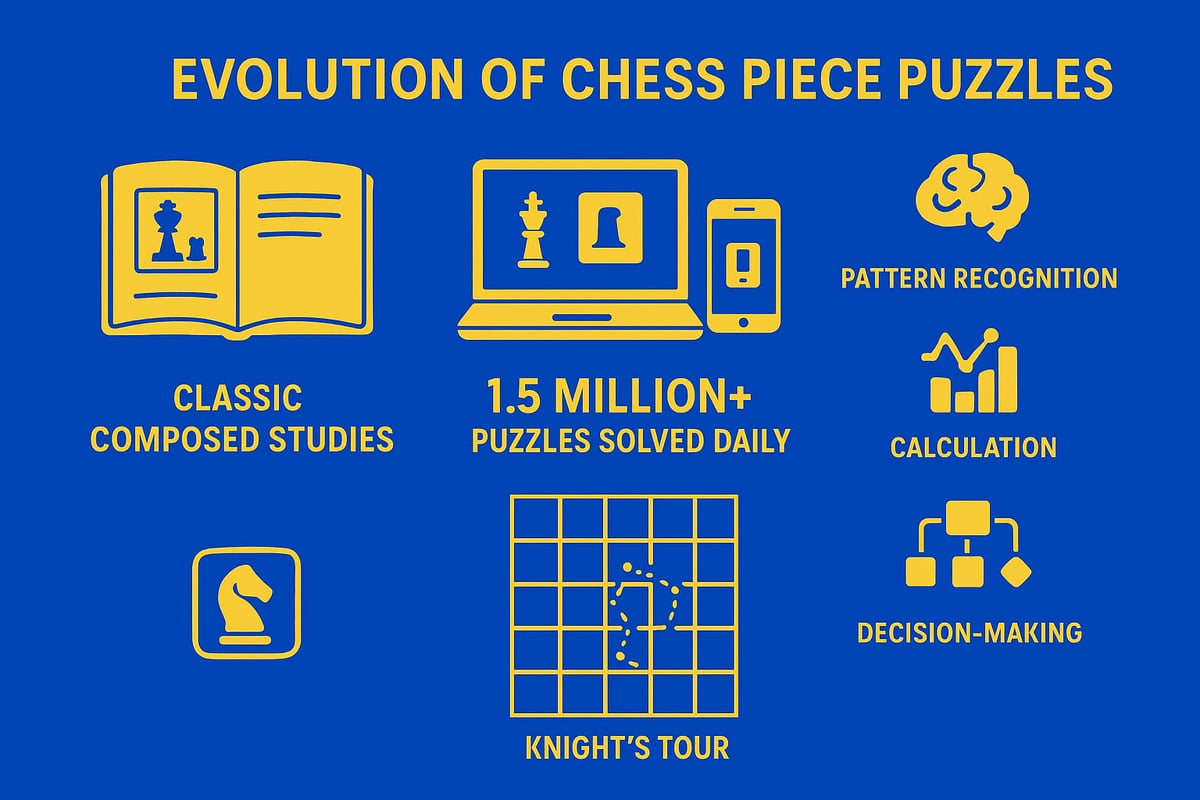
Let’s take a quick look at the fascinating history behind chess piece puzzles. They began as elegant, composed studies in the 19th century, with masters crafting intricate positions to test creativity. Fast forward to today, and you’ll find millions of digital puzzles available online, tailored to every skill level. This evolution means you now have instant access to a world of training opportunities, right at your fingertips.
But how do chess piece puzzles stand out from other types of chess challenges? Unlike full-board tactics or endgame studies, these puzzles zoom in on a smaller set of pieces or a specific motif. This focus allows you to develop deeper insight into piece coordination and tactical ideas, without the distraction of a crowded board.
The popularity of chess piece puzzles is hard to ignore. Check out this quick snapshot:
| Platform | Puzzles Solved Daily |
|---|---|
| Chess.com | 1,000,000+ |
| Lichess | 500,000+ |
That’s over 1.5 million puzzles solved every single day! The variety is impressive too. Here are the most common formats you’ll encounter:
- Mate-in-one or mate-in-two challenges
- Piece placement and reconstruction tasks
- Tactical motif identification (pins, forks, skewers)
Want an example that’s stood the test of time? Try the classic Knight’s Tour puzzle, where you must move a knight to visit every square on the board exactly once. This timeless challenge builds spatial reasoning and creativity, skills that transfer directly to your tournament games.
So, why do both casual players and grandmasters swear by chess piece puzzles? The answer is simple: they provide a safe, structured way to practise critical thinking and tactical execution. Whether you’re aiming for your first rating milestone or preparing for serious competition, these puzzles are a cornerstone of any effective training plan.
If you’re curious about how to get the most from chess piece puzzles, you’ll find even more practical strategies in this guide on how to improve with chess puzzles.
Types of Chess Piece Puzzles and Their Benefits
Are you curious about the world of chess piece puzzles and how they can transform your chess journey? Let’s break down the main types, see what makes each one special, and understand why they’re key to improving your skills. Whether you’re just starting or looking to sharpen your edge, there’s a puzzle style made for you.
Classic Tactical Puzzles
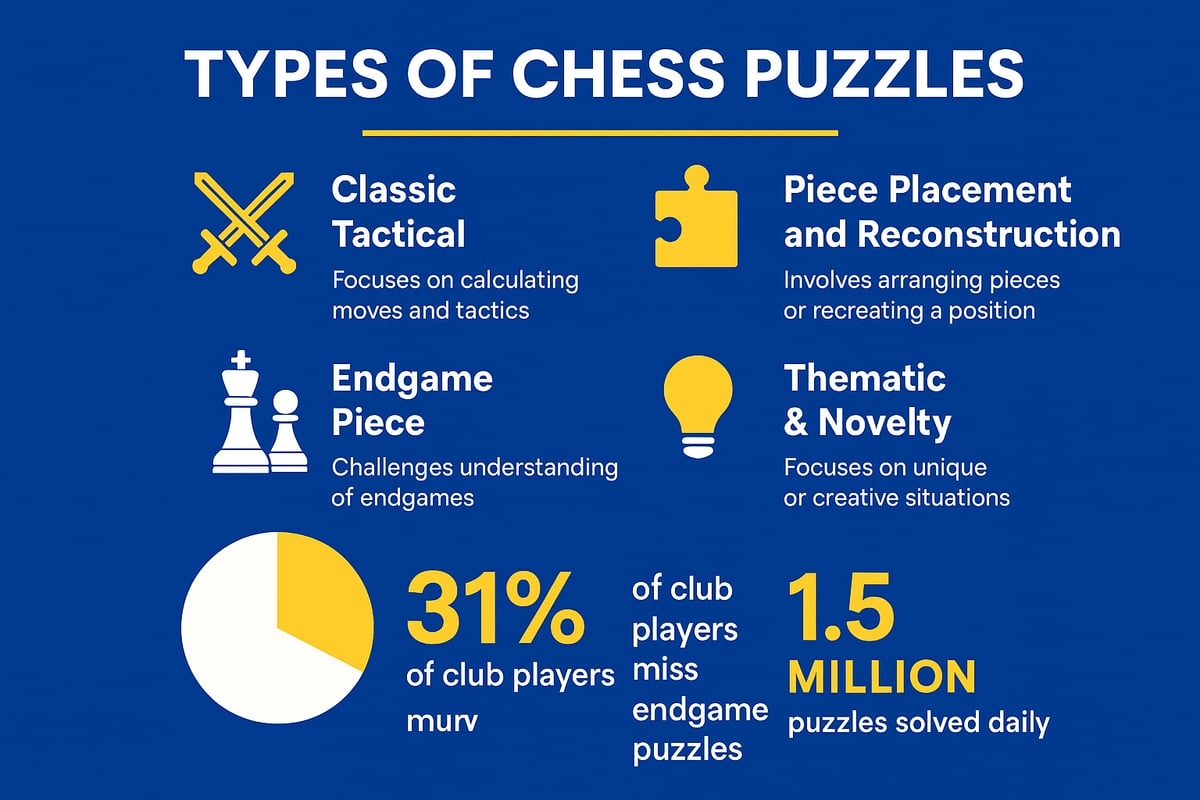
Classic tactical puzzles are the bread and butter of chess piece puzzles. These are the ones you see everywhere – pins, forks, skewers, discovered attacks, and double attacks. They throw you into a scenario where a sharp move can tip the balance. Imagine finding a fork in a real tournament game and suddenly snatching an opponent’s piece with a grin.
Why do these puzzles matter? They train your calculation speed and help you spot winning moves in seconds. Regular practice with tactical puzzles builds your muscle memory for key motifs. For example, a “find the winning fork” puzzle might recreate a moment from a famous match, letting you relive the thrill of spotting tactics under pressure.
If you’re keen to explore more puzzle types and get fresh tips, the Chess Puzzles Blog is packed with insights that can help you tackle new challenges. Mastering chess piece puzzles here lays the foundation for quick, confident play.
Piece Placement & Reconstruction Puzzles
Next up are piece placement and reconstruction puzzles. These chess piece puzzles are all about setting up the board just right. You might be asked to place the pieces to force mate in two or to reconstruct the previous moves based on clues.
Why are these so valuable? They stretch your visualisation and memory, making you picture the board even when pieces aren’t in front of you. This is like mental gymnastics for chess brains.
A classic example: “Place the pieces for a forced mate in two.” It’s a fantastic way to practise seeing patterns and understanding how pieces coordinate. With consistent training on these chess piece puzzles, you’ll soon find yourself recalling positions more easily and planning a few moves ahead, even when the board is crowded.
Endgame Piece Puzzles
Endgame piece puzzles focus on the final act, where only a few pieces remain. These chess piece puzzles strip away the clutter and test your pure understanding of endings – like king and pawn versus king, or rook against bishop.
Did you know that 80 percent of club players miss basic endgame puzzles, according to a ChessBase survey? That’s a huge opportunity for you to stand out. Solving endgame chess piece puzzles helps you learn precise technique, avoid common mistakes, and convert small advantages into victories.
For example, “How does White win with just a king and pawn?” teaches you the building blocks of promotion and opposition. By working on these puzzles, you’ll grow confident in those tense, quiet moments when every move counts. Endgame mastery is what separates strong players from the rest.

Thematic & Novelty Puzzles
Thematic and novelty puzzles bring creativity and fun into your chess piece puzzles routine. These are built around unique ideas – underpromotion, zugzwang, retrograde analysis, and help-mate challenges. Each one asks you to break out of the usual patterns and think outside the box.
A favourite? Retrograde analysis puzzles, where you need to figure out which piece made the last move. Or help-mate puzzles, where both sides work together for a surprising checkmate. These chess piece puzzles boost your lateral thinking and help you see the game from new angles.
Trying out thematic chess piece puzzles keeps things fresh and pushes you to explore the deeper beauty of chess. They’re perfect for anyone who loves a good mystery or wants to challenge their creativity.
Step-by-Step Blueprint: How to Solve Chess Piece Puzzles Effectively
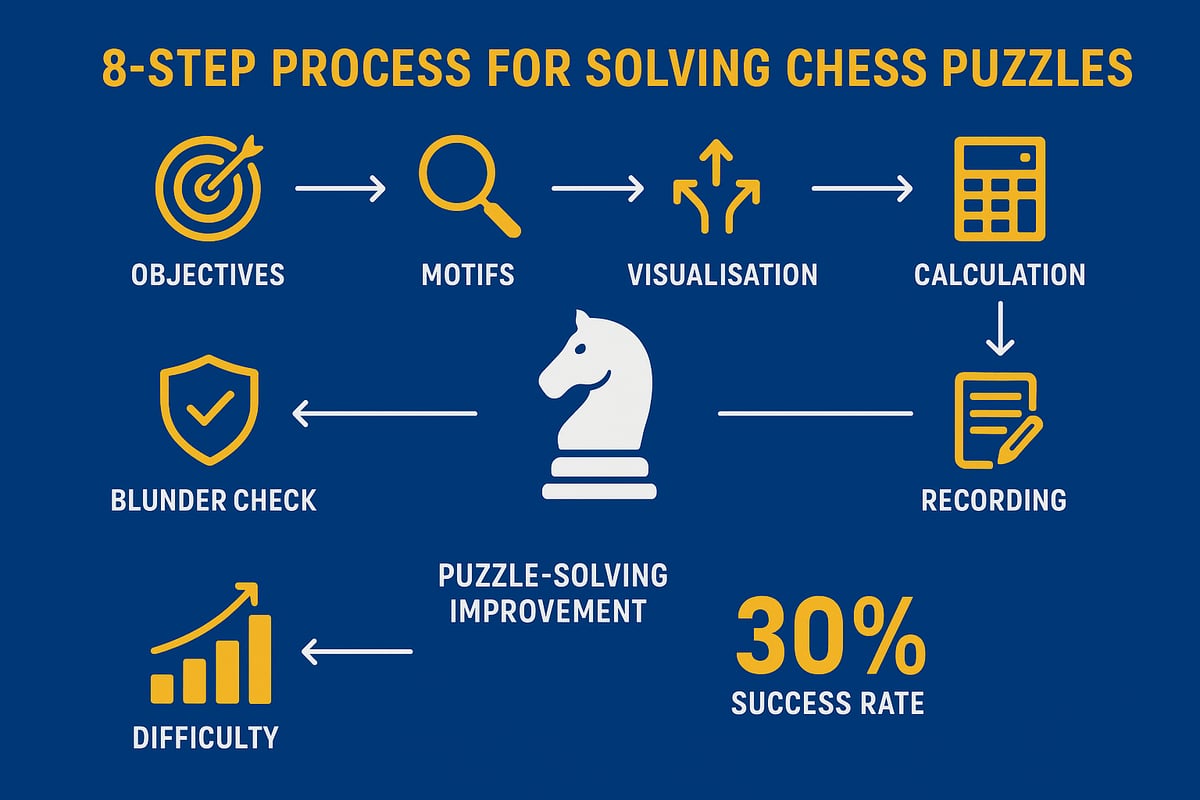
Solving chess piece puzzles can feel like unlocking a new level in your chess journey. By breaking down each step, you can turn tricky positions into bite-sized challenges, building your tactical muscle as you go. Ready to see how the pros do it? Let’s walk through this blueprint together, step by step.
Step 1: Assess the Puzzle Objective
Every great solution to chess piece puzzles starts with understanding the goal. Is it checkmate in two, winning material, or holding a draw? Take a moment to read the instructions carefully.
For example, a “mate in two” puzzle requires a different mindset than “find the best defensive move”. If you rush this step, you might miss the whole point of the challenge.
- Always clarify whether you’re attacking or defending.
- Note if it’s your move or your opponent’s.
- Identify if there’s a move limit.
This habit sets the stage for success with all chess piece puzzles.
Step 2: Scan for Tactical Motifs
Now, get your detective hat on. Chess piece puzzles often hide familiar patterns. Scan the board for checks, captures, and threats—these are your tactical signposts.
Use the “candidate move” method. List every move that creates a threat or solves the puzzle’s objective.
- Look for forks, pins, skewers, and discovered attacks.
- Ask: What would I play if I could move twice?
- Spot loose pieces and exposed kings.
Spotting motifs quickly is what separates casual solvers from puzzle masters.
Step 3: Visualise Piece Movement and Sequences
Here’s where your imagination gets a workout. Visualising moves in chess piece puzzles is like running a mental movie. Can you see where the knight will land after two jumps? What about a queen swooping in for a check?
Practice visualising just one move ahead, then chain them together.
- Trace the path of each piece.
- Imagine the board after your chosen move.
- Picture possible countermoves.
The clearer your mental image, the fewer surprises you’ll face.
Step 4: Calculate Variations Deeply
Don’t just hope your move works—prove it. Calculation is the backbone of chess piece puzzles. Once you’ve picked your candidate moves, play out the responses in your mind.
Let’s say you give a check. What are all the ways your opponent can block, capture, or escape? Calculate every forced line, especially when the solution feels too easy.
- List each reply for your opponent.
- Work through the consequences of each move.
- Avoid shortcuts—thoroughness pays off.
Mastering this step will make your puzzle solutions bulletproof.
Step 5: Double-Check for Blunders and Opponent Resources
Before you play your answer, pause. Chess piece puzzles teach you to look for hidden traps. What’s the worst that could happen if you make your move? Is there a sneaky counterattack?
Always ask yourself:
- Have I left a piece hanging?
- Could my opponent check or fork me in return?
- Did I overlook a defensive resource?
Double-checking cuts down on careless errors and sharpens your tactical awareness.
Step 6: Record and Review Your Solution Process
Want to level up your chess piece puzzles performance? Keep a puzzle log. After you solve (or miss) a puzzle, jot down your thought process. What did you see quickly? Where did you hesitate?
Analysing your mistakes helps you spot patterns in your thinking. Maybe you always miss knight forks or overvalue certain threats.
- Use a notebook, spreadsheet, or digital tool.
- Review old puzzles to find recurring weaknesses.
- Celebrate improvements, however small.
If you want to streamline this process, explore digital Chess Tools for Puzzle Solving which can help you track, analyse, and accelerate your progress.
Step 7: Gradually Increase Puzzle Difficulty
Don’t jump straight into grandmaster-level chess piece puzzles. Start simple, then climb the ladder. Begin with mate-in-one puzzles. Once you’re comfortable, try mate-in-two or three, then move on to multi-move tactical combinations.
- Build confidence with early wins.
- Challenge yourself with more complex puzzles as you progress.
- Use rating systems on puzzle platforms to gauge your level.
Steady progression is the secret to avoiding frustration and burnout.
Step 8: Integrate Puzzle Solving into Daily Training
Consistency is king in chess piece puzzles. Make solving part of your daily routine, like a morning cup of tea. Even five puzzles a day can create real improvement over time.
- Set a daily goal—number of puzzles or minutes spent.
- Track your rating and streaks for motivation.
- Mix in different puzzle types to stay sharp.
Regular practice not only boosts your tactical vision but helps you see patterns faster and play confidently in real games.
Advanced Strategies for Mastering Chess Piece Puzzles
Ready to level up your chess piece puzzles game? Once you’ve got the basics down, it’s time to unlock the skills that separate casual solvers from true puzzle masters. These advanced strategies will help you spot patterns like a grandmaster, sharpen your mind under pressure, and keep improving—even when progress feels slow.
Pattern Recognition: Think Like a Grandmaster
Have you ever wondered how top players seem to “see” solutions in chess piece puzzles almost instantly? It all comes down to pattern recognition. Grandmasters have trained their brains to recall thousands of tactical motifs and familiar positions. When you solve a variety of chess piece puzzles, you start building your own mental library of patterns.
A recent study, Quantifying human performance in chess, found that consistent puzzle training directly boosts your ability to spot these patterns quickly. By exposing yourself to new motifs daily, you’ll find your intuition and calculation speed both improve.
Time Management: Solving Under Pressure
Ever tried a puzzle rush or timed challenge? Practising chess piece puzzles with a clock running simulates tournament conditions. It forces you to trust your instincts, make decisions quickly, and let go of perfectionism.
Try setting a timer and see how many puzzles you can solve in five minutes. Keep track of your stats in a simple table:
| Session | Puzzles Solved | Accuracy (%) | Time (min) |
|---|---|---|---|
| 1 | 10 | 70 | 5 |
| 2 | 12 | 80 | 5 |
| 3 | 15 | 85 | 5 |
This habit trains you to balance speed and accuracy, a crucial skill for both puzzles and real games.
Blindfold Puzzle Solving: Supercharge Your Visualisation
If you really want to test your chess brain, try solving chess piece puzzles without moving the pieces or even looking at the board. This “blindfold” approach might sound intimidating, but it’s a brilliant way to strengthen your visualisation skills.
Start simple: read a puzzle description and visualise each move in your mind. Gradually, you’ll be able to picture longer sequences and more complex positions. This technique is a favourite among advanced players who want to boost their calculation power and memory.
Spaced Repetition: Lock In Your Learning
Have you ever solved a tricky puzzle, only to forget the solution days later? Spaced repetition fixes that. By revisiting chess piece puzzles at increasing intervals, you reinforce tactical ideas and keep them fresh.
Apps and platforms often use spaced repetition algorithms, but you can also do it manually with flashcards or a puzzle log. Mark puzzles you struggled with, then review them after a day, a week, and a month. Over time, you’ll notice those patterns stick, making you quicker and more confident.
Analysing Master-Level Compositions and Overcoming Plateaus
To push your abilities further, study chess piece puzzles created by grandmasters or innovative AI. Analysing these challenging compositions exposes you to rare tactical ideas and creative solutions. Resources like Generating Creative Chess Puzzles highlight how diverse puzzle types can stretch your thinking and keep your training fresh.
Feeling stuck? Plateaus are normal. Mix up your routine: try different puzzle formats, switch time controls, or join a puzzle league for fresh competition. Even world champions like Magnus Carlsen use puzzle rush modes to sharpen their tactical edge and break through stagnation.
With these advanced strategies, you’re not just solving chess piece puzzles—you’re training your mind for peak performance. Keep experimenting, stay curious, and remember: every puzzle solved brings you one step closer to mastery.
Essential Resources and Tools for 2026 Puzzle Success
Ready to take your chess piece puzzles practice to the next level? The right tools can make all the difference. Whether you are just starting or aiming for tournament glory, having the best resources at your fingertips streamlines progress and keeps things fun.
Top Online Platforms and Apps
When it comes to chess piece puzzles, online platforms are absolute game-changers. Sites like Chess.com, Lichess, and Chess24 offer vast libraries of puzzles, from simple mate-in-one to brain-bending tactical motifs. Each platform features custom puzzle sets, adaptive rating systems, and mobile access for learning on the move.
Curious about finding just the right challenge? Advancements in technology now help predict puzzle difficulty, making your training more efficient. For example, Predicting Chess Puzzle Difficulty with Transformers explores how AI can match you with puzzles tailored to your skill level.
Here’s a quick comparison:
| Platform | Custom Puzzles | Rating System | Mobile App |
|---|---|---|---|
| Chess.com | ✔️ | ✔️ | ✔️ |
| Lichess | ✔️ | ✔️ | ✔️ |
| Chess24 | ✔️ | ✔️ | ✔️ |
Books, Courses, and Offline Materials
Sometimes, you just want to unplug and focus. For deep work on chess piece puzzles, books like “Chess Tactics for Champions” and “1001 Chess Exercises for Beginners” are goldmines. Print resources let you jot down notes, highlight key positions, and train without distractions.
Courses, whether online or in person, offer structured learning. Offline puzzle collections help you build calculation skills away from screens. Many players find combining print and digital materials supercharges their understanding of chess piece puzzles, giving a well-rounded toolkit for improvement.
Community and Social Learning
Learning chess piece puzzles is even more rewarding with others. Puzzle leagues, online tournaments, and study groups keep motivation high and sharpen your competitive edge. When you discuss solutions or challenge friends, you see new ideas and patterns that solo play might miss.
Did you know? Players active in puzzle communities improve 30% faster, according to a recent Lichess user survey. Joining a group or participating in a puzzle league can be the secret ingredient to unlocking your full potential in chess piece puzzles.
Chess Cheat Sheets: Visual Puzzle Mastery Tools
If you crave a visual-first approach to chess piece puzzles, Chess Cheat Sheets is a brilliant resource. Their plug-and-play toolkits feature over 1.5 million puzzles, visual cheat sheets, and handy endgame guides. Everything is designed for rapid improvement and easy access.

Beginners and intermediates love the practical training, free sample toolkits, and hands-on quizzes. Trusted by thousands worldwide, Chess Cheat Sheets makes mastering chess piece puzzles efficient and enjoyable. If you want to level up your visual pattern recognition, this is a must-have in your toolbox.
So, after diving into all these puzzle strategies and tips, you might be wondering—what’s the next step to turn this knowledge into real progress on the board? If you’re keen to build your puzzle-solving skills and want everything you need for openings, tactics, and endgames in one place, why not take a look at the complete toolkit trusted by thousands? I’ve found that having all the resources at your fingertips really does make a difference, especially when you want to make steady progress without hours of study. Ready to level up your chess for 2026 and beyond?
Get The FULL Chess Mastery Bundle


