

Understanding chess piece positions is fundamental to becoming a stronger player. Whether you're just learning how the pieces move or you're working to refine your tactical awareness, knowing where to place your pieces can make the difference between victory and defeat. The beauty of chess lies not just in how pieces move, but in how they work together from their positions to control the board and execute your strategic plans. Let's explore everything you need to know about positioning your chess pieces effectively.
The Starting Positions: Your Foundation
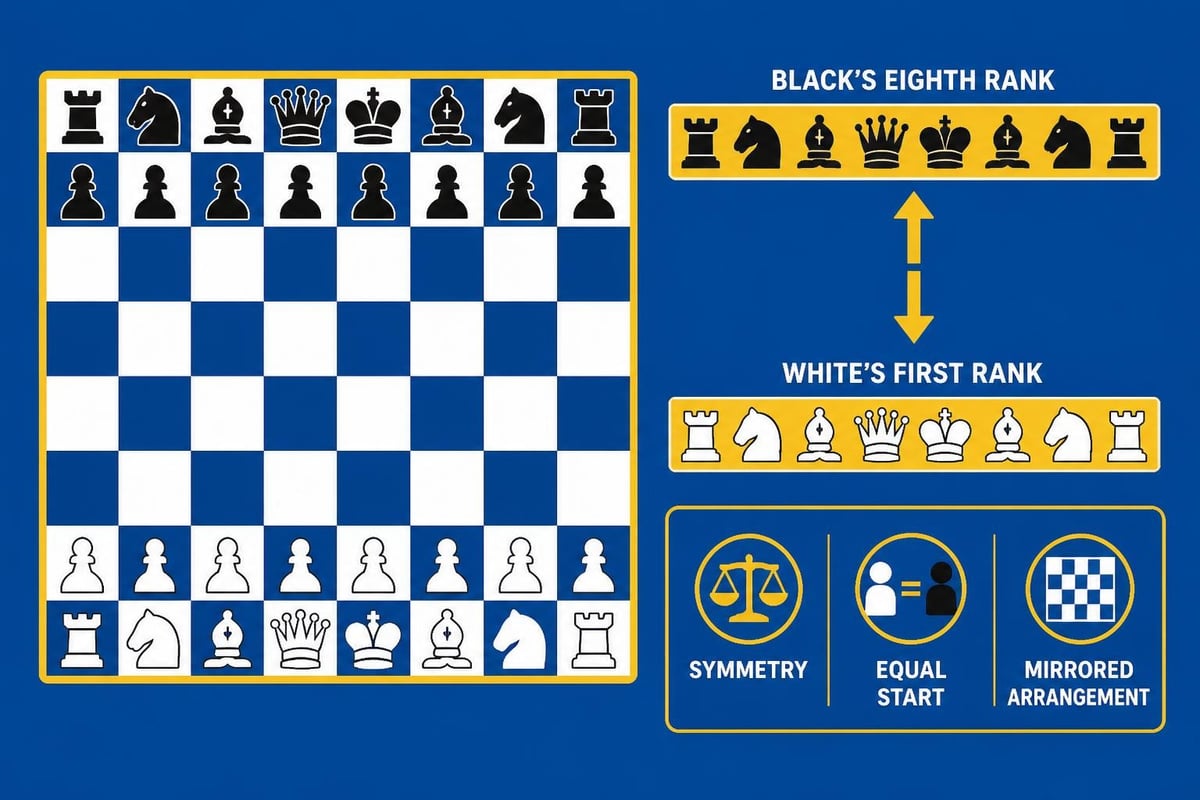
Before you can master advanced chess piece positions, you need to understand the standard starting setup. Every chess game begins with pieces arranged in a specific pattern, and getting this right sets the stage for everything that follows.
The back rank (first rank for White, eighth rank for Black) follows a symmetrical pattern. From left to right, you'll place: rook, knight, bishop, queen, king, bishop, knight, rook. Here's a helpful memory aid: the queen always starts on her own colour (white queen on a light square, black queen on a dark square), and the king takes the remaining central square.
Your pawns form a protective wall across the entire second rank (or seventh rank for Black). This initial pawn structure is crucial because it influences every strategic decision you'll make in the opening phase. For a complete visual reference of how all chess pieces are properly arranged, including board orientation, you'll want to ensure your board setup is correct before every game.
Why Starting Positions Matter
You might wonder why we stick to these rigid starting positions rather than randomizing the setup. The traditional arrangement creates a balanced game where both players have equal opportunities. The centre pawns (e and d files) are positioned to fight for central control immediately, while your pieces are poised to develop efficiently.
Getting familiar with these positions also helps you recognize when something's wrong. If you've ever set up a board and felt something looked odd, it's probably because a piece wasn't in its standard position.
Understanding Piece Values Through Position
Chess piece positions gain meaning when you understand the relative value of each piece. A bishop positioned on an open diagonal is worth more than a bishop blocked by its own pawns. Position and piece value are inseparable concepts.
Here's how pieces traditionally rank by value:
| Piece | Point Value | Positional Considerations |
|---|---|---|
| Pawn | 1 | Value increases near promotion |
| Knight | 3 | Stronger in closed positions |
| Bishop | 3 | Stronger in open positions |
| Rook | 5 | Needs open files for maximum effect |
| Queen | 9 | Most powerful but vulnerable |
| King | Infinite | Weakness in middlegame, strength in endgame |
These values aren't fixed, though. A well-positioned knight can easily outperform a poorly placed rook. This is why understanding how all chess pieces move is just the starting point-you need to learn where they function best.
Knights thrive in the centre of the board where they control up to eight squares. Place them on the rim, and they control only two or three squares (hence the old saying "a knight on the rim is dim"). Your bishops want long, open diagonals. Rooks need open or semi-open files to exert pressure.
Central Control: The Heart of Chess Positions
The four central squares (e4, e5, d4, d5) are the most important on the board. Why? Because pieces positioned in or controlling the centre have maximum influence across the board. A centralized knight can reach any part of the board in just two moves, whilst a knight stuck in the corner might need four or five moves to reach the opposite flank.
Your opening moves should generally aim to control or occupy these central squares. This is why most chess openings revolve around central pawn advances and piece development towards the centre. Whether you're studying the Catalan Opening or the Scotch Game, you'll notice that central control is a primary objective.
Developing Your Pieces Efficiently
Development means moving pieces from their starting positions to more active squares. Good development follows several principles:
- Knights before bishops: Knights have only one good square in the opening (usually f3 and c3 for White), whilst bishops have options
- Don't move the same piece twice: Unless there's a compelling reason, develop different pieces
- Castle early: Get your king to safety and activate a rook simultaneously
- Connect your rooks: Develop enough that your rooks can "see" each other across the back rank
Poor development might involve pushing too many pawns, moving your queen out too early, or failing to castle. These mistakes leave your pieces on suboptimal squares where they can't coordinate effectively.
Tactical Positions: Piece Coordination
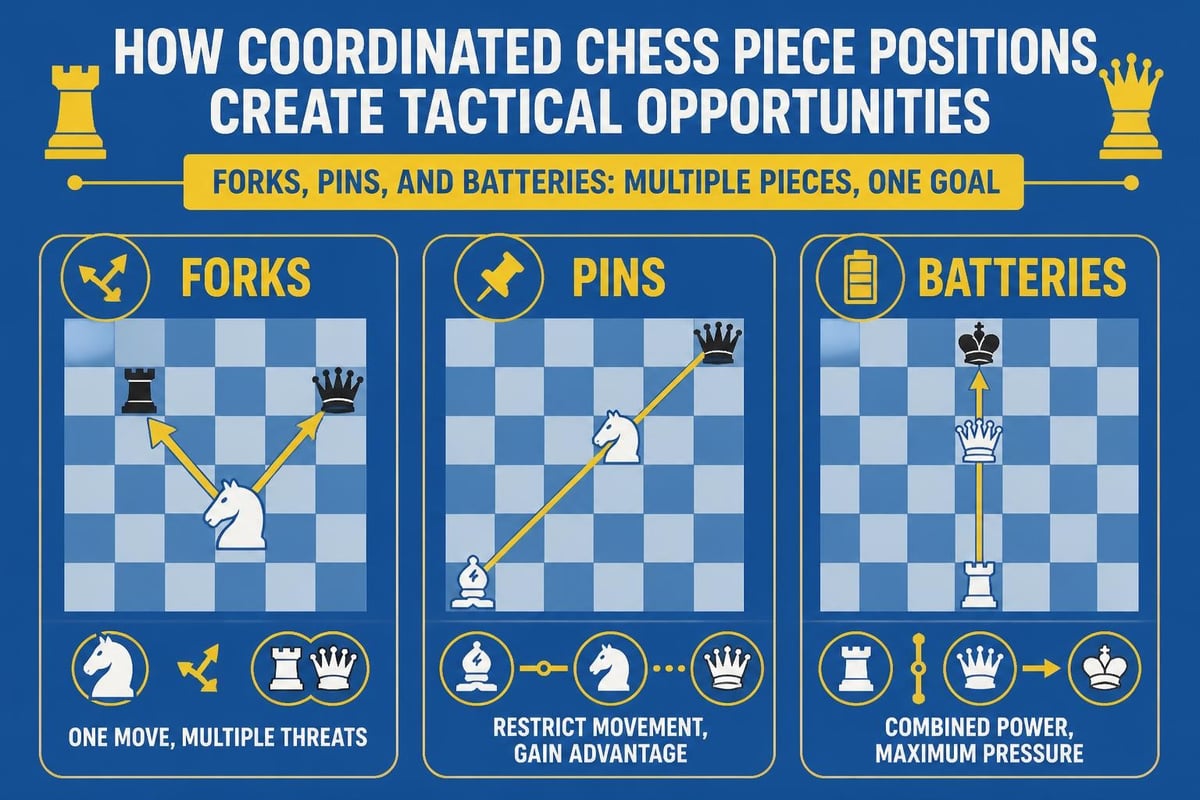
Individual chess piece positions matter less than how your pieces work together. A perfectly placed knight accomplishes little if it's not coordinated with your other forces. This is where tactical patterns emerge.
Forks occur when one piece attacks two or more enemy pieces simultaneously. Knights are particularly good at this due to their unique L-shaped movement pattern. Pins happen when a piece can't move without exposing a more valuable piece behind it. Skewers reverse this: the valuable piece is in front, and moving it exposes the piece behind.
Understanding these tactical themes helps you recognize strong positions. For instance, placing your rook on the seventh rank (second rank for Black) is often powerful because it attacks pawns and restricts the enemy king. Positioning two rooks on the same file creates a "battery" that can penetrate the opponent's position.
Opening Positions and Repertoire Building
The opening phase is all about transitioning from the starting position to a favourable middlegame position. There are hundreds of established opening systems, each aiming for specific types of chess piece positions.
Some openings create open positions with lots of tactical opportunities. The King's Gambit and Italian Game fall into this category. Others create closed positions where strategic manoeuvring matters more than tactics. The French Defence and King's Indian Defence exemplify this approach.
When you're building an opening repertoire, you're essentially deciding what types of positions you want to reach. Do you prefer attacking chess with sharp tactical play? Or do you like strategic positions where you can outmanoeuvre your opponent slowly?
Consider these popular opening approaches:
- Classical development (Italian Game, Spanish/Ruy Lopez): Aims for harmonious piece placement with strong central control
- Gambit play (Queen's Gambit, King's Gambit): Sacrifices material for rapid development and attacking chances
- Hypermodern systems (Nimzo-Indian, King's Indian): Allows the opponent central pawns, then attacks them with pieces
If you're curious about different opening strategies, exploring the most common chess openings will give you insight into the positions top players strive to reach.
Middlegame Positioning Strategy
Once you've completed your development, you enter the middlegame, where understanding optimal chess piece positions becomes crucial. The middlegame is less about following known theory and more about understanding strategic principles.
Outposts are squares where you can place a piece (usually a knight) that can't be attacked by enemy pawns. A knight on an outpost in enemy territory, protected by one of your pawns, can be devastatingly strong. The classic example is a knight on e5 for White (or e4 for Black), supported by a pawn and impossible to dislodge.
Weak squares are the inverse: squares in your position that you can't adequately defend, especially with pawns. Your opponent will try to place pieces on these weak squares, whilst you should aim to control them with pieces even if you can't defend them with pawns.
Open files are vertical columns with no pawns. Rooks and queens thrive on open files because they can penetrate deep into enemy territory. Controlling an open file often means doubling rooks or placing your queen behind a rook on that file.
Piece Activity vs. Material
Sometimes you'll sacrifice a pawn or exchange a piece to achieve better positions for your remaining forces. This trade-off between material and position is one of chess's most fascinating aspects.
A passive bishop trapped behind its own pawns might be worth less than an active knight on a central outpost. Similarly, three well-coordinated minor pieces can sometimes overpower a queen that lacks support. When evaluating positions, ask yourself: "Can my pieces get to where the action is?" If the answer is no, your position probably needs improvement regardless of material count.
Endgame Positions: Precision Matters
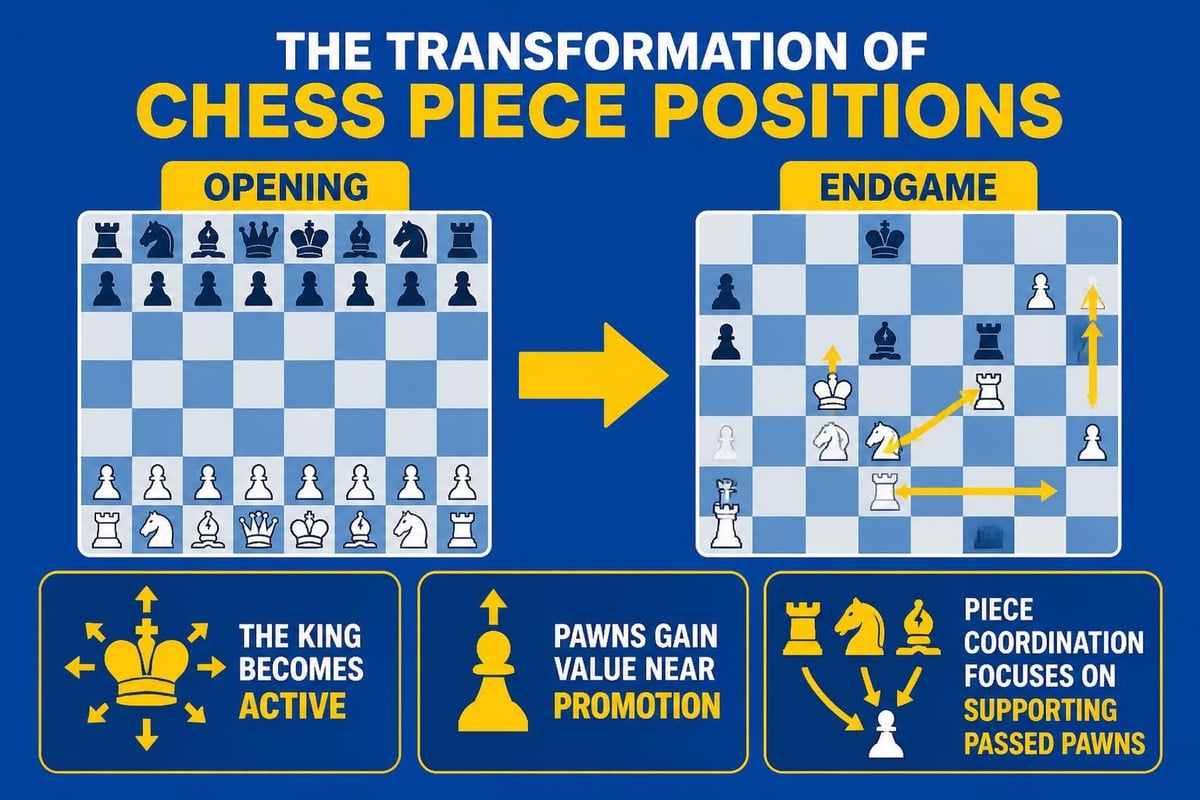
In the endgame, when most pieces have been traded off, positional understanding becomes even more critical. Small advantages in chess piece positions can be the difference between a draw and a win.
King activity becomes paramount in the endgame. Your king transforms from a liability into a powerful piece that should be centralized and active. A king on e4 in a pawn endgame controls crucial squares and supports your pawns' advance.
Pawn structure dominates endgame strategy. Passed pawns (pawns with no enemy pawns blocking their path to promotion) become incredibly valuable. Your pieces should support your passed pawns whilst blocking your opponent's.
Here's a comparison of strong vs. weak endgame positions:
| Strong Position | Weak Position |
|---|---|
| Active, centralized king | Passive king on the back rank |
| Connected passed pawns | Isolated, backward pawns |
| Rook behind passed pawns | Rook passively defending |
| Bishop controlling key diagonals | Bishop blocked by own pawns |
Understanding the fundamentals of chess strategy helps you recognize which positions favour which pieces in the endgame.
Common Positional Mistakes to Avoid
Even intermediate players make positional errors that undermine their chess piece positions. Recognizing these mistakes helps you avoid them in your own games.
Moving without a plan: Every move should serve a purpose. Random piece shuffling wastes time and lets your opponent seize the initiative. Before moving, ask: "What am I trying to achieve with this position?"
Ignoring pawn structure: Once you push a pawn, you can't move it backwards. Pawn moves create permanent weaknesses or strengths in your position. Avoid creating isolated pawns (pawns with no friendly pawns on adjacent files) unless you have compensation through piece activity.
Neglecting king safety: Leaving your king in the centre too long invites disaster. Even if you have a material advantage, an exposed king can lose quickly to a coordinated attack.
Piece placement on poor squares: Some squares are objectively better than others for specific pieces. Placing a knight on the edge of the board, a bishop on a diagonal blocked by your pawns, or a rook on a closed file wastes their potential.
Analyzing Positions Like a Chess Master
Strong players don't just move pieces-they evaluate chess piece positions using a systematic approach. You can develop this skill too.
Start by identifying material balance. Count what pieces remain and who's ahead. Then assess king safety for both sides. Is either king vulnerable to attack? Next, evaluate pawn structure. Look for weaknesses like doubled pawns, isolated pawns, or passed pawns.
Finally, consider piece activity. Which pieces are well-placed? Which are passive or blocked? A position might be materially equal but positionally won for one side because their pieces coordinate better.
For those working on improving their analytical skills, studying chess puzzles regularly trains your mind to recognize patterns in various positions.
Using Technology to Study Positions
Modern chess engines can evaluate positions with incredible accuracy. Whilst you shouldn't rely on them during games, they're excellent learning tools. After your games, use an engine to identify where your chess piece positions were suboptimal.
However, don't just look at the numerical evaluation. Try to understand why the engine prefers certain moves. Does it spot a tactic you missed? Is it prioritizing development over material? Understanding the reasoning behind strong moves improves your positional sense more than memorizing engine recommendations.
Special Positions and Pattern Recognition
Experienced players recognize standard positions and know the typical plans associated with them. This pattern recognition speeds up decision-making and improves positional understanding.
The isolated queen's pawn (IQP) position occurs in many openings, including some lines of the Queen's Gambit. White has active pieces and central control but a potential endgame weakness. Knowing the typical attacking and defensive plans in IQP positions saves valuable thinking time.
Opposite-coloured bishop positions often lead to drawish endgames even with material imbalances, but create sharp middlegame tactics. If you have a light-squared bishop and your opponent has a dark-squared bishop, you each control different coloured squares, creating unique strategic considerations.
Rook and pawn endgames have countless theoretical positions worth knowing. The Lucena position (a winning technique) and Philidor position (a drawing technique) are fundamental patterns every improving player should master.
Dynamic vs. Static Factors in Position
Chess piece positions contain both dynamic and static elements. Static factors (pawn structure, piece placement) remain relatively constant unless deliberately changed. Dynamic factors (piece activity, threats, initiative) can shift rapidly.
A position might have static weaknesses like a backward pawn, but if your pieces are actively placed and creating threats, these dynamic factors can outweigh static problems. Conversely, a statically sound position with perfect pawn structure means little if your pieces are passively placed and you're under constant attack.
Balancing these factors is an art. Beginners often focus too much on material count (static) whilst ignoring activity (dynamic). As you improve, you'll develop intuition for when to prioritize dynamic play and when to consolidate static advantages.
Improving Your Positional Understanding
How do you actually get better at chess piece positions? Consistent practice and study are essential, but focus your efforts effectively.
Study master games: Analyse games by strong players, focusing on how they position their pieces. Don't just replay moves-try to understand the reasoning behind each piece placement. Why did the grandmaster put the knight on that square? What long-term plan does this position support?
Solve positional puzzles: Unlike tactical puzzles with forced winning sequences, positional puzzles ask you to find the best plan or piece placement. These develop your strategic thinking.
Review your own games: After each game, identify moments where your chess piece positions were excellent or terrible. What could you have done differently?
Work with structured resources: Learning from organized materials like those available at Chess Cheat Sheets provides a systematic approach to understanding positions in various opening systems.
The journey to mastering positional chess is ongoing. Even top grandmasters continue refining their understanding of optimal piece placement. Every game offers opportunities to learn something new about how pieces coordinate and control the board.
Mastering chess piece positions transforms your game from random piece pushing to strategic play with clear objectives and plans. By understanding where pieces belong in different phases of the game and how they coordinate to control key squares, you'll make stronger decisions and win more games. Whether you're just learning the basics or refining your positional understanding, Chess Cheat Sheets offers comprehensive guides and resources to help you master piece positioning across all phases of the game, from opening setups to endgame precision.


