

Learning chess can feel overwhelming at first, but understanding the fundamental movements is your gateway to enjoying this timeless game. Whether you've just received your first chess set or you're looking to solidify your foundation, mastering chess moves for beginners is the essential first step towards becoming a confident player. In this guide, we'll break down everything you need to know about how each piece moves, special rules to remember, and how to start thinking strategically about your moves from the very first game.
Understanding the Chess Board Before You Move
Before diving into specific piece movements, you need to understand your battlefield. The chess board consists of 64 squares arranged in an 8x8 grid, alternating between light and dark colours. Each square is a potential destination for your pieces, and knowing how to navigate this grid is crucial.
The board is always set up with a light square in the bottom-right corner from each player's perspective. Files (columns) run vertically and are labelled a through h, whilst ranks (rows) run horizontally and are numbered 1 through 8. This coordinate system helps you record games and follow along with chess notation.
When you're starting out, you might wonder why this matters. Understanding board geography helps you recognise patterns, follow fundamental chess principles for beginners, and communicate about chess with other players. It's like learning the alphabet before writing sentences.
How Each Chess Piece Moves
The Pawn: Your Frontline Infantry
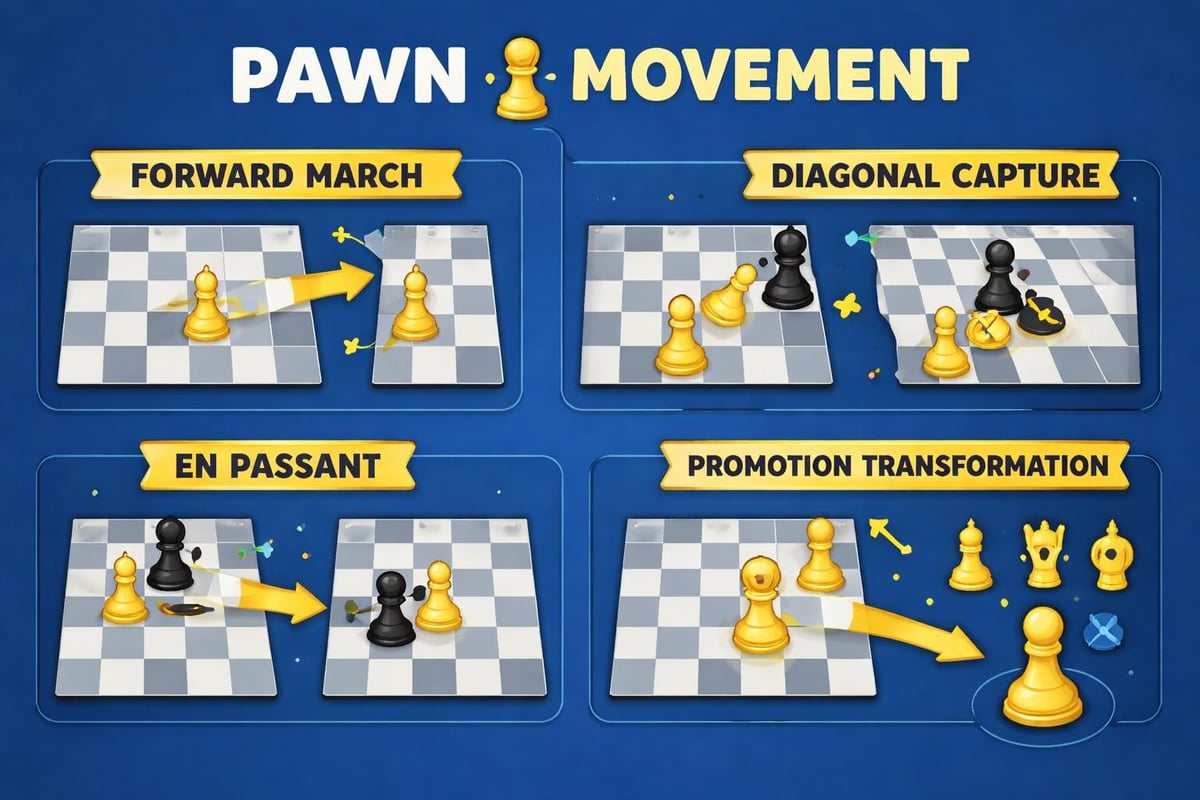
Pawns are often underestimated, but they're the soul of chess. Each player starts with eight pawns, and whilst they're the least mobile pieces, they have unique characteristics that make them fascinating.
Basic pawn movements:
- Move forward one square at a time
- On their first move only, pawns can advance two squares
- Capture diagonally, one square forward-left or forward-right
- Cannot move backwards under any circumstances
Pawns also have two special abilities. En passant is a capture that can occur when an enemy pawn advances two squares and lands beside your pawn. Promotion happens when a pawn reaches the opposite end of the board, transforming into a queen, rook, bishop, or knight (almost always a queen).
The Knight: The Tricky Jumper
Knights move in an L-shape pattern: two squares in one direction and one square perpendicular, or one square in one direction and two squares perpendicular. This creates eight possible destination squares from any central position.
What makes knights special is their jumping ability. They're the only pieces that can leap over other pieces, making them incredibly valuable in crowded positions. When you're learning chess moves for beginners, knights often cause the most confusion, but they're worth mastering.
The Bishop: Diagonal Dominance
Bishops glide along diagonal lines, travelling as many squares as the path remains clear. Each player starts with two bishops: one that travels only on light squares and one confined to dark squares throughout the entire game.
This colour restriction means bishops work best in pairs, complementing each other's weaknesses. A bishop on an open diagonal can control tremendous space, influencing both offensive and defensive possibilities across the board.
The Rook: Straight-Line Power
Rooks are powerhouse pieces that move in straight lines along ranks and files. They can travel any number of squares horizontally or vertically, provided no pieces block their path. With two rooks per player, they're particularly effective when working together.
Rooks shine in the endgame when the board opens up. In the beginning, they start tucked away in the corners, but understanding chess openings helps you activate them effectively.
The Queen: Maximum Flexibility
The queen combines the powers of the rook and bishop, moving any number of squares horizontally, vertically, or diagonally. She's the most powerful piece on the board, valued at approximately nine pawns in chess calculations.
However, don't bring your queen out too early! Beginners often rush to activate their queen, only to have it chased around the board by less valuable pieces. Patience with queen development is a hallmark of improving players.
The King: Protect at All Costs
The king moves one square in any direction: horizontally, vertically, or diagonally. Whilst limited in mobility, the king is infinitely valuable because losing your king means losing the game. The entire objective of chess is to checkmate the opponent's king.
Your king's safety should guide many of your decisions, especially in the opening phase of the game. This is where castling becomes crucial.

Special Moves Every Beginner Must Know
Beyond basic piece movements, chess has several special moves that dramatically impact gameplay. Understanding these is essential for anyone learning chess moves for beginners.
Castling: Your King's Escape Route
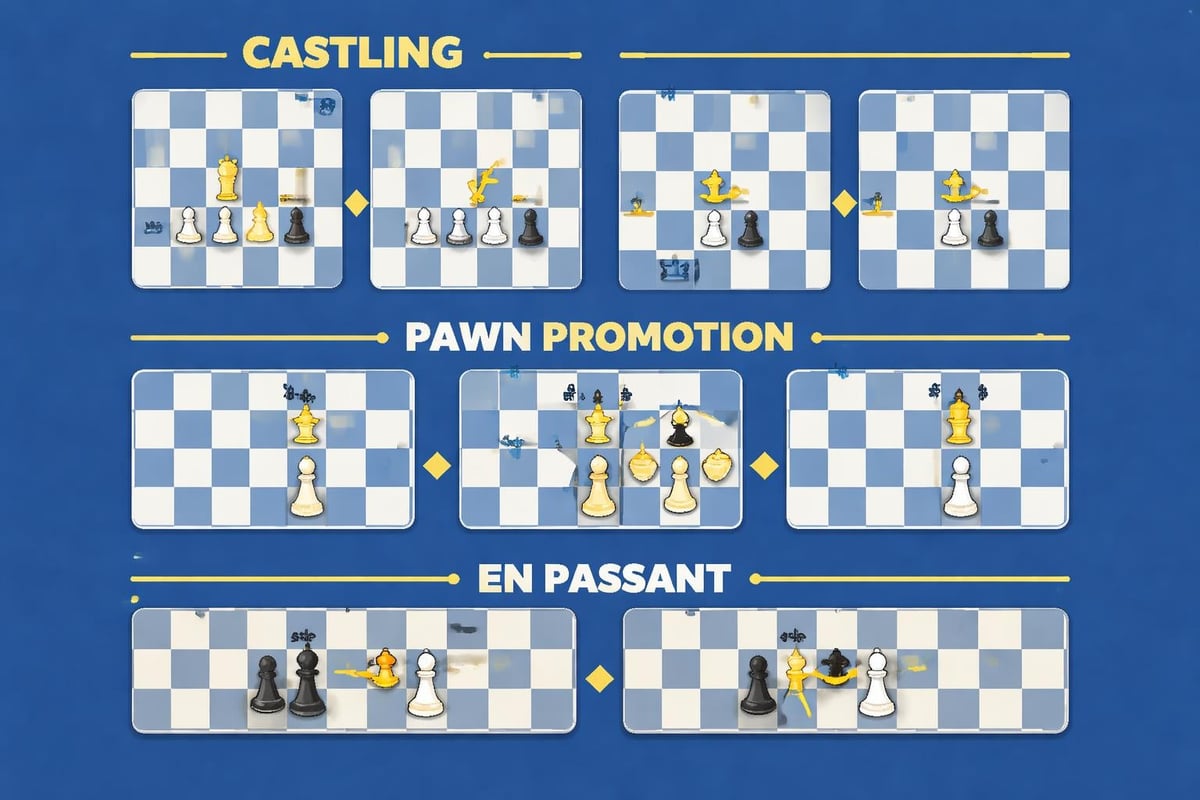
Castling is a unique move involving your king and one rook simultaneously. The king moves two squares towards the rook, and the rook jumps over the king to the adjacent square. This move serves two purposes: it tucks your king into safety and activates your rook.
Requirements for castling:
| Requirement | Details |
|---|---|
| Pieces unmoved | Neither the king nor the chosen rook can have moved previously |
| Clear path | No pieces can occupy squares between the king and rook |
| Safety check | The king cannot be in check, pass through check, or land in check |
| Once per game | Each player can castle only once |
You can castle kingside (shorter distance, often called "castling short") or queenside (longer distance, called "castling long"). Most players developing sound opening strategies castle kingside because it requires moving fewer pieces first.
Pawn Promotion: Creating New Queens
When your pawn reaches the eighth rank (the opposite end of the board), it must immediately transform into a queen, rook, bishop, or knight of the same colour. You can choose any piece except a king, regardless of what pieces remain on the board.
Nearly everyone chooses a queen because it's the most powerful piece, but sometimes a knight promotion can deliver checkmate when a queen cannot. This rare tactic is called "underpromotion."
En Passant: The Phantom Capture
En passant (French for "in passing") is the most misunderstood rule in chess. It occurs when an enemy pawn advances two squares from its starting position and lands directly beside your pawn. You can capture it as if it had only moved one square, but only on your immediate next turn.
This special capture prevents pawns from sneaking past each other and creates tactical opportunities. If you don't execute en passant immediately, you lose the option forever for that particular situation.
Developing a Move Selection Process
Knowing how pieces move is just the beginning. Choosing which moves to make requires a systematic approach that improves with practice.
The Candidate Move Method
Before touching a piece, identify several candidate moves. These are legal moves that look promising based on the position. Understanding candidate moves helps you avoid impulsive decisions that lead to blunders.
Steps for selecting moves:
- Survey the entire board and identify threats
- List 2-4 candidate moves that address the position
- Calculate each candidate move's consequences
- Compare options and select the best move
- Double-check for tactical oversights before moving
This process might seem slow initially, but it becomes second nature with practice. You'll make fewer mistakes and develop better chess intuition.
Recognising Tactical Patterns
Chess tactics are short-term combinations that win material or deliver checkmate. Common patterns like forks, pins, and skewers appear repeatedly in games. Learning to spot essential chess tactics transforms random moves into purposeful attacks.
A fork occurs when one piece attacks two or more enemy pieces simultaneously. Knights are famous for forks because their unique movement pattern creates opportunities from unexpected angles. Queens and pawns can also deliver devastating forks.
Pins immobilise pieces by putting them in front of more valuable pieces. If a bishop pins a knight to a king, moving the knight would expose the king to check, making the knight effectively frozen.
Building Your Opening Move Repertoire
The first several moves of a chess game constitute the opening phase. Whilst memorising lengthy variations isn't necessary for beginners, understanding opening principles ensures you start each game on solid footing.
Core Opening Principles
Opening priorities for beginners:
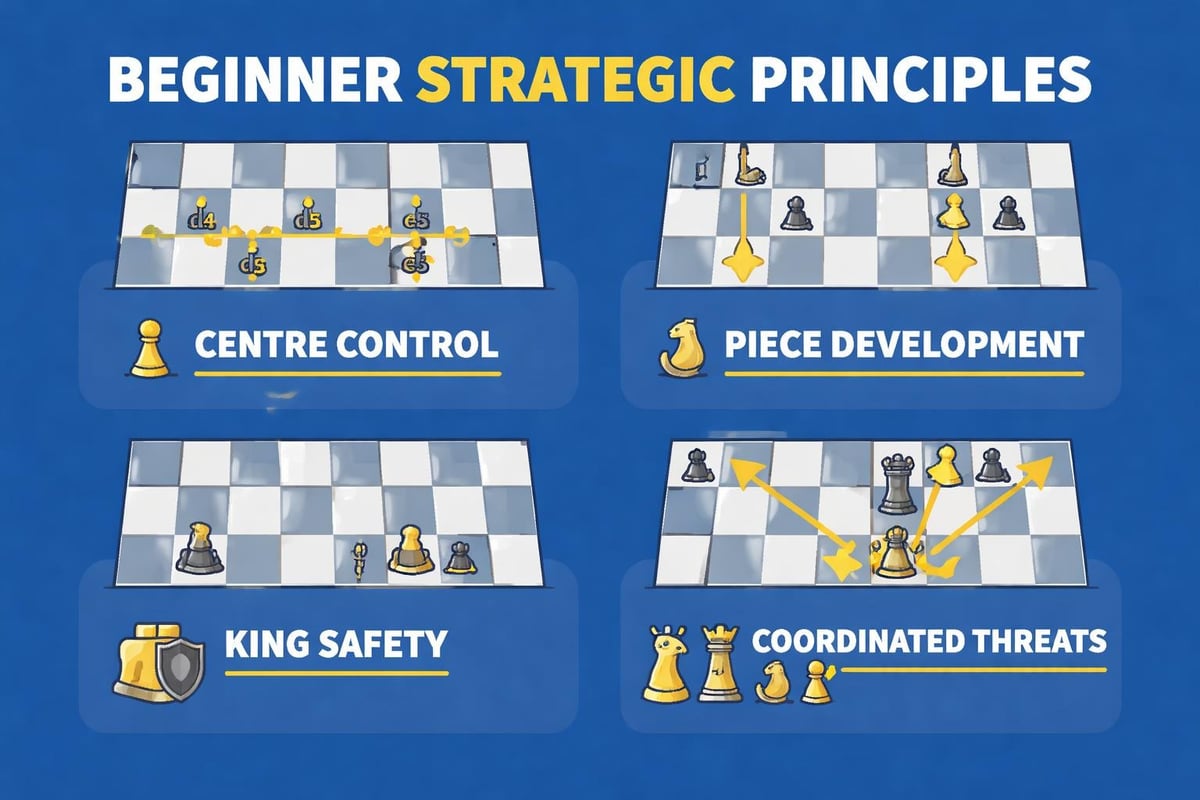
- Control the centre with pawns (e4, d4, e5, d5)
- Develop knights before bishops
- Castle early to secure your king
- Don't move the same piece multiple times
- Avoid bringing your queen out too early
- Connect your rooks by completing development
These principles apply regardless of which specific opening you play. They're guidelines that help you make sensible decisions when you're unsure what to do next.
Exploring opening resources helps you find systems that match your style. Some players prefer aggressive openings that create immediate threats, whilst others favour solid, positional setups.
Simple Openings for Beginners
Rather than memorising complex theory, start with straightforward openings that teach good habits. The Italian Game (1.e4 e5 2.Nf3 Nc6 3.Bc4) develops pieces naturally and controls the centre. The London System offers White a reliable setup that's hard to refute.
For Black, the French Defence or comparing defensive systems helps you understand different pawn structures. The key is consistency: stick with one or two openings until you understand them deeply.
Common Beginner Mistakes to Avoid
Everyone makes mistakes when learning chess moves for beginners, but recognising common pitfalls helps you improve faster. These errors appear in nearly every novice game.
Moving Without Purpose
Random moves weaken your position without achieving anything constructive. Every move should accomplish something: develop a piece, improve a piece's position, create a threat, or defend against an opponent's threat.
Ask yourself before each move: "What does this accomplish?" If you can't articulate a clear purpose, consider alternative moves that align with opening principles.
Neglecting King Safety
Leaving your king in the centre invites disaster. Experienced players ruthlessly punish exposed kings, launching attacks that overwhelm unprepared defences. Castling should be a priority in most games, typically completed within the first ten moves.
Ignoring Opponent's Threats
Focusing exclusively on your own plans whilst ignoring your opponent's ideas leads to tactical disasters. Always check what your opponent threatens before making your move. They might be attacking an undefended piece, preparing a fork, or setting up a devastating combination.
Chasing Minor Advantages
Beginners often sacrifice development to win a pawn or two, only to face a powerful attack from a better-developed opponent. Material advantages matter, but development, king safety, and piece activity often matter more in the opening and middlegame.
Practising Your Moves Effectively
Knowledge without practice remains theoretical. Applying what you've learned about chess moves for beginners requires regular play and study.
Play Regularly Against Various Opponents
Playing against different people exposes you to varied styles and strategies. Online platforms offer unlimited opponents at any skill level, whilst local chess clubs provide face-to-face experience and opportunities to discuss games afterwards.
Don't worry about your initial results. Losing teaches more than winning if you analyse your games to understand what went wrong. Every defeat contains lessons about move selection, tactical awareness, and strategic planning.
Solve Tactical Puzzles
Tactical puzzle practice sharpens your pattern recognition and calculation skills. Working through puzzles trains you to spot opportunities your opponent gives you and avoid leaving pieces hanging.
Start with simple one-move puzzles and gradually increase difficulty. Consistency matters more than volume: solving five puzzles daily builds skill faster than doing fifty puzzles once monthly.
Review Your Games
After each game, review your moves to identify mistakes and missed opportunities. Modern chess platforms provide computer analysis that highlights blunders, but try analysing independently first. This develops your analytical skills and helps you understand your thinking process.
Questions to ask when reviewing:
- Where did I deviate from opening principles?
- Which moves weakened my position?
- What tactical opportunities did I miss?
- How could I have improved my worst move?
Study Complete Games
Watching or studying complete games by strong players demonstrates how opening principles transition into middlegame plans. Understanding complete chess concepts shows you the bigger picture beyond individual moves.
Pay attention to how masters develop their pieces, when they exchange pieces, and how they create winning advantages from small improvements. These patterns become templates for your own games.
Understanding Move Notation
Recording your games helps you review them later and communicate with other chess players. Algebraic notation is the standard system used worldwide, and it's simpler than it appears.
Basic Algebraic Notation
Each piece has a letter: K for king, Q for queen, R for rook, B for bishop, N for knight. Pawns have no letter. Squares are identified by their file (letter) and rank (number), like e4 or d5.
A move is written as the piece letter followed by the destination square: Nf3 means knight moves to f3. Captures are shown with an "x": Bxf7 means bishop captures on f7. Castling kingside is written as O-O, whilst queenside castling is O-O-O.
| Symbol | Meaning |
|---|---|
| + | Check |
| # | Checkmate |
| x | Capture |
| = | Pawn promotion |
| ! | Good move |
| ? | Mistake |
Special symbols add clarity: e8=Q shows pawn promotion to queen, whilst Nbd2 specifies which knight moved when two knights could reach d2. Chess rules and notation provide comprehensive details for deeper understanding.
Planning Beyond Single Moves
As you become comfortable with basic movements, start thinking several moves ahead. Chess rewards planning and foresight more than reactive play.
Developing Plans in Chess
Plans guide your moves towards specific goals. In the opening, your plan might be "develop all pieces and castle kingside." In the middlegame, you might plan "attack the weakened kingside pawns" or "improve my worst-placed piece."
Good plans stem from position evaluation. Assess your position's strengths and weaknesses, then create plans that maximise strengths and minimise weaknesses. If your opponent has weak pawns, plan to attack them. If you control more space, plan to restrict their piece mobility.
Calculating Variations
Calculation means visualising future positions without moving pieces physically. Start by calculating forced sequences: checks, captures, and threats that demand responses. These critical moments require accurate calculation.
Begin with simple calculations: "If I take this pawn, can they recapture? What happens after the recapture?" Gradually extend your calculation depth as your visualisation improves. Most intermediate players calculate 3-5 moves ahead in tactical positions.
Moving Forward with Confidence
You've now explored the essential chess moves for beginners, from basic piece movements to special rules and strategic concepts. The path from novice to competent player involves consistent practice, thoughtful analysis, and gradual expansion of your chess knowledge.
Don't rush to learn everything simultaneously. Master the fundamentals first, ensuring you understand how each piece moves and can execute special moves like castling confidently. Build on this foundation by developing pattern recognition through puzzles and games.
Remember that every strong player started exactly where you are now, uncertain about their moves and overwhelmed by possibilities. The difference between beginners and advanced players isn't innate talent but accumulated experience and dedicated study. Each game you play adds to your chess understanding, even the losses.
Consider starting with simple, solid opening systems rather than complicated theory. Systems like the Italian Game or exploring reliable opening choices help you focus on understanding principles rather than memorising variations.
Most importantly, enjoy the journey. Chess offers lifelong learning opportunities, and the satisfaction of executing a well-planned combination or grinding out a difficult endgame victory makes all the study worthwhile. Keep playing, stay curious, and trust that improvement comes with dedicated practice.
Mastering chess moves for beginners opens the door to a rewarding strategic game that challenges and entertains for decades. With these fundamentals in place, you're ready to start building real chess skills through practice and study. Chess Cheat Sheets provides streamlined guides, opening references, and tactical puzzles designed specifically for players at your level, helping you improve efficiently without getting lost in overwhelming theory. Whether you need quick opening reminders or want to sharpen your tactical vision, our resources support your chess journey from beginner to confident player.


