

You've probably heard that the first few moves in chess can make or break your entire game, right? It's absolutely true. Understanding chess game openings isn't just about memorising sequences; it's about grasping the underlying principles that give you a solid foundation for the middlegame and beyond. Whether you're a complete beginner or an intermediate player looking to sharpen your repertoire, mastering openings transforms how you approach every match. Let's explore the fascinating world of opening theory and discover practical ways to improve your play without drowning in endless variations.

What Makes Chess Game Openings So Important?
The opening phase sets the tone for everything that follows. Think of it as laying the foundation for a house - get it wrong, and the entire structure becomes unstable.
During the first 10-15 moves, you're establishing your pieces on optimal squares, fighting for control of the centre, and ensuring your king's safety. These fundamental objectives appear in virtually every sound opening strategy.
Why do chess game openings matter so much?
- They determine your piece coordination for the middlegame
- Strong openings create immediate tactical opportunities
- Poor opening choices can leave you defending from move one
- Understanding opening principles saves you time on the clock
- Familiarity with positions builds confidence
The Encyclopaedia of Chess Openings has classified hundreds of variations over decades, creating a standardised reference system. But here's the thing: you don't need to memorise everything. Focus on understanding the core concepts behind each opening family.
The Three Golden Principles
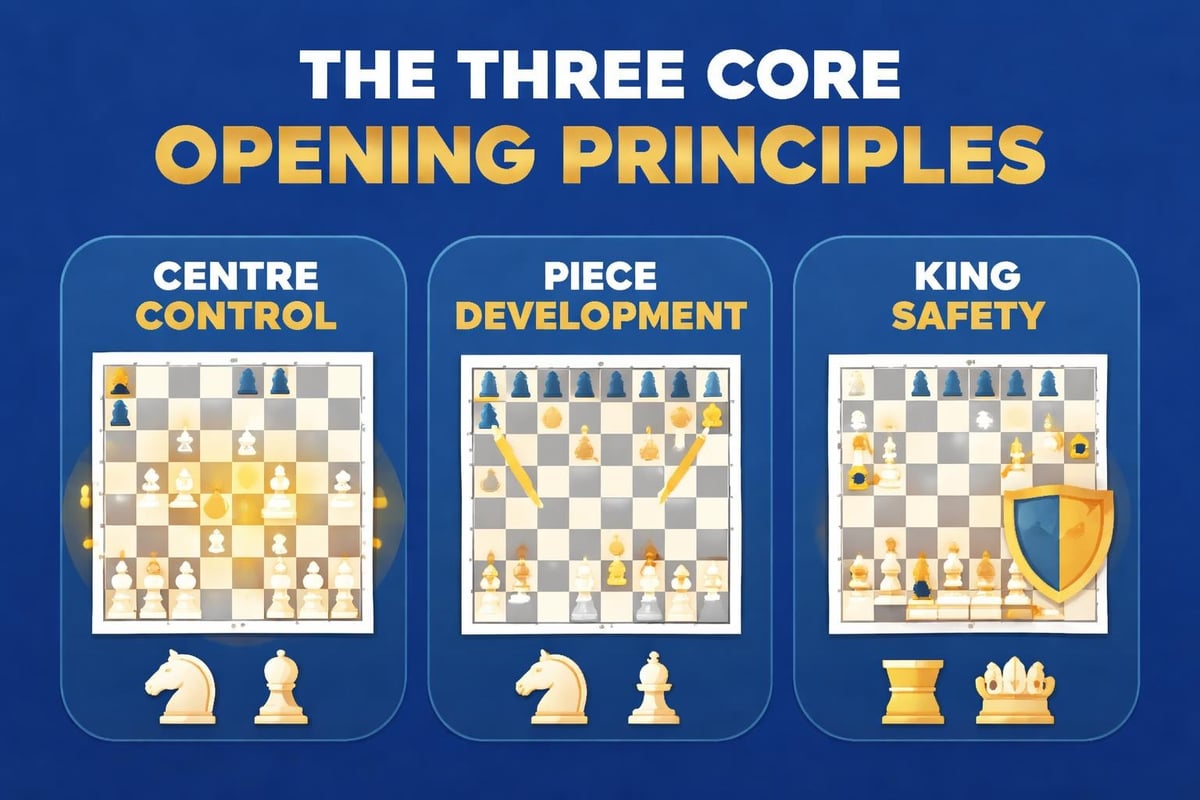
Every strong opening adheres to three fundamental principles that transcend specific variations.
Control the centre. The squares e4, d4, e5, and d5 are the most important real estate on the board. Pieces positioned centrally exert maximum influence across all areas.
Develop your pieces efficiently. Knights before bishops, generally speaking. Get your pieces off the back rank and into the game quickly, avoiding unnecessary pawn moves that don't contribute to development.
Safeguard your king. Castle early to tuck your king away from the centre where tactical fireworks typically explode. This also connects your rooks, preparing them for action.
Popular Chess Game Openings for White
When you have the white pieces, you possess the advantage of moving first. This tempo advantage gives you slightly more flexibility in dictating the game's direction.
The Italian Game
The Italian Game represents one of the oldest and most instructive openings. After 1.e4 e5 2.Nf3 Nc6 3.Bc4, you're developing naturally whilst eyeing Black's vulnerable f7 pawn.
This opening teaches excellent principles: rapid development, central control, and direct threats. It's perfect for players building their foundational understanding.
Key ideas in the Italian Game:
- Control the centre with e4
- Develop the knight to attack e5
- Position the bishop on the aggressive c4 diagonal
- Prepare to castle kingside
- Build pressure gradually
The English Opening
Fancy something more positional? The English Opening starting with 1.c4 offers a completely different flavour. Rather than immediately occupying the centre, you're controlling it from the flank.
This opening typically leads to strategic, manoeuvring games where understanding pawn structures matters more than tactical sharpness. It's favoured by players who prefer outplaying opponents positionally rather than seeking immediate complications.
Queen's Gambit and Its Implications
The Queen's Gambit (1.d4 d5 2.c4) isn't actually a gambit in the traditional sense since Black cannot safely hold the c4 pawn. Understanding the pros and cons of the Queen's Gambit helps you decide whether this opening suits your style.
| Opening Type | Character | Best For |
|---|---|---|
| Italian Game | Tactical, Direct | Beginners learning principles |
| English Opening | Positional, Flexible | Strategic players |
| Queen's Gambit | Solid, Controlling | Structured approach |
Effective Chess Game Openings for Black
Playing Black requires a slightly different mindset. You're responding to White's initiative whilst seeking equality and counterplay opportunities.
The Scandinavian Defense
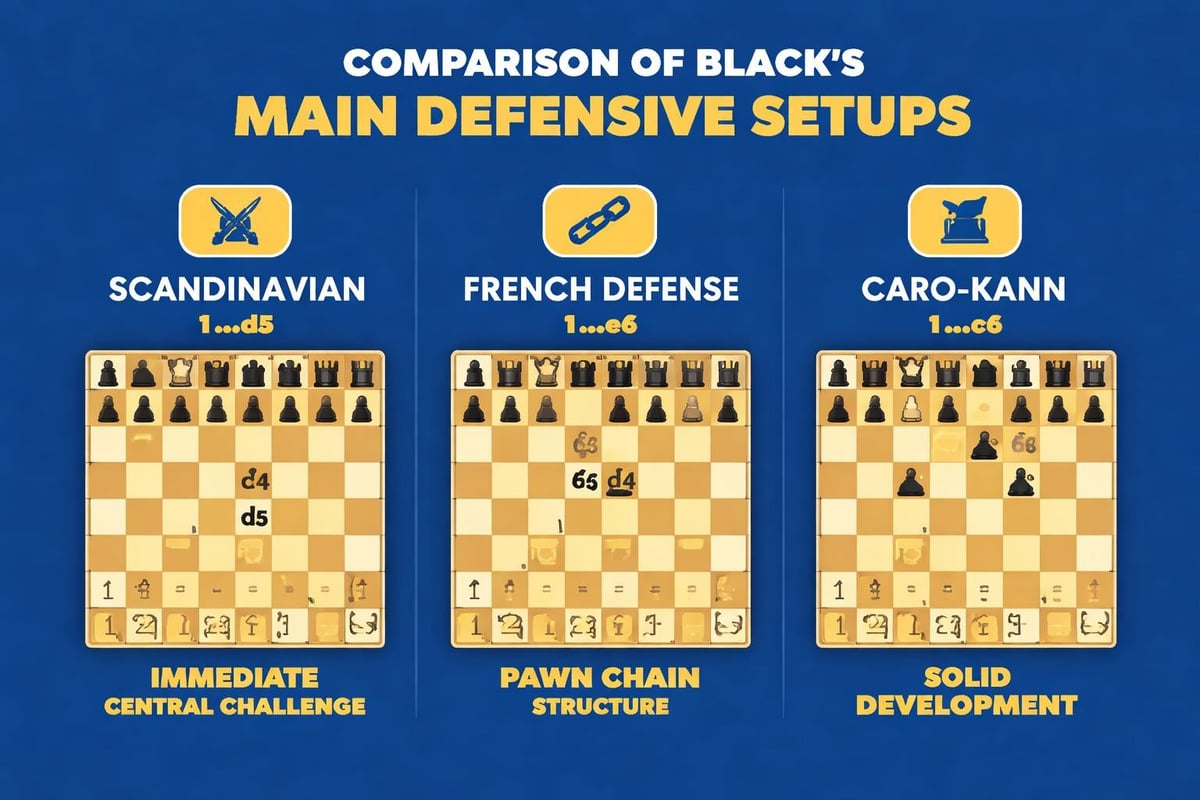
The Scandinavian Defense with 1.e4 d5 immediately challenges White's central pawn. It's straightforward, relatively easy to learn, and avoids mountains of mainstream theory.
After 2.exd5 Qxd5 3.Nc3 Qa5, you've accepted that your queen moves twice in the opening but gained clarity about the pawn structure. This trade-off suits players who prefer clear plans over complex theoretical battles.
French Defense: Solid and Resilient
The French Defense (1.e4 e6) prepares to challenge the centre with d5 whilst maintaining a solid pawn structure. It's one of the most reliable chess game openings for players seeking to frustrate aggressive opponents.
The drawback? Your light-squared bishop often becomes problematic. But the structural solidity and clear strategic plans compensate for this minor inconvenience.
Strategic themes in the French:
- Undermining White's e4 pawn
- Piece play on the queenside
- Potential pawn breaks with c5 or f6
- Long-term pressure rather than immediate tactics
Caro-Kann Defense
Similar to the French but developing the light-squared bishop outside the pawn chain, the Caro-Kann (1.e4 c6) represents a solid, slightly passive choice. It's exceptionally reliable and has been employed at the highest levels for over a century.

Building Your Opening Repertoire
Here's where many players go wrong: they try to learn everything simultaneously. That's a recipe for confusion and mediocre results.
Start Small, Expand Gradually
Begin with one solid opening for White and two defences against 1.e4 and 1.d4 as Black. That's your core repertoire. Master these thoroughly before branching out.
For instance, you might choose:
- As White: Italian Game or Queen's Pawn openings
- Against 1.e4: Scandinavian or French Defense
- Against 1.d4: Slav Defense or King's Indian Defense
This focused approach means you'll encounter your chosen positions repeatedly, accelerating your learning through pattern recognition rather than rote memorisation.
Understanding Over Memorisation
The Handbuch des Schachspiels demonstrated in the 19th century that understanding opening principles matters more than memorising specific move orders. This wisdom remains valid today.
When you comprehend why moves are played, you can reconstruct variations logically. If you forget a specific line, your understanding of piece placement and pawn structures guides you to reasonable alternatives.
How to study openings effectively:
- Learn the main ideas and typical plans
- Study complete games in your chosen openings
- Practice against human opponents, not just engines
- Review your games to identify where you deviated
- Gradually add new variations as you master the basics
Common Mistakes in Chess Game Openings
Even experienced players fall into opening traps. Recognising these pitfalls helps you avoid them.
Moving Pawns Excessively
Every pawn move should serve a purpose. Moving too many pawns without developing pieces leaves you behind in development and vulnerable to attacks.
The Grob Opening demonstrates this extreme: 1.g4 weakens the kingside dramatically. While the Grob Opening has surprise value, it violates fundamental principles and rarely offers White any advantage against prepared opponents.
Bringing the Queen Out Early
Your queen is your most powerful piece, making it a prime target. Developing it too early allows opponents to attack it whilst simultaneously developing their pieces with tempo.
Ignoring King Safety
Delaying castling to launch an attack often backfires spectacularly. Your king in the centre remains vulnerable, and opponents can often strike first.
| Mistake | Consequence | Solution |
|---|---|---|
| Too many pawn moves | Development lag | Move each piece once before moving any piece twice |
| Early queen sorties | Loss of tempo | Develop minor pieces first |
| Neglecting king safety | Tactical vulnerabilities | Castle within first 10 moves |
| Ignoring the centre | Passive position | Challenge or control central squares |
Resources for Learning Chess Game Openings
You've got more learning resources available than any generation of chess players before you. The question isn't where to find information - it's how to use it effectively.
Online Platforms and Databases
Modern chess databases contain millions of games, allowing you to study how grandmasters handle your chosen openings. The analysis features help you understand critical moments and alternative continuations.
Websites like ChessPublishing.com offer monthly updates from grandmasters, keeping you current with the latest theoretical developments. For comprehensive coverage, Chessopolis provides extensive resources organised by opening type.

Books and Traditional References
Despite the digital revolution, chess books remain invaluable. The Oxford Companion to Chess offers historical context and strategic explanations that purely tactical databases miss.
Physical books force you to visualise positions mentally rather than clicking through moves on a screen. This mental practice strengthens your calculation abilities significantly.
Structured Learning Approaches
Looking for free online chess courses? Numerous platforms offer structured curricula that progress logically from basic to advanced concepts.
The key is consistency. Fifteen minutes of focused daily study produces better results than occasional marathon sessions.
Practical Application and Training
Theory without practice remains sterile. You need to test your chess game openings in real games to truly internalise the patterns and ideas.
Playing Thematic Games
Once you've studied an opening, play games specifically to reach those positions. Don't worry excessively about the results initially - focus on applying the principles correctly.
Set up training games where you play your chosen opening from both sides. This dual perspective reveals weaknesses you might otherwise overlook.
Puzzle Practice for Opening Positions
Working through puzzles that arise from your openings reinforces tactical patterns specific to those positions. The Chess Cheat Sheets puzzle collection offers targeted practice organised by opening type.
Benefits of opening-specific puzzles:
- Pattern recognition in familiar structures
- Understanding typical tactical motifs
- Identifying critical moments in positions
- Building confidence in your chosen systems
Analysing Your Games
After each game, spend time reviewing your opening choices. Did you achieve your strategic goals? Where did you deviate from sound principles?
Modern engines provide objective evaluations, but don't just look at the computer's suggestions. Ask yourself: "Did I understand what I was trying to achieve?" Understanding the plan matters more than finding the objectively best move.
Advanced Opening Concepts
As you progress, you'll encounter more sophisticated ideas that separate strong players from club-level enthusiasts.
Transpositions and Move Order Flexibility
Many chess game openings reach identical positions through different move orders. Understanding these transpositions expands your flexibility and prevents opponents from avoiding your preparation.
For example, the Catalan Opening can arise from both 1.d4 and 1.Nf3 move orders, offering White flexibility based on Black's responses.
Repertoire Gaps and Coverage
Every opening repertoire has gaps - positions you haven't specifically studied. The question is whether these gaps are manageable weaknesses or serious vulnerabilities.
Examining the most common chess openings helps you identify which positions you'll face most frequently, allowing you to prioritise your study time effectively.
Learning from the Masters
Studying how elite players employed certain openings reveals subtle ideas that textbooks often miss. Bobby Fischer's opening choices, for instance, demonstrate how classical principles combine with concrete preparation. Exploring what openings Bobby Fischer played provides insights into practical opening selection.
Tailoring Openings to Your Playing Style
Not every strong opening suits every player. Your personality, time management preferences, and strategic inclinations should influence your repertoire choices.
Tactical vs Positional Preferences
Do you thrive in sharp, tactical melees? Openings like the King's Gambit or Sicilian Dragon might suit you. Prefer slow strategic manoeuvring? Consider the Catalan or English Opening.
Time Control Considerations
Blitz games demand openings you know instinctively. Complex theoretical battles work better in classical time controls where you can calculate deeply.
Choosing openings by time control:
- Blitz: Simple, sound openings with clear plans
- Rapid: Moderate complexity, some tactical content
- Classical: Deeper preparation, sharper variations acceptable
Adapting to Opposition
Against stronger players, solid chess game openings minimise their advantage. Against weaker opponents, sharper openings might create complications they'll struggle to navigate.
This flexible approach requires maintaining multiple systems, but the investment pays dividends through improved practical results.
Maintaining and Updating Your Repertoire
Chess theory never stands still. New ideas emerge constantly, and occasionally, entire opening assessments shift based on fresh analysis.
Staying Current Without Overwhelm
You don't need to chase every theoretical novelty. Focus on understanding major developments in your specific openings whilst ignoring irrelevant sidelines.
Checking comprehensive chess resources quarterly keeps you reasonably current without requiring daily database updates.
When to Abandon an Opening
Sometimes an opening stops working. Perhaps opponents have found effective counters, or maybe it no longer suits your evolving style. Don't be afraid to refresh your repertoire when necessary.
| Sign | Action |
|---|---|
| Consistently bad positions | Review fundamental understanding |
| Opponents prepared against you | Add secondary variations |
| Opening feels uncomfortable | Consider switching systems |
| Theory has shifted against it | Update or abandon |
Expanding Methodically
Adding new openings to your repertoire should happen gradually. Master your core systems first, then branch out into related variations that share similar structures and ideas.
Mastering chess game openings requires patience, structured study, and consistent practice, but the rewards transform your entire playing experience. From understanding fundamental principles to building a personalised repertoire, each step strengthens your foundation. Chess Cheat Sheets provides precisely what you need to accelerate this journey - streamlined guides, targeted puzzles, and comprehensive resources designed for efficient learning. Whether you're just starting out or refining your intermediate skills, our materials help you master openings without overwhelming study demands, giving you the confidence to face any opponent across the board.


