

The chess English opening has quietly become one of the most popular choices for club players and grandmasters alike in 2026. Starting with 1.c4, this sophisticated opening system offers White tremendous flexibility and the chance to steer the game into various pawn structures. Unlike more forcing openings that dictate a specific plan from move one, the English allows you to adapt based on your opponent's response. If you're looking to expand your opening repertoire with something solid yet dynamic, you've come to the right place.
Why the Chess English Opening Deserves Your Attention
Have you ever felt trapped by opening theory? Perhaps you've memorised twenty moves of the Ruy Lopez only to face an obscure sideline that throws you off completely. The chess English opening offers a refreshing alternative. Rather than memorising endless variations, you're learning strategic concepts that apply across multiple positions.
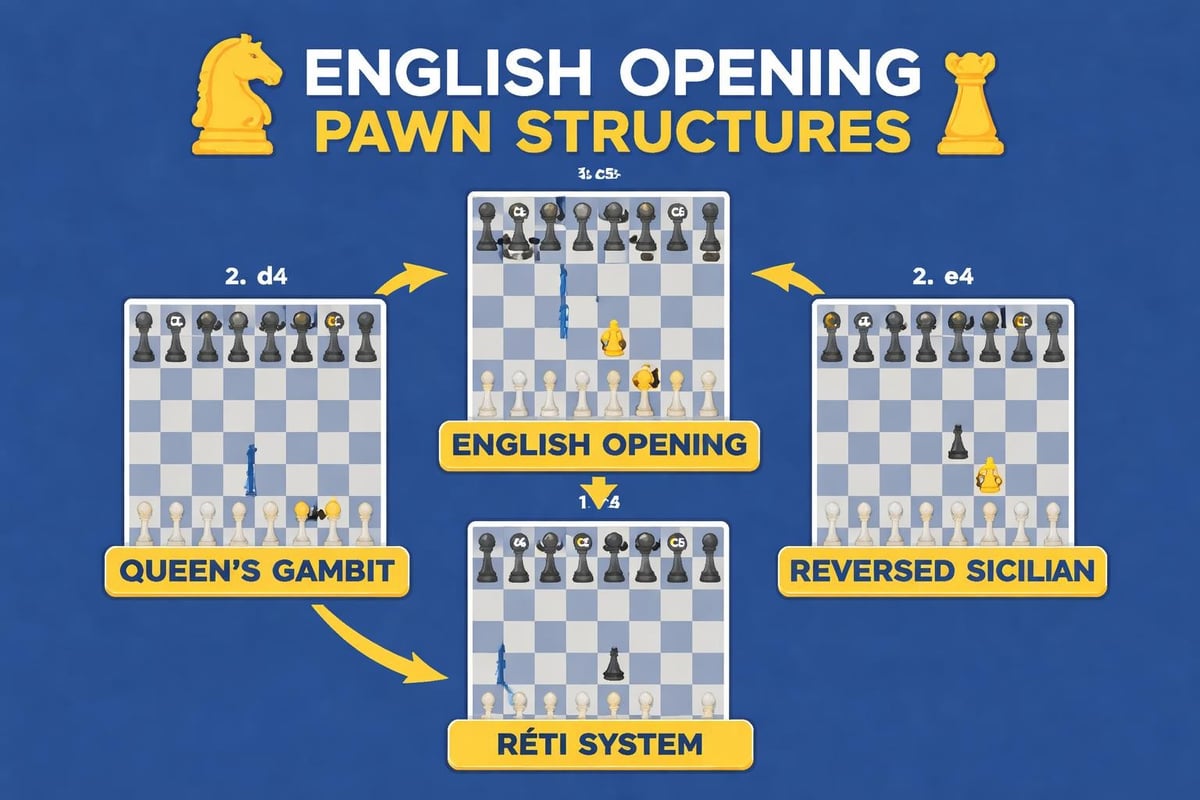
The beauty of 1.c4 lies in its transpositional nature. You can reach Queen's Gambit positions, Réti structures, or unique English formations depending on how Black responds. This flexibility makes it incredibly difficult for your opponents to prepare against you specifically.
Strategic Foundations That Matter
When you play the chess English opening, you're controlling the centre from the flanks rather than occupying it immediately with pawns. This hypermodern approach was revolutionary when players like Aron Nimzowitsch and Richard Réti introduced these concepts in the 1920s. According to historical records on the English Opening, the name itself comes from Howard Staunton's frequent use of 1.c4 during his 1843 match.
But why does this matter for your games today? Simple: most club players are trained to fight for the centre with e4 and d4. When you challenge the d5 square from the side with your c-pawn, you're already pulling them out of their comfort zone.
Core Variations You Need to Know
The chess English opening branches into several main systems based on Black's response. Let's break down the most important ones and what you should know about each.
The Symmetrical English (1.c4 c5)
This is Black's most principled reply, mirroring White's flank approach. The symmetrical structures that arise are deceptively complex. Here's what typically happens:
- 1.c4 c5 2.Nc3 Nc6 3.g3 g6 4.Bg2 Bg7
- White often plays Nf3 and d3, creating a flexible setup
- Both sides develop pieces harmoniously
- The position remains balanced with chances for both players
| White's Plans | Black's Counter-Plans |
|---|---|
| Break with d4 to open the centre | Maintain the symmetry and neutralise White's advantage |
| Create queenside pressure with Rb1 and b4 | Challenge with ...b5 |
| Prepare f4 for kingside expansion | Develop actively and seek counterplay |
The comprehensive guide at Chess.com offers excellent analysis of these symmetrical positions if you want to dive deeper into the theory.
The Reversed Sicilian (1.c4 e5)
Now this is where the chess English opening gets really interesting for Sicilian players. After 1.c4 e5, you've essentially got a Sicilian Defence with an extra tempo as White. Think about that for a moment-you get all the strategic richness of the Sicilian, but you're a move ahead.
Common continuations include:
- 2.Nc3 Nf6 3.Nf3 Nc6 4.g3 (the Four Knights variation)
- 2.Nc3 Nc6 3.g3 g6 4.Bg2 Bg7 (the Botvinnik System)
- 2.g3 preparing a kingside fianchetto immediately
The extra tempo makes a genuine difference. Plans that would be risky for Black in the Sicilian become viable for White here. You can often achieve comfortable equality or a small edge without taking significant risks.
Against 1...Nf6
When Black plays 1...Nf6, you're entering territory that can transpose to various d4 openings. This is where understanding openings for White becomes crucial, as you need to know which transpositions favour your style.
After 2.Nc3, Black faces several choices:
- 2...e6 - heading for Queen's Gambit Declined structures
- 2...g6 - aiming for King's Indian Defence setups
- 2...c5 - entering symmetrical English positions
- 2...e5 - the Anglo-Indian Defence
Each of these paths leads to different middlegame plans, which is why the chess English opening requires understanding rather than pure memorisation.

Tactical Themes and Pattern Recognition
While the chess English opening is primarily positional, several tactical motifs appear repeatedly. Recognising these patterns will save you hours of calculation time during games.
The c5 Break
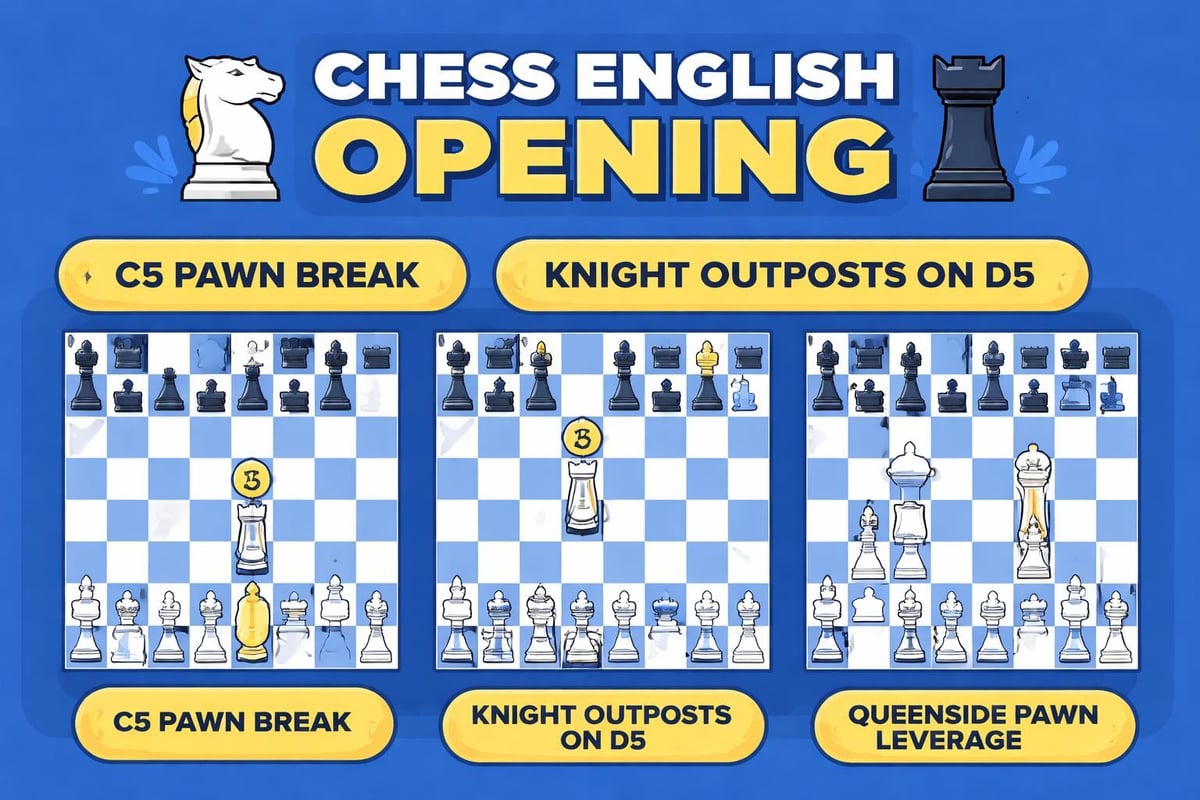
In many English structures, White's thematic break is c4-c5, especially when Black has played ...d6. This advance can:
- Gain space on the queenside
- Prepare b4 and a minority attack
- Create tactical opportunities if Black's pieces are poorly placed
- Force weaknesses in Black's pawn structure
Knight Jumps to d5
Watch for opportunities to plant a knight on d5. In the chess English opening, this central outpost often becomes available because you're controlling it with the c4 pawn rather than occupying d4 with a pawn. A knight on d5 can be remarkably strong, especially when supported by other pieces.
Queenside Pawn Storms
The move b2-b4 appears in numerous English variations. Sometimes it's preparing b5 to clamp down on Black's queenside. Other times it's creating space for the rooks. Understanding when to push b4 versus when to keep flexibility is one of those judgement calls that separates strong English players from beginners.
Practical Middlegame Plans
Theory only gets you so far. What happens when you're past move fifteen and facing a unique position? The chess English opening teaches you to think in terms of pawn structures and piece placement rather than specific move sequences.
Hedgehog Structures
One fascinating structure that arises is the Hedgehog, where Black plays ...a6, ...b6, ...d6, and ...e6, creating a flexible but somewhat passive setup. As White, you need to build pressure gradually:
- Control the centre squares d5 and e5
- Prevent Black's liberating ...b5 and ...d5 breaks
- Manoeuvre pieces to optimal squares
- Only then consider pawn breaks
The strategic insights on the English Opening explain how to handle these positions with patience rather than forcing premature action.
Maroczy Bind Positions
Sometimes the chess English opening transforms into a Maroczy Bind structure (pawns on c4 and e4 versus Black's ...e6 and ...c5). This gives White significant space and restricts Black's minor pieces. Your plan involves:
- Maintaining the bind with careful piece placement
- Preparing a timely d4 or f4 break
- Creating threats on both flanks
- Converting your space advantage into concrete gains
| Position Type | White's Advantage | Key Squares to Control |
|---|---|---|
| Hedgehog | Space and flexibility | d5, e5, c5 |
| Maroczy Bind | Space restriction | d5, d6, f5 |
| Symmetrical | Improved piece coordination | d5, central files |
Common Mistakes to Avoid
Even experienced players stumble when first adopting the chess English opening. Here are the pitfalls you need to sidestep.
Playing Too Passively
Just because the English is a positional opening doesn't mean you can drift aimlessly. You still need concrete plans. Developing pieces without purpose leads to positions where Black equalises comfortably and you've surrendered your first-move advantage.
Ignoring Pawn Breaks
Every pawn structure has critical breaks: d4, e4, f4, or b4 for White. If you never execute these breaks, you're playing without ambition. The skill lies in knowing when to break, not if.
Misunderstanding Transpositions
The chess English opening's transpositional nature is both a strength and a trap. You might think you're playing an English only to find yourself in a Queen's Gambit where you don't know the theory. Understanding which transpositions to allow and which to avoid requires experience and study.
Similar to considerations when exploring the difficulty of the English opening, you need to assess your comfort level with the resulting positions.
Neglecting King Safety
Fianchettoing your king's bishop is common in the English, but don't assume your king is automatically safe. Black can generate kingside attacks, particularly in Reversed Sicilian structures. Castle early and stay alert to tactical threats.
Building Your Opening Repertoire
So you've decided to add the chess English opening to your arsenal. How should you structure your study to get maximum benefit with minimum memorisation?
Start with One System
Rather than trying to learn responses to every Black setup simultaneously, choose one main line and master it thoroughly. I recommend starting with the Symmetrical English (1.c4 c5) because:
- It's Black's most popular response
- The resulting positions teach you strategic thinking
- You'll face it frequently in tournament play
- The concepts transfer to other variations
Once you're comfortable with the symmetrical structures, branch out to the Reversed Sicilian and other systems.
Use the Right Resources
Quality study materials make all the difference. The detailed analysis at Chesscul provides historical context and variation explanations that help you understand why moves are played, not just what moves to play.
For practical learning, consider resources that focus on plans over variations. The Chess Cheat Sheets approach to streamlined guides can help you grasp key concepts without drowning in theoretical lines.
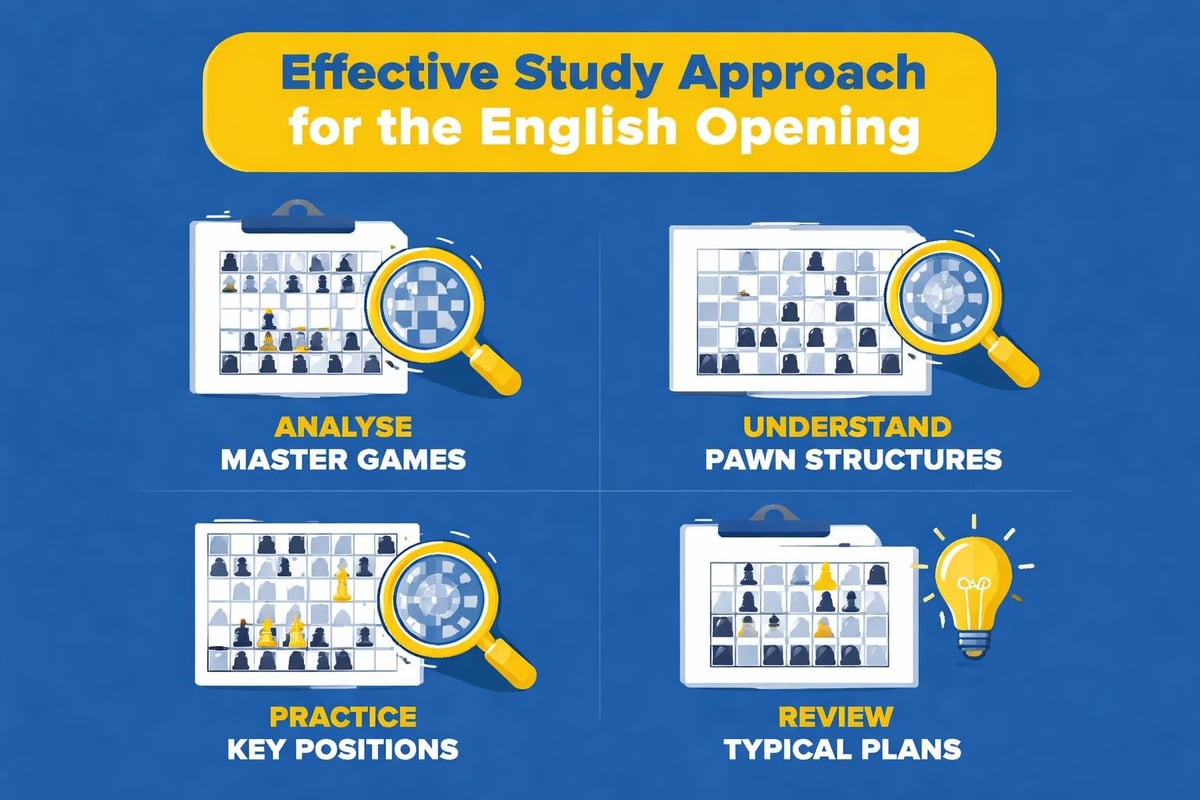
Study Master Games
Watching how strong players handle the chess English opening reveals patterns you won't find in theory books. Look for games by:
- Garry Kasparov (who used the English frequently)
- Mikhail Botvinnik (pioneered many systems)
- Magnus Carlsen (employs it for flexible positions)
- Vladimir Kramnik (demonstrated its drawing potential and winning chances)
Don't just replay moves-pause at critical moments and ask yourself what plan you'd choose.
Adapting to Your Opponent's Style
One of the chess English opening's greatest strengths is its adaptability. You can steer positions towards complexity or simplicity based on your opponent's preferences and weaknesses.
Against Aggressive Players
If your opponent loves tactical complications and sharp positions, the English's solid structure gives you a stable base to absorb their aggression. You can:
- Maintain a sound pawn structure
- Trade pieces when appropriate
- Avoid unnecessary complications
- Convert to favourable endgames
Against Positional Players
When facing someone who excels in slow manoeuvring games, you can use the English to create imbalances:
- Accept isolated pawns for piece activity
- Create pawn weaknesses in their camp
- Generate play on multiple flanks simultaneously
- Avoid symmetrical positions that lead to sterile equality
Tournament Considerations
In a must-win situation, the chess English opening offers practical winning chances without excessive risk. The positions remain rich enough that your opponent must navigate accurately. For tournament players, this balance between ambition and safety proves invaluable.
Conversely, when you need a draw against a higher-rated opponent, steering towards symmetrical English positions can frustrate their winning attempts whilst keeping the position balanced.
Intermediate-Level Refinements
Once you've grasped the basics, these advanced concepts will elevate your English opening play to the next level.
Move Order Nuances
The sequence of moves matters enormously. Playing 2.Nc3 before 2.Nf3 keeps more options open but allows Black different setups. These subtle distinctions affect which variations you'll face.
For example:
- 1.c4 Nf6 2.Nc3 allows 2...d5, reaching certain Queen's Gambit structures
- 1.c4 Nf6 2.Nf3 prevents some of Black's options but commits White earlier
Handling Unusual Responses
What about 1.c4 f5 or 1.c4 b6? These offbeat replies require understanding rather than memorisation. Apply general principles:
- Develop sensibly
- Control central squares
- Don't overreact to strange-looking moves
- Maintain flexibility in your pawn structure
The encyclopaedic coverage at Wikipedia catalogs many of these unusual variations with their ECO codes and historical context.
Integration with Your Overall Repertoire
Your opening choices should complement each other. If you play the Italian Game with 1.e4, adding the chess English opening as your 1.c4 weapon creates a well-rounded repertoire. Both openings reward strategic understanding over tactical sharpness, so your skills transfer between them.
Similarly, understanding the reversed nature of some English positions helps if you play the Sicilian Defence as Black. The strategic concepts mirror each other, just with colours reversed.
Training Exercises to Improve
Knowledge without practice remains theoretical. Here's how to transform your English opening understanding into practical results.
Position-Based Training
Rather than memorising opening lines, practice typical middlegame positions that arise from the chess English opening. Set up positions from move fifteen onwards and practice finding the best plans. This approach, similar to the methodology behind quality chess puzzles, develops your intuition.
Analyze Your Own Games
Every game you play with the English is a learning opportunity. After each game:
- Identify the pawn structure that emerged
- Determine if you executed appropriate plans
- Note where you deviated from principles
- Record successful ideas for future use
Thematic Game Analysis
Study complete games featuring specific English structures. For instance, spend a week analyzing only Hedgehog positions, then move to Maroczy Bind structures. This focused approach builds pattern recognition faster than random game study.
Comparative Study
Compare how different openings reach similar structures. Understanding that certain Caro-Kann positions can arise from English move orders expands your theoretical knowledge and helps you recognize transpositions.
Psychological Advantages
Beyond the board, the chess English opening offers psychological benefits that improve your practical results.
Dictating the Game Type
By choosing 1.c4, you're making a statement about the game you want to play. Most opponents prepare extensively against 1.e4 and 1.d4 but have less deep preparation against the English. This preparation gap often works in your favour.
Comfort Zone Disruption
Players who exclusively face 1.e4 or 1.d4 often feel uncomfortable against the English. The positions look different, the pawn structures are unfamiliar, and their standard plans don't apply. This psychological discomfort leads to mistakes.
Confidence Through Understanding
When you understand an opening's strategic foundation rather than memorising lines, you play with greater confidence. That confidence translates to better decision-making, especially in time trouble.
The strategic guide at Simplify Chess emphasizes this conceptual understanding over rote memorization, which aligns perfectly with sustainable improvement.
The chess English opening rewards players who value flexibility, strategic depth, and practical results over forcing tactical complications. By controlling the centre from the flanks and maintaining adaptable pawn structures, you'll find yourself comfortable in a wide range of middlegame positions. Whether you're looking to expand beyond 1.e4 or searching for a reliable main weapon as White, the English deserves serious consideration. Ready to master this sophisticated opening system without spending months on theoretical study? Chess Cheat Sheets provides streamlined guides and resources specifically designed to help you understand the English opening's key concepts and typical plans, allowing you to play confidently and improve efficiently.


