

You've probably noticed chess popping up everywhere lately. Maybe you caught a few episodes of a chess drama, or perhaps you've seen colleagues playing online during lunch breaks. Whatever sparked your interest, you're now considering taking the plunge into formal chess education. But here's the thing: chess classes for adults aren't just about learning how pawns move. They're about challenging yourself, meeting like-minded people, and developing skills that translate far beyond the 64 squares. Let's explore what adult chess classes can offer you in 2026 and how to find the perfect fit for your lifestyle.
Why Adults Are Flocking to Chess Classes in 2026
Have you wondered why so many adults are picking up chess later in life? The reasons go far beyond simple entertainment.
Chess offers something increasingly rare in our digital age: sustained, focused thinking. When you're calculating variations three or four moves deep, your mind isn't wandering to notifications or emails. Chess4SuccessLA highlights how chess can sharpen the mind and potentially reduce cognitive decline, making it particularly appealing for adults looking to maintain mental agility.
The Brain Benefits You'll Actually Notice
Let's get specific about what happens when you commit to regular chess practice:
- Enhanced pattern recognition that helps you spot opportunities faster
- Improved decision-making under pressure
- Better concentration that carries over into work and personal life
- Increased patience when solving complex problems
- Stronger memory for sequences and positions
Research continues to support what chess players have known for centuries. The game genuinely works your brain like a muscle. But unlike solitary puzzles, chess classes for adults provide structure, accountability, and immediate feedback that accelerates your improvement.
What to Expect from Modern Chess Classes for Adults
Gone are the days when chess instruction meant dusty books and silent study halls. Today's adult chess education has evolved dramatically.
Most contemporary programs recognise that you're not a blank slate. You've got life experience, pattern recognition skills from your career, and probably some chess knowledge from childhood. Quality instructors build on these foundations rather than treating you like a complete beginner.
Class Formats That Fit Your Schedule
One of the biggest advantages of learning chess as an adult in 2026 is flexibility. Here's what's typically available:
| Format | Duration | Best For | Typical Cost Range |
|---|---|---|---|
| Weekly Group Classes | 1-2 hours | Social learners, consistent schedule | £15-40 per session |
| Private Lessons | 45-60 minutes | Rapid improvement, specific goals | £40-100+ per hour |
| Weekend Workshops | Half-day or full-day | Intensive learning, specific topics | £80-200 per workshop |
| Online Courses | Self-paced | Busy schedules, remote learners | £20-150 monthly |
The U.S. Chess Academy discusses how online classes offer particular convenience for adults managing busy lifestyles, allowing you to learn from top instructors regardless of location.
Finding the Right Chess Class for Your Level
Here's where many adults stumble. You might think you're a beginner, but perhaps you remember the rules and just need strategic guidance. Or maybe you've played casually for years and need serious tournament preparation.
Assessing Your Starting Point
Before signing up for chess classes for adults, honestly evaluate where you stand:
- True Beginner: You know piece movements but little else
- Casual Player: You've played games but don't study openings or tactics
- Club Player: You understand basic strategy and want competitive improvement
- Advanced Amateur: You're rated and seeking specific weaknesses to address
The Saint Louis Chess Club provides resources tailored for adult learners at all these levels, making it easier to find your appropriate starting point.
If you're in categories 2-4, you'll benefit tremendously from structured opening study. Resources like the Caro-Kann Defense guide can complement your class learning, giving you concrete opening repertoires to practice.

The Curriculum: What You'll Actually Learn
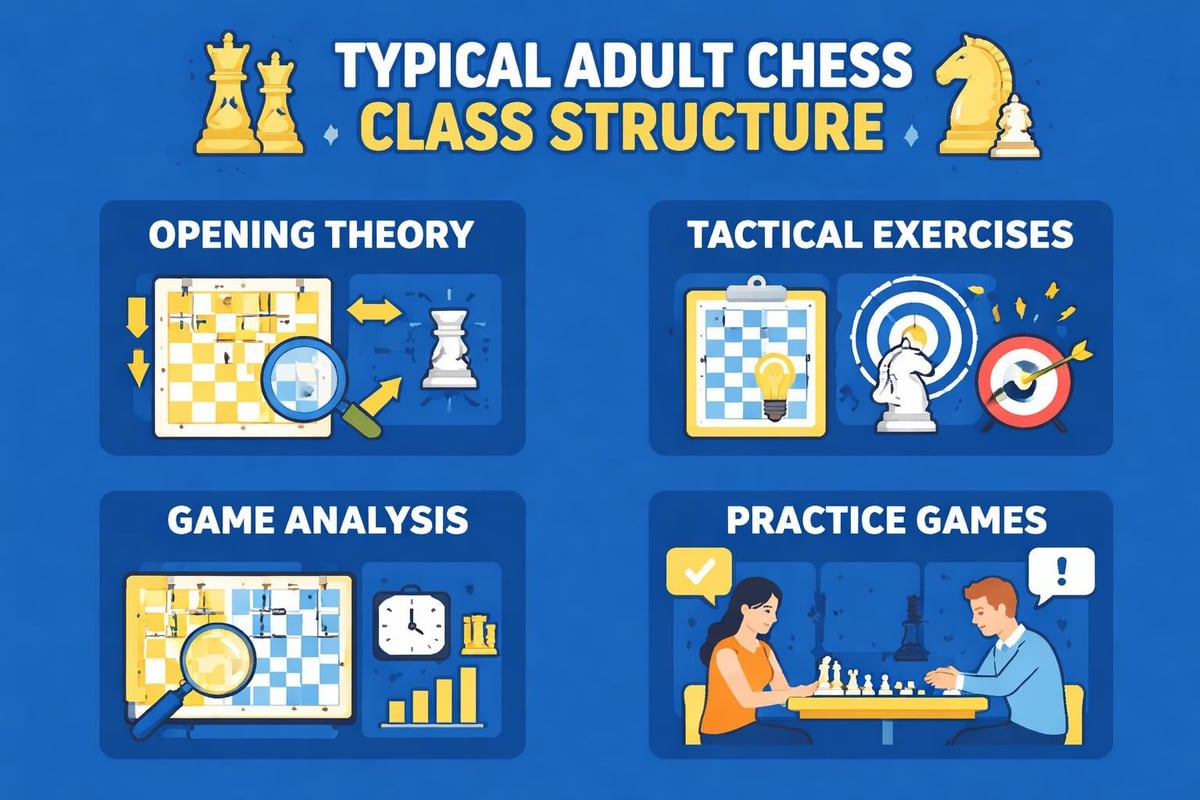
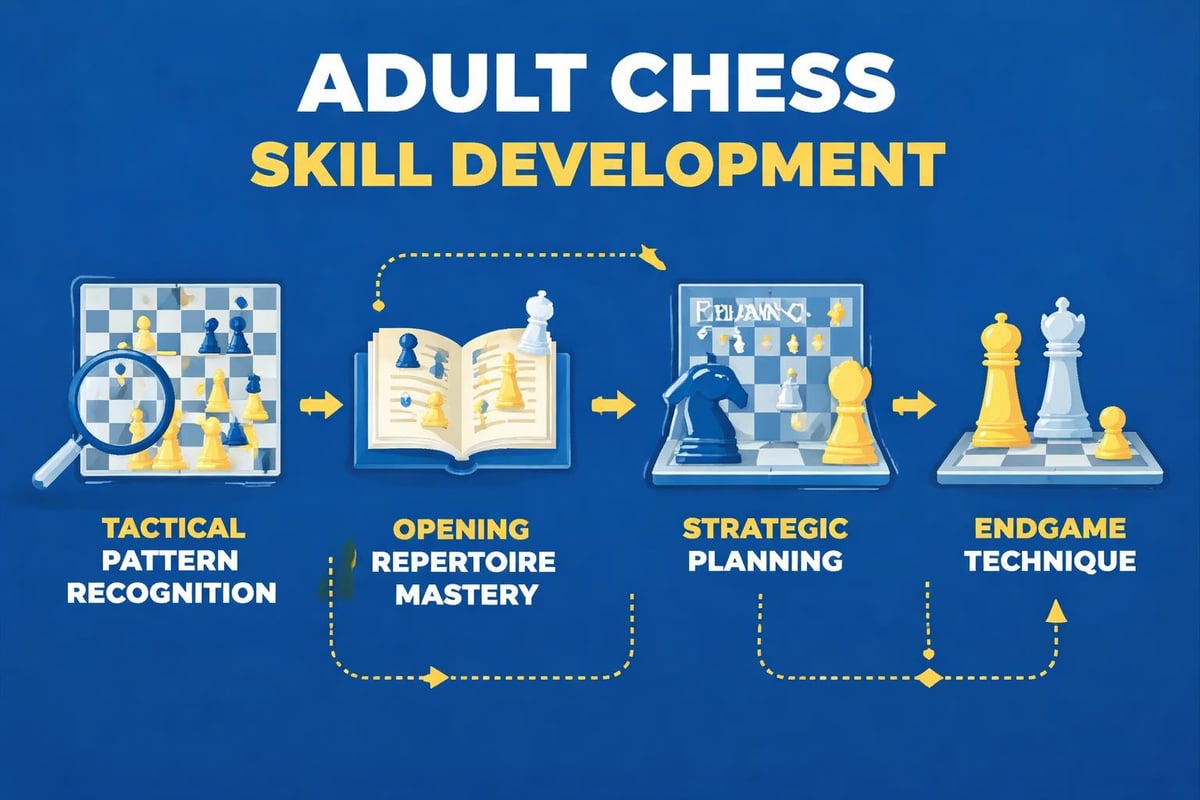
Quality chess classes for adults follow a structured progression, though the exact path varies by instructor and format.
Core Components of Adult Chess Education
Opening Principles and Repertoire Building
Most adult programs dedicate significant time to openings. Why? Because having a solid repertoire boosts confidence immediately. You'll learn:
- Fundamental opening principles (development, centre control, king safety)
- One or two complete systems as White
- Defences against common White openings
- How to handle surprise moves without panicking
Understanding the most common chess openings helps you recognise what you're facing and respond appropriately.
Tactical Training
This is where chess gets exciting. Tactics are the short-term combinations that win material or deliver checkmate:
- Pins, forks, skewers, and discovered attacks
- Mating patterns and combinations
- Calculating forcing sequences
- Recognising when tactics exist in positions
Strategic Understanding
Strategy is your long-term planning. Adult learners often excel here because life experience translates well:
- Pawn structure evaluation
- Piece activity and coordination
- Creating and exploiting weaknesses
- Transitioning between game phases
Endgame Fundamentals
Many games reach simplified positions where technique matters. You'll cover:
- Basic checkmates (king and queen, king and rook)
- Pawn endgames and key squares
- Rook endgames principles
- Theoretical positions every player should know
In-Person vs Online: Which Works Better for Adults?
This might be the biggest decision you'll make. Both formats have passionate advocates, and honestly, the best choice depends entirely on your circumstances.
In-Person Classes: The Traditional Approach
There's something special about moving physical pieces across a board. The U.S. Chess Center offers instructional classes that emphasise the social and confidence-building aspects of face-to-face learning.
Advantages of in-person learning:
- Immediate, nuanced feedback on your thought process
- Natural social connections with fellow students
- No technical issues interrupting your flow
- Physical board helps some learners visualise better
Potential drawbacks:
- Geographic limitations on instructor quality
- Fixed schedules that might clash with work
- Commute time added to lesson time
- Typically higher costs overall
Online Learning: The Modern Alternative
Online chess education has exploded in quality and accessibility. Chesscul offers online chess lessons specifically designed for adults at all levels, with structured teaching systems.
Why online works brilliantly for many adults:
- Access to top instructors worldwide
- Flexible scheduling, including odd hours
- Often more affordable than in-person options
- Easy to review recorded sessions
- Digital tools enhance tactical training
The challenges:
- Requires self-discipline and motivation
- Screen fatigue if you work on computers all day
- Slightly less personal connection
- Technical requirements and occasional glitches
Many successful students combine both approaches, taking occasional in-person workshops whilst maintaining regular online study.
Maximising Your Learning Between Classes
Here's a secret: what you do between chess classes for adults matters more than the classes themselves. Think of classes as your map and compass, but you've still got to walk the path.
Creating Your Personal Practice Routine
Your instructor will assign homework, but effective students go further:
- Play regularly (at least 2-3 games per week)
- Analyse your losses without the engine initially, then check
- Solve tactical puzzles daily (even just 10-15 minutes)
- Review your opening repertoire weekly
- Study master games in your openings
The chess puzzles collection offers targeted practice that complements formal instruction, helping you recognise tactical patterns faster.
Building Your Chess Library
You don't need dozens of books, but a few quality resources accelerate progress. Consider:
| Resource Type | Purpose | Examples |
|---|---|---|
| Opening Guides | Build solid repertoire | Italian Game guide |
| Tactic Books | Pattern recognition | 1001 Chess Exercises for Beginners |
| Strategy Primers | Understanding plans | Amateur's Mind by Jeremy Silman |
| Endgame Manuals | Technical skill | Silman's Complete Endgame Course |
Chess House provides comprehensive learning resources suitable for adult beginners and intermediate players, including both physical and digital materials.
Common Challenges Adults Face (And How to Overcome Them)
Let's be honest about the obstacles you'll encounter. Knowing them ahead of time helps you push through.
The Time Constraint Reality
You're juggling work, family, possibly ageing parents, and trying to maintain some semblance of social life. Where does chess fit?
The solution isn't finding more time; it's using existing time better. Could you solve a few tactics puzzles during your commute? Play a 10-minute game during lunch? Review an opening line whilst dinner cooks?
Learn Chess Easily provides tailored experiences for adults, offering flexible schedules that acknowledge your packed life.
The "I'm Too Old to Improve" Myth
You'll have this thought. Everyone does. Here's the truth: while you probably won't become a grandmaster if you start at 35, you can absolutely reach club-player strength and derive immense satisfaction from the game.
Adults bring advantages that children lack:
- Better focus and discipline
- Superior strategic thinking from life experience
- Stronger motivation (you chose this, unlike kids dragged to lessons)
- More realistic expectations and patience
Handling Losses and Frustration
Chess is humbling. You'll lose games you "should" have won. You'll miss tactics a beginner could spot. This happens to everyone.
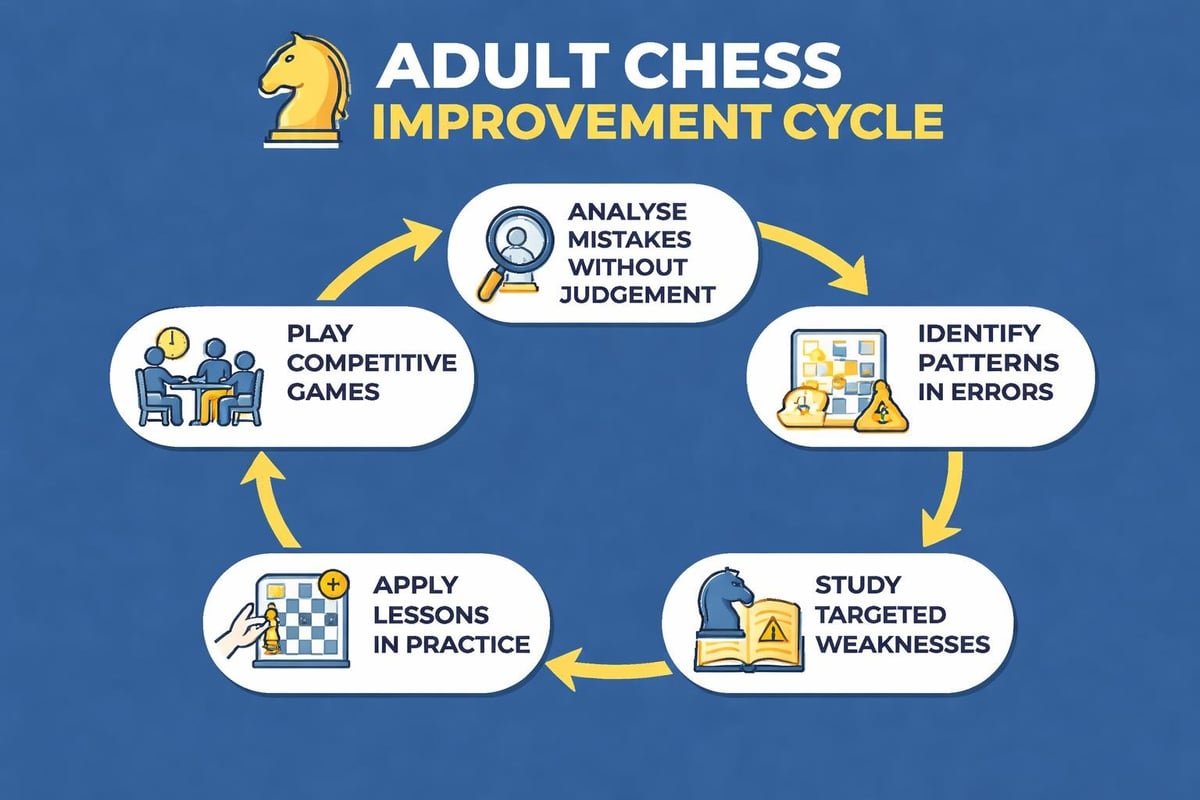
The key is reframing losses as data. Each mistake reveals something you didn't understand. When you blunder, you've identified exactly what to study next. That's not failure; that's efficient learning.
Choosing the Right Instructor or Program
Not all chess classes for adults are created equal. The instructor matters enormously, perhaps more than the format or curriculum.
What Makes a Great Adult Chess Teacher
Look for these qualities:
- Patience with adult learning speeds (you might need concepts explained differently than children)
- Clear communication without excessive jargon
- Structured curriculum that builds logically
- Willingness to adapt to your goals and interests
- Encouraging attitude that celebrates incremental progress
ChessCat Studios offers personalised coaching specifically for adults, focusing on the unique needs of mature learners.
Questions to Ask Before Enrolling
Don't be shy about interviewing potential instructors:
- What's your typical adult student's rating improvement over six months?
- How do you structure lessons for working professionals?
- Can I see a sample curriculum or lesson plan?
- What materials or resources will I need to purchase?
- How do you handle students at different levels in group classes?
- What's your policy on missed sessions or rescheduling?
Many quality programs offer a trial lesson or money-back guarantee. Take advantage of these to ensure the fit feels right.
The Social Side of Adult Chess Classes
One unexpected benefit you'll discover: the chess community is remarkably welcoming to adult learners.
Building Connections Through Chess
Your classmates will become practice partners, friends, and sometimes lifelong chess rivals in the best sense. You'll find yourself discussing variations over coffee, arranging weekend blitz sessions, and attending tournaments together.
The United States Chess Federation provides information on local clubs and tournaments where you can connect with players beyond your immediate class.
Joining the Wider Chess World
As you progress, you'll want to expand beyond classes:
- Local chess clubs for regular casual play
- Online communities for sharing games and analysis
- Weekend tournaments when you're ready for competition
- Chess cafés or meetups in many cities
The connections you make through chess often extend beyond the board. You'll meet people from diverse backgrounds united by their love of the game.
Setting Realistic Goals for Your Chess Journey
What does success look like for you? Be specific. Vague goals like "get better" don't provide direction.
Short-Term Goals (3-6 Months)
These should be achievable and measurable:
- Learn one complete opening system as White and one defence as Black
- Solve 500 tactical puzzles (roughly 3-4 daily)
- Play 30 rated games
- Reduce blunders by half (you'll track this through analysis)
- Learn three essential endgames
Medium-Term Goals (6-12 Months)
As you progress, aim higher:
- Achieve a specific rating milestone (perhaps 1200 or 1400)
- Win your first rated game against a higher-rated opponent
- Complete a chess course or book thoroughly
- Participate in your first over-the-board tournament
- Develop a secondary opening repertoire
Resources like the London System chess opening guide can help you expand your repertoire systematically.
Long-Term Vision (1-2 Years)
Where do you see your chess in the bigger picture?
- Join your local chess club's competitive team
- Achieve a rating that places you in the top quartile of adult learners
- Teach chess basics to friends or family
- Attend a chess holiday or training camp
- Simply maintain the game as a lifelong cognitive exercise
Your goals will evolve as you improve. What seemed impossible in month one becomes routine by month twelve.
Investing in Your Chess Education: What's It Worth?
Let's talk money. Chess classes for adults represent a financial commitment, and you deserve to know what you're getting for your investment.
Typical Costs and Value Proposition
Here's what you might spend on chess education:
- Group classes: £500-1,200 annually for weekly sessions
- Private instruction: £1,600-4,000+ annually (assuming twice monthly)
- Online platforms: £200-600 annually
- Books and materials: £100-300 initially, less ongoing
- Tournament entries: £15-40 per event
Compare this to other hobbies. Golf? Easily £2,000+ annually. Gym membership you barely use? £400-600. Regular restaurant dinners? Far more.
Chess offers exceptional value because the skills compound. Unlike consumable entertainment, every hour invested makes the next hour more rewarding. Plus, you can play for free online forever once you've learned.
Free and Low-Cost Alternatives
If budget is tight, you've got options. Many strong players developed primarily through:
- Free online resources and video content
- Free chess books and PDFs available digitally
- Playing against engines with analysis
- Online forums and communities
- Occasional workshops rather than ongoing classes
The chess resources guide compiles many free and affordable options for serious learners.
However, structured chess classes for adults provide accountability, personalised feedback, and accelerated progress that's difficult to replicate alone.
Common Mistakes Adult Chess Students Make
Let's save you some headaches by addressing the pitfalls others have already discovered.
Mistake #1: Collecting Openings Like Trading Cards
You'll be tempted to learn dozens of openings. Resist. Master one or two systems deeply rather than knowing ten superficially. The Caro-Kann mistakes guide shows how even a single opening has depth worth exploring.
Mistake #2: Neglecting Tactics for "Deep Strategy"
Strategy feels sophisticated and adult. Tactics seem basic. But here's reality: tactics win games at every level below master. Spend at least 30% of your study time on tactical exercises.
Mistake #3: Playing Without Analysing
Playing game after game without reviewing them is like running on a treadmill. You're active but not going anywhere. After each game, spend at least 10 minutes asking: where did the game turn? What did I miss? What patterns appeared?
Mistake #4: Comparing Yourself to Prodigies
You'll see stories about eight-year-olds defeating masters. Ignore them. Your competition is the player you were last month. Are you improving? That's what matters.
Mistake #5: Giving Up After Initial Frustration
The first three months are hardest. You're learning a new language essentially. Many adults quit right before the breakthrough moment when patterns start clicking. Push through this period.
Tailoring Chess Study to Your Professional Background
Your career has shaped how you think. Use this to your advantage in chess classes for adults.
Engineers and Technical Professionals
You'll excel at calculating variations and understanding concrete tactics. Challenge yourself to develop intuition and positional judgement, which may feel less comfortable initially.
Creative Professionals
Your pattern recognition and unconventional thinking are assets. Focus on learning fundamental tactics and avoiding unsound sacrifices. Channel creativity within sound strategic frameworks.
Business and Management Professionals
You understand strategy, resource allocation, and long-term planning. Apply these concepts directly to chess. You might particularly enjoy positional play and manoeuvring.
Teachers and Trainers
You'll quickly grasp chess concepts when explained well. Consider how you might eventually teach others, as explaining concepts deepens your own understanding.
Your instructor should adapt to your learning style. If they can't, find one who will.
The Road Ahead: Your Chess Future
Starting chess classes for adults in 2026 puts you at an exciting time in chess history. The game has never been more accessible, communities have never been more welcoming, and resources have never been more abundant.
Will you become a master? Probably not, and that's perfectly fine. Will you develop a skill that challenges your mind, connects you with interesting people, and provides lifelong enjoyment? Absolutely, if you commit to the journey.
The best time to start was ten years ago. The second best time is today. Your first class, first game, and first victory are waiting. All you need to do is make the move.
Whether you're just beginning your chess journey or looking to break through a plateau, the right combination of structured instruction and quality resources makes all the difference. Chess classes for adults provide the guidance and accountability you need, whilst supplementary materials reinforce those lessons between sessions. Chess Cheat Sheets offers comprehensive guides, opening toolkits, and tactical puzzles designed specifically for adult learners who want to improve efficiently without drowning in theory. Ready to complement your formal instruction with resources that actually make sense? Explore what Chess Cheat Sheets can add to your chess education today.


