Finding the right chess book for intermediate players can feel overwhelming, especially with so many new releases and classic titles available in 2026. If you’re stuck between beginner basics and advanced strategies, you know how vital it is to choose resources that truly help you improve.
This article is designed to guide you through the best choices, spotlighting seven top books that stand out for their practical value, modern insights, and proven results. You’ll discover what makes each chess book for intermediate learners unique, and how these recommendations can help you break through plateaus and reach the next level. Ready to explore your next move? Dive into our expert picks below.
Why the Right Chess Book Matters for Intermediate Players
Choosing the right chess book for intermediate players can feel overwhelming, especially with so many new titles and resources available in 2026. If you're stuck at a certain level and wondering why progress is so hard, you're not alone. Let's break down why finding a targeted chess book for intermediate is crucial for your chess journey.
Understanding the Needs of Intermediate Players
If your chess rating sits between 1200 and 2000 ELO, you are in the classic intermediate range. At this stage, many players hit the infamous "plateau," where progress stalls despite hours of play. The typical challenges? A lack of structured training, limited understanding of deeper strategy, and the feeling that beginner books just don't cut it anymore.
Maybe you've mastered basic tactics, but now struggle to find resources that truly push your skills forward. According to this chess improvement plateau at 1200–1400 Elo article, many intermediate players experience slow improvement unless they switch to more advanced, focused materials. This is exactly where a chess book for intermediate comes into play, offering the next level of insight and training.
Key Criteria for Selecting Chess Books in 2026
Not every chess book for intermediate is created equal, and the best ones in 2026 share some key features. First, you want up-to-date content that reflects how modern chess engines and trends shape the game. Algebraic notation is a must, since descriptive notation is outdated and confusing.
Look for books with:
- Clear diagrams on almost every page
- Practical exercises that test your understanding
- Balanced coverage: calculation, positional play, endgames, and annotated games
A chess book for intermediate should challenge you without overwhelming you, offering a mix of instruction and opportunity to practice what you learn.
How Books Complement Digital Tools and Online Training
Books might seem "old school," but they work best when paired with today's digital chess tools. Think of a chess book for intermediate as your map, while online resources are the terrain where you test your skills. Many players use books to build a strong foundation, then reinforce that knowledge with puzzles, databases, and online games.
For example, you might study an endgame chapter, then practice those positions using an online chess engine or play through related exercises. This blend of book learning and digital practice is the secret sauce for steady improvement, especially for intermediate players.
The Impact of a Good Chess Book: Case Studies & Data
Does reading a chess book for intermediate really make a difference? Data suggests yes. Surveys show that club players who consistently study recommended books improve their ELO faster than those relying solely on online play. Coaches often share stories of students who made breakthroughs after tackling classics like "How to Reassess Your Chess" or "Think Like a Grandmaster."
Even as chess evolves, the best books remain relevant, bridging the gap between basic skills and advanced mastery. A well-chosen chess book for intermediate is more than a resource—it can be a turning point in your chess journey.
Top 7 Chess Books for Intermediate Players in 2026
Struggling to find the perfect chess book for intermediate improvement? You’re not alone. With so many options in 2026, it’s easy to feel lost in a sea of classic and modern titles. Let’s break down the seven best choices, each offering a unique path forward for your chess journey.
Chess Cheat Sheets – Ultimate Chess Mastery Bundle
If you want a chess book for intermediate study that skips the fluff and gets right to the action, the Ultimate Chess Mastery Bundle is a standout. Priced flexibly, you can grab bundles or opt for lifetime access, and there are even select free resources like the Scandinavian Defense Toolkit.

What makes this resource unique? Unlike a traditional chess book for intermediate learners, it delivers visual cheat sheets, opening toolkits, endgame guides, and over 1.5 million puzzles. The plug-and-play format is perfect if you crave rapid improvement without memorizing endless prose.
You’ll enjoy instant digital delivery, global accessibility, and a comprehensive approach to all phases of the game. Beginners and intermediates alike find it time-efficient and effective, with thousands of fans worldwide. You can even sample high-value tools for free.
One thing to note: This isn’t a classic chess book for intermediate players who love deep dives into prose. If you’re looking for visual learning, practical focus, and an all-in-one resource that covers openings, tactics, and endgames, this bundle is hard to beat. Want to explore more digital resources? Check their Ultimate Chess Mastery Bundle for a hands-on learning experience.
How to Reassess Your Chess (4th Edition) – Jeremy Silman
Looking for a chess book for intermediate players ready to move beyond the basics? Silman’s classic, usually priced between $25 and $35, is a club-level favorite.
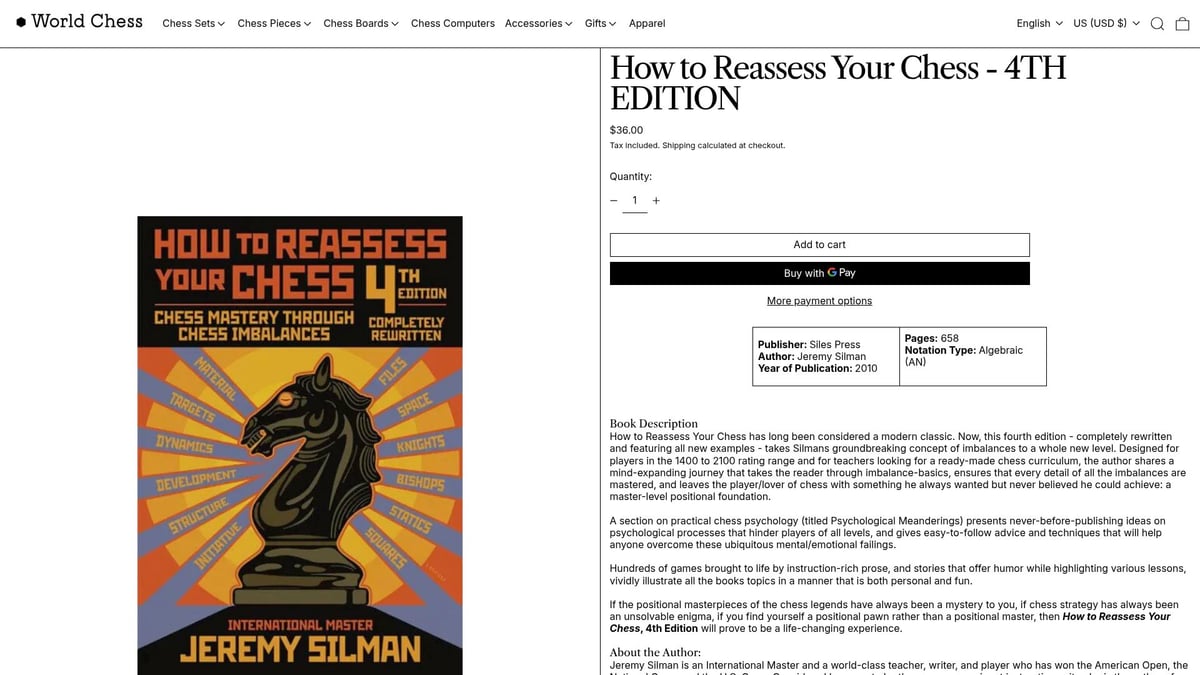
Silman’s “imbalances” framework gives you the tools to evaluate positions and plan effectively. It’s packed with practical advice, actionable exercises, and clear explanations. Many players find this chess book for intermediate improvement transforms the way they approach strategy and planning.
While it doesn’t focus much on openings or endgames, the depth of positional understanding you’ll gain is worth the multiple readings it may require. Coaches and masters consistently recommend this book for its unique approach.
Pros:
- Clear, actionable advice
- Exercises that apply to real games
Cons:
- Limited on openings/endgames
- May need several passes for full benefit
If your goal is to break plateaus and develop a strategic edge, this chess book for intermediate learners is a must-have.
Grandmaster Preparation: Calculation – Jacob Aagaard
When it comes to sharpening tactical vision, Aagaard’s book stands out as a top chess book for intermediate and advanced players (typically ELO 1600+). At $30 to $40, it’s a serious investment in your calculation skills.
Inside, you’ll find advanced exercises, structured problem sets, and detailed solutions that teach you disciplined thinking under pressure. This chess book for intermediate improvement is not for the faint of heart, but the results speak for themselves.
Pros:
- Deep and challenging content
- Proven to boost calculation
Cons:
- Too advanced for lower intermediates
- Requires dedicated study time
Part of a respected training series, many titled players use this chess book for intermediate and beyond to push their tactical boundaries. If you’re ready to put in the work, your calculation skills will thank you.

Chess Structures: A Grandmaster Guide – Mauricio Flores Rios
Ever feel lost in the middlegame? This chess book for intermediate players focuses on 28 key pawn structures, giving you strategic plans and model games for each. Usually around $25 to $35, it’s a practical investment in your structural understanding.
You’ll learn how to handle common positions, spot plans, and avoid typical mistakes. The diagrams are clear, and the coverage spans a wide range of openings. If you’re a club player looking for a chess book for intermediate structure-based learning, this guide fills a major gap.
Pros:
- Immediately applicable concepts
- Wide opening coverage
Cons:
- Focused on structures, not tactics/endgames
Endorsed by grandmasters, this chess book for intermediate study is ideal if you want to improve your planning and middlegame confidence.
Think Like a Grandmaster – Alexander Kotov
For decades, this classic has been the chess book for intermediate and advanced students aiming to master calculation. Priced $20 to $30, Kotov’s work introduces the candidate moves method and the analysis tree—tools that help you think like a pro.
The writing is accessible, and the logical processes explained here have influenced generations of players. While some language may feel dated, and there’s little on modern openings, the core lessons in this chess book for intermediate skill-building are timeless.
Pros:
- Timeless calculation techniques
- Cited by world champions
Cons:
- Dated language in places
- Limited opening theory
If you want to avoid blunders and develop a disciplined mind, this is a foundational chess book for intermediate learners.
Endgame Strategy – Mikhail Shereshevsky
Many intermediate players overlook the endgame, but this chess book for intermediate study bridges the gap between theory and practice. At $25 to $35, Shereshevsky’s guide is packed with endgame principles, practical examples, and his famous “do not hurry” advice.
You’ll find real-world positions, clear structure, and advice that’s easy to follow. While it’s focused on endgames (with less on tactics or strategy), it’s often recommended as the best practical chess book for intermediate endgame mastery.
Pros:
- Practical, relatable examples
- Suitable for club and tournament play
Cons:
- Focused only on endgames
If you’re seeking a chess book for intermediate endgame improvement, this is the go-to resource.
My 60 Memorable Games – Bobby Fischer
Want to learn from a legend? Fischer’s classic, available for $20 to $30, is a chess book for intermediate players who love annotated games. Each game is packed with strategic insights and pattern recognition tips.
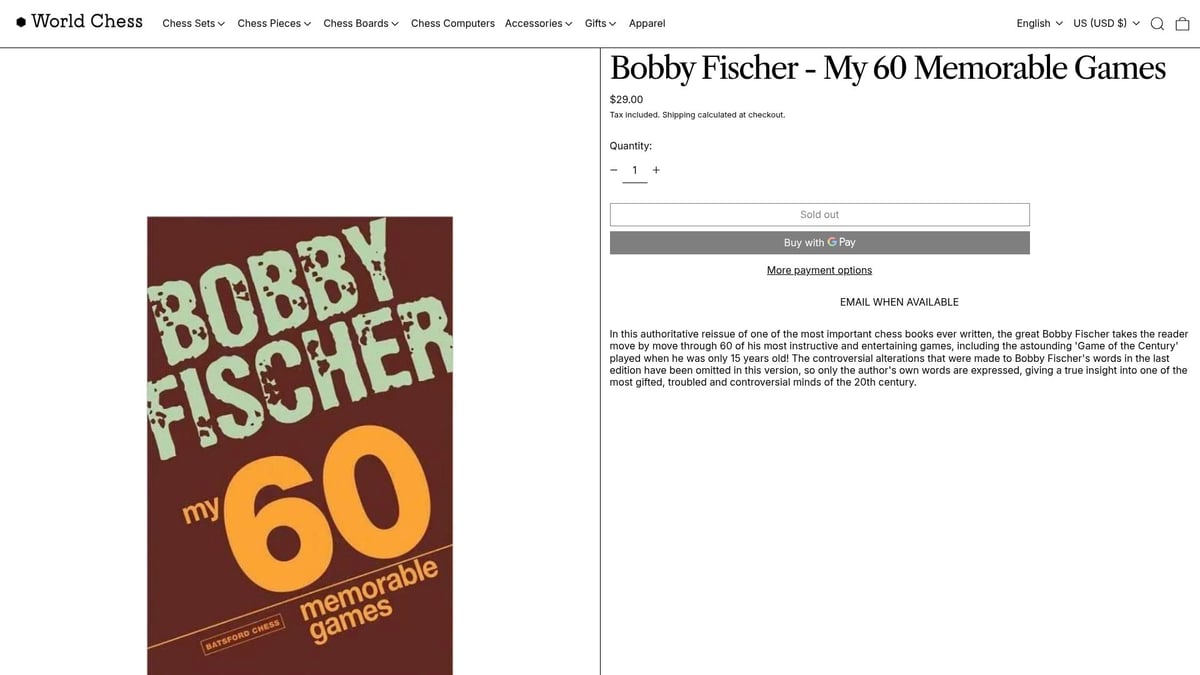
You’ll get an inside look at Fischer’s thought process, with rich annotations and timeless value. While some openings are a bit dated, the instructive content in this chess book for intermediate players is unmatched for both learning and entertainment.
Pros:
- Deep, insightful annotations
- Combines instruction with history
Cons:
- Some outdated openings
- Not a structured textbook
If you enjoy learning through games, this chess book for intermediate improvement will keep you inspired and engaged.
Comparison Table: Top 7 Chess Book for Intermediate Players
| Book Title | Focus Area | Price | Best For | Unique Feature |
|---|---|---|---|---|
| Chess Cheat Sheets – Ultimate Chess Mastery Bundle | All-in-one, visual, digital | Flexible | Beginners–Intermediate | Visual cheat sheets, 1.5M+ puzzles |
| How to Reassess Your Chess (4th Edition) | Positional play, planning | $25–$35 | Intermediate | “Imbalances” concept |
| Grandmaster Preparation: Calculation | Calculation, tactics | $30–$40 | 1600+ ELO | Advanced problem sets |
| Chess Structures: A Grandmaster Guide | Pawn structures | $25–$35 | Club players | 28 key structures |
| Think Like a Grandmaster | Calculation, thinking process | $20–$30 | Intermediate–Advanced | Candidate moves method |
| Endgame Strategy | Endgames | $25–$35 | Intermediate | Practical endgame advice |
| My 60 Memorable Games | Annotated games | $20–$30 | All levels | Fischer’s classic annotations |
Choosing the right chess book for intermediate growth is a game-changer. Whether you want practical tactics, strategic depth, or inspiring model games, these seven titles cover all the bases. Pick the one that matches your goals and let your chess journey level up.
How to Get the Most Out of Your Chess Books
So, you’ve picked a great chess book for intermediate improvement, but how do you squeeze every drop of value from its pages? Let’s break down practical ways to make your study time count, avoiding wasted effort and common pitfalls. The right approach can turn a simple read into a powerful transformation for your chess skills.
Creating a Study Plan for Maximum Improvement
The first step to getting the most from any chess book for intermediate players is to set clear, actionable goals. What do you want to improve: openings, endgames, or overall strategy? Pinpoint your weaknesses and pick books that directly address them.
Consistency beats intensity every time. Rather than cramming, carve out regular study slots each week. Even 20–30 focused minutes a day can move the needle. Mix your chess book for intermediate study with real games, both online and over-the-board, so you can apply new concepts right away.
If you want a ready-made routine, consider using an intermediate chess study plan to structure your journey. This can help you track progress and stay motivated.
Active Learning Techniques
Reading a chess book for intermediate players is just the beginning. To make learning stick, get hands-on. Set up positions from the book on a real chessboard. Physically moving the pieces helps your brain connect ideas with real play.
Before you peek at solutions, challenge yourself to write down your candidate moves and plans. This simulates tournament thinking and exposes gaps in your understanding. For tough positions, use spaced repetition: revisit key examples in your chess book for intermediate players every few days. Over time, patterns and principles will become second nature.
- Use a notebook to track mistakes and recurring themes.
- Summarize each chapter in your own words.
- Quiz yourself with flashcards for tricky endgame positions.
Combining Books with Digital Tools
You don’t have to choose between a chess book for intermediate skill and online resources. In fact, blending both is the secret sauce for faster improvement. After reading a chapter, hop onto a chess puzzle platform or database to reinforce the concepts.
Modern engines are excellent for checking your understanding, but don’t let them do all the thinking for you. Use them to verify your ideas after you’ve tried to solve a position. To keep your motivation high, log your results and track your rating gains. If you’re searching for quality online complements, check out the best websites to learn chess for practice and community support.
Common Mistakes to Avoid
It’s easy to fall into traps when studying a chess book for intermediate growth. One big mistake is reading passively, flipping pages without working through examples or playing out positions. Another is juggling too many books at once, which can scatter your focus and slow progress.
Don’t ignore endgames or positional play just because tactics feel more exciting. Balance is key. Avoid relying only on your memory—active engagement and real play are what cement your understanding from any chess book for intermediate learners.
Frequently Asked Questions: Chess Books for Intermediate Players
If you are searching for the best chess book for intermediate learners, you likely have a few burning questions before diving in. Let's tackle the most common ones to help you choose wisely and make the most of your study time.
What Makes a Chess Book Suitable for Intermediate Players?
When picking a chess book for intermediate learners, you want something that bridges the gap between basic tactics and deeper strategy. At this level, look for books with practical advice, annotated games, and exercises that challenge your growing skills. Clarity is key, so algebraic notation and readable diagrams make a huge difference.
You might also want to expand your opening repertoire. A resource like Every chess opening guide can complement your main book and help you stay current. Endorsements from coaches and titled players are a good sign that a chess book for intermediate use is both trusted and effective.
How Many Chess Books Should I Study at Once?
It is tempting to grab every chess book for intermediate players you can find, but less is often more. Stick to one or two books at a time, ideally focusing on different areas like strategy and endgames. This keeps your learning structured and prevents overwhelm.
Try to complete one section or chapter before moving to another. Rotating subjects, such as spending a week on tactics and then a week on positional play, can keep things fresh. Remember, steady progress beats frantic multitasking when it comes to mastering a chess book for intermediate study.
Are Classic Chess Books Still Relevant in 2026?
You might wonder if a classic chess book for intermediate readers is outdated. The truth is, many classics remain foundational, especially those by authors like Kotov or Fischer. Just make sure to pick editions with updated algebraic notation for easier reading.
However, supplementing classics with more recent books ensures you are learning openings and analysis influenced by modern engines. Combining time-tested wisdom with up-to-date content gives you the broadest perspective, making your chess book for intermediate study more effective and enjoyable.
Where Can I Buy These Chess Books?
Finding the right chess book for intermediate players is easier than ever. Major online retailers like World Chess Shop and Amazon offer both print and digital editions. Digital books are convenient for travel, while print editions make it easier to annotate and reference.
If you are looking for value or want to sample before buying, check out Free chess books for download. Bundles and special offers can also help you save money as you build your chess library. Whatever your preference, there is a chess book for intermediate needs waiting for you.
So, now that you’ve seen the best chess books for intermediate players in 2026, you’re probably wondering—what’s the fastest way to put all this new knowledge into action? I totally get it! The right resources can be a real game-changer, especially when you want efficient, practical improvement without the overwhelm. If you’re ready to boost your openings, tactics, and endgames with visual guides and plug-and-play resources (and maybe even skip a bit of memorization), why not check out the all-in-one bundle I mentioned? You can explore it here: Get The FULL Chess Mastery Bundle