

Starting a chess game with the white pieces gives you a significant advantage: the first move. But which opening should you actually play? Whether you're just starting out or looking to expand your repertoire, choosing from the best openings for white can feel overwhelming. There are hundreds of named variations, countless move orders, and endless strategic ideas to consider. Don't worry, though. In this guide, we'll break down the most effective openings for white players in 2026, helping you find the perfect match for your playing style and skill level.
Why Your Opening Choice Matters
You might be wondering: does it really make that much difference which opening I play? The short answer is yes, absolutely.
Your opening sets the entire tone for the game. It determines whether you're fighting for central control, launching an immediate attack, or building a solid positional foundation. The most popular openings used by top players have been refined over centuries, with each move backed by concrete strategic principles.
Think of your opening as a conversation starter. Some openings politely introduce themselves and slowly build rapport (like the Ruy Lopez), whilst others burst through the door demanding immediate attention (like the King's Gambit). The best openings for white share common features: they fight for the centre, develop pieces quickly, and create threats that Black must address.
Understanding Your Playing Style
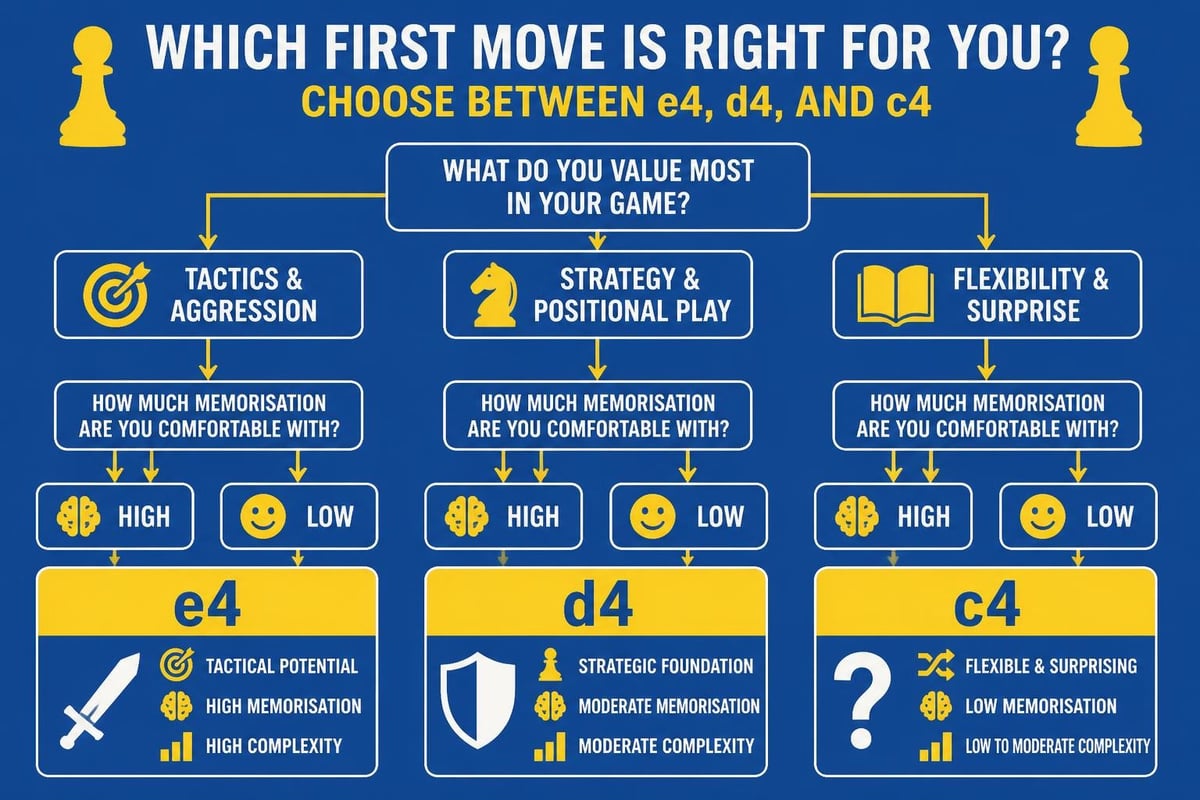
Before diving into specific openings, let's identify what kind of player you are. Do you thrive on tactical complications and sharp positions? Or do you prefer slowly outplaying opponents with superior piece placement?
Tactical players typically enjoy:
- Sharp, forcing positions
- Sacrificial opportunities
- Concrete calculation over general principles
- Rapid piece development
Positional players generally prefer:
- Long-term strategic advantages
- Pawn structure battles
- Piece manoeuvring
- Gradual pressure
There's no right or wrong style. The key is matching your opening choices to your natural preferences, which makes studying theory much more enjoyable and helps you understand the positions you reach.
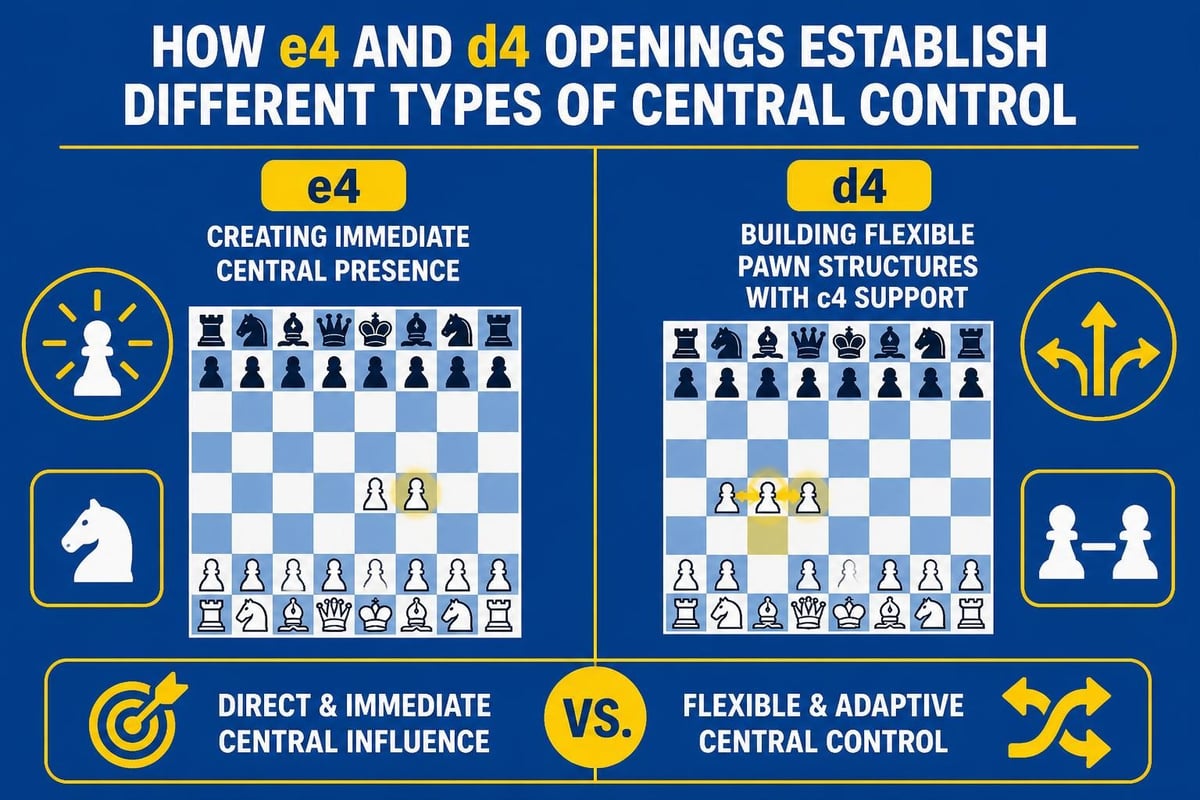
The King's Pawn Openings (1.e4)
Starting with 1.e4 is the most direct way to fight for the centre. This move has been the foundation of effective opening strategies for beginners and grandmasters alike.
The Ruy Lopez: Time-Tested Excellence
The Ruy Lopez (1.e4 e5 2.Nf3 Nc6 3.Bb5) has remained one of the best openings for white for over 400 years. Why? Because it perfectly balances immediate threats with long-term strategic goals.
After 3.Bb5, you're not just developing your bishop. You're putting pressure on the e5 pawn, preparing to castle, and keeping your options open for future pawn breaks. The Ruy Lopez creates rich strategic positions where both sides have clear plans, but White maintains a slight initiative.
| Aspect | Ruy Lopez Characteristics |
|---|---|
| Complexity | Moderate to High |
| Tactics | Medium |
| Strategy | High |
| Best for | Patient, strategic players |
| Main idea | Pressure e5, control centre, gradual advantage |
The beauty of the Ruy Lopez is its flexibility. You can play aggressively with early d4 breaks, or build slowly with manoeuvres like Re1, Bf1, and d3. This adaptability makes it incredibly reliable at all levels.
The Italian Game: Classical and Effective
The Italian Game (1.e4 e5 2.Nf3 Nc6 3.Bc4) is one of the oldest openings in chess, and it's still going strong in 2026. By developing your bishop to c4, you're immediately targeting Black's vulnerable f7 square whilst maintaining flexible central options.
What makes the Italian Game particularly attractive for improving players is its straightforward plans. You develop naturally, castle kingside, and look for tactical opportunities based on concrete calculations rather than abstract positional ideas.
The Giuoco Piano variation (with c3 and d4) leads to rich middlegames where both sides fight for central control. Meanwhile, the aggressive Evans Gambit (b4) offers tactical fireworks for those who enjoy sacrificial play.
Scotch Game: Direct and Powerful
Want to take the fight to Black immediately? The Scotch Game (1.e4 e5 2.Nf3 Nc6 3.d4) is your weapon of choice. By playing d4 on move three, you're forcing Black to make critical decisions early.
After 3...exd4 4.Nxd4, the position opens up dramatically. The Scotch creates tactical opportunities from the very beginning, with White often sacrificing the knight on c6 to damage Black's pawn structure and activate pieces.
This opening suits aggressive players who trust their tactical vision. It's less forgiving than the Ruy Lopez – mistakes get punished quickly – but it also offers excellent winning chances when you know what you're doing.

The Queen's Pawn Openings (1.d4)
Starting with 1.d4 offers a different flavour entirely. These openings tend to be more positional, with the centre often remaining closed for longer. They're among the best openings for white for players who enjoy outmanoeuvring opponents.
Queen's Gambit: The Gold Standard
The Queen's Gambit (1.d4 d5 2.c4) isn't actually a gambit at all – Black can't hold the c4 pawn safely. What it is, however, is one of the most solid and reliable openings in chess.
By playing c4, you challenge Black's central stake immediately. If Black takes with dxc4, you recapture later with easy development and central control. If Black maintains the tension with e6 or c6, you've got a rich positional battle ahead.
Understanding the strategic nuances of the Queen's Gambit helps you appreciate why it's been the choice of world champions. The positions reward patient play, prophylactic thinking, and deep strategic understanding.
Main Queen's Gambit Systems:
- Queen's Gambit Declined: Black plays e6, leading to rock-solid but somewhat passive positions
- Queen's Gambit Accepted: Black takes on c4, accepting a temporary pawn but getting active piece play
- Slav Defence: Black supports d5 with c6, maintaining central tension
- Semi-Slav: Combining c6 and e6, Black aims for a solid yet flexible setup
The Catalan: Modern Sophistication
The Catalan Opening (1.d4 Nf6 2.c4 e6 3.g3) represents modern chess at its finest. By fianchettoing your king's bishop, you exert long-term pressure on the centre whilst maintaining remarkable flexibility.
What makes the Catalan particularly effective is how it combines the best features of several systems. You get the central control of the Queen's Gambit, the fianchettoed bishop pressure of the King's Indian, and incredible piece coordination.
The Catalan requires understanding positional chess principles deeply. You're not delivering immediate threats; instead, you're building small advantages that accumulate over time. It's perfect for players who enjoy squeezing opponents with superior piece placement.
London System: Reliability Personified
The London System (1.d4 d5 2.Bf4 or 1.d4 Nf6 2.Bf4) has exploded in popularity over the past decade, and for good reason. It's one of the best openings for white beginners can learn quickly whilst still being respected at the highest levels.
The London System's appeal lies in its consistent setup. You develop your bishop to f4, control the e5 square, and build a solid position regardless of Black's choices. There's minimal opening theory to memorise, allowing you to focus on understanding typical plans.
| Opening | Theory Load | Strategic Complexity | Tactical Sharpness | Winning Chances |
|---|---|---|---|---|
| Ruy Lopez | High | High | Medium | Excellent |
| Italian Game | Medium | Medium | High | Very Good |
| Scotch Game | Medium | Medium | Very High | Excellent |
| Queen's Gambit | Very High | Very High | Medium | Excellent |
| Catalan | High | Very High | Low | Very Good |
| London System | Very Low | Medium | Low | Good |
Flank Openings: The Chess Rebel's Choice
Not everyone wants to fight for the centre with pawns. Flank openings like the English Opening (1.c4) offer an alternative approach that's gained tremendous respect in competitive chess.
The English Opening: Flexible and Deep
The English Opening mirrors the Sicilian Defence with colours reversed, giving White an extra tempo. This seemingly small advantage translates into rich, complex positions where you can steer the game toward your preferred structures.
What's brilliant about the English Opening is its incredible flexibility. You can transpose into favourable versions of other openings, or maintain an independent character with systems like the Botvinnik setup or the symmetrical English.
Common English Opening Plans:
- Control d5 with c4 and Nc3
- Fianchetto the king's bishop for long-term pressure
- Play d3 and e4, transposing to King's Indian structures
- Maintain the c4/e4 pawn chain for central dominance
The English rewards deep positional understanding. You're playing for small advantages that accumulate – a better pawn structure here, more active pieces there. It's less about forcing immediate tactics and more about suffocating opponents with superior coordination.
Matching Openings to Your Skill Level
Here's something nobody talks about enough: not all of the best openings for white are suitable for every skill level. Your rating and experience should absolutely influence which openings you focus on.
For Beginners (Under 1200)
If you're just starting out, prioritise openings with clear plans and minimal theoretical demands. The Italian Game and London System are perfect choices because they teach fundamental principles whilst being immediately playable.
Focus on understanding why moves work rather than memorising sequences. Every move should serve a purpose: develop a piece, control the centre, or improve your king's safety. The opening principles guide at Chess Cheat Sheets breaks these concepts down beautifully.
For Intermediate Players (1200-1800)
Once you've mastered basic principles, it's time to expand your repertoire. This is when studying the Ruy Lopez or Queen's Gambit pays enormous dividends. Yes, they require more theory, but you'll gain deeper strategic understanding.
Consider having one main opening with e4 and one with d4. This gives you flexibility whilst keeping your study manageable. Many improving players find success with the Italian Game and Queen's Gambit combination.
For Advanced Players (1800+)
At this level, your opening preparation becomes a competitive weapon. The Ruy Lopez, Marshall Attack, Queen's Gambit, and Catalan all offer the depth required for serious competition. You're not just learning moves – you're understanding the underlying ideas that make positions tick.
Advanced players benefit from studying recent games by top grandmasters. Modern analysis tools reveal nuances that weren't understood even five years ago, making opening preparation an ongoing journey rather than a destination.
Building Your Opening Repertoire
Let's talk practically. How do you actually go about learning these openings effectively?
Step-by-step repertoire building:
- Choose one e4 and one d4 opening – Don't spread yourself too thin
- Learn the main line thoroughly – Master the most common responses first
- Study typical middlegame positions – Understand where your opening leads
- Review your games – Identify which variations you actually face
- Add variations gradually – Expand based on opponents' choices
The biggest mistake players make is trying to learn everything at once. Pick your core openings, study them deeply using resources like comprehensive opening guides, and expand gradually as you encounter different defensive setups.
Converting Opening Advantages into Wins
Knowing the best openings for white means nothing if you can't convert your advantages. Here's the reality: most games aren't won in the opening – they're won because one player better understood the resulting middlegame.
Recognising Your Opening's Goals
Each opening aims for specific middlegame structures. In the Ruy Lopez, you're often playing for a kingside attack combined with central pressure. In the Queen's Gambit, you might be exploiting a queenside majority or weak central squares.
Spend time studying complete games in your chosen openings. Watch how strong players transition from opening to middlegame, maintaining their advantages through logical development and strategic planning. The collection of puzzles can help you recognise tactical patterns specific to your openings.
Common Transitional Ideas
| Opening | Typical Middlegame Plan | Key Pieces | Critical Squares |
|---|---|---|---|
| Ruy Lopez | Kingside attack with Re1, Nf1-g3 | Rooks on e1/f1, Ng3 | e5, f5, d5 |
| Italian Game | Central breakthrough with d4 | Light-squared bishop, central knights | d4, e5, f7 |
| Queen's Gambit | Minority attack or central control | Queen's rook, light-squared bishop | c5, e5, d5 |
| Catalan | Pressure on long diagonal | Fianchettoed bishop, queen | c4, d5, queenside pawns |
| London System | Kingside expansion with e4, f4 | Dark-squared bishop, e4 pawn | e5, h7, kingside space |
Dealing with Black's Defences
Here's what really matters: knowing what to do when Black doesn't cooperate with your plans. The best openings for white need solid answers to Black's main defensive tries.
Against the Sicilian Defence
After 1.e4 c5, you've got several excellent choices. The Open Sicilian (2.Nf3 followed by 3.d4) leads to sharp, tactical battles where preparation matters enormously. Alternatively, the Closed Sicilian (2.Nc3 and 3.g3) offers a safer, more strategic approach.
Many club players find success with anti-Sicilian systems like the Rossolimo (3.Bb5 against 2...Nc6) or the Alapin (2.c3). These sidestep the sharpest theoretical battles whilst maintaining excellent winning chances.
Against the French Defence
The French (1.e4 e6) is notoriously solid and has frustrated white players for generations. Your main systems include the Advance Variation (3.e5), the Tarrasch (3.Nd2), and the Exchange (3.exd5).
Each approach creates different position types. The Advance leads to closed positions with pawn chains, the Tarrasch to complex strategic battles, and the Exchange to symmetrical but subtly better positions for White.
Against the Caro-Kann Defence
The Caro-Kann (1.e4 c6) aims for solid, slightly passive positions. Your most challenging try is the Advance Variation (3.e5), creating space advantages and kingside attacking chances.
Alternatively, the Classical Variation (4.Nf3 and 5.Nc3) leads to more traditional development battles where both sides complete their setup before the real fight begins.
Studying Openings Efficiently
Let's address the elephant in the room: how much time should you actually spend on opening study? The answer depends on your level and goals, but here's a sensible framework.
Time allocation by skill level:
- Beginners: 20% openings, 30% tactics, 30% endgames, 20% full games
- Intermediate: 30% openings, 35% tactics, 20% endgames, 15% full games
- Advanced: 40% openings, 30% tactics, 15% endgames, 15% strategy
Notice that even advanced players shouldn't spend more than 40% of study time on openings. Tactics, endgames, and strategic understanding remain crucial throughout your chess journey.
When you do study openings, make it active. Don't just read – play through games, set up positions on a board, and test yourself on key variations. The most effective learning happens when you engage deeply with the material rather than passively consuming it.
Recent Trends in White's Opening Theory
Chess theory never stands still. What worked brilliantly in 2020 might have been refuted by 2026. Staying current with theoretical developments gives you a competitive edge.
Recent analysis has revealed that some classic openings like the Ruy Lopez and Queen's Gambit remain statistically strongest even with modern engines. However, the specific variations popular at top levels have shifted.
The Berlin Defence to the Ruy Lopez, once considered boring and drawish, has been revitalised with aggressive tries like 6.Re1 and 7.Bb5. Similarly, the Queen's Gambit has seen renewed interest in sharper systems like the Catalan and the aggressive 5.Bg5 variations.
Choosing from the best openings for white doesn't have to be complicated – it's about finding systems that match your style, skill level, and study preferences. Whether you prefer the tactical fireworks of the Italian Game or the strategic depth of the Queen's Gambit, consistent study and practice will serve you far better than jumping between different openings every week. At Chess Cheat Sheets, you'll find comprehensive guides, streamlined cheat sheets, and practical resources designed to help you master your chosen openings efficiently, so you can spend more time playing great chess and less time drowning in endless theory.


