

Finding the best move in chess can feel overwhelming, especially when you're staring at a complex position with dozens of legal possibilities. Whether you're just starting out or you've been playing for a while, developing a reliable method for identifying strong moves is absolutely crucial to your improvement. The good news? You don't need to be a grandmaster or study for hours every day to make better decisions at the board. With the right approach and some practical frameworks, you can dramatically improve your move selection and start winning more games.

Understanding What Makes a Move "Best"
Before diving into how to find the best move, we need to address what "best" actually means in chess. Is it the move that wins material? The one that checkmates fastest? Or perhaps the move that improves your position most significantly?
The truth is, the best move depends entirely on your position. In tactical positions with immediate threats, the best move might be a forcing sequence that wins material or delivers checkmate. In quieter positions, it could be a subtle positional manoeuvre that improves your piece coordination or weakens your opponent's pawn structure.
The Three Categories of Best Moves
Think about chess moves in three broad categories:
- Forcing moves: Checks, captures, and threats that demand immediate responses
- Improving moves: Developing pieces, controlling key squares, or enhancing piece activity
- Prophylactic moves: Preventing your opponent's plans or addressing weaknesses before they become problems
Each position will favour one category over others. Your job is to recognise which type of move the position demands. A forcing move in a quiet position might just give away tempo, whilst a slow improving move when you're under attack could be disastrous.
Building Your Move Selection Framework
Now, how do you actually go about finding strong candidate moves? Let me share a systematic approach that works brilliantly for players at all levels.
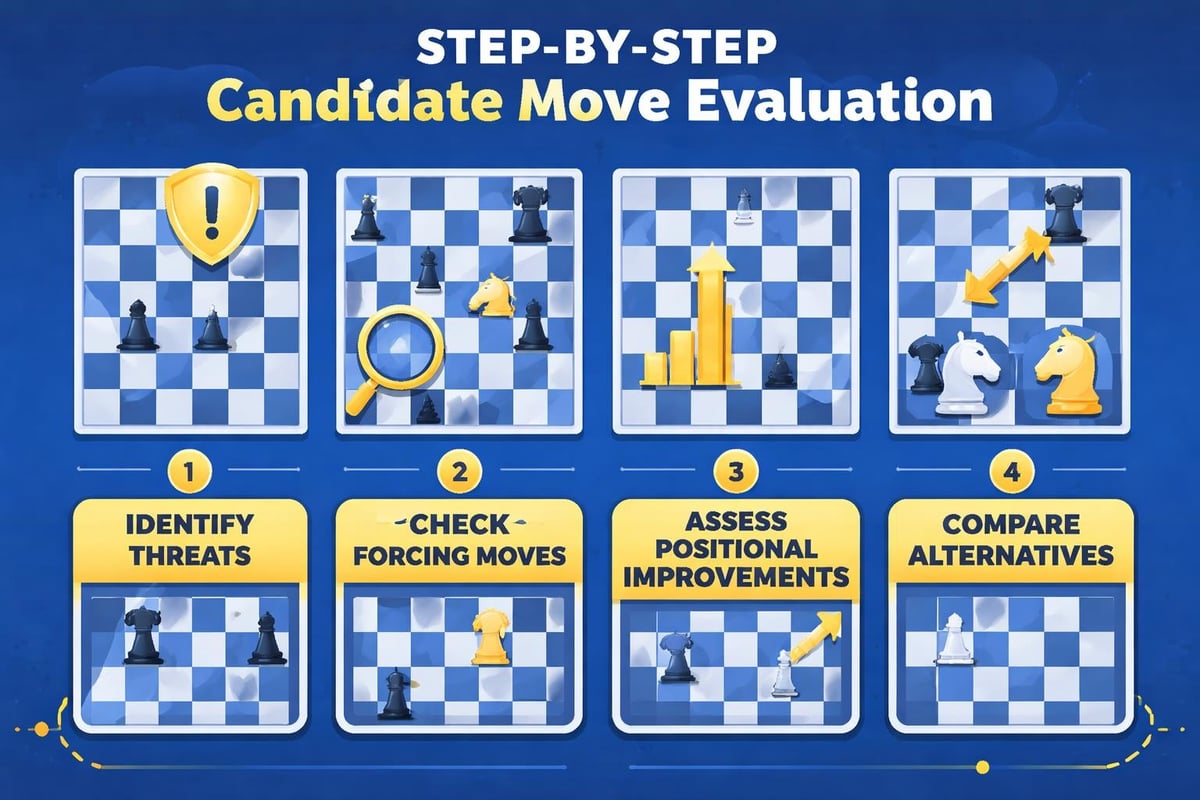
Start by asking yourself three fundamental questions every single move:
- What is my opponent threatening?
- Can I create an immediate threat of my own?
- What needs improving in my position?
These questions form the foundation of sound chess thinking. Understanding the basics of chess strategy helps you answer these questions more effectively. Before you even consider your own plans, you need to address any immediate threats your opponent has created.
The Candidate Move System
Here's a practical method I recommend:
Step 1: Scan for all checks and captures (your forcing moves)
Step 2: Look for moves that develop pieces or improve their activity
Step 3: Consider defensive moves if you're under pressure
Step 4: Evaluate 3-5 candidate moves based on concrete calculation
Don't waste mental energy calculating random moves. Narrow your focus to legitimate candidates, then dive deep into those specific variations. This approach saves time and reduces errors significantly.
Opening Principles That Guide Your Best Move
The chess opening phase has its own logic when it comes to finding the best move. You're not looking for brilliant tactical shots in move five; you're establishing a solid foundation for the middlegame.
During the opening, your best move typically follows these principles:
- Control the centre with pawns and pieces
- Develop knights before bishops
- Castle early to protect your king
- Don't move the same piece twice without good reason
- Connect your rooks when development is complete
When you're learning popular systems like those covered in most common chess openings, you'll notice these principles appearing repeatedly. That's not coincidence-they represent fundamental truths about effective chess play.
| Opening Phase Priority | Why It Matters | Common Mistake to Avoid |
|---|---|---|
| Centre control | Dictates piece mobility and space | Ignoring central pawns entirely |
| Piece development | Brings forces into the game | Moving pieces multiple times early |
| King safety | Prevents tactical disasters | Delaying castling too long |
| Piece coordination | Enables tactical combinations | Developing pieces to poor squares |
Finding Your Best Opening Moves
Rather than memorising endless variations, focus on understanding opening ideas. When you grasp why certain moves are played, you'll naturally find the best move even in unfamiliar positions.
For instance, if you're exploring the King's Fianchetto Opening, you'll understand that your bishop belongs on g2 (or g7 for Black) to control the long diagonal. This understanding guides your move selection throughout the opening phase.
Tactical Awareness: Spotting the Best Move Through Patterns
Here's where chess gets exciting. Chess tactics are the building blocks of combinations, and recognising tactical patterns is essential to finding the best move in complex positions.
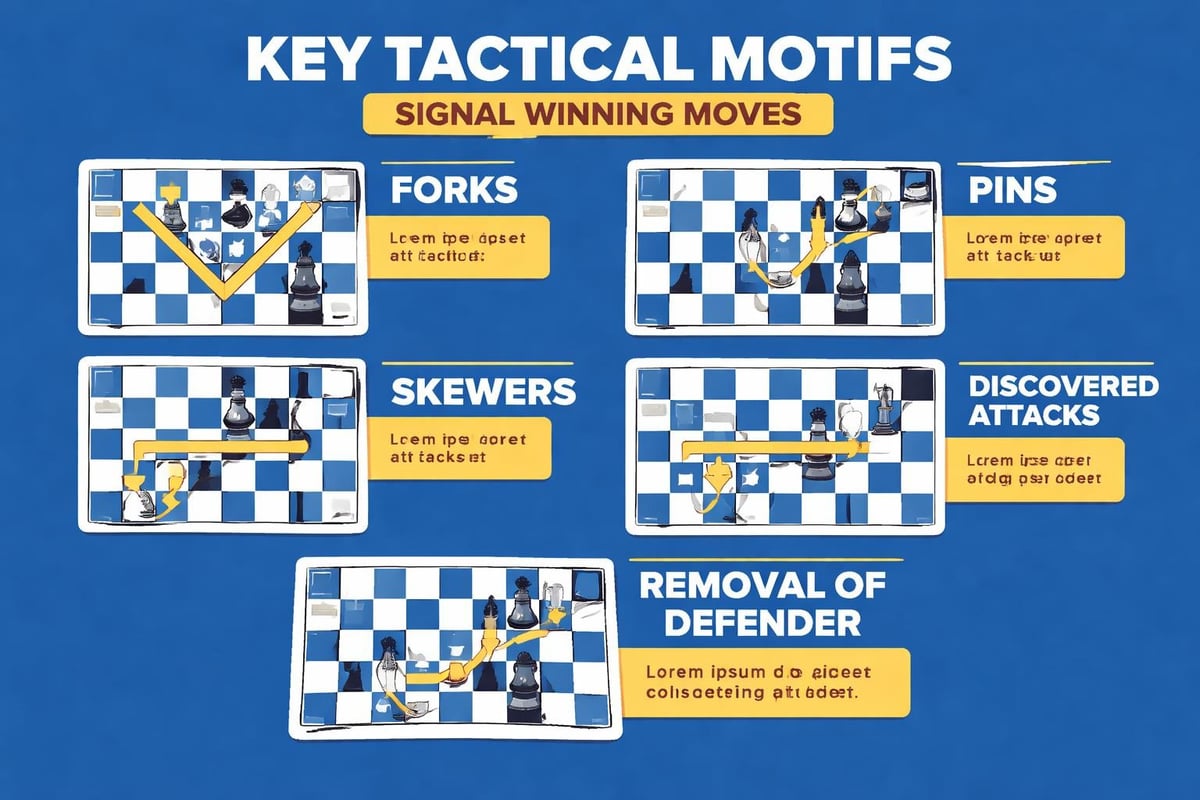
The most common tactical themes you should train your eye to spot include:
- Forks: One piece attacks two or more enemy pieces simultaneously
- Pins: A piece cannot move without exposing a more valuable piece
- Skewers: A valuable piece must move, exposing a less valuable piece behind it
- Discovered attacks: Moving one piece reveals an attack from another
- Removal of the defender: Eliminating or deflecting a piece that protects something important
Regular practice with chess puzzles dramatically improves your ability to spot these patterns instantly. The more tactical motifs you've seen, the faster you'll recognise when your best move involves a tactical blow.
Calculating Tactical Sequences
When you've spotted a potential tactic, you need to calculate accurately. Here's the process:
- Identify the tactical motif (fork, pin, etc.)
- Calculate all forcing moves in the sequence
- Check for defensive resources your opponent might have
- Verify the final position is genuinely better for you
Don't assume your tactics work. Calculate them thoroughly. Many games are lost because players jumped on an attractive combination without checking the refutation.
Positional Chess: When the Best Move Isn't Obvious
Not every position offers tactical fireworks. In fact, most middlegame positions require positional understanding rather than tactical calculation. This is where many improving players struggle.
Positional chess involves factors like pawn structure, piece activity, square control, and long-term plans. Your best move in these positions might be subtle-a quiet rook lift, a bishop repositioning, or a pawn advance that creates space.
Key Positional Elements to Consider
When tactical opportunities aren't available, evaluate these factors:
Piece Activity: Are all your pieces participating in the game, or are some sitting idly on their starting squares?
Pawn Structure: Do you have weak pawns that need defending? Can you create passed pawns or attack your opponent's weak points?
King Safety: Is your king adequately protected, or do you need to improve its shelter?
Space Advantage: Do you control more of the board, giving your pieces greater freedom?
The resources available at Chess Cheat Sheets can help you develop this positional understanding through structured study. Understanding these concepts transforms how you evaluate positions.
| Positional Factor | Strong Position | Weak Position | Best Move Goal |
|---|---|---|---|
| Piece Activity | All pieces on strong squares | Pieces blocked or passive | Improve worst-placed piece |
| Pawn Structure | No weaknesses, mobile pawns | Isolated, doubled, or backward pawns | Fix weaknesses or create counterplay |
| King Safety | Well-sheltered behind pawns | Exposed to attack | Improve shelter or eliminate attackers |
| Space | Control of centre and key files | Cramped, limited mobility | Gain space through pawn breaks |
Endgame Mastery: Finding Precision Moves
The chess endgame demands a completely different approach to finding the best move. With fewer pieces on the board, calculation becomes more concrete, but knowledge of theoretical positions becomes crucial.
In endgames, your best move often relies on understanding key concepts:
- King activation (your king becomes a fighting piece)
- Pawn promotion races
- Opposition and zugzwang
- Theoretical drawing or winning positions
You can't calculate your way through every endgame from scratch. You need to know fundamental positions like king and pawn versus king, rook endgames with one pawn, and basic checkmate patterns.
Converting Advantages in the Endgame
When you've reached a winning endgame, your best move focuses on technique rather than brilliance. The goal is converting your advantage methodically, avoiding unnecessary complications.
Follow this approach:
Simplify when ahead: Trade pieces (but not pawns) when you're up material
Activate your king: Bring it toward the centre and support your pawns
Create passed pawns: These require your opponent's pieces to stop them
Avoid stalemate tricks: Always leave your opponent legal moves when you're winning
Understanding endgame theory prevents you from throwing away won positions or failing to save drawable ones. The endgame guides available can accelerate your learning significantly.

Using Technology to Improve Your Best Move Recognition
Modern chess players have an incredible advantage: chess engines that can evaluate positions with superhuman strength. Chess computers have revolutionised how we understand the game and train ourselves.
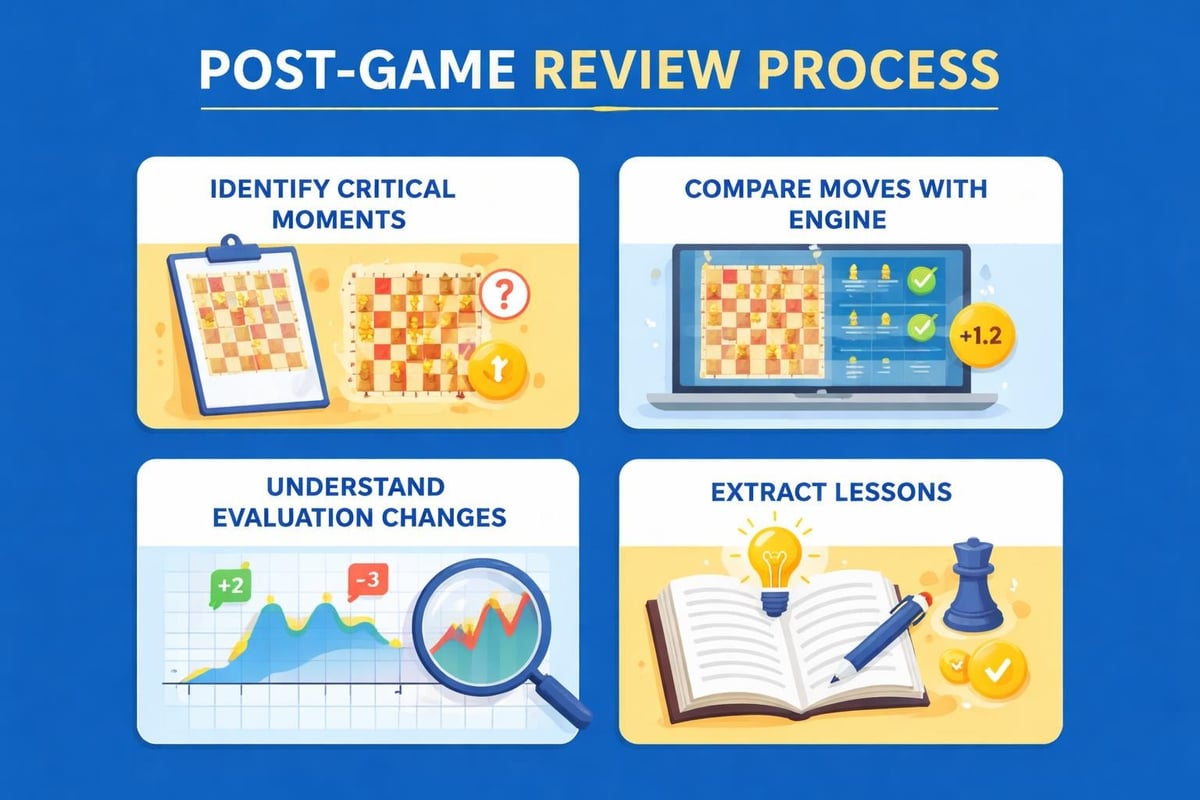
However, there's a right way and a wrong way to use engines. Simply checking if the engine agrees with your moves teaches you nothing. Instead, use them like this:
- Play your game without engine assistance
- Analyse the game yourself first, noting critical moments
- Check engine evaluations at those critical points
- Understand why the engine prefers its suggestion
- Extract general principles you can apply to future games
The key is understanding the "why" behind engine suggestions. When the engine recommends a move you didn't consider, ask yourself what you missed. Was it a tactical motif? A positional nuance? A defensive resource?
Practical Training Methods for Better Move Selection
Knowing how to find the best move theoretically is one thing. Consistently doing it in your games requires deliberate practice. Here are proven training methods:
Puzzle Training
Solve tactical puzzles daily, but don't just find the first move. Calculate the entire sequence until you understand why it works. The opening puzzles collections help you recognise tactical patterns specific to your repertoire.
Slow Game Analysis
Play longer time control games where you have time to think properly. After each game, spend at least 20 minutes analysing it yourself before checking with an engine.
Guess the Move
Study master games by covering up the moves and trying to guess what the master played. This trains you to think like stronger players and broadens your move selection intuition.
Blindfold Visualisation
Practice calculating variations without moving pieces. Start with simple positions and gradually increase complexity. This dramatically improves your calculation accuracy.
Psychological Factors in Finding the Best Move
Chess psychology plays a surprisingly large role in move selection. Even when you know what the best move is objectively, psychological factors can lead you astray.
Common psychological traps include:
- Confirmation bias: Seeing only moves that fit your preconceived plan
- Overconfidence: Assuming your position is better than it actually is
- Time pressure panic: Making rushed decisions when the clock is ticking
- Loss aversion: Playing too cautiously to avoid losing rather than playing to win
Being aware of these biases helps you counteract them. When you find yourself gravitating toward a particular move, consciously force yourself to consider alternatives. Challenge your assumptions before committing.
Building Decision-Making Discipline
Create a pre-move checklist that you follow consistently:
- What has my opponent's last move changed?
- Are there any immediate threats?
- What are my candidate moves?
- Which candidate is objectively best?
- Have I checked for blunders?
This systematic approach prevents impulsive moves and ensures you're making conscious, reasoned decisions rather than reacting emotionally to the position.
Different Time Controls, Different Approaches
Your method for finding the best move should adapt to your time control. What works in classical chess won't work in blitz, and vice versa.
Classical Chess (90+ minutes)
You have time for deep calculation and thorough position evaluation. Use your time to find the absolute best move, especially in critical positions. Don't rush through the opening or endgame thinking they're "easy."
Rapid Chess (10-25 minutes)
Focus on strong candidate moves rather than perfection. Calculate one or two moves deep unless tactics demand more. Trust your intuition based on pattern recognition.
Blitz Chess (3-5 minutes)
Rely heavily on pattern recognition and general principles. You can't calculate everything, so make moves based on your understanding of typical plans and tactics in similar positions. Accept that you'll make mistakes-so will your opponent.
The skills developed through studying structured guides like those for the Scandinavian Defense help you make faster, more intuitive decisions in faster time controls.
Common Mistakes in Move Selection
Let's address the typical errors that prevent players from finding their best move consistently:
Moving too quickly: Even in positions that look simple, take time to check for tactics
Ignoring opponent's threats: Always address what your opponent is threatening before pursuing your own plans
Falling in love with a move: Sometimes the move you want to play isn't the move you should play
Neglecting king safety: Many games are lost because players ignored king safety for too long
Playing hope chess: Hoping your opponent won't see your weaknesses rather than addressing them
Overcomplicating simple positions: Sometimes the simple, solid move is genuinely best
Recognising these mistakes in your own games is the first step to eliminating them. Keep a journal of the types of errors you make repeatedly, then consciously work to address them.
Finding the best move consistently is a skill that develops over time with deliberate practice and structured study. By combining solid opening knowledge, tactical awareness, positional understanding, and endgame technique, you'll dramatically improve your decision-making at the board. Whether you're just beginning your chess journey or looking to break through to the next level, Chess Cheat Sheets provides the streamlined guides, puzzles, and resources you need to master these concepts efficiently without spending countless hours on extensive study. Take your move selection to the next level and start making confident, winning decisions today.


