

Starting your chess journey can feel overwhelming when you see grandmasters rattling off complex opening variations with names you can't even pronounce. But here's the truth: you don't need to memorise 20 moves deep into theory to play strong chess. What you need are solid, practical openings that teach you fundamental principles whilst giving you winning chances. The best chess openings for beginners focus on simple development, controlling key squares, and creating positions you can actually understand. Let's explore which openings will serve you best as you build your chess foundation.
Why Opening Choice Matters More Than You Think
You might wonder whether spending time on openings is worth it when tactics and endgames seem more important. Fair question. But your opening sets the entire tone for the game ahead.
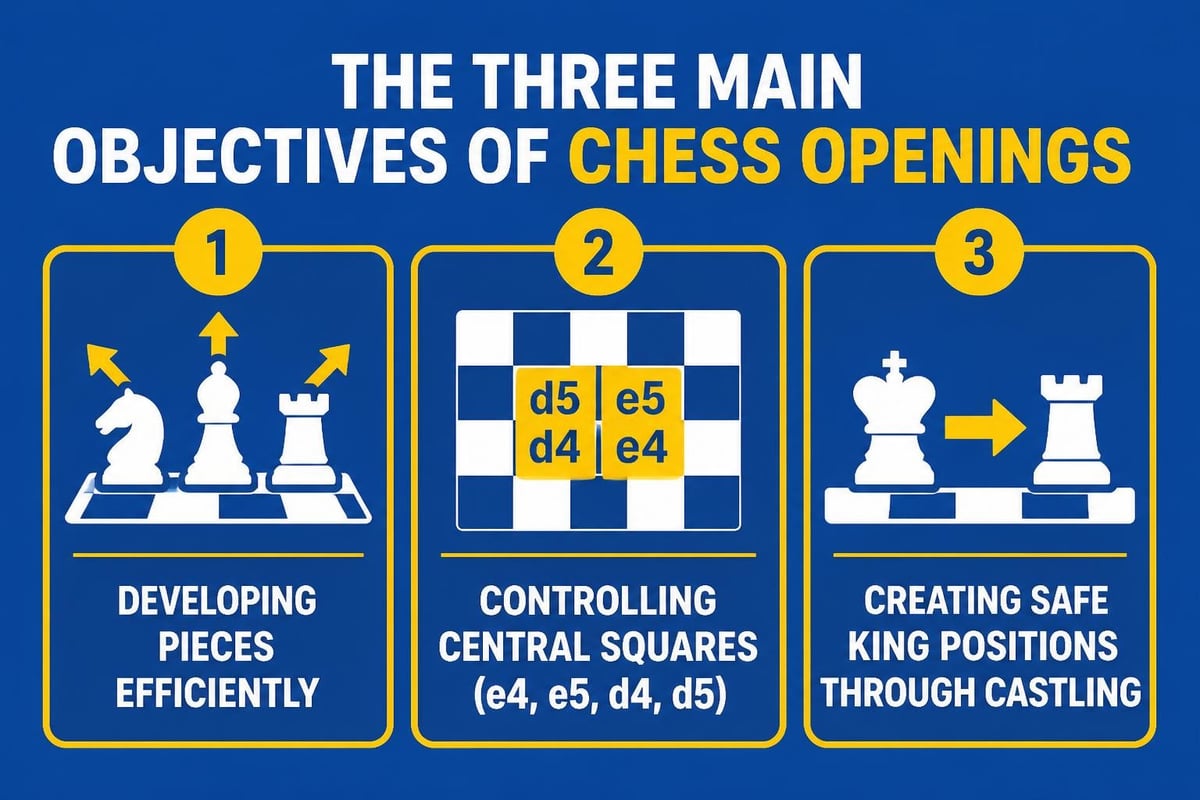
A good opening does three crucial things for you. First, it gets your pieces into active positions where they can influence the game. Second, it helps you avoid early disasters that end your game before it truly begins. Third, it creates positions that align with your understanding level.
When you choose openings suited to your level, you're not just playing moves. You're building pattern recognition that will serve you for years. Understanding opening principles forms the bedrock of chess improvement.
The Core Principles You Must Know
Before diving into specific openings, let's nail down what makes any opening work. These principles apply whether you're playing the Italian Game or something more exotic.
Control the centre with your pawns and pieces. The squares e4, e5, d4, and d5 are the heart of the board. Whoever dominates these squares usually dominates the game.
Develop your pieces quickly. Get your knights and bishops out before moving the same piece twice. Each move should contribute to your position.
Ensure king safety early. Castle within your first 10 moves in most games. Your king needs shelter before the middlegame battles begin.
The Best White Openings for Beginners
Playing White gives you the first move advantage, which means you set the agenda. These openings help you seize that initiative without requiring encyclopaedic knowledge.
The Italian Game: Your Reliable Foundation
The Italian Game (1.e4 e5 2.Nf3 Nc6 3.Bc4) stands as perhaps the single best opening for beginners playing White. Why does it work so brilliantly for learning players?
It naturally follows opening principles. You advance your centre pawn, develop knights before bishops, and aim your bishop at the weak f7 square. Every move makes logical sense.
| Advantage | Why It Matters |
|---|---|
| Simple development | Pieces find natural squares without complex theory |
| Clear attacking ideas | The f7 pawn provides an obvious target |
| Flexible pawn structures | You can adapt to different Black responses |
| Teaches tactical patterns | Pins, forks, and discovered attacks appear naturally |
The Italian Game appears in countless beginner resources because it genuinely works. You'll find it featured on chess education platforms that understand what new players need. The Italian Game's straightforward approach makes it perfect for building your opening repertoire.
The London System: Solid and Systematic
If you want an opening that works against virtually any Black setup, the London System delivers. You play 1.d4, 2.Bf4, 3.e3, 4.Nf3, and 5.Bd3 in some order, creating a rock-solid position.
What makes the London special for beginners? You're not reacting to Black's moves as much as building your own fortress. This reduces the amount you need to memorise dramatically.
- Develops all your pieces to sensible squares
- Creates a safe king position after castling
- Gives you clear middlegame plans
- Works regardless of Black's response
The London System's middlegame plans flow naturally from the opening position. You're learning chess strategy, not just memorising moves.
The Scotch Game: Active and Aggressive
For players who want more dynamism, the Scotch Game (1.e4 e5 2.Nf3 Nc6 3.d4) opens the position early. You're trading your d-pawn for Black's e-pawn, creating immediate central tension.
This opening teaches you to handle open positions where tactics matter. It's slightly more complex than the Italian Game but still manageable for dedicated beginners. The positions you reach have clear piece activity and concrete plans.
The Best Black Openings for Beginners
Playing Black means responding to White's opening move, but you still have excellent options that don't require excessive study.
Against 1.e4: The Caro-Kann Defense
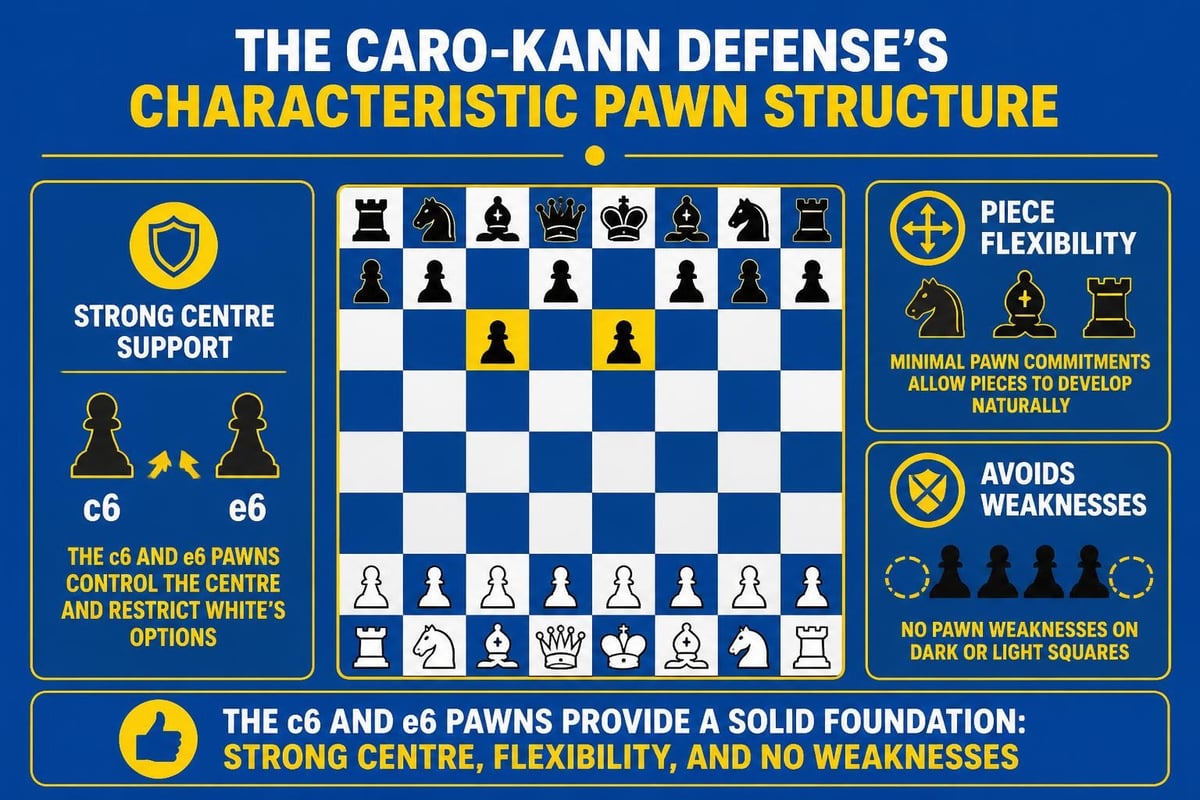
The Caro-Kann Defense (1.e4 c6) might seem unusual at first, but it's one of the best chess openings for beginners playing Black. You're preparing to challenge White's centre with ...d5 whilst keeping your light-squared bishop free.
Why does this work so well? The Caro-Kann leads to solid, slightly passive positions where you're difficult to attack. You're learning defensive skills whilst maintaining counterplay.
Key benefits of the Caro-Kann:
- Solid pawn structure that's hard to break
- Clear development plan for your pieces
- Fewer forcing variations to memorise
- Teaches patient, positional play
The Caro-Kann's classical variation provides a perfect balance between soundness and practical chances. You're building a position that can withstand White's early pressure.
Against 1.e4: The French Defense
If you prefer keeping more tension, the French Defense (1.e4 e6 2.d4 d5) creates immediate central conflict. You're challenging White's pawn chain from the start.
The French teaches you to fight for the centre even when playing Black. Yes, your light-squared bishop can become problematic, but you learn important strategic concepts like pawn chains and piece manoeuvring.
Against 1.d4: The Queen's Gambit Declined
When White plays 1.d4, the Queen's Gambit Declined (1.d4 d5 2.c4 e6) offers classical, time-tested solidity. Despite its name, you're not really declining anything significant. You're building a strong central presence.
This opening appears in guides to common chess openings because it has stood the test of time. You're walking the same path as world champions whilst learning fundamental chess.
| Opening Feature | Beginner Value |
|---|---|
| Straightforward development | Knights to f6 and d7, bishops to e7 and d7 |
| Central pawn majority | Your e6 and d5 pawns control key squares |
| Multiple strategic plans | You can expand on the kingside or queenside |
| Reduced tactical complexity | Fewer forcing sequences than sharper defenses |
Against 1.d4: The Slav Defense
The Slav Defense (1.d4 d5 2.c4 c6) combines the Queen's Gambit's central structure with keeping your light-squared bishop outside the pawn chain. It's like getting the best of both worlds.
For beginners, the Slav provides solid positions without the cramped feel some other defenses create. Your pieces find active squares naturally, and you maintain flexibility in your plans.
Common Opening Mistakes to Avoid
Knowing what not to do matters just as much as knowing the right moves. Let's address the traps beginners fall into repeatedly.
Moving the same piece multiple times in the opening wastes your development. Unless you're responding to a serious threat, get all your pieces out before moving one twice.
Neglecting king safety causes countless losses. Yes, attacking looks exciting, but your king huddled in the centre becomes a liability fast. Castle early and often.
Bringing your queen out too early invites attacks that develop your opponent's pieces. Your queen is powerful, but it's also a target. Let your minor pieces develop first.
Ignoring the centre by playing only on the flanks rarely works. Simple chess openings all emphasise central control for good reason.
Creating unnecessary weaknesses with random pawn moves squanders your position. Every pawn move creates permanent changes to your structure. Make them count.

How to Learn Your Chosen Openings
Selecting the best chess openings for beginners is just the first step. You need an effective learning approach to make these openings work for you.
Study the Key Ideas, Not Just Moves
Memorising move orders helps, but understanding why you make each move matters more. What squares are you controlling? Which pieces are you developing? What's your plan if Black responds differently?
When you grasp the ideas, you can reconstruct the moves even if you forget the exact sequence. This deep learning sticks with you far longer than rote memorisation.
Practice Against Real Opposition
Reading about openings differs vastly from playing them under pressure. You need practical experience to recognise patterns and handle unexpected responses.
Start by playing your chosen opening in casual games where the result matters less than learning. Notice where you struggle and which positions feel comfortable. This feedback guides your study.
Use Structured Learning Resources
Having clear, organised information accelerates your progress significantly. Comprehensive opening guides that break down key variations and ideas save you countless hours of confused study.
Look for resources that provide:
- Clear move diagrams for each position
- Explanations of strategic themes
- Common tactical patterns to watch for
- Practice positions and puzzles
- Middlegame plans flowing from the opening
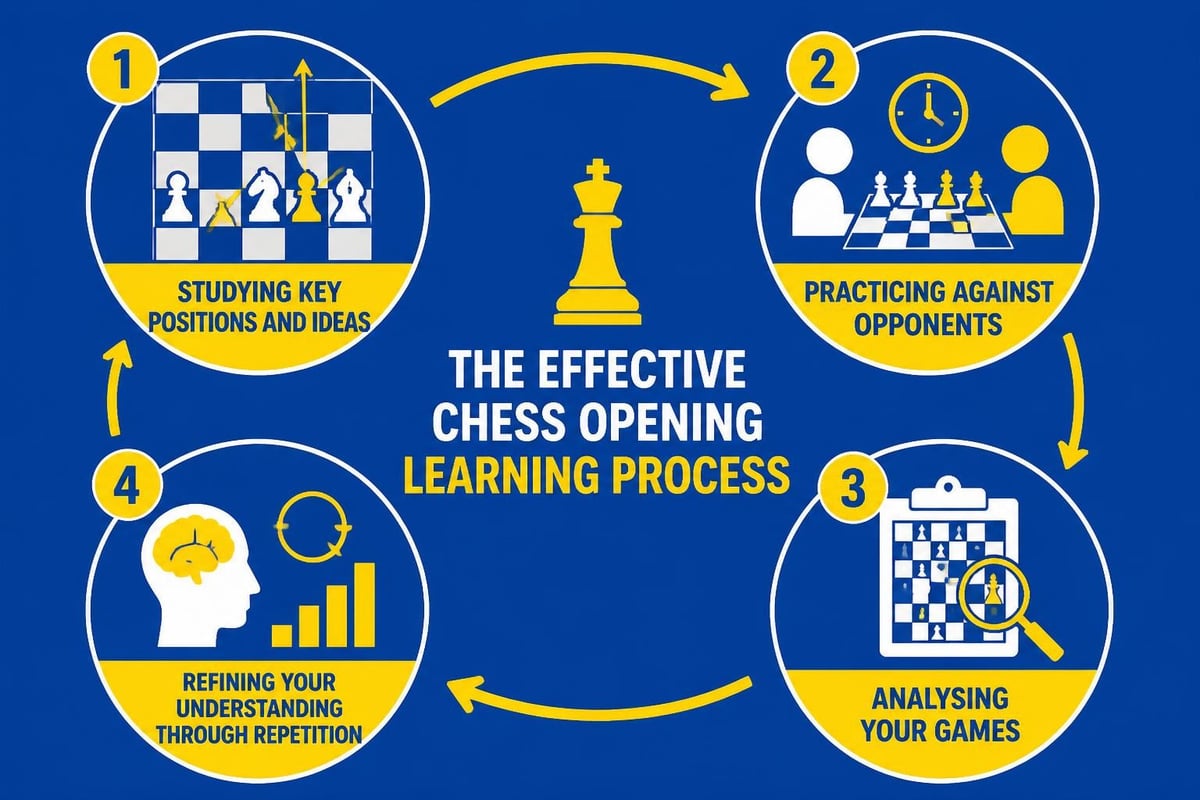
Analyse Your Games
Every game you play teaches you something about your openings. Where did you go wrong? Which moves felt awkward? When did your position deteriorate?
Spend 10 minutes after each game reviewing the opening phase. You'll spot patterns in your mistakes and identify gaps in your knowledge. This targeted improvement beats random study every time.
Building Your Opening Repertoire
You don't need 20 different openings to play good chess. Start narrow and build gradually.
For White, pick one opening and stick with it for at least 50 games. Whether you choose the Italian Game, London System, or something else, commit to learning it properly. Depth beats breadth when you're starting.
For Black, you need responses to both 1.e4 and 1.d4. That means two openings maximum initially. The Caro-Kann against 1.e4 and the Slav against 1.d4 makes an excellent combination.
When to Expand Your Repertoire
Once you've played 100+ games with your core openings and understand the typical positions deeply, then consider branching out. You might add the Ruy Lopez as White for more complexity or the Sicilian Defense as Black for sharper play.
But rushing into multiple openings fragments your learning and slows improvement. Master the fundamentals first through focused practice.
Matching Openings to Your Playing Style
Not every opening suits every player, even amongst the best chess openings for beginners. Your personality and preferences matter.
Do you prefer calm, strategic positions? The London System as White and the Caro-Kann as Black give you solid structures and clear plans.
Do you enjoy tactical complications? The Italian Game and Scotch Game as White with the French Defense as Black create sharper positions.
Do you want maximum flexibility? Systems like the London let you adapt to whatever Black plays without extensive preparation.
Testing different openings in practice helps you discover what resonates with your chess personality. You'll perform best with openings that match how you think.
The Role of Opening Preparation
How much should you actually study openings as a beginner? This question trips up many players who either over-prepare or under-prepare dramatically.
Spend about 20% of your total chess study time on openings. The remaining 80% should cover tactics, endgames, and whole-game analysis. Effective chess improvement requires balanced development across all game phases.
Your opening study should include:
- Learning 8-10 moves of your main lines
- Understanding the key strategic ideas
- Knowing 2-3 responses to common deviations
- Practising the positions through games
- Reviewing your opening phase mistakes
That's enough to play the opening competently without drowning in theory. As you improve, you'll naturally learn more variations through experience.
Transitioning from Opening to Middlegame
The best chess openings for beginners set you up for successful middlegames. But you need to recognise when the opening ends and the middlegame begins.
Generally, you've reached the middlegame when most pieces are developed and both sides have castled. Now what? Your opening choice should have created natural plans you can pursue.
From the Italian Game, you might attack on the kingside using your active pieces. From the London System, you might expand in the centre or prepare a minority attack. The opening teaches you these plans through repeated play.
Understanding these transitions prevents the common problem of playing good openings but then drifting aimlessly in the middlegame. Your opening repertoire should connect logically to positions you know how to handle.
The openings you choose as a beginner shape your entire chess development, so selecting solid, principle-based options gives you the strongest foundation. Whether you prefer the classical approach of the Italian Game or the systematic solidity of the London System, focus on understanding ideas rather than memorising endless variations. Ready to accelerate your opening knowledge and start winning more games? Chess Cheat Sheets provides streamlined guides and resources that break down complex openings into clear, actionable strategies you can implement immediately in your games.


