

You've set up your pieces, your opponent makes their first move, and suddenly you're wondering: what are the actual best chess moves to win? It's not just about memorising sequences or copying grandmaster games. Winning at chess comes down to understanding fundamental principles, recognising patterns, and executing tactics at the right moment. Whether you're just starting out or looking to break through to the next level, knowing which moves give you the strongest winning chances can transform your results on the board. Let me walk you through the essential moves and strategies that'll help you convert more positions into victories.
Understanding What Makes a Winning Move
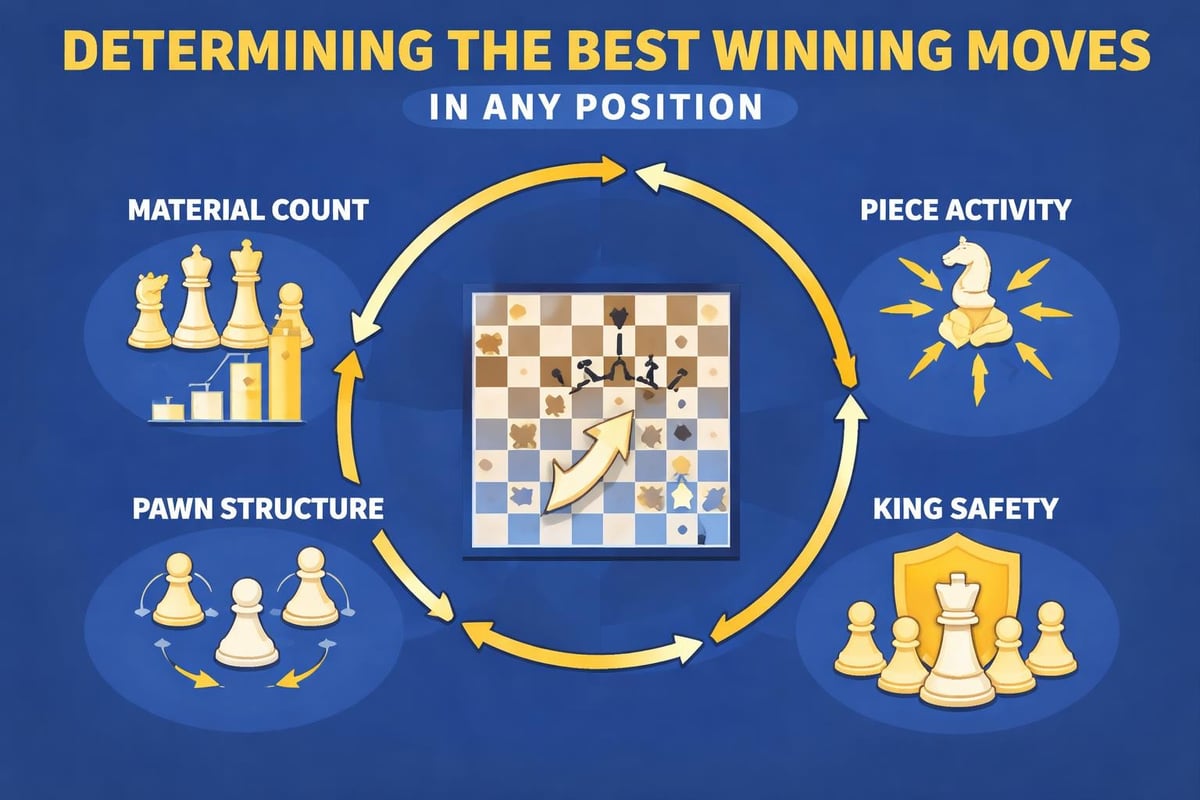
Before diving into specific tactics, it's worth asking: what actually constitutes one of the best chess moves to win? Not every brilliant move leads to checkmate, and not every checkmate comes from a flashy sacrifice.
A winning move typically does one of several things. It might control a critical square, activate a dormant piece, create multiple threats simultaneously, or exploit a weakness in your opponent's position. Sometimes the best move is the quiet one that sets up an unstoppable threat two or three moves later.
The Context Matters More Than the Move
Here's something many players don't realise early on: the same move can be brilliant in one position and terrible in another. Context is everything. When you're learning about winning chess strategies, you'll discover that understanding when to apply certain tactics matters as much as knowing them.
Think about it this way:
- Material advantage: When you're ahead, trading pieces often wins
- Time advantage: When you're better developed, open the position
- Positional advantage: When you control key squares, improve your worst piece
- Tactical advantage: When pieces are undefended, calculate forcing sequences
The position dictates which principles apply most strongly at any given moment.
Opening Moves That Set You Up for Success
Your first ten moves absolutely matter. Starting poorly doesn't guarantee a loss, but it makes everything harder. The best chess moves to win often begin in the opening phase, where you establish control and development.
Control the Centre From Move One
Every strong player will tell you the same thing: control the centre. But what does that actually mean in practice?
When you control central squares (e4, d4, e5, d5), your pieces have maximum mobility. A knight on e4 can reach eight different squares, whilst a knight on a1 would control just two. That's why moves like 1.e4 or 1.d4 are so popular.
If you're playing Black, you need solid defensive options. The best openings for Black often involve challenging White's central control immediately or allowing it temporarily whilst preparing a counter-strike.
For White, here are your strongest opening move options:
| Opening Move | Strengths | Typical Plans |
|---|---|---|
| 1.e4 | Direct, aggressive, controls centre | King-side attacks, open games |
| 1.d4 | Solid, strategic, harder to counter | Queen-side expansion, closed positions |
| 1.Nf3 | Flexible, can transpose | Adapt to opponent's setup |
| 1.c4 | Modern, controls from distance | Flank attacks, hyper-modern play |
Development Beats Everything Else
You can't win if your pieces are still on their starting squares. Development means getting your pieces into the game quickly and purposefully.
I've seen countless games where one player completes their development by move eight whilst their opponent fiddles with pawns. Guess who usually wins? The player whose rooks, knights, and bishops are actively placed.
Follow these development priorities:
- Knights before bishops (they have fewer good squares)
- Castle early (usually by move 10)
- Connect your rooks (complete development)
- Don't move the same piece twice without good reason
The Italian Game exemplifies perfect development, with both sides activating pieces harmoniously whilst fighting for central control.

Tactical Patterns That Win Games
Here's where things get exciting. Tactics are the tools that convert advantages into victories. Understanding common tactical patterns gives you the ability to spot opportunities your opponent misses.
Forks, Pins, and Skewers
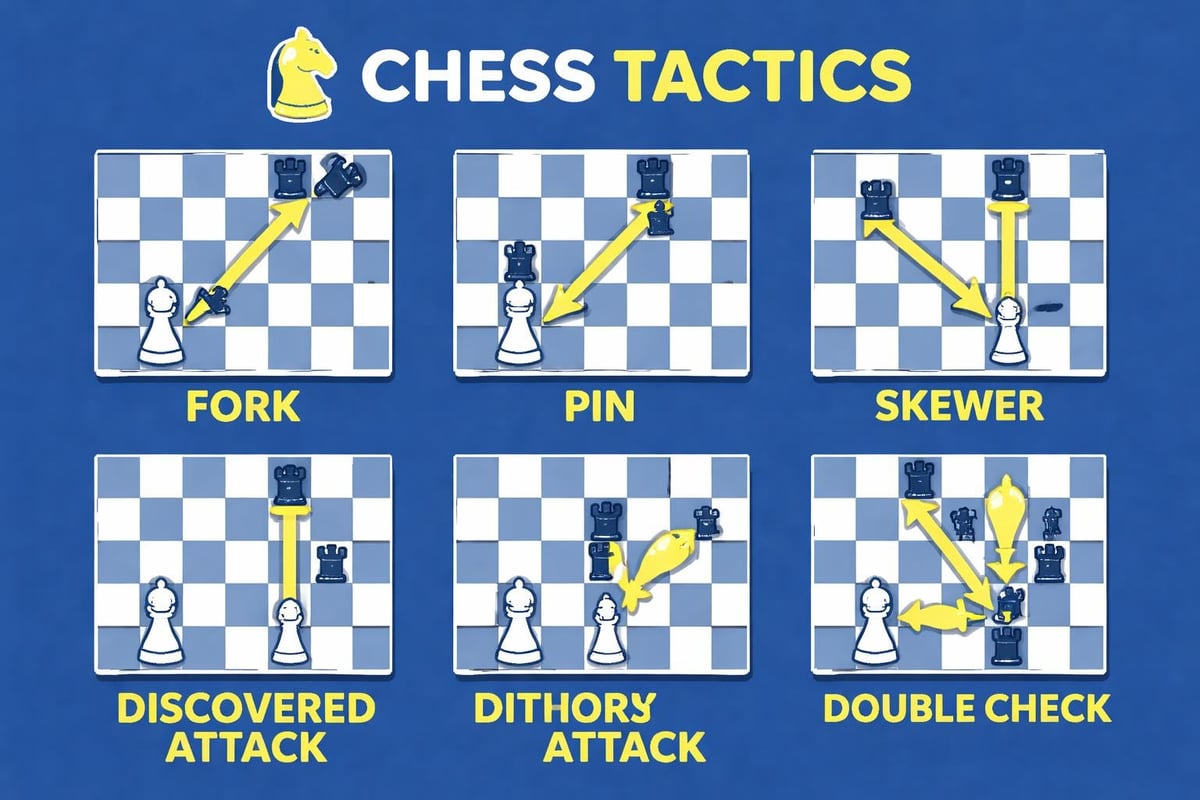
These fundamental tactics win material by attacking multiple pieces simultaneously or restricting piece movement.
Forks happen when one piece attacks two or more enemy pieces at once. Knight forks are particularly devastating because knights move in unusual patterns that opponents overlook. Picture a knight on e4 attacking a queen on d6 and a rook on c5 simultaneously.
Pins restrict a piece because moving it would expose a more valuable piece behind it. A bishop pinning a knight to the queen is a classic example. The knight can't move without losing the queen.
Skewers are reverse pins: you attack a valuable piece, and when it moves, you capture the less valuable piece behind it. Rooks and bishops excel at this tactic.
Discovered Attacks and Double Checks
These advanced tactics create devastating threats by moving one piece to reveal an attack from another.
A discovered attack occurs when moving one piece uncovers an attack from a piece behind it. For instance, moving a knight might reveal a bishop attack on the opponent's queen. What makes this powerful? You get two threats in one move.
Double checks take this further. When the moving piece also gives check whilst uncovering another check, the opponent must move their king. They can't block both checks or capture both pieces. It's often game-ending.
Many common winning patterns involve these discovered attack themes, particularly in middlegame positions where pieces are actively placed.
Combinations That Force Checkmate
The best chess moves to win are often parts of longer combinations. A combination is a forced sequence of moves leading to a tangible advantage, usually checkmate or significant material gain.
Learn these classic mating patterns:
- Back rank mate: Trapping the opponent's king on the first rank with their own pawns
- Queen and rook mate: Using major pieces to deliver checkmate on the edge of the board
- Smothered mate: A knight delivers checkmate whilst the king is blocked by its own pieces
- Anastasia's mate: A knight and rook work together to trap and checkmate the king
When you study remarkable historical chess moves, you'll notice many involve sacrificing material to set up unstoppable mating attacks. The key is calculating accurately so you know the sacrifice works before making it.
Middlegame Strategies for Converting Advantages
You've survived the opening, developed your pieces, and now you're in the complex middlegame. This is where games are truly won or lost. The middlegame requires planning, calculation, and knowing which advantages to pursue.
Creating Weaknesses in Your Opponent's Position
The best chess moves to win in the middlegame often involve creating permanent weaknesses. Unlike temporary disadvantages, permanent weaknesses can't be fixed.
Pawn weaknesses include:
- Isolated pawns (no friendly pawns on adjacent files)
- Backward pawns (can't advance safely)
- Doubled pawns (two pawns on the same file)
- Passed pawns (no enemy pawns can stop them)
Once you create these weaknesses, you attack them repeatedly with different pieces. Your opponent must defend passively whilst you improve your position.
Square weaknesses matter just as much. If your opponent's dark-squared bishop is gone, their dark squares become vulnerable. Place your pieces on these weak squares and they become difficult to dislodge.
Piece Activity Over Material
Here's a counterintuitive truth: sometimes the best winning move involves sacrificing material. Why? Because active pieces can create threats faster than passive pieces.
Compare these scenarios:
| Position Type | Material | Activity | Winning Chances |
|---|---|---|---|
| You're down a pawn | -1 | All pieces active, enemy king exposed | Good |
| You're up a pawn | +1 | Pieces uncoordinated, opponent attacking | Poor |
| Material equal | 0 | Your rook on 7th rank, doubled pawns | Excellent |
A rook on the seventh rank (your opponent's second rank) is worth more than a pawn in most positions. It attacks pawns, restricts the king, and creates constant threats.
The Power of Pawn Breaks
Pawn breaks are pawn moves that challenge your opponent's pawn structure, opening lines for your pieces. They're among the most important strategic moves in chess.
In the Caro-Kann Defense, the typical pawn break c5 challenges White's centre. In positions where you're playing for a win, timing your pawn breaks correctly can transform your position from slightly better to completely winning.
Look for pawn breaks that:
- Open files for your rooks
- Create outposts for your knights
- Expose the enemy king
- Activate your bishops
Sometimes the preparation for a pawn break matters more than the break itself. Placing your pieces on ideal squares before pushing the pawn maximises the impact.
Endgame Techniques That Secure Victory
You've played well, gained an advantage, and reached the endgame. Now don't throw it away! The endgame requires precise technique to convert your advantage.
King Activity Becomes Paramount
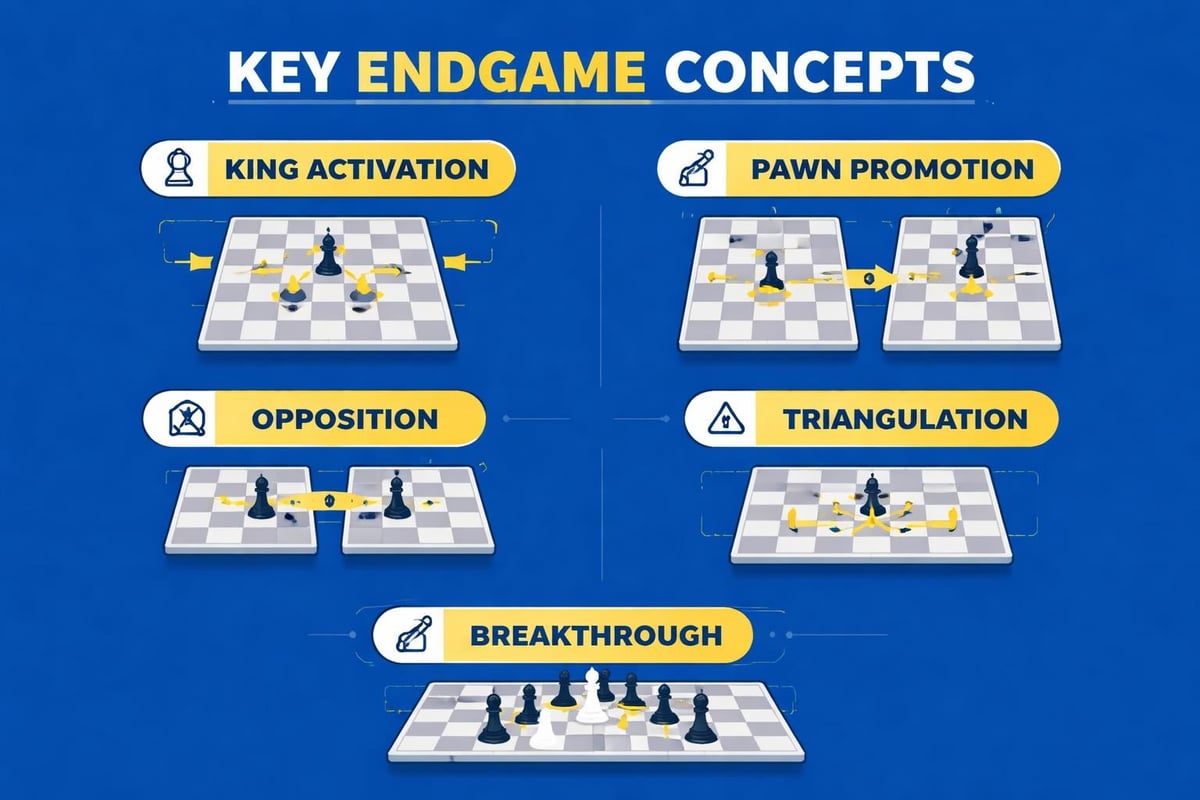
In the endgame, your king transforms from a liability to an attacking piece. Activating your king early in the endgame is often the difference between winning and drawing.
Your king should:
- Support pawn advances
- Attack enemy pawns
- Control key squares
- Cut off the opponent's king
In pawn endgames, king activity matters more than material. A position with equal pawns but a better-placed king is often completely winning.
Opposition and Triangulation
These technical concepts separate good endgame players from great ones. Opposition occurs when kings face each other with one square between them. The player who doesn't have the move has the opposition.
Having the opposition often determines who wins pawn endgames. If you have the opposition, you can invade your opponent's position or force them backwards.
Triangulation is a technique where you "lose a move" to put your opponent in zugzwang (a position where any move worsens their situation). You move your king in a triangle whilst your opponent's king can only shuffle between two squares.
Converting Material Advantages
Being up a pawn doesn't automatically win. You need proper technique. The general principles for converting extra material include:
- Trade pieces, not pawns (reducing your opponent's counterplay)
- Create a passed pawn
- Activate your king
- Push the passed pawn with piece support
- Force promotion or win more material
When you're ahead, avoid complications. Simple, clear moves that maintain your advantage work better than brilliant tactics that might backfire.
Practical Tips for Finding Winning Moves
Theory is helpful, but application wins games. How do you actually find these best chess moves to win during an actual game with the clock ticking?
Candidate Moves and Calculation
Don't calculate every legal move. That's impossible and unnecessary. Instead, identify 3-4 candidate moves that look promising, then calculate deeper.
Your candidate moves should include:
- Forcing moves: Checks, captures, threats
- Improving moves: Piece improvements, prophylactic moves
- Critical moves: Moves that change the position fundamentally
Calculate forcing sequences first because they limit your opponent's options. If you find a forced win, you're done. If not, evaluate quieter improving moves.
Learning from Your Games
Every game you play contains lessons. The best chess moves to win aren't just moves you make successfully, they're also moves you missed that you should have found.
After each game, ask yourself:
- Where did I gain or lose the advantage?
- Which tactical opportunities did I miss?
- Did I follow opening principles?
- Were my plans in the middlegame coherent?
- Did I execute the endgame correctly?
Using resources like the comprehensive guides available helps you identify patterns in your play that need improvement.
Pattern Recognition Development
The more patterns you know, the faster you'll spot opportunities. Grandmasters don't calculate more than club players; they recognise patterns instantly that others must calculate.
Build your pattern library by:
- Solving tactical puzzles daily
- Studying master games
- Reviewing your own games
- Learning standard endgame positions
- Studying opening themes specific to your repertoire
When you understand winning patterns and practical checkmates, these become automatic in your play. You spot them without conscious effort.
Time Management and Practical Play
The best move you can't find in time is worse than a good move you play confidently. Time management is crucial.
Allocate your time based on position complexity:
- Simple positions: Move quickly, save time
- Critical moments: Use extra time to calculate accurately
- Time trouble: Play forcing moves that give your opponent chances to go wrong
In practical play, a slightly inferior move played quickly can be better than the perfect move played in time pressure. Your opponent might have calculated your best move but not anticipated your second-best option.
Training Methods to Improve Your Winning Percentage
Knowing the best chess moves to win theoretically differs from executing them consistently. Deliberate practice bridges this gap.
Tactical Training Daily
Spend at least 15-20 minutes daily solving tactical puzzles. This sharpens your pattern recognition and calculation skills more than any other training method.
Focus on:
- Themed puzzles: Study one tactical motif at a time (pins, forks, etc.)
- Difficulty progression: Start easy, gradually increase complexity
- Timed puzzles: Build speed alongside accuracy
- Review mistakes: Understand why you missed the solution
The tactical power moves you'll learn through consistent practice become second nature in your games.
Opening Preparation With Purpose
Don't just memorise moves. Understand the ideas behind your openings. When you know why you're making each move, you can handle deviations confidently.
Build a focused repertoire:
- Choose 1-2 openings for White
- Choose 2-3 defences against 1.e4 and 1.d4
- Study the typical middlegame plans
- Learn the critical theoretical lines
Resources offering streamlined opening guides help you build this repertoire efficiently without getting overwhelmed by excessive theory.
Endgame Study
Many players neglect endgames, but they're foundational. A single endgame mistake can waste 40 moves of brilliant play.
Master these endgames first:
| Endgame Type | Why It Matters | Study Priority |
|---|---|---|
| King and pawn vs King | Most fundamental | Essential |
| Rook and pawn vs Rook | Extremely common | Essential |
| Queen vs Pawn (7th rank) | Frequently reached | High |
| Bishop vs Knight | Understanding piece value | Medium |
| Opposite-coloured bishops | Often drawn despite material | Medium |
Understanding these positions gives you confidence to simplify into winning endgames instead of playing for unclear middlegame complications.
Analysing Master Games
Watching how strong players win teaches you plans and strategies that work at higher levels. Don't just replay moves; try to guess the next move and understand why the master chose differently if you guessed wrong.
Focus on games featuring your openings. When you see how grandmasters handle the middlegame positions arising from your opening repertoire, you absorb typical plans and piece manoeuvres naturally.
Avoiding Common Mistakes That Lose Games
Sometimes the best chess moves to win aren't brilliant attacks but simple moves that avoid blunders. Understanding common mistakes helps you sidestep them.
Moving Too Quickly
Blunders usually come from moving without checking basics. Before every move, verify:
- Does this move leave any pieces undefended?
- Does my opponent have any checks, captures, or threats?
- Am I walking into a pin, fork, or skewer?
Taking five extra seconds for this mental checklist prevents 90% of one-move blunders.
Ignoring Your Opponent's Threats
You've found a brilliant attacking move, but have you checked what your opponent is threatening? Many losses come from executing your plan whilst ignoring your opponent's stronger plan.
Always ask: "What is my opponent trying to do?" Prophylactic thinking (preventing your opponent's ideas) is just as important as pursuing your own plans.
Overvaluing Material
A pawn is worth approximately three tempi (moves) in the opening. If you win a pawn but fall three moves behind in development with your king stuck in the centre, you haven't gained an advantage. You've gotten worse.
Evaluate positions holistically:
- Material count
- Piece activity
- King safety
- Pawn structure
- Space advantage
Sometimes sacrificing material for overwhelming piece activity or a dangerous attack is the correct decision.
Playing Hope Chess
"Hope chess" means making moves and hoping they work rather than calculating. You might hope your opponent doesn't see your hanging piece, or hope they don't find the best defence.
Hope doesn't win chess games. Calculation does. If you can't verify your move is sound, find a different move.
Mastering the best chess moves to win takes consistent practice, pattern recognition, and understanding core principles that apply across all positions. By focusing on strong opening development, recognising tactical opportunities, converting advantages in the endgame, and avoiding common mistakes, you'll see your win rate improve steadily. Chess Cheat Sheets provides exactly the streamlined guides, opening cheat sheets, and practical resources you need to accelerate this improvement without spending years studying dense theory. Whether you're strengthening your opening repertoire or sharpening your tactical vision, you'll find clear, actionable guidance that transforms your understanding into results on the board.


