

Chess, the timeless game of strategy, continues to inspire players of all ages. With the basics of chess for beginners more accessible than ever, anyone can start playing and improving quickly.
This definitive guide is designed to help you master the essentials, from understanding the chessboard to learning the rules and key tactics. You’ll discover how to open a game, avoid common mistakes, and find resources to accelerate your progress.
Ready to begin your chess journey? Dive in, follow these simple steps, and start playing smarter chess today.

Understanding the Chessboard and Pieces
Learning the basics of chess for beginners starts with getting comfortable with the board and the pieces. If you've ever looked at a chessboard and felt a bit lost, you're not alone. Once you know how everything fits together, the game opens up and becomes much more approachable.
Layout of the Chessboard
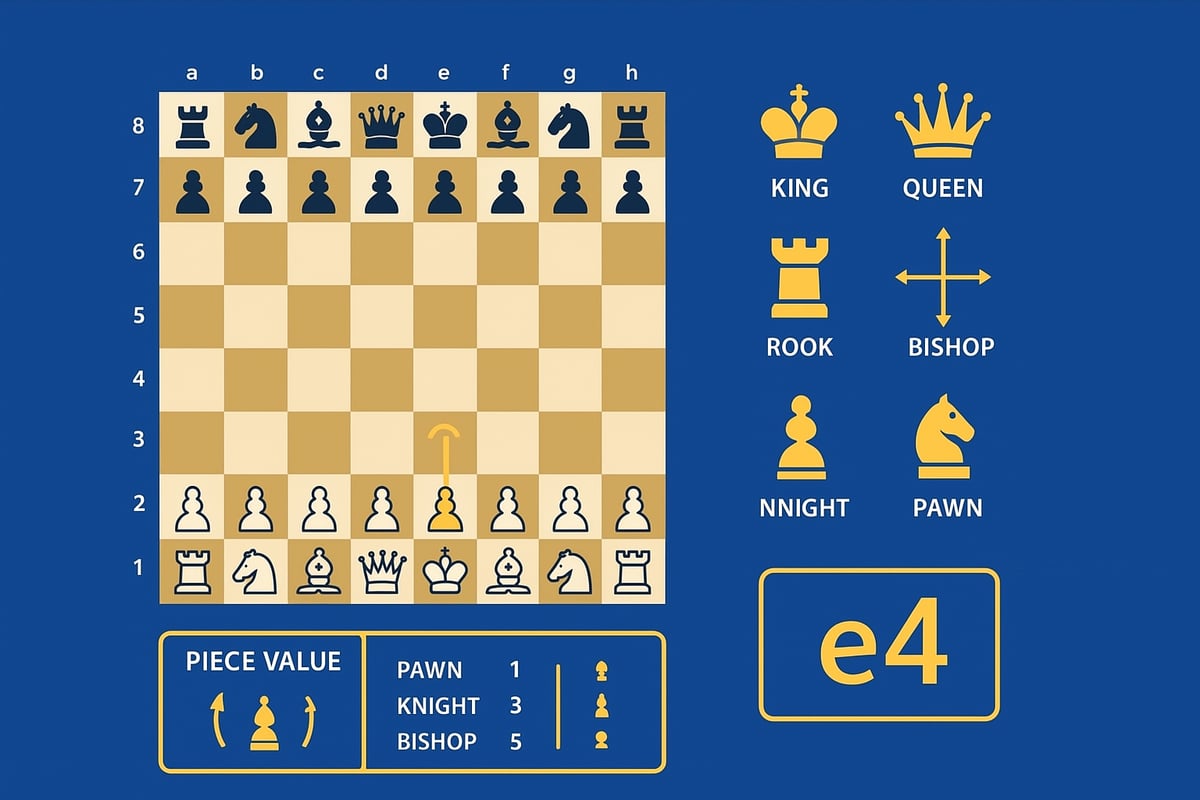
The chessboard is a simple 8x8 grid, totaling 64 squares that alternate between light and dark colors. To set up the board correctly, make sure a light square is in the bottom right corner from your perspective.
Each vertical column is called a "file" (labeled a to h), and each horizontal row is a "rank" (numbered 1 to 8). This labeling system is essential for the basics of chess for beginners, as it helps you pinpoint any square instantly.
For example, the square "e4" is located at the intersection of the e-file and the 4th rank. This square is central and often used in openings because it helps control the board's center. Understanding these coordinates is a foundation for reading chess books and following online games.
Introduction to Chess Pieces
There are six unique pieces in chess: King, Queen, Rook, Bishop, Knight, and Pawn. Each side starts with the same set, so you and your opponent have equal tools at the start of every game.
Here is a quick overview:
- King: The tallest piece, with a cross on top.
- Queen: Slightly shorter than the king, with a rounded crown.
- Rook: Looks like a small castle tower.
- Bishop: Has a pointed top with a notch.
- Knight: Shaped like a horse's head.
- Pawn: The smallest piece, plain and round.
Each player starts with 1 King, 1 Queen, 2 Rooks, 2 Bishops, 2 Knights, and 8 Pawns. Knowing the basics of chess for beginners includes being able to identify these pieces quickly and place them correctly on the board.
Movement Rules for Each Piece
In chess, every piece moves in its own special way. Mastering how they move is a core part of the basics of chess for beginners.
- King: Moves one square in any direction, but never into check.
- Queen: Moves any number of squares diagonally, horizontally, or vertically.
- Rook: Only in straight lines, not diagonally.
- Bishop: Only on diagonals, always on the same color.
- Knight: Makes an "L" shape (two squares in one direction, one in another), and can jump over pieces.
- Pawn: Moves forward one square, but captures diagonally. On its first move, it can go forward two squares.
If you want a handy reference for these moves, check out the How to Play Chess Cheat Sheet, which visually summarizes all the movement rules for quick learning.
Piece Value and Importance
Not all pieces are created equal in chess. Understanding their relative value is a key step in the basics of chess for beginners. Here's a quick table to help:
| Piece | Value |
|---|---|
| Pawn | 1 |
| Knight | 3 |
| Bishop | 3 |
| Rook | 5 |
| Queen | 9 |
These values help you decide when to trade pieces. For instance, losing a queen (9 points) for a pawn (1 point) is almost always a bad idea. Keeping track of material is vital for beginners who want to make smart decisions and avoid simple mistakes.
Piece Placement and Setup
Setting up the board correctly is crucial for the basics of chess for beginners. Place the rooks in the corners, followed by knights next to them, then bishops. The queen goes on her matching color square (white queen on white, black queen on black), and the king takes the remaining spot.
A helpful mnemonic: "Queen on her color." Pawns fill the entire second rank for white and seventh rank for black. Double-check your setup before you start, as even experienced players sometimes make placement mistakes.
Notation Basics
Chess uses "algebraic notation" to record and communicate moves. Each square has a unique label, like "e4" or "d5." A typical opening move looks like this:
1. e4 e5
This means white moved a pawn to e4, and black replied with a pawn to e5. Learning this system is part of the basics of chess for beginners, making it easier to study games and share your progress with others.
Fundamental Rules of Chess
Learning the fundamental rules is the first real step to mastering the basics of chess for beginners. Whether you're playing your very first game or watching a tournament, knowing these rules helps you make sense of every move and outcome. Let's break down each rule in a way that's easy to remember and apply.
Objective of the Game
At its core, the basics of chess for beginners revolve around one goal: checkmating your opponent's king. This means placing the king under attack with no escape.
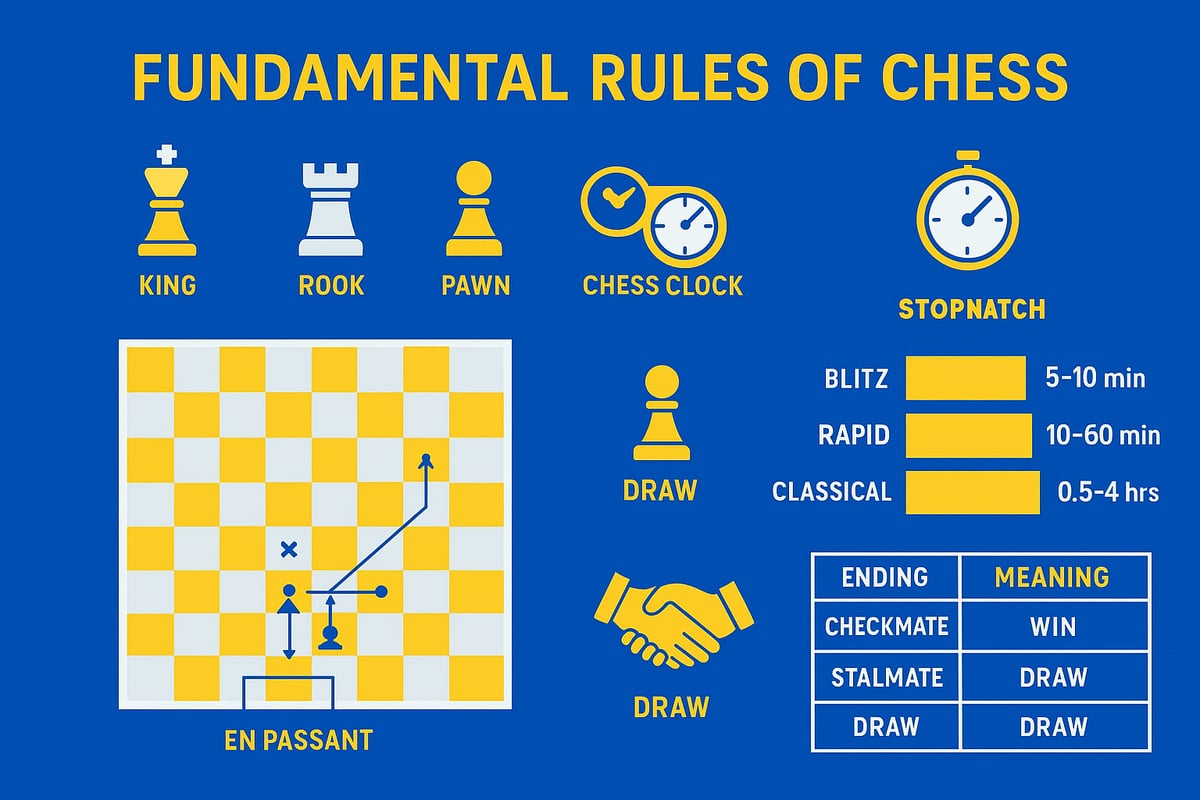
Sometimes, games end without a winner. Stalemate occurs when a player has no legal moves, but their king isn't in check. Other draws can happen too, such as when neither side has enough material to checkmate.
For example, picture a king trapped in the corner, surrounded by its own pawns, with no safe squares left. If it's not in check, that's a stalemate, not a win. Understanding these scenarios is central to the basics of chess for beginners.
Legal and Illegal Moves
In chess, every move must follow strict rules. You can't move your king into check, and you can't make a move that leaves your king attacked. The "touch-move" rule in tournaments means if you touch a piece, you must move it if possible.
Here's a common illegal move: moving your king onto a square threatened by an enemy rook. That's not allowed, and you'll be asked to choose a legal move instead. For more examples and clear explanations, check out Help with Chess Moves, which covers the basics of chess for beginners in detail.

Special Moves: Castling, En Passant, Pawn Promotion
Some moves in chess are unique and may surprise new players. Castling lets you move your king two squares toward a rook, then place the rook beside the king. You can't castle if the king or rook has moved, or if the king is in, moves through, or ends up in check.
En passant is a special pawn capture. If an enemy pawn moves two squares forward from its starting position and lands next to your pawn, you can capture it as if it had only moved one square.
Pawn promotion happens when your pawn reaches the opposite end of the board. You can swap it for a queen, rook, bishop, or knight. These special moves are a crucial part of the basics of chess for beginners.
Check and Checkmate
Check is when your king is under direct threat. You must respond by moving the king, blocking the attack, or capturing the attacking piece. If you can't escape, that's checkmate, and the game ends.
Imagine your king on the back rank, with a queen attacking from the front and all escape squares blocked. This is a textbook example of checkmate. Learning to recognize checks and respond correctly is vital in the basics of chess for beginners.
Draws and Other Endings
Not every chess game ends in victory. Besides stalemate, draws occur through threefold repetition (the same position repeats three times), the fifty-move rule (no capture or pawn move in fifty moves), or if neither side has enough material to checkmate.
Here's a quick table for reference:
| Draw Type | Explanation |
|---|---|
| Stalemate | No legal moves, king not in check |
| Threefold Repetition | Same position appears three times |
| Fifty-move Rule | Fifty moves pass with no pawn move or capture |
| Insufficient Material | Not enough pieces to force a checkmate |
In beginner games, draws are less common, but as you advance, you'll see them more often. This knowledge is part of mastering the basics of chess for beginners.
Timers and Clocks
Chess clocks add excitement and pressure to the game. There are three main types: blitz (fast-paced, usually 3-5 minutes per player), rapid (10-30 minutes), and classical (longer games, often 60+ minutes). Time pressure can lead to mistakes, so beginners should practice at different speeds.
Learning to manage your time is another key skill within the basics of chess for beginners. Try different formats and see which pace helps you think best.
Chess Etiquette and Sportsmanship
Good manners matter in chess. Start and end games with a handshake or a polite message online. If you know you're lost, resign gracefully. Avoid distracting your opponent, and always play fairly.
Online, follow chat rules, offer rematches if games are close, and never cheat. Respect for others is just as important as knowing the basics of chess for beginners.
Essential Opening Principles for Beginners
Learning the basics of chess for beginners always starts with understanding the opening. The first moves you play set the tone for the entire game. If you ever feel lost after just a few moves, you’re not alone. Every grandmaster started as a beginner, and grasping the opening phase is your first real step toward improvement.
The Importance of the Opening Phase
Why do chess coaches stress the opening? Because the basics of chess for beginners hinge on building a solid foundation. The opening is your chance to claim space, develop your army, and keep your king safe. If you skip these steps, you might fall behind quickly, leaving your pieces awkward and your king exposed. Beginners often make the mistake of moving pieces aimlessly, but a good opening gives you a clear plan from the start.
Key Opening Principles
Let’s dive into the golden rules for openings. First, control the center with pawns like e4, d4, e5, or d5. Next, develop your knights and bishops before moving your queen. Castle early to keep your king safe and connect your rooks. Avoid moving the same piece repeatedly or bringing your queen out too soon.
For a deeper look at these principles, check out Chess Opening Principles for Beginners. Applying these basics of chess for beginners will help you avoid common pitfalls and build confidence in your first moves.
Popular Beginner Openings
Curious about which openings to try? The Italian Game is a classic: 1.e4 e5 2.Nf3 Nc6 3.Bc4. It opens lines for your pieces and helps you practice key principles. The Queen’s Gambit (1.d4 d5 2.c4) is another timeless favorite, offering quick development and central control. Beware of quick traps like the Scholar’s Mate, which can catch you off guard. Sticking to these basics of chess for beginners keeps you focused on learning, not memorizing.
Opening Traps and How to Avoid Them
Traps are sneaky tactics that can ruin your game in just a few moves. The Fool’s Mate is the fastest checkmate, but it’s easy to prevent if you know the signs. Watch out for early attacks on f2 and f7 squares—these are vulnerable points for both sides. By sticking to the basics of chess for beginners, you’ll spot traps sooner and defend your position with confidence.
Balancing Attack and Defense
It’s tempting to launch a wild attack from move one, but successful players know how to balance aggression and caution. Overcommitting to attack without proper support leaves your king exposed. Instead, build up your position, develop all your pieces, and be patient. If you focus on the basics of chess for beginners, you’ll learn to recognize when an attack is ready or when it’s time to defend.
Mistakes to Avoid in the Opening
Some mistakes show up in nearly every beginner game: moving the same piece over and over, pushing edge pawns too early, or grabbing material while ignoring development. These errors can cost you time and leave your position weak. Stick to the basics of chess for beginners by developing your army quickly, keeping your king safe, and not chasing pawns at the expense of your plan.
Resources for Learning Openings
Ready to get hands-on? There are tons of books, online videos, and interactive databases that break down openings for new players. Practice openings against computer opponents or friends to build muscle memory. Many sites offer opening trainers and puzzles, making learning the basics of chess for beginners both fun and effective. Challenge yourself with different openings to discover what fits your style.
Chess Cheat Sheets: Visual Opening Guides for Rapid Learning
If you want a shortcut to mastering openings, Chess Cheat Sheets offers visual guides perfect for the basics of chess for beginners. These sheets simplify complex ideas into easy-to-follow diagrams, toolkits, and puzzles. They’re designed for practical use, so you can reference them during games or study sessions. Free samples and bundled resources make it easy to start learning and improve quickly.

Basic Tactics and Strategies Every Beginner Should Know
Chess is more than just moving pieces; it’s a fascinating journey of clever tricks and long-term planning. If you’re looking to master the basics of chess for beginners, understanding both tactics and strategies will help you win more games and enjoy them even more. Let’s break down what you need to know, one step at a time.
Introduction to Chess Tactics
Tactics are the short-term combinations that help you gain material or deliver checkmate. For anyone studying the basics of chess for beginners, learning tactics is like discovering secret weapons on the board. Most beginner games are decided by tactical shots rather than deep strategy.
Imagine you spot a move that attacks two pieces at once, or a sneaky trick that leads to a quick win. That’s the magic of tactics. They’re not just flashy; they’re practical tools that can turn the tide in your favor.
Common Tactical Motifs
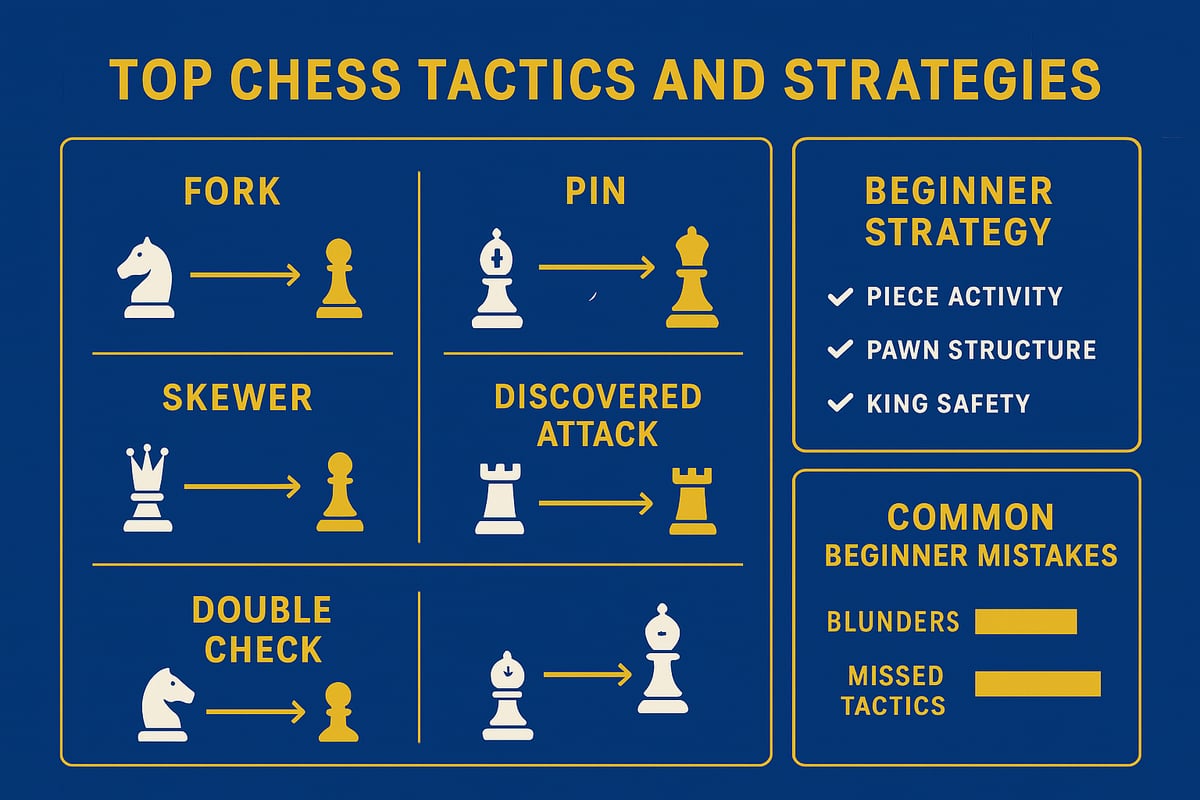
So, what are the most common tactical ideas you’ll need as you learn the basics of chess for beginners? Here are the big ones:
- Forks: One piece attacks two or more enemy pieces at the same time.
- Pins: A piece can’t move without exposing a more valuable piece behind it.
- Skewers: A valuable piece is attacked and, when it moves, something less valuable is captured.
- Discovered Attacks: Moving one piece unleashes a hidden attack from behind.
- Double Checks: Two pieces give check at once, forcing the king to move.
Want to see visuals and more examples? This Essential Chess Tactics for Beginners page offers clear diagrams and explanations to help you recognize these motifs in your next game.
Examples and Practice
Let’s put these tactical motifs into action. Imagine you’re playing a game and spot a fork with your knight. Suddenly, you’re attacking your opponent’s king and rook at once. Or maybe you use a pin, freezing their bishop in place.
Here’s a quick puzzle using code notation:
[FEN "rnbqkbnr/pppppppp/8/8/8/8/PPPPPPPP/RNBQKBNR w KQkq - 0 1"]
1. e4 e5 2. Nf3 Nc6 3. Bb5
This is the start of the Ruy Lopez, where pins and forks often appear. Practicing these patterns helps you spot them fast, which is crucial for mastering the basics of chess for beginners.
Introduction to Chess Strategy
While tactics are like fireworks, strategy is the steady plan behind the scenes. The basics of chess for beginners aren’t complete without understanding why you place your pieces where you do.
Strategy is about long-term goals: keeping your king safe, controlling the center, and making your pieces work together. It’s the difference between reacting to threats and building your own.
Fundamental Strategic Concepts
Some strategic ideas pop up in every game. Here are a few essentials for the basics of chess for beginners:
- Open Files and Diagonals: Rooks and bishops love open lines to move freely.
- Pawn Structure: Watch for doubled, isolated, or backward pawns—they can be weaknesses.
- Creating Weaknesses: Sometimes, pushing a pawn or trading pieces can make your opponent’s position crumble.
Use this table to compare key concepts:
| Concept | Why It Matters | Example |
|---|---|---|
| Open File | Rooks become powerful | Place rook on e-file |
| Strong Pawn Center | Controls key squares | Pawns on e4 and d4 |
| King Safety | Avoid surprise attacks | Castle early |
Combining Tactics and Strategy
The best players blend tactics and strategy seamlessly. Maybe you sacrifice a pawn (a tactical idea) to open up the board for your bishops (a strategic goal). The basics of chess for beginners come alive when you see how a clever move can support your bigger plan.
Picture this: you spot a tactical fork, but only because you set up your position strategically. That’s how you move from just reacting to actually creating your own opportunities.
Training Tactics Effectively
How can you get better at spotting these ideas? Consistent practice is key. Solve puzzles daily, review your games, and use online tools that reinforce the basics of chess for beginners.
Puzzles focus your mind on patterns, so the next time a fork or pin appears, you’ll see it in a flash. Many chess websites and apps are perfect for sharpening your tactical eye, even on the go.
Step-by-Step Guide: Playing Your First Chess Game
Ready to play your very first chess game? Let’s break down the basics of chess for beginners into simple, actionable steps. You’ll learn how to set up the board, make your first move, develop your pieces, protect your king, spot threats, checkmate your opponent, and review your play. By following these steps, you’ll build confidence and enjoy your chess journey from the very start.
Step 1: Setting Up the Board Correctly
Before your first move, make sure the chessboard is set up right. Place the board so a white square is at your bottom-right corner. Each player lines up their pieces on the two rows closest to them. The back row, from left to right, is rook, knight, bishop, queen, king, bishop, knight, rook. The second row is filled with pawns.
A common beginner mistake is placing the queen on the wrong color. Remember this trick: the queen always goes on her matching color square. Getting this step right sets a solid foundation for learning the basics of chess for beginners.
Step 2: Making the First Move
With the board ready, it’s time for the opening move. Most beginners start with 1.e4 or 1.d4, advancing a central pawn two squares forward. These moves open lines for your pieces and control the center, which is key to a strong start.
How do you decide between them? 1.e4 leads to open, tactical games, while 1.d4 often brings slower, strategic battles. Don’t worry too much, just pick one and focus on learning the basics of chess for beginners as you play. Over time, you’ll get a feel for what suits your style.
Step 3: Developing Pieces Efficiently
After your first move, focus on bringing out your knights and bishops. Don’t move the same piece repeatedly in the opening. Avoid making too many pawn moves or bringing your queen out early, which can make you a target.
Good development means your pieces are active and ready to support each other. This step is essential for anyone studying the basics of chess for beginners. Prioritize development over quick attacks, and your games will instantly improve.
Step 4: Castling and King Safety
Castling is a special move that helps protect your king and connects your rooks. You can castle kingside or queenside, but only if neither the king nor the rook has moved, and the squares between them are empty and not attacked.
Try to castle early in the game. This simple habit keeps your king safe and prepares your rooks for action. In the basics of chess for beginners, learning to value king safety can mean the difference between victory and defeat.
Step 5: Spotting and Responding to Threats
Always be on the lookout for threats to your pieces, both direct and indirect. If your opponent attacks, ask yourself: can I move, defend, or counterattack? Basic tactics like forks, pins, and skewers can appear suddenly.
To sharpen your skills, practice with puzzles and real-game scenarios. For step-by-step help, check out Improve Your Positional Skills to reinforce the basics of chess for beginners and spot threats faster in your games.
Step 6: Executing a Simple Checkmate
Once you’ve developed your pieces and kept your king safe, aim for a basic checkmate. The two most common patterns are the two-rook checkmate and the king-and-queen checkmate. Use your pieces together to limit the enemy king’s movement and deliver checkmate on the edge of the board.
Practice these patterns until you can do them confidently. Mastering simple checkmates is a key milestone in the basics of chess for beginners and will help you finish games with confidence.
Step 7: Reviewing and Learning from Your Game
After the game, take a few minutes to review what happened. Did you miss any threats or overlook a checkmate? Use online tools to analyze your moves and spot mistakes. This habit helps you improve quickly and enjoy chess even more.
Looking for more ways to build on the basics of chess for beginners? Explore Free Chess Books for Beginners for downloadable guides and practical advice to deepen your understanding and sharpen your skills.
Next Steps: Resources and Communities for Beginner Chess Improvement
Starting your chess journey is exciting, but real progress comes from connecting with resources and communities that nurture your growth. Whether you want to play daily, study theory, or meet fellow enthusiasts, there is a world of opportunities to explore. Let’s break down exactly where to go next as you master the basics of chess for beginners.
Online Chess Platforms for Practice
If you want to put the basics of chess for beginners into action, online platforms are your best friend. Sites like Chess.com, Lichess, and Chess24 let you play games against real people or bots at any time.
You can solve puzzles, join tournaments, and track your improvement automatically. These platforms offer beginner-friendly interfaces and allow you to review your games instantly. You will also find forums, clubs, and leaderboards to connect with others.
Many beginners start here to gain experience fast, and you can play at your own pace, whether you have five minutes or an hour.
Books and Courses for Beginners
There are countless resources to help you master the basics of chess for beginners. Classic books like "Bobby Fischer Teaches Chess" or "Chess for Dummies" break down concepts in simple language.
Online video courses and tutorials make learning interactive and visual. If you want a structured approach to strategy, the Chess Strategy Study Plan for Beginners is an excellent place to start, offering step-by-step lessons on planning and piece play.
Mixing books with video content can help solidify your understanding and keep you motivated.
Chess Clubs and Local Communities
Joining a chess club can supercharge your experience with the basics of chess for beginners. Clubs offer in-person play, coaching, and a chance to meet players of all levels.
You can participate in local tournaments, attend workshops, and get instant feedback on your games. Search for clubs at schools, libraries, or community centers—many welcome absolute beginners.
If in-person options are limited, look for online clubs and meetups, where you’ll find a supportive environment and plenty of advice.
Tracking Your Progress
Tracking your journey is key when learning the basics of chess for beginners. Most online platforms assign you a rating that changes as you win or lose games.
You can set personal milestones, like reaching a certain rating or mastering a specific tactic. Keep a journal or digital log of your games and lessons learned.
Reviewing your progress helps identify patterns, strengths, and weaknesses, making your practice more focused and rewarding.
Leveraging Technology for Improvement
Technology is a game-changer for anyone studying the basics of chess for beginners. Chess engines like Stockfish and Leela Chess Zero can analyze your games and suggest improvements.
Many mobile apps offer bite-sized practice sessions and tactical drills on the go. Use built-in analysis tools to spot mistakes and learn from grandmaster-level suggestions.
Combining human study with computer analysis helps you develop both intuition and accuracy, speeding up your improvement.
Social Media and Streaming
Chess is more social than ever, and social media is a fantastic way to stay inspired as you learn the basics of chess for beginners. Follow top streamers on Twitch or YouTube for live commentary, lessons, and fun challenges.
Join Reddit communities, Discord servers, or Facebook groups to ask questions and share your progress. Watching others play and interact can give you fresh ideas and new ways to approach your own games.
Building a Consistent Practice Routine
Consistency is the secret ingredient in mastering the basics of chess for beginners. Start by playing a few games each week, mixing in tactics puzzles and video lessons.
Create a simple schedule: maybe 20 minutes of puzzles on weekdays, games on weekends, and a review session on Sunday. Setting small, achievable goals will keep you motivated and prevent burnout.
Remember, steady practice beats cramming—progress is all about building good habits.
So, now that you’ve got a solid grasp on the basics and you’re itching to play your first real games, what’s the best next step? If you want to see real improvement fast (without getting lost in endless theory), openings are honestly where most beginners gain or lose ground. I’ve been there—wondering which moves actually set me up for success. The good news? You don’t have to figure it out alone. Dive into practical, easy-to-follow resources that make learning fun and straightforward. Ready to level up your game? Start Improving Your Openings and see how much smoother your next chess match can be!


