

Ever wondered how to shake up your opponents from move one and create tactical chaos right from the start? The alekhine defense is one of the most provocative and psychologically demanding openings in chess. Named after the legendary fourth World Champion Alexander Alekhine, this hypermodern defence deliberately invites White to build a massive pawn centre, only to attack it relentlessly from the flanks. It's not for the faint-hearted, but if you're looking for dynamic positions with plenty of tactical opportunities, you've come to the right place.
Understanding the Core Concept Behind the Alekhine Defense
What makes the alekhine defense so unique? After 1.e4 Nf6, Black immediately attacks White's central pawn with the knight. This seems straightforward enough, but here's where it gets interesting. White's natural response is to chase the knight with 2.e5 Nd5, and then White can continue building pawns in the centre with moves like 3.d4 and 4.c4.
Your friends might look at the board and think you've lost your mind. Why would anyone willingly allow their opponent to establish such a dominant-looking pawn centre? The answer lies in the hypermodern principles that revolutionised chess thinking in the early 20th century.
The Hypermodern Philosophy in Action
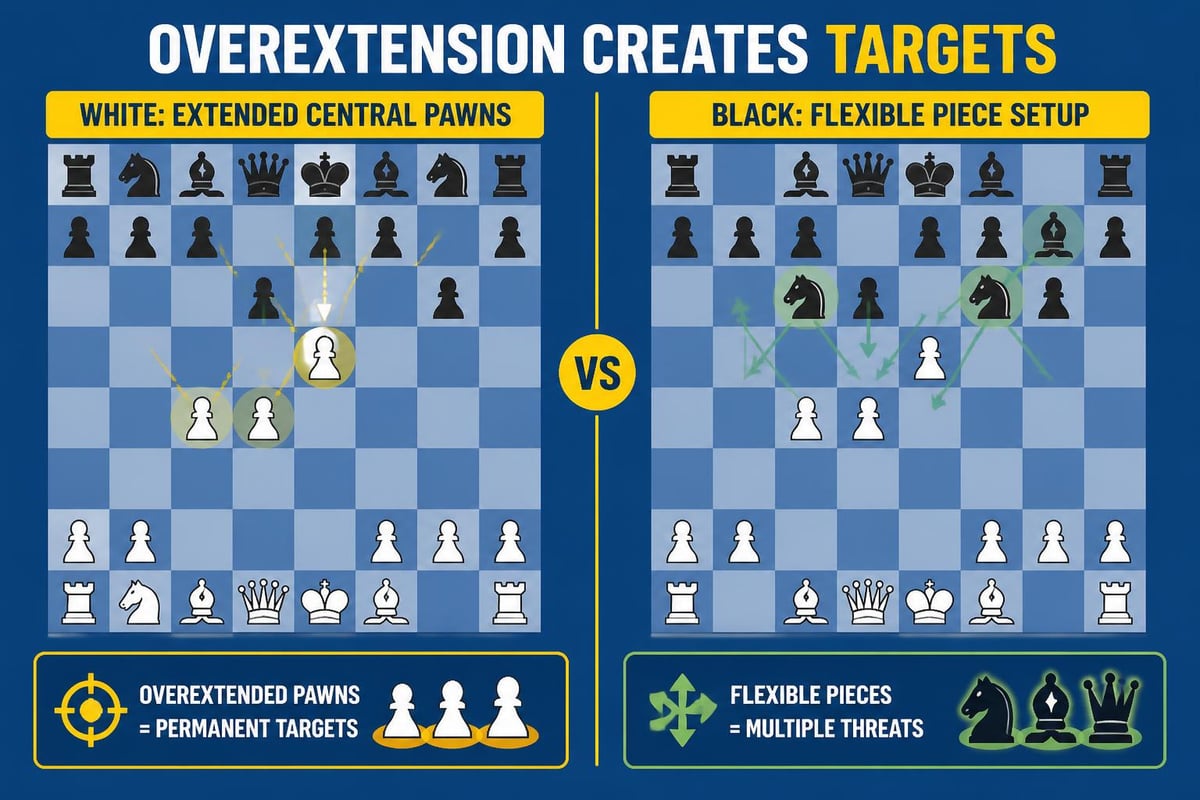
Traditional chess wisdom suggested that controlling the centre with pawns was paramount. But the alekhine defense turns this on its head. Instead of occupying the centre, Black aims to control it from a distance whilst encouraging White to overextend.
Think of it like a strategic trap. White's pawns advance with great enthusiasm, looking impressive and powerful. But pawns can't move backwards, and each advance creates potential weaknesses. Your job as Black is to identify those weaknesses and exploit them ruthlessly.
Main Line Variations You Need to Know
The alekhine defense branches into several key variations after the initial moves. Understanding these different paths is crucial for mastering chess openings effectively.
The Four Pawns Attack
This is the most aggressive approach White can take. After 1.e4 Nf6 2.e5 Nd5 3.d4 d6 4.c4 Nb6 5.f4, White establishes four pawns in the centre. Intimidating? Absolutely. Unbeatable? Far from it.
Here's what you need to consider:
- White's centre looks impressive but becomes a target
- Black often plays ...dxe5, opening lines to attack the pawn chain
- Piece activity becomes crucial for both sides
- Tactical opportunities abound due to the sharp nature of the position
The Four Pawns Attack requires accurate play from both sides. One misstep and the position can unravel quickly. That's exactly what makes it exciting for tactical players who enjoy the Alekhine Defense.

The Exchange Variation
After 1.e4 Nf6 2.e5 Nd5 3.d4 d6 4.c4 Nb6 5.exd6, White exchanges pawns immediately. This variation is less theoretical and often leads to more straightforward positions.
| White's Advantages | Black's Compensation |
|---|---|
| Simpler pawn structure | Active piece play |
| Less theoretical knowledge required | Development advantage |
| Solid central control | Dynamic counterplay |
The Exchange Variation might seem less critical, but don't underestimate it. Many strong players use it to avoid the main theoretical lines whilst maintaining a comfortable position.
The Modern Variation
The Modern Variation (1.e4 Nf6 2.e5 Nd5 3.d4 d6 4.Nf3) is currently the most popular choice at the highest levels. White develops naturally before committing to c4.
This flexible approach means:
- White keeps options open for pawn structure
- Black must be prepared for various setups
- The resulting positions are strategically rich
- Both sides have chances for advantage
You'll find this variation covered extensively in the comprehensive Alekhine's Defense guide, which breaks down the key ideas and typical plans.
Strategic Plans for Both Colours
Now let's talk strategy. What are you actually trying to achieve in the alekhine defense, and how should White respond?
Black's Strategic Objectives
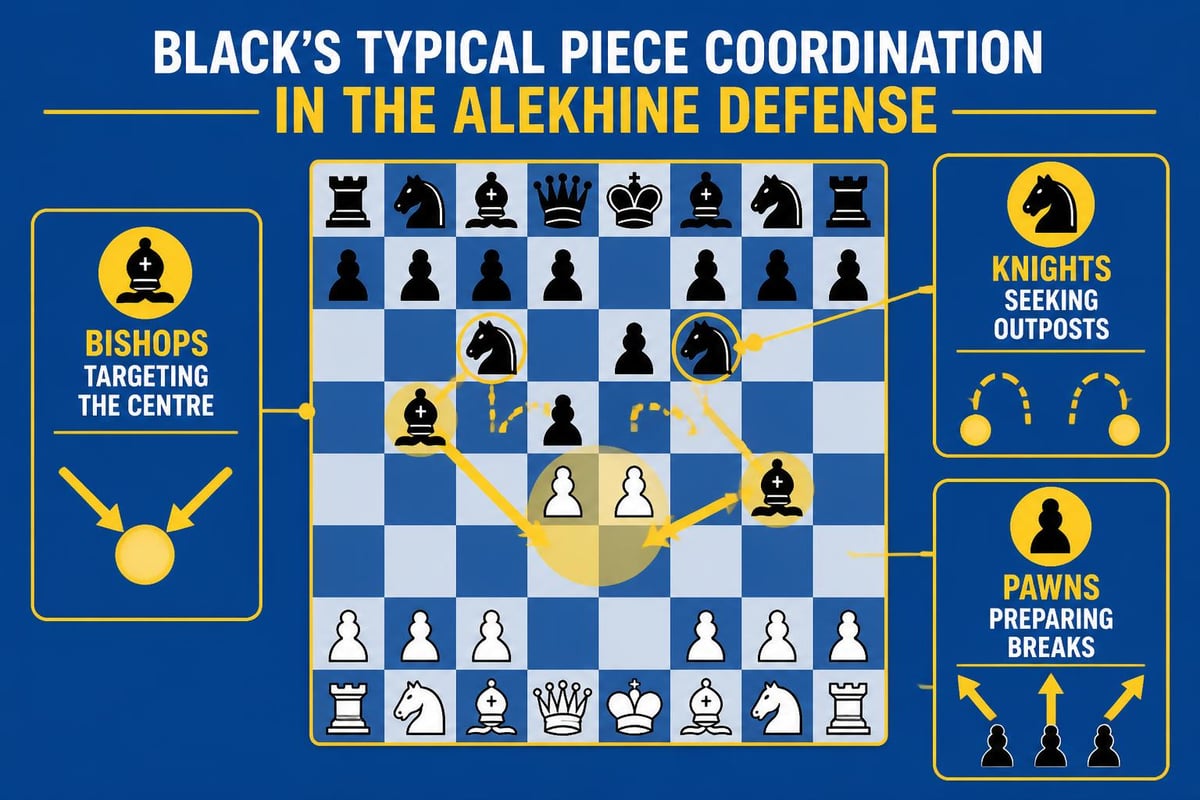
Your primary goal as Black is to prove that White's pawn centre is a liability rather than an asset. But how exactly do you accomplish this?
Undermining the Centre: Use pawn breaks like ...c5 or ...f6 to challenge White's pawn chain directly. Timing is everything here. Strike too early and your position collapses; wait too long and White consolidates.
Piece Activity Over Material: Sometimes you'll need to sacrifice material to keep White's king in the centre or to activate your pieces. The alekhine defense rewards brave, tactical play.
Exploiting Weaknesses: Those advanced pawns create squares that White can no longer control. Look for outposts on d5, e4, or f5 where your knights can settle comfortably.
White's Game Plan
If you're facing the alekhine defense as White, you need a clear plan to justify your space advantage. Simply pushing pawns aimlessly won't cut it.
Your strategy should include:
- Maintaining the centre whilst developing pieces harmoniously
- Preventing Black's pawn breaks through accurate piece placement
- Creating threats that force Black into passive defence
- Converting space into a lasting advantage through piece coordination
The challenge for White is balancing aggression with solid development. Push too hard and your position becomes riddled with holes. Play too cautiously and Black equalises effortlessly.
Common Tactical Themes and Traps
The alekhine defense is rich with tactical motifs that every player should recognise. Missing these patterns can turn a promising position into a disaster within a few moves.
Early Knight Forks
Because the knight starts on f6 and often ends up on d5, fork possibilities emerge naturally. Watch for tactics involving Nc3-b5 or Nd5-b4, hitting multiple pieces simultaneously.
Central Pawn Breaks
When Black plays ...c5 or ...f6, these moves often come with tactical justification. The pawn break might be supported by a pin, a discovered attack, or a piece sacrifice that demolishes White's centre.
Piece Sacrifices for Attack
The dynamic nature of the alekhine defense means that piece sacrifices for attack occur regularly. Knights on d5 might sacrifice themselves on f4 or b4. Bishops might land on h3 or a6 with devastating effect.
Here's a typical tactical sequence:
- Black plays ...c5, attacking the d4 pawn
- White defends with Nc3
- Black continues ...cxd4, opening the c-file
- After Nxd4, Black has ...Nc6, creating multiple threats
- The position explodes into tactical complications
These aren't random tactics. They're logical consequences of the opening's structure. Understanding the typical patterns in chess openings helps you spot these opportunities faster.
Comparing the Alekhine Defense to Other Black Defences
How does the alekhine defense stack up against other responses to 1.e4? Let's examine the key differences.
| Opening | Pawn Structure | Tactical Complexity | Theoretical Depth |
|---|---|---|---|
| Alekhine Defense | Asymmetrical, dynamic | Very high | Moderate |
| French Defense | Closed, strategic | Moderate | Very high |
| Caro-Kann Defense | Solid, symmetrical | Low to moderate | High |
| Sicilian Defense | Asymmetrical | High | Extremely high |
If you've been reading about the Caro-Kann vs French Defense debate, you'll notice the alekhine defense offers something different. It's less theoretical than the Sicilian, more provocative than the Caro-Kann, and demands tactical alertness from move one.
Practical Advice for Club Players
Right, let's get practical. How should you actually implement the alekhine defense in your games?
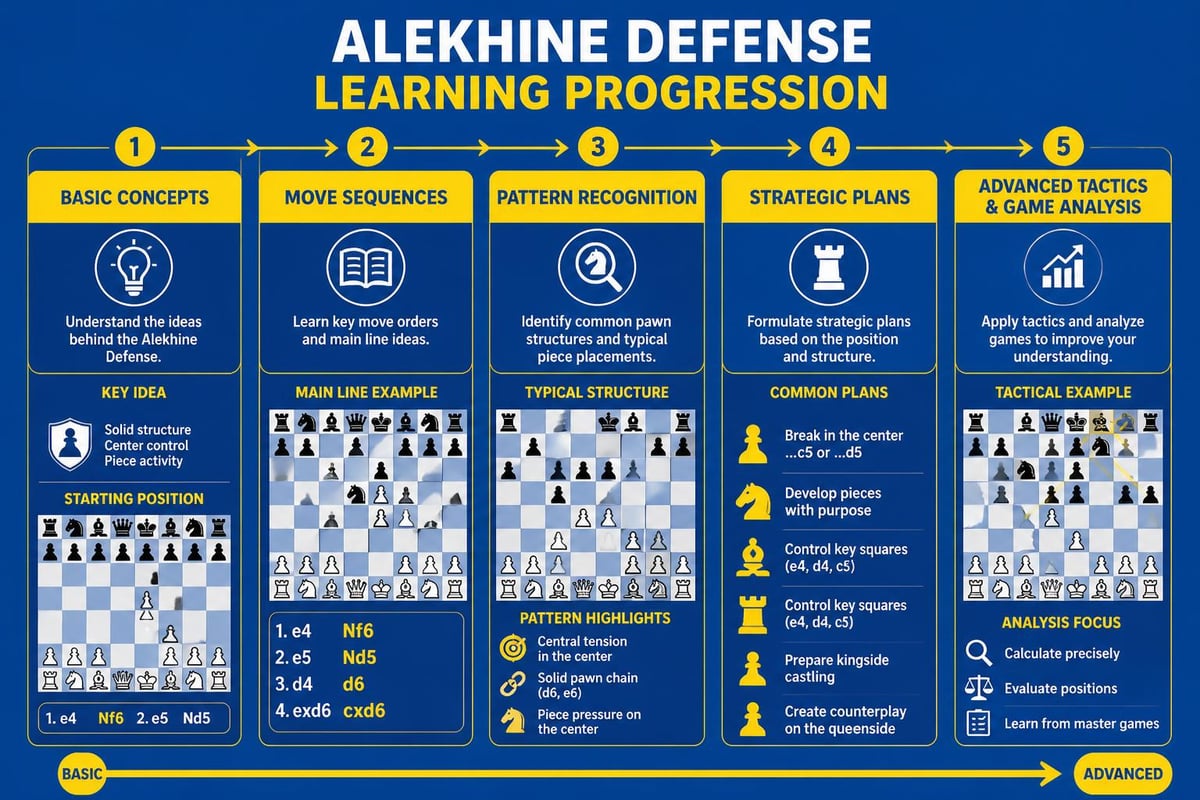
Start with the Main Lines
Don't begin by studying obscure sidelines. Focus on understanding the Four Pawns Attack and the Modern Variation first. These appear most frequently and teach you the essential ideas.
Master these fundamental concepts:
- How to react when White builds a large pawn centre
- Where to place your pieces for maximum activity
- Which pawn breaks work in different structures
- Common tactical patterns specific to this opening
Study Annotated Games
Reading through games where strong players employed the alekhine defense provides invaluable insight. You'll see how they handled various White setups, where they created counterplay, and which mistakes to avoid.
The historical significance of the Alekhine's Defense showcases how world-class players have used this opening to achieve remarkable victories.
Practice with Purpose
Simply playing the alekhine defense without understanding isn't enough. After each game, analyse what went right and wrong. Did you challenge the centre at the right moment? Were your pieces coordinated? Did you spot the tactical opportunities?
Consider these training methods:
- Solve tactical puzzles from Alekhine Defense positions
- Play training games focusing on specific variations
- Review your games with stronger players or engines
- Memorise key theoretical positions, not just moves
When Should You Play the Alekhine Defense?
Every opening has its ideal circumstances. When does the alekhine defense make the most sense?
Against aggressive opponents: If your opponent loves to attack and push pawns forward, they're likely to overextend in the Alekhine. This plays right into your hands.
When you want unbalanced positions: Drawing isn't your goal? The alekhine defense creates the kind of imbalanced positions where both sides have winning chances.
In shorter time controls: The tactical nature of this opening means that opponents often burn time trying to find the best continuation. This works brilliantly in blitz and rapid games.
When avoiding mainstream theory: Tired of facing the same Ruy Lopez or Italian Game preparation? The alekhine defense offers fresh positions with less computer-memorised theory.
However, there are situations where you might want to avoid it:
- When you need a safe draw with Black
- Against opponents who play very solidly and avoid complications
- In must-win situations where you prefer having more control
- When facing a well-prepared specialist in this opening
Modern Perspectives and Computer Analysis
The chess engine revolution has changed how we view many openings. What does modern analysis tell us about the alekhine defense?
Interestingly, while engines initially dismissed the opening as slightly worse for Black, deeper analysis reveals that Black's compensation is very real. The research on how AlphaZero evaluates chess openings shows that even super-strong AI struggles to crack Black's position with perfect play.
Key Computer Discoveries
Recent engine analysis has uncovered several interesting findings:
- Many "refuted" lines actually offer adequate compensation
- The Four Pawns Attack isn't as crushing as once believed
- Certain move orders give Black better chances than previously thought
- Positional sacrifices often work better than tactical ones
This doesn't mean you should rely entirely on engine recommendations. Understanding the ideas remains more important than memorising computer moves, especially for players below master level.
Building Your Repertoire Around the Alekhine Defense
If you've decided to add the alekhine defense to your arsenal, how should you construct your repertoire?
Essential Variations to Study
You can't learn everything, so prioritise these lines:
- Against 2.e5: This is the critical line. Know how to handle the Modern Variation and Four Pawns Attack.
- Against 2.Nc3: The Vienna Game setup. Have a solid response prepared.
- Against 2.d3: The King's Indian Attack approach. Understand the resulting pawn structures.
Complementary Openings
The alekhine defense works well alongside certain other openings in your repertoire. Consider pairing it with:
- The Scandinavian Defense for variety against 1.e4
- The King's Indian Defense against 1.d4, which shares hypermodern principles
- The Dutch Defense for an aggressive alternative against 1.d4
This combination gives you fighting chances with Black across different opponent strategies whilst maintaining thematic consistency in your chess understanding.
Psychological Aspects of Playing the Alekhine Defense
Let's talk about the mental game. The alekhine defense isn't just about moves on the board; it's about psychological warfare.
Disrupting Opponent Preparation
Most players prepare main lines like the Ruy Lopez or Italian Game. When you play 1...Nf6 after 1.e4, you've immediately taken them into less familiar territory. This psychological edge can be worth half a point in practical play.
Watch your opponent's clock. Are they thinking longer than usual? That's a good sign you've successfully disrupted their preparation.
Managing the Complexity
The alekhine defense creates positions where both sides need to calculate accurately. This can be mentally taxing. Train yourself to:
- Stay calm when facing an intimidating pawn centre
- Trust your understanding of the position's dynamics
- Calculate forcing sequences completely before committing
- Recognise when to simplify versus when to maintain tension
Confidence Through Preparation
Nothing builds confidence like thorough preparation. When you understand why you're allowing White's pawn advances, you'll play with conviction rather than doubt. Study the comprehensive resources available, including the detailed overview of Alekhine's Defense variations, to build that confidence.
Resources for Deeper Study
Ready to take your alekhine defense knowledge further? Here are some excellent resources:
Books and Videos: Look for materials by specialists in this opening. Annotated game collections featuring Alekhine himself provide historical context and practical examples.
Online Databases: Study recent games by strong players who employ this defence regularly. Notice how they handle different White setups and which new ideas they're testing.
Training Positions: Set up critical positions on a board and play them against friends or online. This active learning solidifies your understanding far better than passive study.
For a structured approach to improving your overall chess game while studying specific openings, explore the various chess resources available to modern players.
Final Thoughts on Mastering This Opening
The alekhine defense represents a bold, uncompromising approach to chess. It demands courage, tactical vision, and a willingness to embrace complexity. Not every player will feel comfortable with its provocative nature, and that's perfectly fine.
But if you're drawn to dynamic positions where accurate calculation and strategic understanding matter more than memorised theory, this opening might become a powerful weapon in your repertoire. The key is patient study, regular practice, and a willingness to learn from both victories and defeats.
Remember that even world champions have struggled to crack the alekhine defense with perfect play. Your opponents at the club level certainly won't find it easy. Give yourself time to understand the nuances, and you'll discover a fascinating opening that rewards creativity and fighting spirit.
The beauty of the alekhine defense lies not in forcing a quick advantage but in creating the kind of rich, complex positions where superior understanding and tactical alertness decide the game. That's exactly where improvement happens, and where the most memorable games unfold.
The Alekhine Defense offers a refreshing alternative to mainstream chess theory, combining tactical fireworks with deep strategic content that rewards dedicated study. Whether you're looking to expand your opening repertoire or searching for a fighting weapon that catches opponents off guard, this hypermodern defence delivers exactly what tactical players crave. Chess Cheat Sheets provides comprehensive guides and streamlined resources that help you master the Alekhine Defense and other challenging openings without drowning in endless theory, giving you the confidence to play dynamic chess from move one.


