


4 Person Chess: Rules, Strategy & Getting Started
You've mastered the Sicilian Defence, studied your endgames, and conquered countless opponents across the 64 squares. But have you ever wondered what happens when you add two more players to the mix? 4 person chess flips everything you know about traditional chess on its head, creating a dynamic, unpredictable battlefield where alliances shift, tactical opportunities multiply, and the strategic depth reaches entirely new dimensions. This variant isn't just about moving pieces anymore; it's about reading three opponents simultaneously, coordinating with teammates, and adapting to a constantly evolving board state that would make even the most experienced players rethink their approach.
What Exactly Is 4 Person Chess?
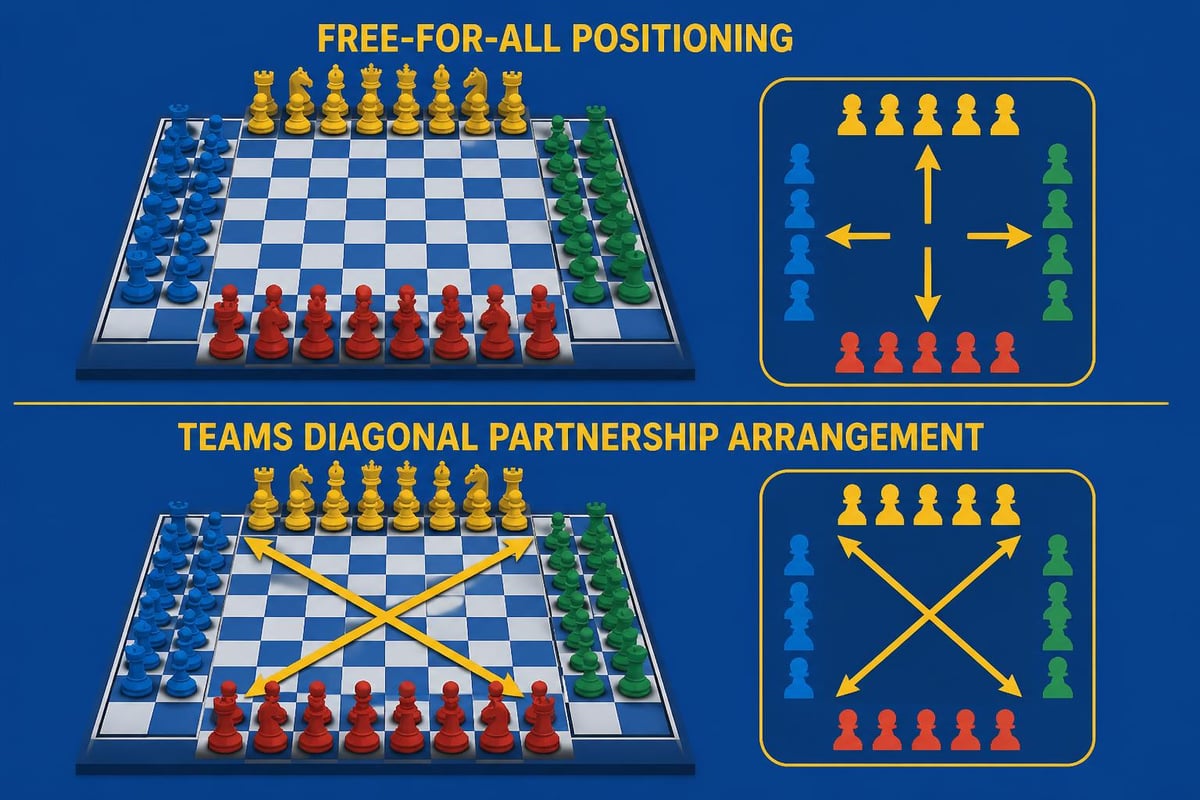
Traditional chess pits two minds against each other in a battle of wits and calculation. 4 person chess expands this concept by introducing either four individual players competing in a free-for-all format or two teams of two players working together towards victory.
The game uses a specially designed board with four armies positioned at each cardinal direction. Unlike the standard 8x8 board you're familiar with, most 4 player chess variations employ a unique cross-shaped or extended board configuration that accommodates all four sets of pieces.
Each player controls a full set of chess pieces in their designated colour, typically red, blue, yellow, and green. The armies start in their respective corners or sides, and gameplay proceeds clockwise around the board.
The Two Main Game Modes
When you're diving into 4 person chess, you'll encounter two primary formats:
Free-for-All Mode
- Every player fights for themselves
- Last player with their king on the board wins
- Points awarded for capturing pieces and delivering checkmate
- Alliances are temporary and purely strategic
Teams Mode
- Two partnerships compete (typically diagonal opponents)
- Partners coordinate strategy and protect each other
- Victory requires checkmating both opposing kings
- Communication and teamwork become essential
The choice between these modes fundamentally alters your strategic approach. In teams, you're protecting your partner whilst simultaneously attacking two opponents. In free-for-all, you're constantly assessing which player poses the greatest immediate threat whilst avoiding becoming everyone's target.
Understanding the Rules and Mechanics
Right, let's tackle the specifics. The basic movement rules remain largely unchanged from traditional chess. Your knights still jump in their L-shape, bishops slide diagonally, and pawns trudge forward (with some notable exceptions we'll discuss).
Pawn Promotion Zones Pawns can promote when reaching any of the three opposing sides of the board. This creates multiple promotion threats simultaneously, dramatically increasing tactical complexity. Understanding basic chess principles becomes even more crucial when you're tracking pawn advancement on multiple fronts.
Check and Checkmate Variations Here's where things get interesting. In team play, special checkmate rules apply:
| Checkmate Type | Description | Points/Outcome |
|---|---|---|
| Standard Mate | You checkmate an opponent | Inherit their pieces and points |
| Partner Mate | Your teammate delivers mate | Points split between partners |
| Double Check | Checked by both opponents | Must escape both threats simultaneously |
When you checkmate an opponent in free-for-all, you don't just eliminate them. According to the 4 player chess rules on Chess.com, you inherit their army, controlling both your original pieces and theirs. This mechanic creates dramatic power swings mid-game.
Castling and Special Moves
Castling works similarly to traditional chess, but with added considerations. You must ensure no opponent's pieces attack the squares your king crosses. With three potential attackers, this becomes significantly trickier.
En passant captures function normally, but remember that pawns might be advancing from three different directions toward your position. Stay alert for these tactical opportunities from unexpected angles.
Strategic Fundamentals for Multiplayer Chess
Your standard chess opening repertoire won't translate directly to 4 person chess. The strategies that work brilliantly against a single opponent often crumble when facing three simultaneous threats.
Early Game Priorities
- Develop pieces toward the centre
- Establish king safety quickly
- Monitor all three opponents' development
- Avoid becoming the primary target
The centre control principle remains vital, but now you're competing with three others for the same key squares. This creates fascinating tension in the opening phase.

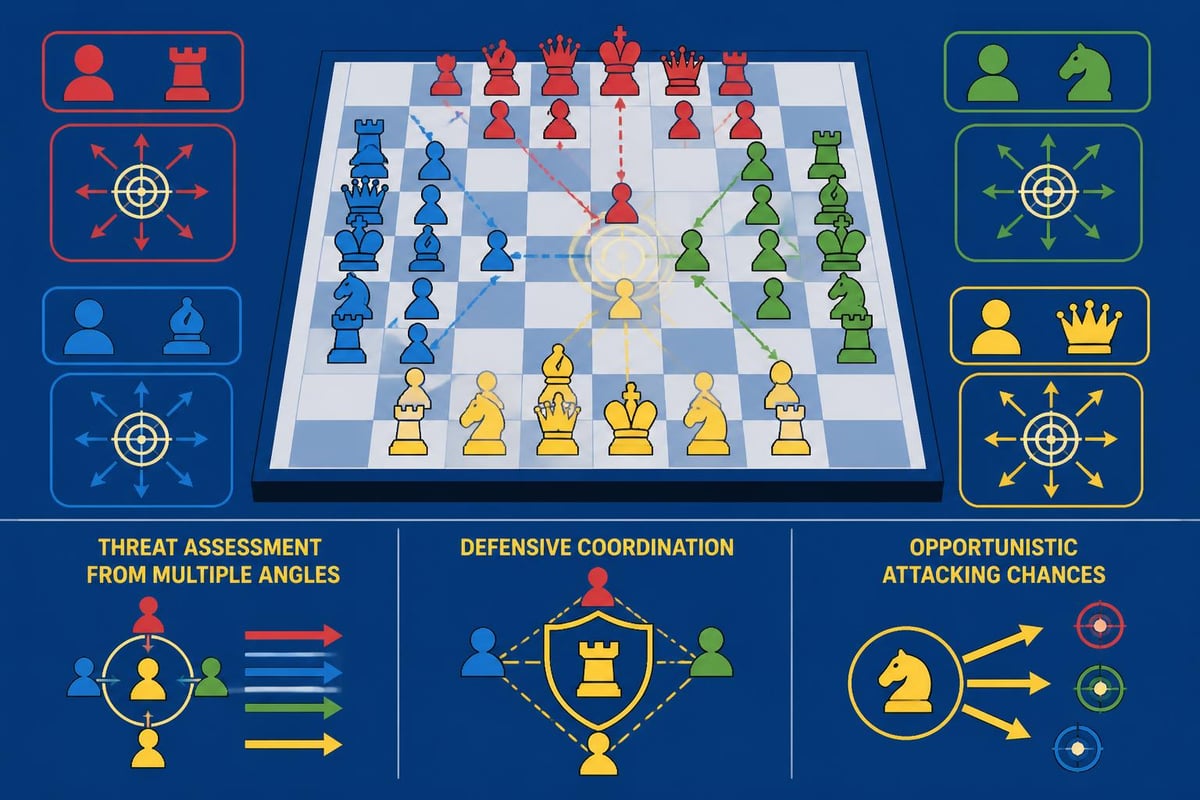
Targeting and Threat Assessment
One of the most critical skills you'll develop is deciding which opponent to attack. Targeting the strongest player might seem logical, but it often backfires. You'll find yourself weakened whilst the other two opponents strengthen unopposed.
Instead, consider these factors:
- Weakest defensive position: Attack the player most vulnerable to immediate threats
- Point standings: In free-for-all, pursue whoever's ahead
- Piece activity: Target the opponent with the least developed position
- Alliance dynamics: Break up any informal partnerships forming against you
The psychological element intensifies dramatically. You're not just calculating variations, but reading three opponents' intentions simultaneously. Developing strong chess fundamentals gives you the foundation to process this complexity.
Team Play Dynamics and Coordination
Playing 4 person chess with a partner introduces an entirely new dimension. You're no longer solely responsible for your survival; you're part of a coordinated unit.
Communication Strategies Whilst you can't explicitly tell your partner which moves to make, you can signal intentions through piece placement and development patterns. Experienced teams develop a shared tactical language that doesn't require words.
Division of Responsibilities
Successful partnerships often assign informal roles:
| Role | Primary Function | Strategic Focus |
|---|---|---|
| Aggressor | Initiates attacks | Pressure opposing kings |
| Defender | Protects partner | Maintains solid structure |
| Opportunist | Exploits weaknesses | Tactical strikes when available |
| Coordinator | Balances both | Adapts to game state |
These aren't rigid positions. You'll switch roles constantly based on the evolving situation. The key is ensuring both partners aren't simultaneously overextending in aggressive positions.
Protecting Your Partner's King Your partner's king safety is as crucial as your own. If either king falls, your team loses. This means you'll often sacrifice material to defend your partner's position, trusting they'll reciprocate when you need support.
Consider piece trades differently in team play. Trading your queen for an opponent's queen might weaken you individually but strengthens your team if it removes a major attacking piece threatening your partner.
Tactical Patterns Unique to Four Players
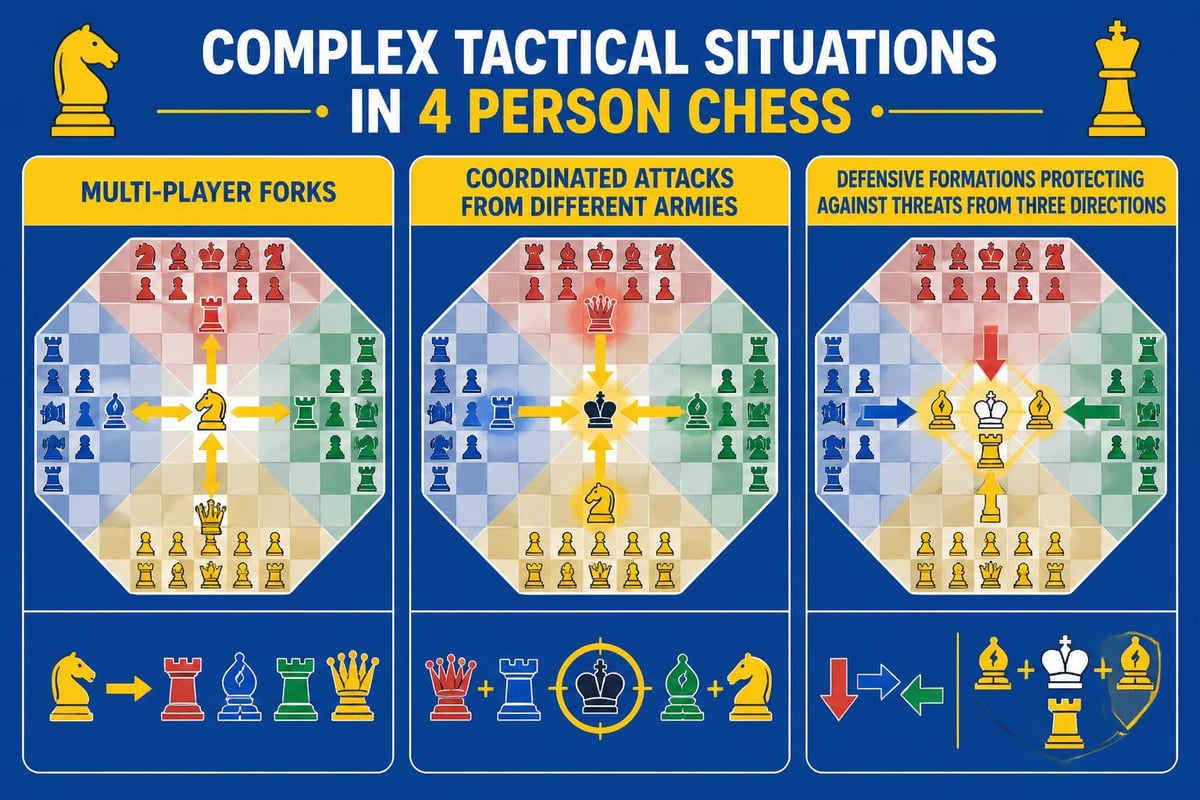
Traditional chess tactics like pins, forks, and skewers all exist in 4 person chess, but they manifest with added complexity. A knight fork might simultaneously attack pieces from two different opponents. A discovered check could come from an unexpected angle whilst you're focused on another threat.
Multi-Directional Attacks The most powerful tactical motif in 4 person chess involves coordinating threats from multiple directions simultaneously. When two or more players attack the same king, defensive resources stretch dangerously thin.
You'll encounter situations where you can deliver check whilst another opponent's piece also attacks the king. These compound threats are extraordinarily difficult to defend against, often leading to quick checkmates.
Common Tactical Mistakes
Beginners often fall into these traps:
- Focusing too intensely on one opponent whilst ignoring the others
- Overextending pieces without adequate defensive support
- Failing to track pawn promotion threats from multiple directions
- Neglecting king safety in pursuit of aggressive attacks
- Missing backwards attacks from the player behind you
The tactical principles you've learned in standard chess still apply, but you must apply them omnidirectionally. That beautiful attack you're preparing might leave you vulnerable to an assault from behind.
Point Scoring and Winning Strategies
In free-for-all 4 person chess, the scoring system adds another strategic layer. You earn points for capturing pieces and delivering checkmate, making your approach more nuanced than simple survival.
Point Values
- Pawn: 1 point
- Knight/Bishop: 3 points
- Rook: 5 points
- Queen: 9 points
- Checkmate: 20 points plus all opponent's remaining pieces
This scoring encourages aggressive play whilst balancing risk. Should you sacrifice material for a checkmate opportunity? The points might justify it, even if you weaken your position against the remaining players.
Endgame Considerations
4 person chess endgames rarely resemble traditional endings. You might face a situation with three players remaining, each with vastly different material counts. The player with the most pieces isn't necessarily winning if they're everyone's primary target.
Position matters more than material in these complex endgames. A coordinated attack by two materially weaker players can overwhelm a single opponent with more pieces. According to advanced 4 player chess strategies, maintaining flexibility and avoiding isolation become paramount in the late game.
Kingside vs Queenside Development Unlike traditional chess where you choose one side for castling, 4 person chess requires developing pieces on all fronts. You can't afford to leave any flank underdeveloped because threats emerge from every direction.
Adapting Your Chess Knowledge
You've invested time learning chess openings and studying positional principles. How much of that knowledge transfers to 4 person chess?
The fundamental concepts absolutely carry over. Piece activity, king safety, pawn structure, and tactical awareness remain crucial. However, their application differs significantly.
Opening Principles in Multiplayer Standard opening theory doesn't exist for 4 person chess in the same way it does for traditional chess. You won't memorize 15 moves of theory. Instead, you'll apply general principles:
- Control central squares when possible
- Develop knights before bishops
- Castle relatively early
- Connect your rooks
- Avoid early queen sorties
These sound familiar because they mirror standard chess wisdom. The difference lies in execution whilst monitoring three opponents simultaneously.
Learning Resources and Practice
Getting better at 4 person chess requires dedicated practice. Fortunately, online platforms make this accessible. You can play 4 player chess on Chess.com against opponents worldwide, experimenting with both free-for-all and teams formats.
The skills you develop translate back to traditional chess as well. The heightened tactical awareness required for tracking multiple threats sharpens your calculation abilities in regular games.
Variants and Alternative Rules
The basic 4 person chess framework has spawned numerous variants, each with unique rules and strategic considerations. Some versions introduce fog of war, where you can only see portions of the board. Others implement simultaneous moves, dramatically increasing complexity.
Popular Variants
- QuadKings: Features simultaneous moves and hidden information
- Chess960 variant: Randomized starting positions for all four armies
- Capture-all: First to capture all opponents' major pieces wins
- Points rush: Time-limited games with point-based victory conditions
The QuadKings variant represents one of the most innovative approaches, fundamentally changing how players process information and plan moves. Rather than turns proceeding clockwise, all players input moves simultaneously, revealed at the same time.
Historical Context and Evolution
4 person chess isn't a modern invention. Historical variations date back centuries, with different cultures developing their own multiplayer chess systems. The current popular formats evolved from these traditional games, refined for modern competitive play.
The rise of online chess platforms has accelerated 4 person chess's popularity. What once required gathering four players physically now happens instantly through digital platforms, exposing millions to this engaging variant.
Building Your Multiplayer Skills
Transitioning from 2-player to 4 person chess challenges even strong traditional players. Your rating in standard chess doesn't directly predict your multiplayer performance. Some aspects require completely new skill development.
Key Skills to Develop
- Peripheral awareness: Processing information from three opponents simultaneously
- Threat prioritization: Deciding which danger demands immediate attention
- Alliance management: Reading temporary partnerships and potential betrayals
- Psychological reading: Understanding all three opponents' playing styles and tendencies
- Adaptive planning: Adjusting strategy as the game state evolves rapidly
You'll improve fastest by playing regularly and reviewing your games. Notice which situations led to your elimination. Did you overextend? Focus too heavily on one opponent? Miss a crucial defensive move?
Training Methods
Consider these approaches for improvement:
- Play both formats regularly: Experience free-for-all and teams modes equally
- Watch high-level games: Observe how strong players manage multiple threats
- Analyze your losses: Identify the decision that led to your downfall
- Practice tactical puzzles: Sharpen your calculation speed
- Study partner communication: Learn signaling techniques for team play
The fundamental chess skills you're developing in standard chess provide the foundation. 4 person chess builds additional layers onto that base, creating a richer strategic experience.
Common Questions and Misconceptions
Many players approach 4 person chess expecting chaos and randomness. Whilst the game certainly features more unpredictability than traditional chess, skilled players consistently outperform weaker opponents. Strategy and calculation still determine outcomes.
"Isn't it just luck?" Not remotely. Strong positional play, tactical awareness, and strategic planning produce consistent results. The better player wins more often, just as in standard chess.
"Can you really plan ahead?" Absolutely, though your plans must remain flexible. You'll calculate shorter variations than in 2-player chess, typically 3-5 moves deep rather than 10-15. The depth decreases, but planning remains essential.
"Does it help my regular chess?" Yes, particularly your tactical vision and threat assessment. The rapid decision-making and constant vigilance required sharpen skills applicable to traditional games.
Time Management Considerations
4 person chess games move quickly. Each player has less thinking time per move, demanding efficient calculation and decision-making. This fast pace makes the game accessible but also challenging for players accustomed to lengthy deliberation.
Tournament games typically allot 3-5 minutes per player, creating intense time pressure. Learning to make solid decisions quickly becomes crucial for competitive success.
4 person chess offers a refreshing departure from traditional two-player battles whilst building upon the fundamental skills you've developed. Whether you're playing free-for-all or teams format, the expanded tactical landscape sharpens your awareness and strategic thinking. If you're looking to strengthen your chess foundation before diving into multiplayer variants, Chess Cheat Sheets provides comprehensive guides, opening resources, and tactical puzzles designed to build your skills efficiently without overwhelming study requirements, giving you the confident foundation needed to excel in any chess format you choose.
