

Have you ever wondered what chess would be like if you could share the battlefield with a teammate? That's exactly what 2v2 chess offers. This collaborative format transforms the solitary nature of traditional chess into a dynamic team experience where communication, coordination, and shared strategy become just as important as tactical brilliance. Whether you're looking to add variety to your chess practice or develop entirely new skills, team chess formats are gaining serious momentum in the chess community.
What Exactly Is 2v2 Chess?
When we talk about 2v2 chess, we're actually referring to several distinct variants that all share one common thread: four players working in teams of two. The most straightforward version involves two boards running simultaneously, where teammates play as White and Black respectively against opposing team members. Your team wins when one player achieves victory on their board.
But that's just scratching the surface. The beauty of team chess lies in its diversity.
The main 2v2 chess formats include:
- Standard dual-board team chess with independent games
- Bughouse (also called Tandem Chess), where captured pieces transfer between boards
- Chess 2vs2, played on an extended 8x16 board
- Consultation chess, where teammates share a single board
Each variant brings its own flavour to the game. Some require lightning-fast reflexes and communication, whilst others demand deep strategic planning between partners. The format you choose depends entirely on what aspects of chess you want to emphasize.
Why Team Chess Is Growing in Popularity
The rise of platforms like Relay Chess, which offers dedicated features for 2v2 team chess including instant matchmaking and ranked leaderboards, shows just how much demand exists for collaborative chess formats. Even top-level players are getting involved-the Team Chess Battle tournament featuring Hikaru Nakamura and Anish Giri demonstrated that 2v2 chess can be both competitive and entertaining at the highest levels.
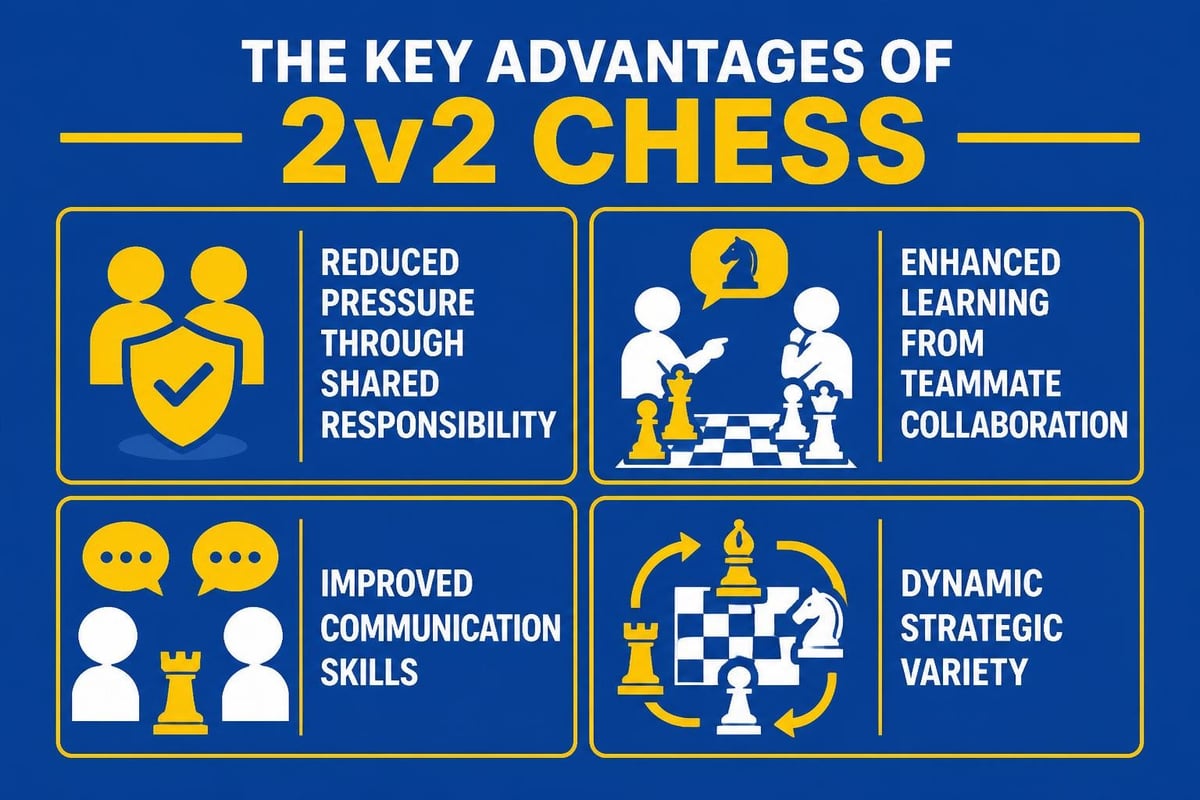
What's driving this growth? Simply put, team chess offers something traditional chess cannot: shared responsibility and collaborative problem-solving.
Understanding the Main 2v2 Chess Variants
Let's break down the most popular formats you'll encounter. Each one offers unique challenges and opportunities for developing different aspects of your chess game.
Dual-Board Team Chess
This is the most accessible entry point into 2v2 chess. Two separate games run simultaneously on adjacent boards. You and your teammate each play your own game-one as White, one as Black-against members of the opposing team.
The critical factor? Time management and emotional support. When your teammate is struggling, can you finish your game quickly enough to help them psychologically? When you're under pressure, does knowing your partner is winning give you confidence to push for complications?
Key strategic considerations:
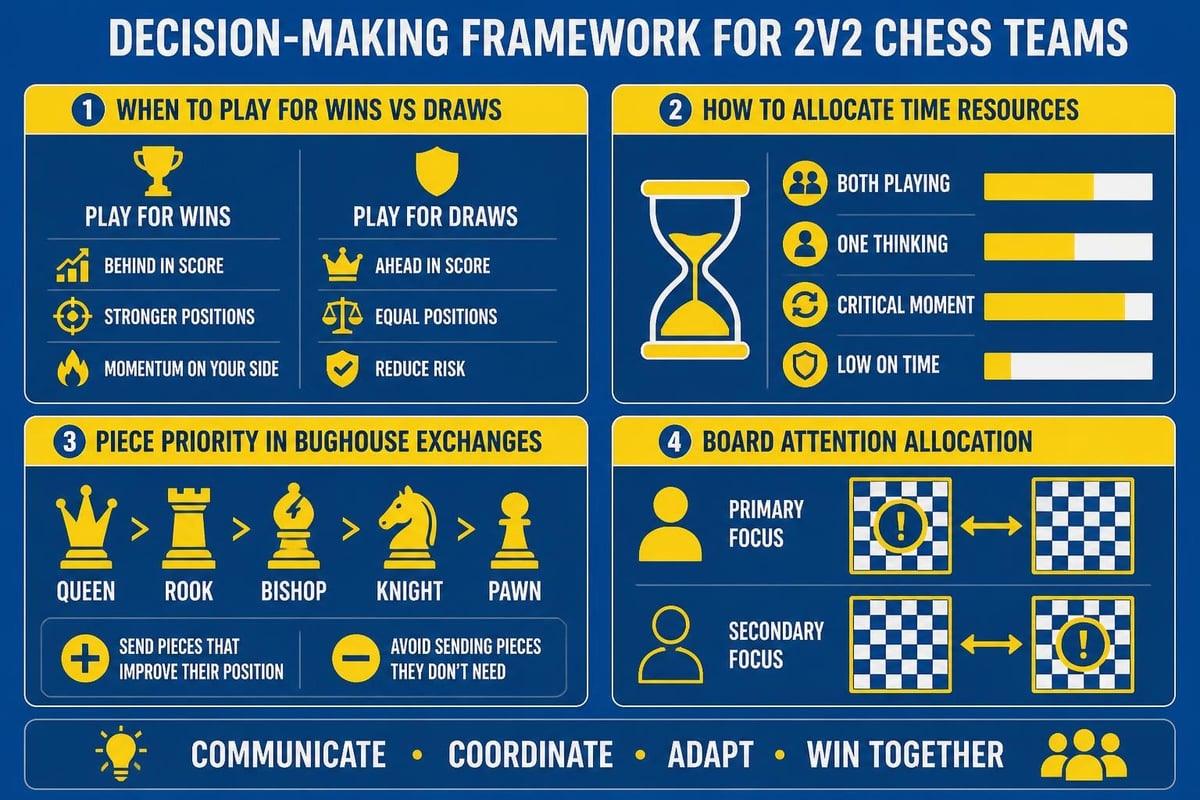
- Board coordination: understanding when to play for a quick win versus solid equality
- Time pressure management across two simultaneous games
- Psychological warfare: creating pressure on opponents through early victories
- Endgame conversion: efficiently closing out winning positions
This format works brilliantly for players who already have a solid foundation in traditional chess openings, as your individual opening knowledge transfers directly. You're essentially playing normal chess with the added dimension of team dynamics.
Bughouse: The Fast and Furious Variant
Now we're talking about something completely different. Bughouse chess is where 2v2 chess gets absolutely chaotic. Two boards run simultaneously, but here's the twist: every piece you capture gets passed to your teammate, who can then drop it anywhere on their board instead of making a normal move.
| Bughouse Feature | Impact on Gameplay |
|---|---|
| Piece transfers | Captured pieces become resources for your partner |
| Time pressure | Typically played at 3-5 minute time controls |
| Communication | Constant coordination required between teammates |
| Material imbalance | Traditional piece values become less relevant |
| Tactical complexity | Combinations must consider both boards simultaneously |
Bughouse absolutely rewards quick thinking and communication. You'll find yourself shouting requests like "I need a knight!" whilst simultaneously trying to capture the right pieces for your partner. It's chess on steroids, and it develops your tactical vision in ways standard chess simply cannot.
The opening principles you've learned from resources like the Sicilian Defense guide still matter, but they're compressed into hyperspeed games where tactical alertness trumps deep strategic understanding.

Chess 2vs2 on Extended Boards
If you want something truly unique, Chess 2vs2 on an 8x16 board offers a fascinating middle ground. All four players share one massive board, with two sets of pieces for each team positioned on opposite ends. Teams alternate moves, and the first team to deliver checkmate wins.
This variant emphasizes:
- Coordinate attacks between teammates
- Defensive coverage across the expanded board
- Timing of piece coordination
- Space management in the centre
The extended board creates entirely new strategic landscapes. Suddenly, that knowledge you've built up about controlling the centre becomes twice as complex. You're not just fighting for the traditional centre squares-you're managing a vastly expanded middle ground where your pieces and your teammate's pieces must work in harmony.
Developing Your 2v2 Chess Skills
Moving from solo chess to team chess requires adapting your mindset. You're no longer the sole decision-maker, and that's actually liberating once you embrace it.
Communication Is Your Secret Weapon
In Bughouse, verbal communication during the game is not just allowed-it's essential. Learning to quickly and clearly communicate what pieces you need, what threats you're facing, and what you're planning creates a massive advantage. But even in silent formats like standard dual-board team chess, pre-game communication about strategy and opening choices matters enormously.
Effective communication tips:
- Develop shorthand phrases for common situations
- Establish clear piece priority systems in Bughouse
- Agree on opening strategies before the match begins
- Create signals for critical moments that need attention
Think about it this way: in traditional chess, you might spend hours studying the Ruy Lopez to gain a small edge. In 2v2 chess, spending thirty minutes coordinating with your teammate can provide similarly powerful advantages.
Choosing the Right Teammate
Not all chess partnerships work equally well. Your ideal 2v2 chess teammate isn't necessarily the strongest player you know-it's someone whose style complements yours and who communicates well under pressure.
Consider these partnership dynamics:
| Your Style | Ideal Teammate Style | Why It Works |
|---|---|---|
| Aggressive attacker | Solid defender | Balances risk across boards |
| Positional player | Tactical opportunist | Covers different game phases |
| Time pressure prone | Fast player | Compensates for tempo management |
| Opening specialist | Strong endgame player | Division of expertise across game stages |
I've seen partnerships where both players were individually rated 1800, but together they performed at 2000+ level because of perfect style complementarity. The chemistry matters more than you might think.
Training for Team Chess
Your individual chess improvement directly benefits your 2v2 chess performance, but you should also incorporate team-specific training. Set up regular practice sessions with your partner. Play Bughouse at faster time controls than you're comfortable with to develop rapid decision-making. Analyze games together, focusing on moments where better coordination could have changed the outcome.
The chess puzzles you solve to sharpen your tactical vision become even more valuable in team formats, where you need to spot tactics across multiple boards simultaneously. That pattern recognition you're building translates directly into faster piece transfer decisions in Bughouse or better board assessment in dual-board formats.
Where to Play 2v2 Chess Online
Finding the right platform for your preferred team chess variant makes all the difference. The online chess landscape has evolved significantly to accommodate team formats.
Platform Options for Different Variants
For standard dual-board team chess, major platforms like Chess.com offer team match features where clubs can organize 2v2 matches between teams. The community has been actively discussing expanded options for 2v2, 3v3, and 4v4 formats, showing strong demand for enhanced team chess features.
Platform comparison for 2v2 chess:
- Relay Chess: Purpose-built for 2v2 team chess with integrated chat and rankings
- Chess.com: Team matches through club features, Bughouse support
- Lichess: Community interest in 2v2 features, with active forum discussions
- Specialized Bughouse servers: Dedicated platforms for fast-paced Bughouse play
If you're specifically interested in Bughouse, you'll find dedicated communities and servers that focus exclusively on this variant. The pace is frantic, the community is passionate, and the learning curve is steep but rewarding.
For those wondering where to play specific 2v2 chess variants online, the chess community has compiled helpful recommendations across various platforms. The key is matching your preferred variant to the platform that supports it best.
Strategic Depth in Team Chess Formats
Here's where 2v2 chess gets really interesting from a strategic perspective. The collaborative element adds layers of complexity that don't exist in individual play.
Board Coordination Strategy
In dual-board team chess, you face a fascinating meta-game decision: do you both aim for sharp, tactical positions, or does one player go for solid equality whilst the other pushes for advantage? This strategic conversation happens before the game begins and evolves as positions develop.
Consider this scenario: Your teammate has a winning position with plenty of time. You're equal but in a complex middlegame. The smart play might be to simplify into a drawable endgame, knowing your team only needs one win. This kind of strategic flexibility doesn't exist in solo chess.
The Psychology of Shared Responsibility
One of the most underappreciated aspects of 2v2 chess is how it affects your psychological approach to the game. That crippling fear of making a mistake? It's halved when you have a teammate. The pressure of a must-win situation? Shared between two boards.
This psychological dimension makes team chess an excellent training ground for players who struggle with competitive anxiety. You're still playing serious chess, developing the same skills you'd work on through chess opening guides, but the emotional stakes feel different when you're not carrying the entire burden alone.
Adapting Your Opening Repertoire
Your solid opening repertoire from solo play needs subtle adjustments for team chess. In dual-board formats, you might coordinate openings with your teammate-if they're playing an aggressive King's Gambit as White, perhaps you choose a solid defensive setup as Black to balance the team's risk profile.
In Bughouse, opening choice becomes about piece activity and quick development rather than deep theoretical preparation. Those slow, positional setups you might employ in classical chess? They're liabilities when you need to generate piece trades quickly to supply your teammate.
The fundamental principles from common chess openings still apply-control the centre, develop pieces efficiently, ensure king safety-but the priority ordering shifts based on your team's overall strategy.
Building a 2v2 Chess Community
Whether you're organizing informal games with friends or competitive team tournaments, building a consistent 2v2 chess community enhances the experience dramatically.
Starting Local Team Chess Groups
Many chess clubs have discovered that adding team chess events increases engagement, especially among players who might feel intimidated by solo competition. If you're part of a chess club or considering starting one, team formats offer an accessible entry point.
Steps to organize your first team chess event:
- Choose a format (dual-board is most accessible for beginners)
- Establish clear time controls and rules
- Create balanced teams through random draw or rating-based pairing
- Set up boards with adequate space for communication (in Bughouse) or separate areas (for dual-board)
- Plan for multiple rounds to give everyone substantial playing time
You'll find that players who normally wouldn't participate in competitive events often jump at the chance to play team chess. The collaborative element reduces anxiety and increases enjoyment.
Online Team Chess Communities
The internet has made finding 2v2 chess partners and opponents easier than ever. Join team chess forums, participate in platform-specific team events, and engage with the growing community of team chess enthusiasts. Many players are looking for consistent partners for regular practice sessions.
Building these connections enhances your chess journey beyond just improving your rating. You'll develop friendships, learn different approaches to the game, and discover aspects of chess strategy that solo play never reveals.
The Future of 2v2 Chess
Looking at current trends, team chess formats are poised for significant growth. Major platforms are exploring enhanced features, top players are participating in exhibition events, and the casual chess community is discovering the social appeal of collaborative play.
The tournament scene for 2v2 chess is expanding. We're seeing more organized events, better prize funds, and increased streaming coverage. As platforms like Relay Chess continue developing purpose-built team chess infrastructure, the barrier to entry keeps dropping.
Integration with Chess Education
For developing players, 2v2 chess offers unique educational benefits. It forces you to articulate your chess thinking to your teammate, which deepens your understanding. It exposes you to your partner's thought processes, broadening your strategic perspective. And it provides immediate feedback in a supportive environment where mistakes are shared learning opportunities rather than solitary failures.
Think about how you might combine individual study-working through opening systems, solving tactical puzzles, reviewing endgame positions-with team chess practice. This balanced approach develops both your independent chess skills and your collaborative abilities.
The educational value extends beyond pure chess knowledge. You're developing communication skills, learning to work under pressure with a partner, and building the kind of strategic coordination that has applications far beyond the chessboard.
Competitive Team Chess in 2026
As we move through 2026, the competitive landscape for team chess continues evolving. Rating systems specifically designed for team formats are emerging, allowing players to track their collaborative performance separately from their individual ratings. Tournament organizers are experimenting with hybrid formats that combine individual and team events in multi-day festivals.
The prize pools are growing too. What started as casual fun among friends is becoming a legitimate competitive pursuit with real stakes. For ambitious players, developing strong 2v2 chess skills alongside traditional chess expertise is becoming a smart career move.
2v2 chess transforms the classic game into a collaborative adventure where communication, coordination, and shared strategy create entirely new dimensions of play. Whether you're drawn to the lightning-fast chaos of Bughouse or the strategic depth of coordinated dual-board matches, team chess offers fresh challenges that will sharpen your skills whilst reducing the pressure of solo competition. Ready to complement your team chess journey with solid opening knowledge and tactical training? Chess Cheat Sheets provides comprehensive guides, puzzles, and resources designed to build your chess foundation efficiently, giving you and your teammate the individual skills needed to dominate together on the board.


