

Are you ready to unlock your chess potential in 2025? If you feel stuck memorizing endless opening lines but never truly improving, you’re not alone. Many players fall into the trap of rote learning without real progress.
Imagine if you could study chess openings in a way that actually boosts your confidence and results at the board. What if you could build a powerful opening repertoire, sidestep common mistakes, and use smart tools for faster learning?
This guide is here to help. Whether you’re a beginner or aiming for expert level, you’ll find a step-by-step process designed for real improvement. Get set to explore opening principles, choose the right openings, use the latest study methods, and discover resources that make your opening preparation both practical and fun.

Understanding Chess Openings: Principles and Purpose
Unlocking your chess potential starts with understanding why the opening phase is so important. Many players jump right into memorizing lines, but if you want to study chess openings effectively, you need to grasp the deeper purpose behind those first moves. Let’s break down the essentials, step by step.
The Role of Openings in Modern Chess
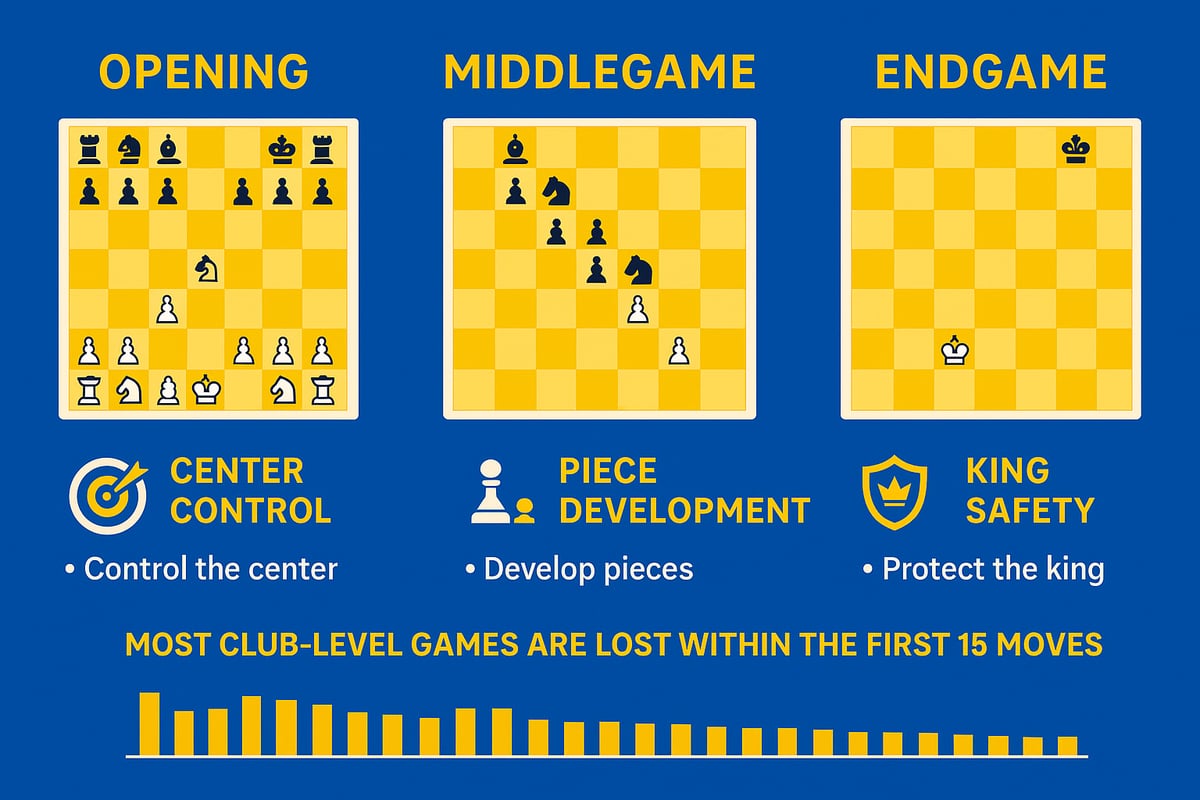
Every chess game begins with the opening. This phase isn't just about moving pieces out of their starting squares. Your choices here set the tone for the middlegame and even the endgame. If you study chess openings with purpose, you create a solid foundation for the rest of your play.
Did you know that at the club level, most games are decided by mistakes within the first 15 moves? Players who follow structured opening principles often gain better positions, while random move orders can lead to early problems. Imagine two players, one following a plan and the other just winging it. The difference becomes clear fast.
Core Principles: Center, Development, King Safety
No matter which opening you choose, some universal principles guide strong play. Controlling the center allows your pieces maximum activity. Quick development gets your knights and bishops into the game, so you’re not left behind. King safety, especially timely castling, is crucial to avoid early attacks.
Classic blunders often happen when players ignore these basics. For example, moving the queen out too soon or neglecting to castle can lead to disaster. To dive deeper into these essential ideas, check out Opening Principles Every Player Must Know. When you study chess openings, always keep these principles in mind.
Understanding Opening Theory vs. Memorization
Opening theory is the collective knowledge about the best moves and plans in the first part of the game. Over time, theory evolves as new ideas and improvements are discovered. But here’s the catch: simply memorizing move sequences won’t help you truly study chess openings.
Grandmasters often stress learning the ideas behind moves. For example, understanding why a fianchetto structure works is more valuable than just knowing the next move in a line. If you know the plan, you can adapt, even when your opponent surprises you. This approach builds real chess strength.
Typical Mistakes Made by Inexperienced Players
It’s easy to fall into traps when you first study chess openings. Many beginners get obsessed with rare or “meme” openings found online, chasing flashy traps rather than solid play. Ignoring classical principles for quick tricks can backfire.
Another common mistake is picking openings that don’t match your style or rating. For instance, the English Opening might suit intermediate players who want a slower game, but it can confuse beginners who need more structure. Data shows that opening mistakes are most frequent in the 800-1400 rating range, where players are still learning the basics.
Choosing the Right Openings for You in 2025
Picking the best openings for your chess journey can feel overwhelming, especially with so many choices out there. If you want to study chess openings effectively, the trick is to tailor your repertoire to your unique style, goals, and experience. Let’s break down how to find your ideal openings for 2025.
Assessing Your Playing Style and Goals
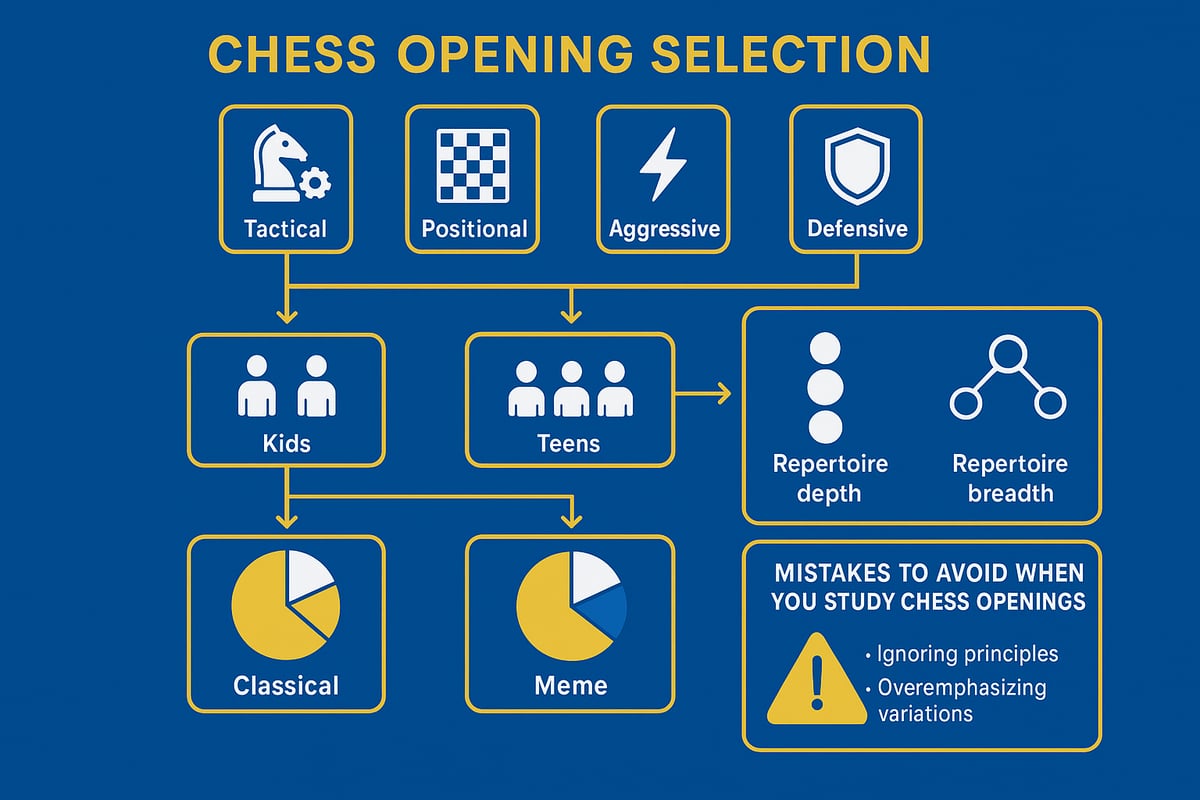
Do you love sharp tactics, or do you prefer slow, strategic battles? Identifying your style is the first step if you want to study chess openings the right way.
Ask yourself these questions:
- Do you enjoy open, tactical fights or closed, maneuvering positions?
- Are you comfortable with risk, or do you value safety?
- What are your chess goals: casual play, club tournaments, or online blitz?
For example, tactical players often thrive with the Sicilian Defense, while positional players may lean toward the Queen’s Gambit. Matching your strengths with the right opening helps you play more confidently and enjoy the learning process as you study chess openings.
If you want more guidance, check out the How to Master Chess Openings guide for foundational strategies tailored to your style.
Evaluating Popularity and Effectiveness of Openings
It’s tempting to jump on whatever opening is trending, but is it the best fit for you? Using online databases like Chess.com, Lichess, and FIDE stats lets you see which openings are most played at your rating level.
Here’s a quick comparison:
| Opening | Popularity (2024-2025) | Common at Rating |
|---|---|---|
| Italian Game | Very High | 800-1800 |
| Sicilian Defense | High | 1200+ |
| London System | Rising | All levels |
| King's Gambit | Low | Rarely |
Following trends can be helpful, but sometimes carving your own path leads to better results. Remember, the goal is to study chess openings that make sense for your comfort zone and ambitions, not just what’s popular.
Age, Experience, and Opening Selection
Your age and chess experience also play a big role in what you should play. For kids and absolute beginners, simple and solid openings are best. Think of openings like the Italian Game or Four Knights—these teach fundamentals and avoid early pitfalls.
As you gain experience, you might explore more complex systems. For example, the English Opening is great for intermediate players who already understand the basics, but it can be tricky for total beginners.
Adults often have more patience for deep study, while younger players benefit from repetition and clear plans. No matter your stage, always choose to study chess openings that match your current level and help you grow step by step.
Balancing Breadth and Depth in Your Repertoire
Should you learn a little about many openings, or specialize deeply in a few? This is a classic question for anyone who wants to study chess openings efficiently.
Here’s a simple way to think about it:
- Beginners: Focus on 1-2 main openings for White and Black.
- Intermediates: Add a backup system, but avoid spreading yourself too thin.
- Advanced: Go deeper in your favorites, and only branch out for specific opponents.
Grandmasters often have vast repertoires, but club players see more improvement by mastering key lines. A focused approach lets you study chess openings with purpose, rather than getting lost in endless variations.
Avoiding “Meme” and Dubious Openings in Serious Play
Meme and trap openings—like the Bongcloud or Stafford Gambit—are everywhere online, but do they work over the board? The truth is, these offbeat lines rarely hold up against prepared opponents.
Relying on such openings can create bad habits and limit your growth. Data shows that meme openings have much lower success rates than classical lines at most rating levels.
Before making one your main weapon, check if top players ever use it in serious games. When you study chess openings, focus on proven systems that teach solid principles. Save the “fun” stuff for casual play, and build your repertoire around lines that stand the test of time.
Step-by-Step: How to Study Chess Openings Effectively in 2025
Ready to transform the way you study chess openings? Here’s your ultimate, step-by-step blueprint for mastering the opening phase in 2025. Whether you’re just starting out or aiming to sharpen your tournament edge, these practical steps will guide you from basics to advanced strategies, using modern tools for maximum progress.
Step 1: Learn the Classical Principles First
Before you dive deep into opening books or databases, start with the timeless basics. When you study chess openings, the foundation is always about three things: control the center, develop your pieces quickly, and keep your king safe.
Let’s break it down:
-
Center Control: Place pawns and pieces where they influence the central squares. Moves like
e4,d4,Nf3, andNc3are classic. - Development: Get your knights and bishops out early. Don’t move the same piece multiple times unless necessary.
- King Safety: Castle early. Avoid pushing too many pawns on the side where your king will be.
Why does this matter? Games at every level are often lost because someone ignored these basics. Think about how many times you’ve seen someone get checkmated quickly after neglecting to castle or losing a central pawn. When you study chess openings, always check if your moves follow these principles.
Step 2: Choose and Focus on a Core Opening Repertoire
Next, it’s time to narrow your focus. Instead of trying to learn every opening, study chess openings by building a core repertoire tailored to your style.
Here’s how to do it:
- Pick one or two openings for White and Black that you enjoy and understand.
- Consider classic choices like the Italian Game, Caro-Kann, or Queen’s Gambit.
- Use criteria such as popularity, your comfort level, and how often they appear in your games.
For example, if you like open positions, the Italian Game is a great start. If you prefer solid play as Black, the Caro-Kann might suit you. By focusing your efforts, you’ll make much faster progress as you study chess openings.
Step 3: Study Model Games by World-Class Players
Watching how top players handle your chosen openings is like getting a masterclass for free. As you study chess openings, look for annotated games by grandmasters.
Here’s a simple plan:
- Find games where your opening is played by world champions or strong grandmasters.
- Pay attention to the plans, not just the moves. Why did Magnus Carlsen play
d3instead ofd4in the English Opening? What’s the idea behind Petrosian’s bishop maneuvers? - Use resources with comments or video explanations to clarify critical moments.
Check out this table summarizing model player choices:
| Opening | Model Player |
|---|---|
| Italian Game | Fabiano Caruana |
| English Opening | Magnus Carlsen |
| Caro-Kann | Tigran Petrosian |
By analyzing these games, you’ll internalize patterns and ideas, helping you study chess openings with real understanding.
Step 4: Understand Typical Plans, Traps, and Structures
Memorizing moves isn’t enough. To truly study chess openings, you must get familiar with common pawn structures, piece placements, and tactical traps.
Some key pointers:
- Learn the typical pawn skeletons in your openings. For example, the d4-d5 chain in the Queen’s Gambit, or the open e-file in the Italian Game.
- Spot classic traps, like the “Greek Gift” bishop sacrifice in e4-e5 games.
- Use diagrams, hand-drawn sketches, or online resources to visualize these patterns.
Try this example:
[FEN "r1bqkb1r/pppp1ppp/2n2n2/2B1p3/4P3/5N2/PPPP1PPP/RNBQK2R w KQkq - 2 4"]
1. Ng5 d5 2. exd5 Nxd5 3. Nxf7 Kxf7 4. Qf3+ Ke6 5. Nc3
By recognizing these motifs, you’ll avoid falling into traps and make smarter decisions as you study chess openings.
Step 5: Supplement with Modern Digital Tools and Resources
The way you study chess openings has changed. Today, digital tools make learning faster and more interactive.
Here’s what you should try:
- Databases: Use Chess.com’s Opening Explorer or Lichess Study to review master games and trends.
- Courses: Platforms like Chessable offer interactive courses with spaced repetition, making it easier to remember key lines.
- Video Lessons: YouTube and Twitch have endless content from titled players explaining opening ideas.
Check out this quick comparison:
| Tool | Best For |
|---|---|
| Online Explorer | Game review, trends |
| Chessable | Memorization, drilling |
| YouTube/Twitch | Visual explanations |
When you study chess openings with these tools, you’ll see results much faster than with old-fashioned books.
Step 6: Practice with Puzzles and Thematic Drills
Theory alone won’t cut it. To really internalize what you study, chess openings need to be practiced through puzzles and drills.
What works best?
- Solve puzzles based on your chosen openings. For example, Sicilian Najdorf tactic packs or Queen’s Gambit traps.
- Use online platforms that offer opening-specific drills and quizzes.
- Set up your favorite positions and play against the computer or friends.
A sample training routine could look like this:
- 10 puzzles from your opening
- 5 blitz games using only your repertoire
- Review mistakes and repeat
By making this a habit, you’ll reinforce what you study. Chess openings become second nature, not just theory in your head.
Step 7: Test Your Openings in Real Games and Analyze Results
Ultimately, the best way to study chess openings is by putting them to the test. Play real games, both online and over-the-board.
Here’s how to turn games into learning:
- Track which openings you use and your win/loss rates.
- After each game, review the opening phase. Did you follow your plan? Where did you go wrong?
- Use computer analysis to spot missed opportunities or recurring mistakes.
For example, after 50 games, you might notice you’re losing more with the French Defense than the Caro-Kann. That’s a sign to adjust your study. Chess openings are a living part of your game, always evolving as you learn from experience.
Visual Opening Guides and Cheat Sheets for Efficient Learning
Learning visually can supercharge the way you study chess openings. If you prefer diagrams and quick-reference guides to thick books, tools like Chess Openings Visual Guide offer plug-and-play resources for mastering main lines, traps, and plans.

With visual cheat sheets, you can focus on practical knowledge and skip endless memorization. These resources often include opening toolkits, puzzle packs, and step-by-step diagrams. Beginners and intermediates will appreciate the clarity, while advanced players can use them for fast review.
Free and lifetime access options mean you can keep updating your study. Chess openings become less about rote learning and more about real understanding, so you progress faster and with more confidence.
Applying Your Opening Knowledge in Practical Play
Ever wondered how to turn all that theory into real results over the board? Once you study chess openings, the next step is applying your knowledge where it counts—actual games. Let’s break down the practical side of making your opening work shine, whether you’re playing online blitz or a weekend tournament.
Adapting to Opponent’s Responses and Surprises
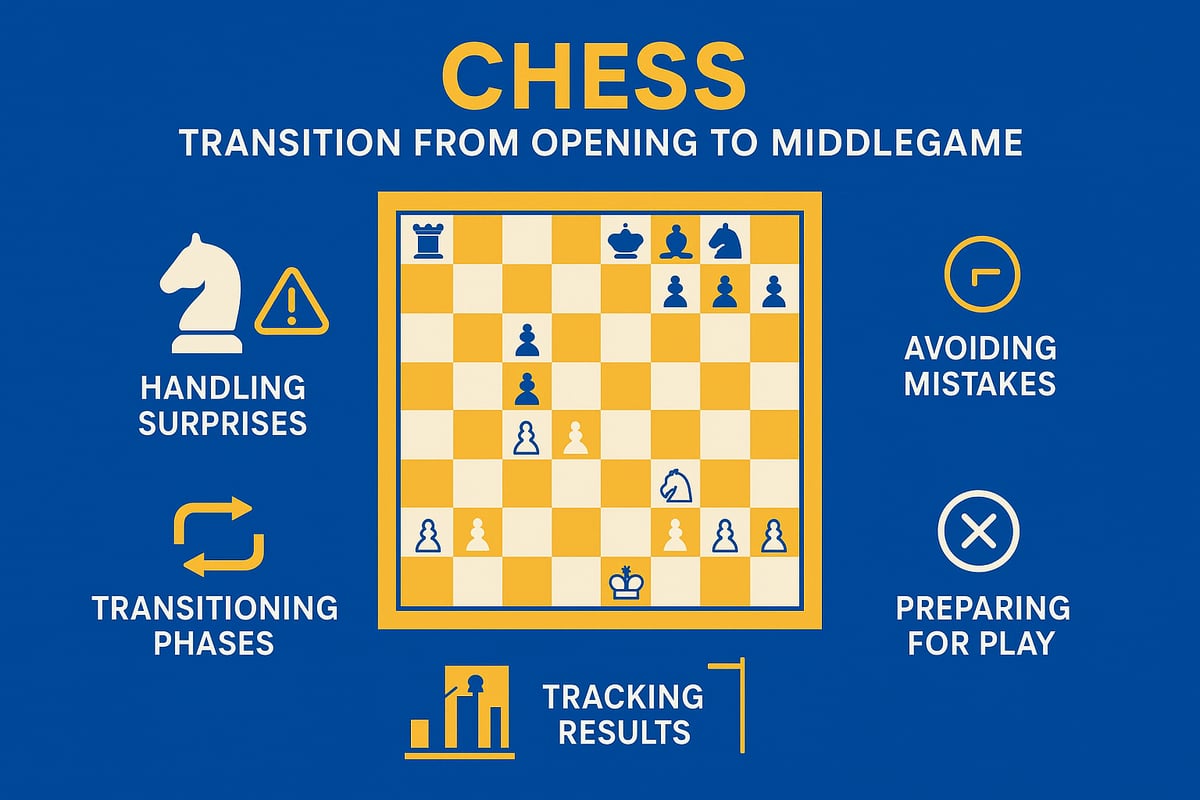
No matter how much you study chess openings, opponents will throw curveballs. What happens when they play an unexpected sideline or a move you haven’t seen? It’s easy to panic, but this is where your grasp of opening principles becomes your best friend.
Instead of memorizing every branch, focus on understanding why moves are played. If your opponent leaves the “book,” pause and ask: Does this move ignore center control, development, or king safety? Often, you can exploit early inaccuracies by sticking to the basics.
When you encounter a surprise—say, a quirky Queen’s Gambit line—fall back on core ideas and adapt. Want more strategies for handling the unknown? Check out these tips for studying chess openings effectively to boost your flexibility and confidence.
Transitioning from Opening to Middlegame
You’ve survived the opening—now what? This moment is crucial. If you study chess openings with a plan, you’ll recognize when your setup is complete and it’s time to shift gears.
Look for signs: most pieces developed, king castled, and central tension resolved. That’s your cue to start thinking about middlegame plans. For example, in the King’s Indian Defense, the opening often leads to dynamic pawn storms and piece maneuvering. Spot these patterns early, and you’ll be ready to attack or defend with purpose.
Remember, your opening should flow into a middlegame you understand. If you’re unsure what to do next, review model games and note how top players transition smoothly from setup to strategy.
Avoiding Common Practical Mistakes
Even after you study chess openings, mistakes can creep in during practical play. One classic error is obsessing over theory at the expense of development. It’s tempting to chase a rare line and forget to get your pieces out or to skip castling in hopes of a quick attack.
Another pitfall is falling into traps you only half-know. For instance, the Fried Liver Attack can punish careless play if you don’t know the defensive ideas. Always double-check your tactics before grabbing pawns or launching attacks.
Want to sidestep these blunders? Practice with opening-specific puzzles and review games where you lost material early. It’s the quickest way to turn theoretical knowledge into practical strength.
Using Opening Preparation in Tournaments and Online Play
Tournament and online environments test your ability to study chess openings under pressure. Preparation matters, but so does adaptability. Before a big event, review your likely opponents’ favorite lines and brush up on the main ideas, not just the moves.
For rapid and blitz games, consider adding a surprise weapon or two—something sound but less common. In classical formats, stick to your core repertoire and be ready to adjust if you get surprised early.
Balance is key: don’t over-prepare for one opponent and neglect your general skills. The best players blend targeted prep with universal principles, making them tough to catch off guard.
Tracking Your Progress and Refining Your Repertoire
How do you know if your efforts to study chess openings are paying off? Tracking is essential. Keep a log of your games, noting which openings you played, your results, and any recurring mistakes. Here’s a simple sample table:
| Opening Played | Games | Wins | Losses | Common Errors |
|---|---|---|---|---|
| Italian Game | 20 | 12 | 8 | Missed tactics |
| Sicilian Defense | 15 | 8 | 7 | Late development |
| Queen’s Gambit | 10 | 6 | 4 | Poor transition |
Regularly review this data. If an opening consistently underperforms, consider swapping it out. You can also take the Chess Openings Quiz for Players to assess your strengths and uncover areas for improvement. Over time, updating your repertoire and focusing on weak spots will lead to steady growth.
Advanced Tips and Resources for Mastering Chess Openings in 2025
Ready to take your quest to study chess openings to the next level? As you build your repertoire, it pays to tap into the latest technologies, connect with the chess community, and keep your resources fresh. Let’s break down the most effective advanced strategies for 2025.
Leveraging AI and Latest Technology for Opening Study
Artificial intelligence is revolutionizing the way you study chess openings. Modern engines like Stockfish and Leela can analyze your chosen lines, spot hidden tactics, and even suggest fresh ideas that human players may overlook. You can explore AI-generated novelties to stay ahead of the curve and evaluate the soundness of trendy systems.
For educators and serious students, the use of generative AI is a game-changer. If you’re curious about the educational impact, check out Enfoque Odychess: Un método dialéctico, constructivista y adaptativo para la enseñanza del ajedrez con inteligencias artificiales generativas, which dives into innovative methods for mastering openings with AI support.
Regularly running your repertoire through these tools helps you find gaps and correct mistakes before they appear on the board. Embrace technology to make your opening study smarter and more effective.
Joining Online Communities and Learning from Others
Chess is a social game at its core. When you study chess openings, joining online communities can accelerate your progress. Engaging with forums, Discord servers, and chess clubs lets you hear a variety of viewpoints and get feedback on your repertoire.
Platforms like Chess.com and Reddit’s r/chess offer dedicated spaces to share your ideas, ask questions, and analyze games with other players. Many communities run themed tournaments or opening-specific study groups so you can practice lines in a supportive environment.
By collaborating with others, you’ll pick up practical tips, discover new resources, and stay motivated. Don’t underestimate the value of learning from peers who have faced the same opening challenges as you.
Staying Updated with Opening Trends and Novelties
The chess landscape is always evolving, so it’s wise to keep your finger on the pulse when you study chess openings. Following top-level tournaments, watching live commentary, and subscribing to opening-focused newsletters can help you spot new ideas before they become mainstream.
Tools like ChessBase, Lichess Opening Explorer, and YouTube channels dedicated to opening analysis are fantastic for tracking what’s hot. For instance, recent novelties in the London System or Catalan can shift the meta overnight.
Make it a habit to review games from elite players and incorporate fresh lines or improvements into your own repertoire. Consistent updates keep your openings sharp and your opponents guessing.
Combining Opening Study with Tactics and Endgames
You can’t study chess openings in isolation. Strong players always combine opening knowledge with tactical awareness and endgame fundamentals. Why? Because the best openings set you up for positions where your tactical skills and endgame plans can shine.
Try solving puzzles based on your openings or practicing key endgames that frequently arise from your favorite lines. This approach builds pattern recognition and practical confidence. For more on developing memory and tactical sharpness, explore The Best Techniques to Memorize Chess Openings, which covers spaced repetition and visualization methods.
Remember, the most successful players are well-rounded. Make sure your study routine balances all three phases of the game.
Recommended Books, Courses, and Digital Tools for 2025
Having the right resources at your fingertips is crucial as you study chess openings in 2025. Below is a quick comparison of standout options:
| Resource Type | Example/Platform | Why It’s Great |
|---|---|---|
| Book | "Fundamental Chess Openings" | Clear explanations, up-to-date |
| Interactive App | Chessable MoveTrainer | Spaced repetition, gamified |
| Video Course | GothamChess YouTube channel | Engaging, covers all levels |
| Database Tool | Lichess Opening Explorer | Free, huge game database |
Choose tools with strong user reviews and expert endorsements. Mix formats—books, apps, videos—so your learning stays fresh and enjoyable. Regularly update your toolkit to match your evolving repertoire and interests.
So, after exploring all these practical tips for studying chess openings in 2025, you might be wondering, “Alright, where do I actually start putting this into action?” I totally get it—having a smart plan is great, but taking that first step makes all the difference. If you’re ready to boost your confidence and finally see real improvement in your games, I’d highly recommend you Start Improving Your Openings. You’ll find clear, practical resources designed exactly for players like us—no overwhelming theory, just easy steps to take your opening play to the next level. Why not give it a try?


