

You've probably spent countless hours studying openings, analysing games, and trying to memorise complex variations. But what happens when you don't have a training partner or simply want to sharpen your tactical vision on your own schedule? That's where solitaire chess comes in, offering a unique approach to chess improvement that puts you in complete control of your training sessions. This puzzle-solving method has helped countless players develop their pattern recognition, calculation skills, and strategic thinking without needing an opponent across the board.
What Exactly Is Solitaire Chess?
Think of solitaire chess as a chess puzzle with a twist. Rather than finding the one brilliant move in a position, you're working through a series of captures where each piece must capture another until only one piece remains on the board.
The concept is beautifully simple yet remarkably effective for training. You start with a small cluster of pieces positioned on the board, and your task is to clear the board by having each piece capture another piece with every move. The challenge? You need to plan ahead to ensure you don't leave yourself stuck with pieces that can't reach each other.
Two Distinct Forms of Practice
When we talk about solitaire chess, we're actually discussing two different but equally valuable training methods:
The Physical Puzzle Game
ThinkFun's Solitaire Chess board game presents challenges on a compact board with actual chess pieces. Each challenge card shows you where to place specific pieces, creating increasingly difficult scenarios as you progress through the difficulty levels.
The Training Method
The second interpretation involves working through chess positions alone, analysing moves without an opponent. Grandmaster Gregory Kaidanov has demonstrated this approach, showing how players can improve their chess understanding through solo analysis.
Why Solitaire Chess Works for Skill Development
You might wonder whether solving capture puzzles actually translates to better chess play. The answer lies in understanding what skills you're developing beneath the surface.
Pattern Recognition at Its Core
Every time you solve a solitaire chess puzzle, you're training your brain to recognise piece relationships instantly. Which pieces can attack which squares? What sequences of captures are possible? These are the same questions you ask during actual games when calculating tactical sequences.
Your brain builds a library of patterns. After solving dozens of puzzles, you'll start seeing capture sequences faster, and this speed carries over to your regular games when you need to calculate exchanges or tactical strikes.
Forced Calculation Practice
Unlike some chess training where you might peek at answers or give up early, solitaire chess puzzles demand complete solutions. You can't leave two pieces on the board and call it close enough. This forces you to calculate accurately through to the end of sequences.
The constraints are strict:
- Every move must be a capture
- All pieces except one must be removed
- You must find the exact sequence that works
These limitations create perfect conditions for developing your calculation discipline.

Getting Started with Solitaire Chess Puzzles
Ready to add this training method to your chess improvement routine? Here's how to begin effectively without overwhelming yourself.
Starting with Simple Positions
Begin with three-piece puzzles. Yes, they might seem trivially easy, but they establish the fundamental logic you'll need for complex scenarios.
A typical beginner puzzle might have:
- A rook on d4
- A bishop on f2
- A knight on e6
Your task is finding which piece captures which, in what order, to leave just one piece standing.
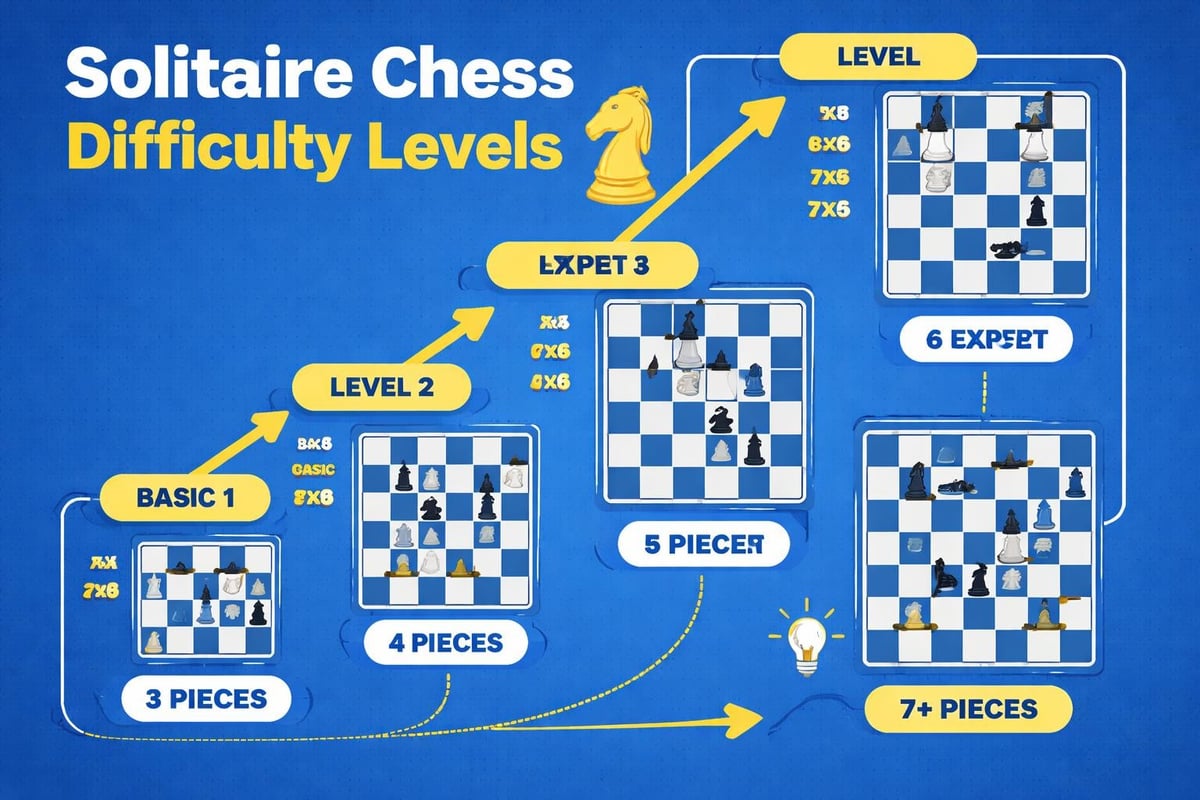
Progressive Difficulty Levels
| Difficulty Level | Pieces on Board | Skills Developed | Average Solve Time |
|---|---|---|---|
| Beginner | 3-4 pieces | Basic captures, simple sequences | 30-60 seconds |
| Intermediate | 5-7 pieces | Multiple pathways, planning ahead | 2-5 minutes |
| Advanced | 8-10 pieces | Complex calculations, visualisation | 5-15 minutes |
| Expert | 10+ pieces | Deep analysis, multiple try sequences | 15+ minutes |
Don't rush through the levels. Mastering each difficulty thoroughly builds a stronger foundation than struggling through puzzles above your current ability.
Techniques for Solving Complex Puzzles
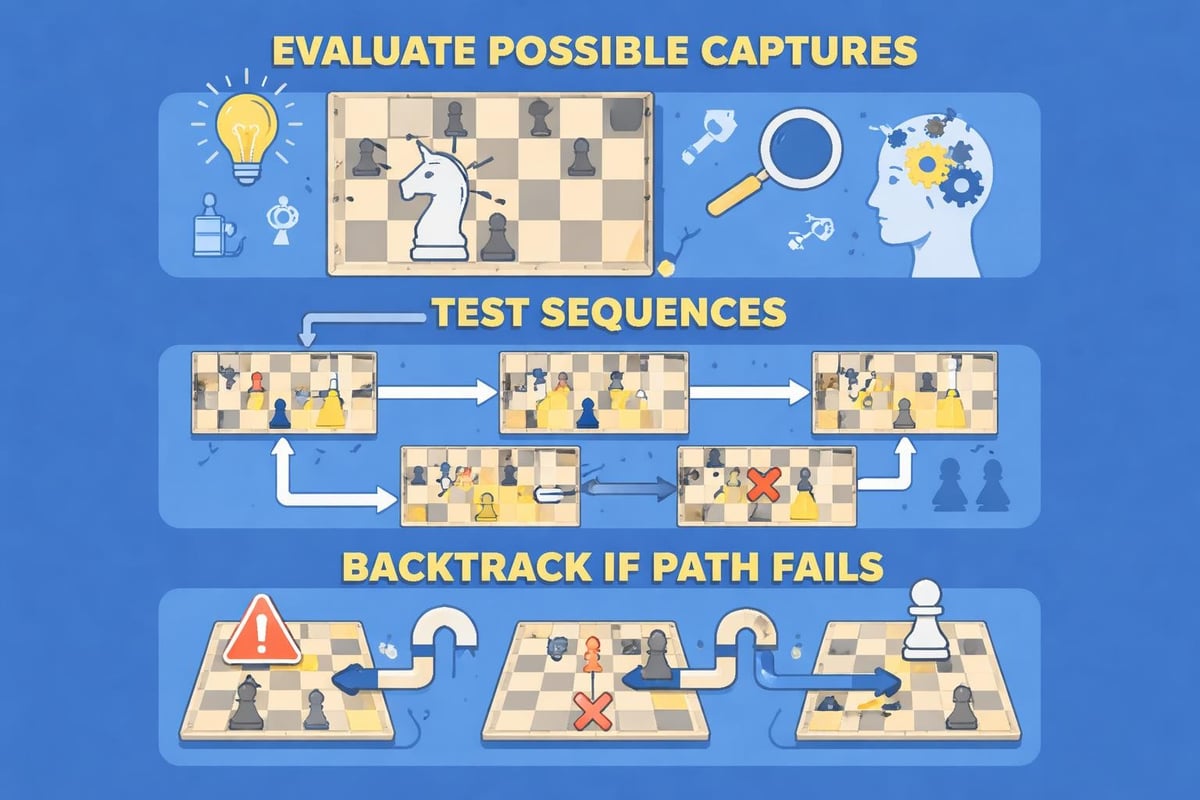
Once you've moved beyond the basics, you'll need systematic approaches to crack harder puzzles without getting frustrated.
Working Backwards
Sometimes the best strategy is starting from the end. Look at the board and ask: which piece could potentially be the last one standing? Then work backwards to see if you can construct a capture sequence that leads to that outcome.
This reverse-engineering approach often reveals solutions that forward calculation misses. It's particularly useful when you're stuck on a puzzle that seems impossible.
Identifying Forcing Moves
Certain pieces can only capture one other piece on the board. These "forced" moves are your anchors. Start by identifying which captures must happen, even if you don't know their order yet.
Let's say you have:
- A knight that can only reach one piece
- A bishop trapped by its colour squares
- A rook with multiple options
The knight's move is forced at some point. The bishop's options are limited. The rook provides flexibility. Understanding these constraints narrows your solution space dramatically.
Trial and Error (The Smart Way)
Don't be afraid to try sequences that might fail. The key is learning from each attempt rather than randomly guessing.
When a sequence doesn't work, ask yourself:
- Where did it break down?
- Which piece ended up stranded?
- Could a different move order solve this?
This analytical trial-and-error builds your tactical intuition faster than trying to solve everything mentally on the first attempt.
Connecting Solitaire Chess to Your Overall Training
How does this solo puzzle-solving fit into a comprehensive chess improvement plan? The connections are stronger than you might initially think.
Tactical Pattern Recognition
The capturing sequences in solitaire chess mirror real-game tactics. You're essentially practising forks, pins, and piece coordination in a constrained environment. When you return to regular games, these patterns emerge more quickly in your calculations.
If you're also working through standard tactical puzzles, you'll notice the skills reinforce each other. Solitaire chess builds your capture calculation speed, while traditional tactics add the complexity of opponent responses.
Opening Preparation Enhancement
While solitaire chess doesn't directly teach opening theory, it strengthens the calculation skills you need when critical moments arise in your favourite openings. Whether you're navigating the Italian Game or defending with the Caro-Kann, sharp calculation separates adequate moves from winning ones.
The improved visualisation from regular solitaire chess practice helps you see deeper into forcing variations that arise from opening positions.
Resources and Tools for Continuous Practice
Where can you find quality solitaire chess puzzles to keep your training fresh and challenging?
Physical and Digital Options
Physical Puzzle Sets
The commercial board game offers 60 challenges across four difficulty levels. It's portable, requires no screen time, and provides immediate tactile feedback. Video tutorials can help you understand the physical setup if you're new to the format.
Books and Publications
Bruce Pandolfini's "Solitaire Chess" compiles 50 challenging puzzles with detailed solutions. Working through a structured book ensures progressive difficulty and provides insights into the author's solving approach through the explanations.
Creating Your Own Puzzles
Once you understand the principles, you can create custom puzzles using any chess board. Place pieces randomly within a small area and see if a solution exists. This reverse-engineering process deepens your understanding of piece relationships.
Integration with Other Study Methods
Your chess training shouldn't exist in isolated silos. Solitaire chess works best when combined with:
- Regular tactical puzzle solving
- Opening repertoire study through resources like Chess Cheat Sheets
- Endgame practice
- Analysing your own games
A balanced training schedule might dedicate 15-20 minutes daily to solitaire chess puzzles as a warm-up before deeper study sessions.
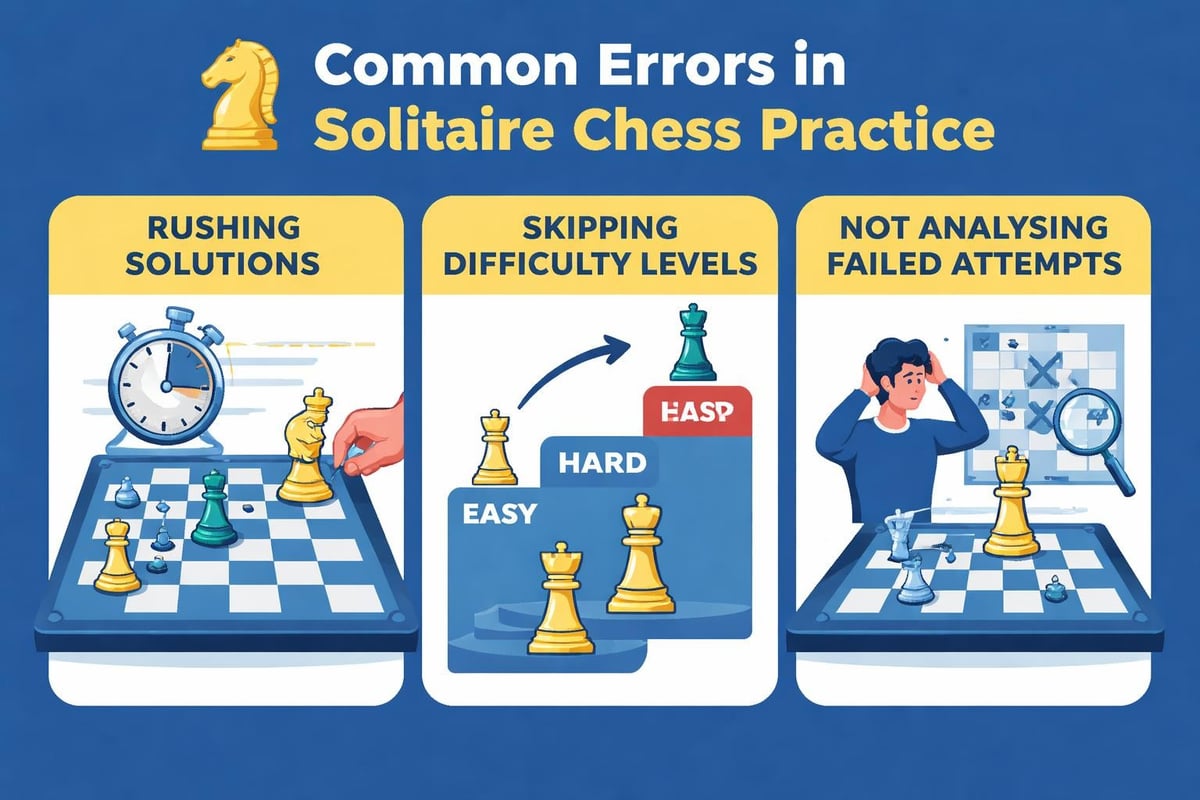
Common Mistakes and How to Avoid Them
Even with simple rules, players often develop habits that limit their improvement from solitaire chess practice.
Rushing Through Easy Puzzles
Just because you can solve three-piece puzzles quickly doesn't mean you should speed through them mindlessly. Each puzzle, regardless of difficulty, offers an opportunity to reinforce proper calculation habits.
Slow down and verbalise your thinking: "The knight can capture the bishop, then the rook captures the knight." This verbal reinforcement strengthens the neural pathways you're building.
Giving Up Too Quickly on Hard Puzzles
When you hit a challenging puzzle that resists your first few attempts, frustration tempts you to check the solution. Resist this urge.
Set a time limit instead. Commit to working on a difficult puzzle for 10-15 minutes before looking at hints or solutions. The struggle itself builds mental stamina and problem-solving persistence.
Not Reviewing Solutions
After solving a puzzle (or checking the answer), don't immediately move to the next one. Review the solution and ask:
- Was this the only possible sequence?
- Are there alternative solutions?
- What made this puzzle tricky?
- Which piece relationships did I initially overlook?
This reflection transforms puzzle-solving from mere entertainment into genuine skill development.
Advanced Applications and Variations
Once you've mastered standard solitaire chess, these variations add fresh challenges and target specific skills.
Time-Limited Challenges
Set a timer for each puzzle based on difficulty. This simulates game pressure where you can't spend unlimited time calculating. It's excellent practice for improving your calculation speed without sacrificing accuracy.
For intermediate puzzles, try solving within two minutes. Advanced puzzles might get five minutes. Track your success rate and average times to measure improvement.
Blindfold Solitaire Chess
Ready for a serious challenge? Set up a puzzle, study it for 30 seconds, then cover the board and solve it from memory. This dramatically enhances your visualisation skills and board memory.
Start with simple three-piece puzzles before attempting this variation with more complex positions. The difficulty jump is substantial, but the visualisation gains are remarkable.
Creating Themed Puzzles
Design puzzles that focus on specific pieces or patterns:
- Knight-only puzzles (all knights capturing each other)
- Rook and bishop coordination challenges
- Puzzles emphasising long-range piece coordination
These themed challenges isolate specific aspects of piece interaction, deepening your understanding of how different pieces work together.
Measuring Your Progress
How do you know if solitaire chess practice is actually improving your chess strength?
Quantitative Metrics
Track these concrete indicators:
- Average solve time per difficulty level (should decrease over weeks)
- Success rate before checking solutions (should increase)
- Maximum puzzle difficulty solved (should progress upward)
- Number of attempts needed per puzzle (should decrease)
Keep a simple training log. Even basic notes like "Solved 5 intermediate puzzles, average time 3 minutes" provide valuable feedback on your development.
Qualitative Improvements
Beyond numbers, notice these signs of progress:
- Faster pattern recognition in regular games
- Improved confidence calculating forcing sequences
- Better visualisation of piece movements
- Increased comfort with complex positions
You might find yourself spotting tactical opportunities in your games that you previously would have missed. That's solitaire chess training manifesting in practical play.
Building a Consistent Practice Routine
Sporadic puzzle-solving won't deliver the same results as regular, structured practice. Here's how to build consistency.
Daily Integration Strategies
Morning Mental Warm-Up
Solve 2-3 puzzles before your main chess study session. This activates your tactical thinking and prepares your mind for deeper work.
Break-Time Practice
Keep a solitaire chess set or app handy for short breaks throughout your day. Five minutes solving a puzzle refreshes your mind and maintains your chess awareness.
Evening Wind-Down
End your day with 1-2 challenging puzzles. Unlike strenuous opening study, puzzle-solving provides engaging mental activity without overstimulation before sleep.
Weekly Goals and Challenges
Set specific weekly targets:
- Monday-Wednesday: Solve 5 intermediate puzzles daily
- Thursday-Friday: Attempt 2-3 advanced puzzles
- Weekend: Tackle one expert-level puzzle with unlimited time
This structured approach ensures progressive challenge while maintaining manageable daily commitments.
The Connection to Over-the-Board Performance
Does time spent on solitaire chess actually translate to rating points? Let's examine the transfer of skills.
Tactical Awareness in Critical Moments
Games are decided in critical moments where accurate calculation matters most. The deep calculation practice from solitaire chess prepares you for these crucial positions.
When you're playing the Scandinavian Defense and a complex tactical sequence emerges, your trained ability to see capturing patterns helps you navigate accurately.
Time Management Benefits
Players who regularly solve solitaire chess puzzles often report better time management in their games. The practice of calculating efficiently under self-imposed constraints carries over to clock management.
You'll find yourself spending less time on straightforward tactics because your pattern recognition has improved, leaving more time for strategic decisions.
Confidence in Complex Positions
Perhaps the most valuable transfer is psychological. When you've successfully solved hundreds of intricate solitaire chess puzzles, you approach complex game positions with confidence rather than anxiety.
This mental shift often proves as valuable as the technical skills you've developed. Confident players calculate more accurately because they trust their ability to find solutions.
Solitaire chess offers a uniquely effective training method that sharpens your tactical vision, calculation accuracy, and pattern recognition through engaging solo practice. Whether you're working with a physical puzzle set or solving positions from a book, the skills you develop transfer directly to your over-the-board performance. Ready to accelerate your chess improvement with structured, easy-to-follow resources? Chess Cheat Sheets provides comprehensive guides, tactical puzzles, and opening resources designed specifically for players looking to strengthen their game efficiently without overwhelming study sessions.


