

Ever watched a chess game end before you'd barely settled into your seat? Those lightning-fast victories aren't just luck. Quick chess wins represent a fascinating intersection of opening knowledge, tactical awareness, and opponent psychology. Whether you're playing casual games or competitive matches, understanding how to secure rapid victories can dramatically improve your results and confidence at the board. Let's explore the techniques, patterns, and strategic thinking that can help you finish games in record time.

Understanding the Psychology of Quick Chess Wins
Why do quick chess wins happen so frequently, even at intermediate levels? The answer lies partly in understanding your opponent's mindset during the opening phase.
Most players operate on autopilot during the first few moves. They've memorised a sequence or two, and they follow it religiously without considering what you're actually doing. This creates opportunities.
When you deviate from expected lines, many opponents continue with their planned moves rather than adapting. That's your window. You're not exploiting weaknesses in the position itself-you're exploiting weaknesses in their approach.

Common Psychological Traps
Think about the last time someone surprised you in the opening. Did you pause and recalculate, or did you push forward with your original plan? Most players choose the latter, and that's exactly what makes various chess traps and tricks so effective.
Here's what typically happens:
- Overconfidence in preparation – Players trust their memorised lines too much
- Failure to spot threats – Focus on development rather than immediate dangers
- Reluctance to deviate – Fear of unfamiliar positions keeps them on course
- Time pressure decisions – Especially relevant in blitz and rapid formats
The beauty of targeting these psychological vulnerabilities? You don't need to be a grandmaster. You just need to recognise patterns and understand when your opponent is likely to make automatic moves.
Early Checkmate Patterns Worth Memorising
Let's get practical. What are the actual patterns that deliver quick chess wins?
The Scholar's Mate and Its Cousins
You've probably seen Scholar's Mate-that four-move checkmate targeting f7. Whilst experienced players defend against it easily, understanding why it works teaches valuable lessons about weak squares.
The f7 square (f2 for Black) is naturally vulnerable because it's only protected by the king initially. Any opening that targets this square repeatedly creates pressure.
Variations to know:
- Legal's Mate – Sacrifices the queen to deliver checkmate with minor pieces
- Back Rank Patterns – Exploiting an undeveloped king position
- Smothered Mate – Using a knight when the king is trapped by its own pieces
Want to see these in action? The five-move checkmate using the Englund Gambit demonstrates how quickly things can collapse with accurate play.
Opening Traps in Popular Systems
Each opening system has its landmines. If you're playing regularly, you'll encounter the same openings repeatedly. That's your opportunity to learn specific traps.
| Opening System | Common Trap | Moves to Mate |
|---|---|---|
| Italian Game | Fried Liver Attack variations | 8-12 moves |
| Sicilian Defense | Traxler Counter-Attack | 10-15 moves |
| French Defense | Fishing Pole trap | 8-10 moves |
| Caro-Kann | Fantasy Variation pitfalls | 12-15 moves |
The Italian Game chess opening guide breaks down several of these tactical sequences in detail, giving you ready-made weapons for your repertoire.
Punishing Common Opening Mistakes
Here's where quick chess wins become most accessible. You don't need to set elaborate traps-just wait for your opponent to hand you the game.
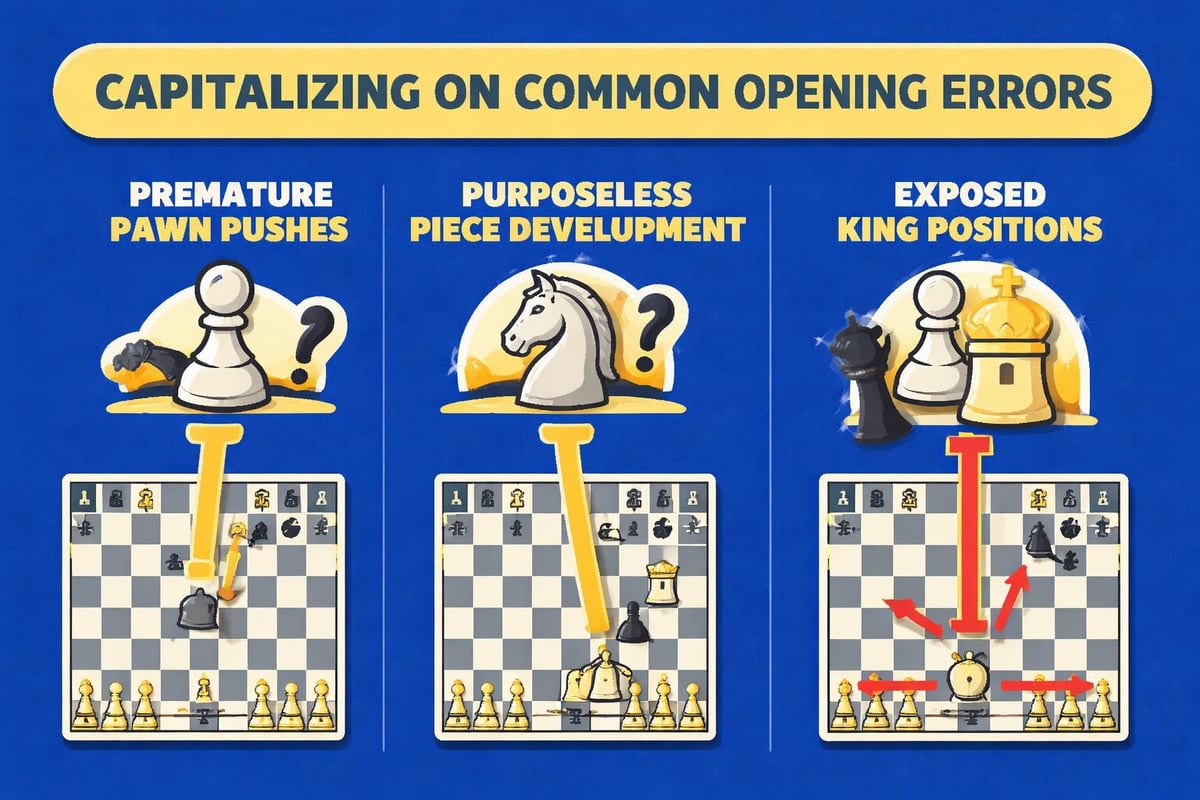
Spotting Weakening Pawn Moves
When your opponent pushes pawns unnecessarily in the opening, they're creating permanent weaknesses. Every pawn move is a commitment you can potentially exploit.
Watch for these red flags:
- h3/h6 moves – Often played to prevent pins but weakening the kingside
- g4 premature attacks – Exposing the king before it castles
- a3/a6 without purpose – Wasting tempo on irrelevant moves
- f3/f6 moves – Weakening the king's shelter and central control
The moment you spot these moves, shift your thinking. How can you punish this specific weakness? Sometimes it's an immediate tactical blow. Sometimes it's positional pressure that compounds into a winning advantage within 15 moves.
Developing Pieces Without Purpose
Development matters, but random development is almost as bad as no development. When opponents move pieces to squares that don't contribute to their plan, they're falling behind in the real race-the race for control.
I've seen countless games where someone develops their knight to h3 or a3, places bishops on squares where they're blocked by their own pawns, or brings the queen out too early. Each of these mistakes creates opportunities for quick chess wins through tactical shots.
Time Management in Fast Chess Formats
Quick chess wins become even more critical when playing fast chess formats like blitz and bullet. Here, time itself becomes a weapon.
Blitz Strategy Adjustments
In blitz chess (typically 3-5 minutes per player), the nature of quick chess wins changes. You're not just looking for checkmate-you're looking for positions where your opponent will struggle to find the right moves under time pressure.
Key principles:
- Choose openings with immediate tactical threats
- Prioritise positions with forcing sequences
- Create complications when ahead on the clock
- Simplify when your opponent is low on time
Watching quick wins at the 2021 World Blitz Championship reveals how even grandmasters crack under time pressure when faced with concrete threats.
Bullet Chess Considerations
Bullet chess (1-2 minutes total) is chaos theory applied to chess. Here, memorised patterns and rapid piece activity matter more than deep calculation.
The players who excel at bullet chess wins typically employ a few specific strategies:
- Pre-move common responses – Anticipating obvious moves to save time
- Avoid complex positions – Simple, forcing play wins more than brilliant plans
- Flag awareness – Sometimes winning on time is the primary goal
- Develop rapidly – Every tempo counts exponentially more
Building Your Quick Win Repertoire
Right, let's talk about creating a systematic approach to adding quick chess wins to your game. You can't memorise every trap in every opening, so how do you choose?
Repertoire Selection Criteria
Start with openings you already play. There's no point learning a brilliant trap in the Budapest Gambit if you never play 1.d4 as White or face it as Black.
Look at your recent games. Which openings do your opponents play most frequently? Those are your targets. If everyone at your level plays the Italian Game, learn the Italian Game traps. If you constantly face the French Defense, study French Defense pitfalls.
The Sicilian Defense chess opening guide offers excellent starting points for one of chess's most popular openings, complete with tactical motifs that appear repeatedly.
Pattern Recognition Development
Quick chess wins rely heavily on pattern recognition. You need to spot familiar tactical themes even when they appear in unfamiliar positions.
Here's how to build that skill:
- Solve tactical puzzles daily – The Chess Cheat Sheets puzzles collection provides targeted practice
- Review your losses – Identify where you missed winning opportunities
- Study master games – Focus on games that ended quickly
- Analyse trap variations – Understand why each trap works, not just the moves
| Skill Level | Daily Practice Time | Focus Areas |
|---|---|---|
| Beginner | 15-20 minutes | Basic checkmate patterns, Scholar's Mate variations |
| Intermediate | 30-45 minutes | Opening traps in your repertoire, tactical combinations |
| Advanced | 60+ minutes | Deep preparation, rare line analysis, pattern expansion |
Defensive Awareness: Avoiding Quick Losses
Understanding quick chess wins means understanding how to avoid them too. Every trap works both ways-if you know the pattern, you won't fall into it.
Common Defensive Principles
The best defense against quick chess wins is simple: follow fundamental principles and think on every move. Sounds obvious? Yet most quick losses happen because players violate basic rules.
Essential defensive habits:
- Castle early (usually within the first 10 moves)
- Don't weaken squares around your king without reason
- Develop pieces toward the centre
- Question your opponent's moves (why did they play that?)
- Take time on unusual moves, even if they look harmless
When studying the ten-move checkmate in the Two Knights Defense, you'll notice Black's defeat came from ignoring White's threats and continuing with standard development.
Trap Recognition
If you know the common traps in your openings, you can't fall for them. It's that straightforward.
Spend time learning the traps in both colours. When you know what Black's hoping for in the Stafford Gambit, you won't blunder into it as White. When you understand White's tricks in the Fried Liver Attack, you can sidestep them as Black.
This is exactly where resources like opening cheat sheets prove invaluable-they distil the critical trap variations you need to know without overwhelming you with endless theory.

Converting Advantages into Quick Victories
Sometimes you won't deliver checkmate in 10 moves. But you might win a piece or achieve a crushing position early. How do you convert that into a quick chess win rather than letting your opponent complicate matters?
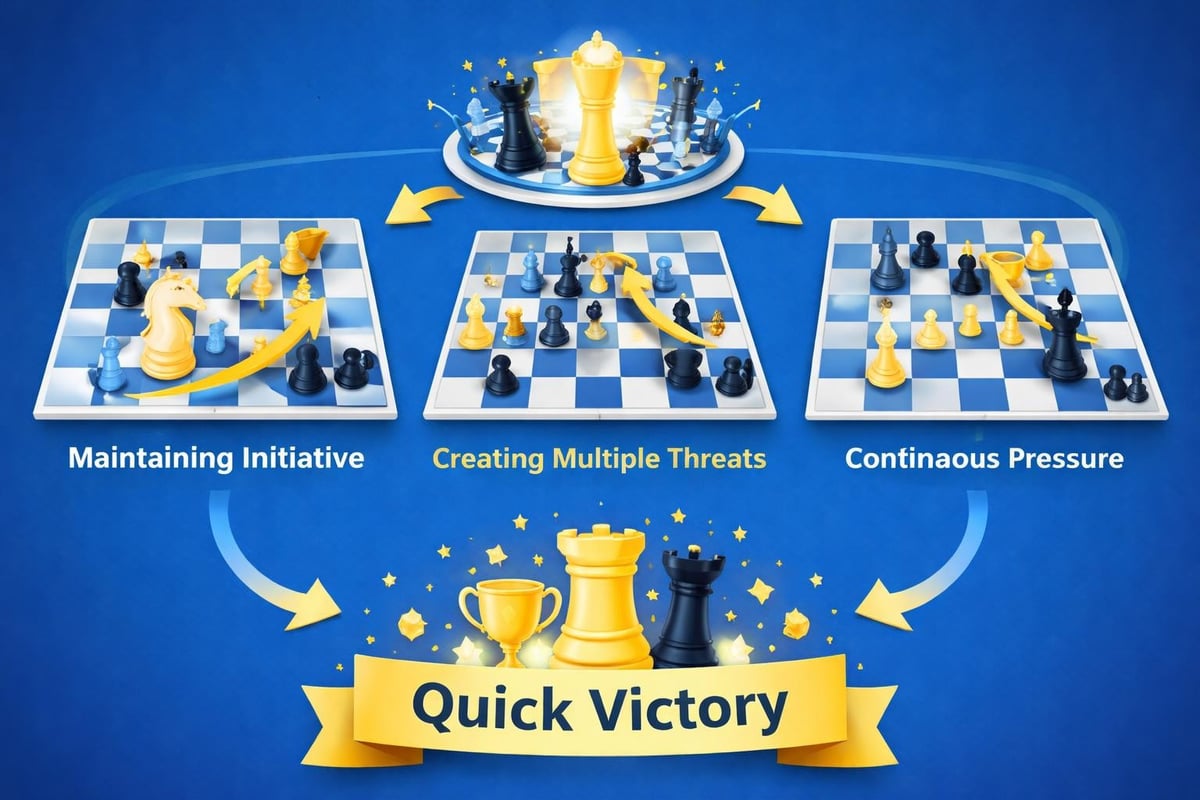
Maintaining Pressure
When you're winning, your instinct might be to trade pieces and simplify. Sometimes that's correct. But in positions where you have a significant lead in development or a direct attack on the king, simplification can throw away your advantage.
Ask these questions:
- Does my opponent's king still unsafe?
- Do I have more pieces attacking than they have defending?
- Can I create multiple threats simultaneously?
- Will trading pieces relieve the pressure?
If you've got your opponent on the ropes, keep punching. Don't give them time to reorganise and consolidate.
Avoiding Overconfidence
Here's the irony: more quick chess wins are lost than won. What do I mean? Players achieve winning positions in 8-10 moves, then get careless and blunder it all away.
You've won the opening battle. Brilliant. Now finish the game with the same accuracy. Check for simple defensive moves before assuming checkmate. Verify your calculations. Don't let excitement override good technique.
This is where studying games by strong players helps. GM Ben Finegold's analysis of quick wins in 15 moves or fewer shows how professionals maintain precision even when victory seems certain.
Practical Training Exercises
Knowledge without practice remains theoretical. Here's how to actively develop your quick chess win skills.
Daily Tactical Training
Set aside 15-30 minutes daily for focused tactical work. Not random puzzles-targeted exercises that reinforce quick win patterns.
Recommended practice routine:
- Warm-up (5 minutes) – Two-move checkmate puzzles from collections like these
- Pattern drilling (10 minutes) – Solve positions featuring specific tactical themes
- Game analysis (10-15 minutes) – Review one quick win game, trying to understand each move's purpose
- Position recreation (5 minutes) – Set up critical positions from memory and find the winning move
Game Analysis Framework
After each game (win or loss), conduct a focused five-minute review:
- Where could I have won more quickly?
- Did my opponent miss a faster win?
- Which tactical patterns appeared?
- How can I handle this opening better next time?
This isn't about deep engine analysis. It's about pattern recognition and practical improvement. The best websites to learn chess offer analysis tools that make this process straightforward.
Opening Repertoire for Quick Wins
Want to maximise your chances of quick chess wins? Choose openings with inherent tactical richness.
Aggressive White Openings
As White, you have the first-move advantage. Use it to create immediate threats and complications.
Top choices for tactical players:
- Italian Game – Rich in tactics, especially the Evans Gambit and Fried Liver variations
- King's Gambit – Sacrifices material for rapid development and attack, perfect for understanding King's Gambit strategies
- Danish Gambit – Gives up two pawns for overwhelming piece activity
- Vienna Game – Flexible system with many tactical possibilities
These openings create sharp positions where one mistake can prove fatal. They're perfect for club players looking to pressurise opponents from move one.
Sharp Black Defenses
Playing Black doesn't mean playing passively. Several defenses create immediate counterplay and trap opportunities.
- Sicilian Defense – The most fighting response to 1.e4
- Scandinavian Defense – Develops quickly and creates imbalances, as explored in the Scandinavian Defense guide
- Budapest Gambit – Sacrifices a pawn for rapid piece play
- Albin Counter-Gambit – Aggressive response to the Queen's Gambit
Each of these gives Black chances for quick chess wins through active piece play and tactical complications.
Adjusting Strategy by Opponent Level
Not all opponents require the same approach. Tailoring your quick win strategy to your opponent's level increases your success rate.
Against Beginners
Beginners make fundamental errors regularly. You don't need elaborate traps-just sound principles and patience.
They'll likely:
- Bring their queen out too early
- Neglect king safety
- Miss simple tactical threats
- Make random pawn moves
Your approach: Play solid chess and wait for the mistake. It will come. Then convert efficiently.
Against Intermediate Players
Intermediate players know basic tactics and opening principles. Here, specific preparation pays dividends.
They'll avoid obvious blunders but might not know deeper opening theory. This is where studying specific opening traps and variations becomes valuable. You're looking for lines that deviate around moves 5-8, where book knowledge runs out but tactical complications continue.
Against Stronger Opposition
Against stronger players, quick chess wins become rarer. These opponents know the common traps and play principled chess.
Your best chances come from:
- Superior opening preparation in sharp lines
- Creating complex positions where calculation matters more than general knowledge
- Exploiting time pressure in faster time controls
- Taking calculated risks in must-win situations
Even strong players make mistakes. The key is creating positions where mistakes are punishable.
Competitive Application
How do quick chess wins fit into competitive chess? More importantly than many players realise.
Tournament Time Management
In tournament play, especially with multiple rounds, quick chess wins offer a significant practical advantage. Finishing a game in 15 moves rather than 50 means:
- More energy for subsequent rounds – Mental fatigue affects later games
- Time for preparation – Extra time to study your next opponent
- Psychological boost – Confidence from a dominant victory
- Practical rating gains – In Swiss tournaments, winning quickly can improve tiebreak scores
Match Play Considerations
In match situations, the psychological impact of quick chess wins multiplies. Crushing your opponent rapidly in game one can affect their preparation and mindset for remaining games.
This is why opening preparation becomes so critical at higher levels. A well-timed surprise can yield not just one quick win, but destabilise your opponent's entire match strategy.
Resources for Continuous Improvement
Developing your quick chess win skills is an ongoing process. Here's how to maintain momentum.
Structured Learning Materials
Random study produces random results. Structured resources that build systematically from basic to advanced patterns work best.
Opening toolkits provide comprehensive coverage of specific systems, including trap variations, defensive resources, and practical examples. They're designed for players who want depth without drowning in theoretical variations.
Building a Personal Database
Keep a document or notebook of quick wins-both yours and those you study. Organise them by opening, tactical theme, and move count.
Include these details:
- Opening name and variation
- Critical position (use a diagram or FEN)
- Key tactical theme
- Opponent's mistake (if applicable)
- Your notes on when this pattern applies
Over time, you'll build a personal reference library perfectly suited to your repertoire and playing style.
Mastering quick chess wins isn't about memorising hundreds of trap variations-it's about understanding tactical patterns, recognising opponent mistakes, and converting advantages efficiently. Whether you're aiming to finish games in 10 moves or simply capitalise on early opportunities, these principles will sharpen your tactical vision and improve your results. Ready to accelerate your chess improvement? Chess Cheat Sheets provides the streamlined guides, opening resources, and tactical puzzles you need to master these patterns without extensive study, helping you achieve those satisfying quick victories more consistently.


