

Chess openings can feel overwhelming when you're first starting out, can't they? With hundreds of named variations and countless possible move orders, it's easy to get lost in the theory. But here's the thing: you don't need to memorise every opening under the sun to play strong chess. Instead, focusing on the most popular chess openings gives you a solid foundation that'll serve you well in the vast majority of your games. These time-tested systems have remained popular for good reason, and understanding them will boost your confidence from move one.
Why Popular Chess Openings Matter for Your Development
Let's talk about why studying popular chess openings is actually one of the smartest investments you can make in your chess education. When you learn mainstream openings, you're essentially learning the same systems your opponents will likely be using. This means you'll encounter these positions repeatedly in actual games, giving you practical experience that reinforces your theoretical knowledge.
Think about it this way: if you learn an obscure opening that only appears once every fifty games, you'll struggle to retain the ideas. But when you study the most common chess openings, you're practising those patterns game after game. Your pattern recognition improves, and suddenly you're spotting tactical opportunities and strategic plans almost instinctively.
The benefits of focusing on popular openings include:
- More frequent practice opportunities against real opponents
- Better quality learning resources and analysis available
- Deeper understanding through repeated exposure
- Easier transition to intermediate-level theory
The Italian Game: A Foundation for Understanding Chess
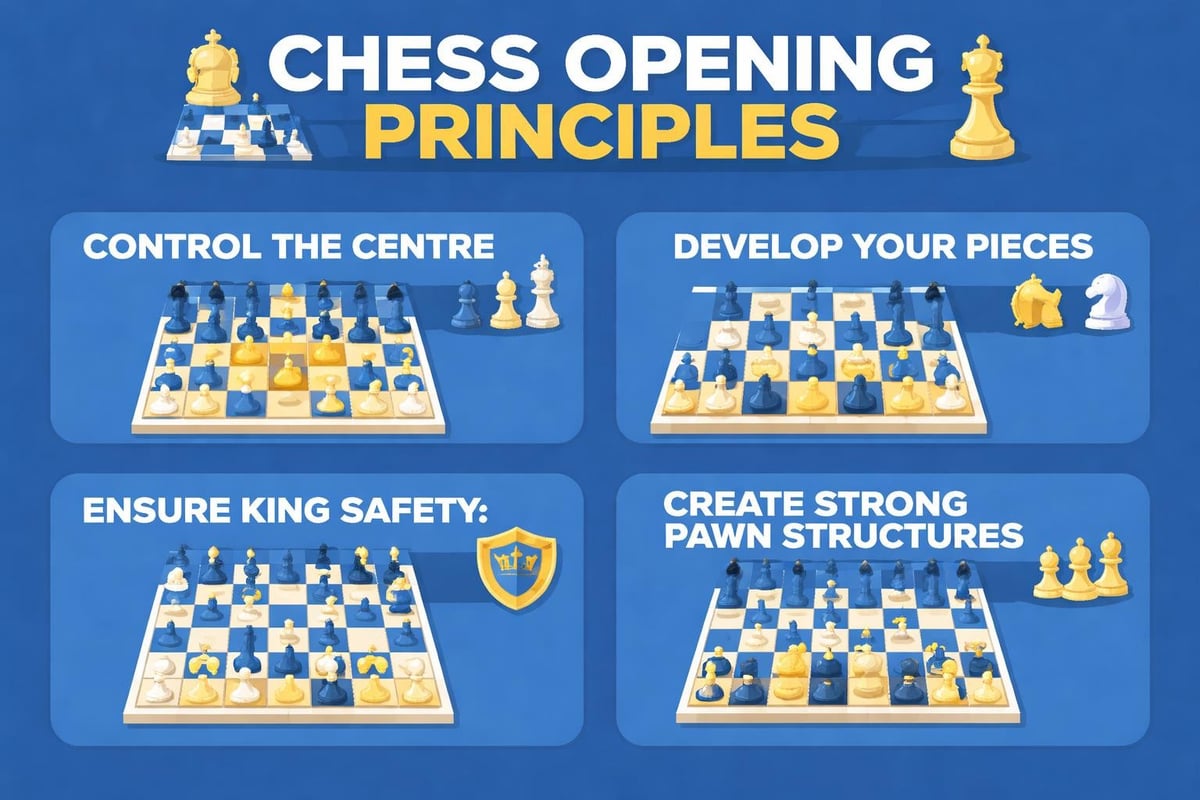
The Italian Game stands as one of the oldest and most instructive openings you can learn. Starting with 1.e4 e5 2.Nf3 Nc6 3.Bc4, this opening exemplifies classical chess principles. You're developing pieces rapidly, controlling the centre, and preparing to castle kingside.
What makes the Italian Game brilliant for learners is its flexibility. You can play aggressively with the Evans Gambit, opt for the solid Giuoco Piano, or choose the quieter Giuoco Pianissimo. Each variation teaches different aspects of chess strategy whilst maintaining the core opening structure.
Key Ideas in the Italian Game
The central battle often revolves around the d4 and d5 squares. White typically aims to establish a strong pawn centre with d4, whilst Black works to challenge this expansion. Understanding these tensions helps you navigate the middlegame positions that arise.
When studying the Italian Game chess opening guide, pay special attention to piece coordination. Your bishop on c4 targets the vulnerable f7 square, whilst your knights can reposition to maximise their effectiveness based on Black's setup.
The Sicilian Defense: Black's Fighting Response
If you're playing Black against 1.e4, you'll absolutely need to know the Sicilian Defense (1.e4 c5). It's the most popular chess openings choice for Black at all levels, from club players to world champions. Why? Because it offers Black excellent winning chances whilst avoiding the symmetrical positions that can arise from 1...e5.
The Sicilian creates immediate imbalance. You're not mirroring White's pawn structure; you're challenging the centre from the side. This asymmetry often leads to sharper, more dynamic positions where both sides have genuine winning chances.
| Sicilian Variation | Character | Best For |
|---|---|---|
| Najdorf | Sharp, complex | Experienced players |
| Dragon | Aggressive, tactical | Attacking players |
| Sveshnikov | Positional compensation | Strategic thinkers |
| Classical | Solid, flexible | Beginners to intermediate |
| Accelerated Dragon | Quick development | Practical players |
The Ruy Lopez: Chess's Timeless Classic
The Ruy Lopez (1.e4 e5 2.Nf3 Nc6 3.Bb5) has appeared in the best chess openings for beginners guides for centuries. Named after a 16th-century Spanish priest, this opening demonstrates sophisticated strategic thinking.
Unlike the Italian Game, which attacks f7 immediately, the Ruy Lopez takes a more nuanced approach. The bishop on b5 puts pressure on the knight that defends the e5 pawn, creating subtle threats that unfold over many moves.
Main Lines and Strategic Themes
The main line continues 3...a6 4.Ba4, and from here, Black has several respectable options. The closed variations after 4...Nf6 5.0-0 Be7 6.Re1 b5 7.Bb3 lead to rich strategic battles involving pawn breaks, piece manoeuvres, and long-term planning.
What's fascinating about the Ruy Lopez is how it rewards deep understanding over pure memorisation. Yes, there's theory to learn, but grasping the strategic ideas matters more than remembering move 23 in some obscure sideline.

Queen's Gambit and Closed Openings
Not all popular chess openings begin with 1.e4. The Queen's Gambit (1.d4 d5 2.c4) represents an entirely different strategic philosophy. Rather than occupying the centre with pawns, White offers a pawn to gain central control through pieces.
Don't worry, though. Despite the name, it's not really a gambit. After 2...dxc4, White can easily recover the pawn whilst maintaining excellent piece development. Many players prefer declining the gambit with 2...e6 or 2...c6, leading to solid, strategic positions.
Popular Queen's Pawn openings include:
- Queen's Gambit Declined (solid and classical)
- Queen's Gambit Accepted (active counterplay)
- Slav Defense (flexible pawn structure)
- Semi-Slav (complex and rich)
- Tarrasch Defense (active piece play)
The French Defense: Solid and Strategic
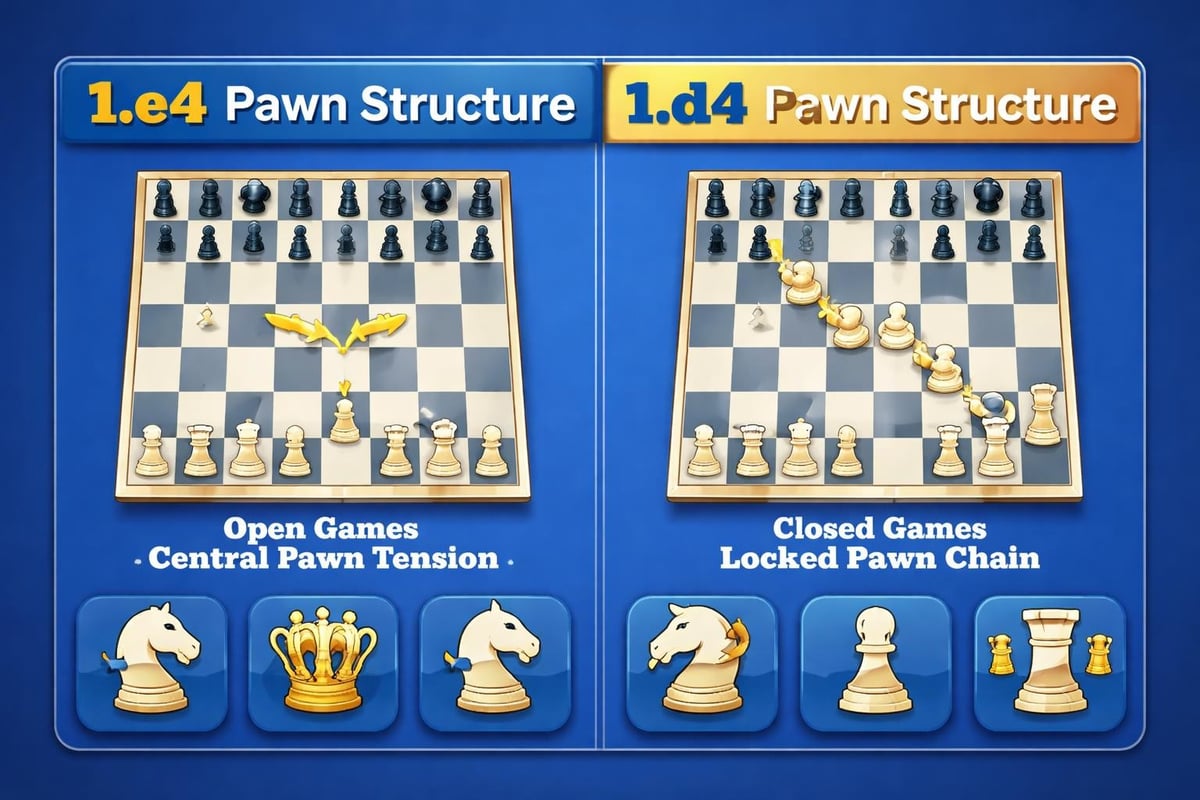
The French Defense (1.e4 e6) offers Black a completely sound system based on strategic complexity rather than tactical fireworks. After 2.d4 d5, Black immediately challenges White's central pawn, often leading to a locked pawn chain that defines the middlegame strategy.
Learning the French Defense teaches you about pawn breaks, piece manoeuvres in closed positions, and long-term strategic planning. You'll often play ...c5 and ...f6 breaks at precisely the right moment to crack open White's position.
The Caro-Kann Defense chess opening guide shares similar strategic DNA with the French, though with subtle differences in pawn structure and piece development.
The London System: Reliable and Straightforward
If you're looking for a system that works against virtually any Black setup, the London System deserves serious consideration. White develops with d4, Bf4, e3, Nf3, and typically Nbd2, creating a solid structure that's hard to refute.
The beauty of the London lies in its flexibility. You can reach similar positions regardless of Black's move order, which dramatically reduces your preparation time. This makes it particularly attractive for busy players who can't spend hours studying opening theory.
When to Choose the London
The London System excels when you want to reach a playable middlegame without theoretical debates. It's not the most ambitious opening choice, but it's remarkably reliable. You'll understand the typical plans, know where your pieces belong, and avoid early disasters.
However, don't fall into the trap of playing it mechanically. Understanding what are the pros and cons of the London System helps you maximise its strengths whilst avoiding its weaknesses.
King's Indian Defense: Dynamic Counterplay
The King's Indian Defense (1.d4 Nf6 2.c4 g6 3.Nc3 Bg7) represents Black's most aggressive response to 1.d4. Rather than fighting for the centre immediately, Black finesses development and prepares a kingside pawn storm with moves like ...e5, ...f5, and even ...g5 in some positions.
This opening produces incredibly sharp positions where both sides attack on opposite flanks. White often expands on the queenside with moves like b4 and c5, whilst Black launches a ferocious kingside assault. It's not for the faint-hearted, but it's tremendously exciting.
| Aspect | King's Indian | Queen's Gambit Declined |
|---|---|---|
| Pawn structure | Asymmetric | Symmetric |
| Complexity | Very high | Moderate |
| Attack potential | Both flanks | Gradual pressure |
| Defensive requirements | Precise | Solid |
Choosing Your Opening Repertoire
So how do you select which popular chess openings to include in your repertoire? Start by considering your playing style. Do you prefer tactical complications or strategic manoeuvring? Sharp positions or solid ones? Your personality should guide your choices.
For White, I'd recommend starting with either 1.e4 or 1.d4 and building a repertoire around that move. If you choose 1.e4, you might play the Italian Game against 1...e5 and an Anti-Sicilian against 1...c5. If you prefer 1.d4, the London System offers simplicity, whilst the Queen's Gambit provides classical options.
Building a Black Repertoire
Against 1.e4, pick one main defence and stick with it. The Sicilian offers the most winning chances but requires substantial study. The French and Caro-Kann provide solid, strategic alternatives. Against 1.d4, you'll need responses to several White setups, making it slightly more complex.
Consider these factors when choosing:
- Time available for study
- Your tactical calculation strength
- Preference for sharp or quiet positions
- Comfort level with theoretical debates
- Long-term development goals
How to Study Popular Chess Openings Effectively
Memorising moves without understanding the ideas behind them is a recipe for disaster. Instead, focus on learning the key concepts, typical pawn structures, and common tactical patterns. When you understand why moves are played, you'll remember them naturally.
Start each opening study session by reviewing the fundamental principles. What is this opening trying to achieve? What pawn breaks are typical? Where do the pieces belong? These questions guide your learning far better than rote memorisation.
Playing through master games in your chosen openings provides invaluable insight. Watch how strong players navigate the opening phase, transition to the middlegame, and convert their advantages. You'll absorb patterns and ideas that directly improve your practical play.
Common Mistakes to Avoid
One trap that catches many improving players is studying too many popular chess openings simultaneously. Your brain can only retain so much information, and spreading yourself too thin means you'll know nothing deeply. Better to master two or three systems thoroughly than dabble in twenty superficially.
Another mistake is neglecting the middlegame positions that arise from your openings. The opening doesn't exist in isolation. You need to understand what happens after move fifteen, how to conduct the typical pawn breaks, and which endgames commonly arise.
The Theoretical Depth Trap
Don't get sucked into studying ultra-deep theory in sharp variations. Unless you're a titled player, you probably won't face opponents who know move thirty of the Najdorf Poisoned Pawn. Focus instead on understanding moves 1-15 exceptionally well, knowing the key ideas, and developing your general chess understanding.
Remember that even among the most popular chess openings, you'll encounter countless positions where both sides have deviated from theory. Your understanding of chess principles matters more than memorised variations in these situations.
Practical Application and Game Experience
Theory means nothing without practical application. You need to play your chosen openings repeatedly in real games to internalise the patterns and ideas. Online platforms make this easy. Play rapid or blitz games specifically to practise your opening repertoire.
After each game, analyse the opening phase. Did you achieve a comfortable position? Where did you deviate from your preparation? What improvements could you make? This feedback loop accelerates your learning dramatically.
Consider maintaining an opening repertoire document where you record your chosen lines, key ideas, and adjustments based on game experience. This living document evolves as you gain experience and helps consolidate your knowledge.
Resources for Deeper Study
Whilst studying popular chess openings, you'll eventually need quality resources beyond basic principles. Video courses, books, and database programs each offer unique advantages. Videos provide intuitive understanding, books offer deep analysis, and databases let you explore millions of games.
For chess openings for intermediate players, structured learning materials that guide you from basic ideas to sophisticated concepts work best. Having all the information organised clearly saves countless hours of research time.
Puzzle training specifically focused on opening positions sharpens your tactical vision in the structures you'll actually play. When you solve hundreds of tactical puzzles from your chosen openings, the patterns become second nature.
Transitioning from Opening to Middlegame
The real test of your opening knowledge comes when theory ends and you're on your own. Have you achieved your opening objectives? Is your king safe? Are your pieces actively placed? These questions determine whether your opening preparation was successful.
Understanding typical middlegame plans for your openings is absolutely crucial. In the Italian Game, you might pursue a kingside attack or exploit weak squares. In the French Defense, you'll often play for the ...c5 or ...f6 breaks. These plans should guide your opening choices.
Study complete games in your repertoire, paying special attention to how strong players transition from opening to middlegame. You'll notice consistent patterns: certain pawn breaks at specific moments, piece relocations that anticipate opponent plans, and prophylactic moves that prevent counterplay.
Mastering popular chess openings takes time and dedication, but the rewards are substantial. When you understand the core systems that appear in most games, you'll approach the board with confidence and clarity. Chess Cheat Sheets provides comprehensive guides, puzzles, and resources designed to accelerate your opening mastery without overwhelming you with unnecessary theory. Our streamlined approach helps you focus on the essential knowledge that translates directly to improved results, giving you the tools to dominate from move one.


