

Imagine getting through your favorite chess opening, only to feel lost as soon as the real battle begins. That’s the challenge most players face in middlegame chess. The opening moves are mapped, but once the middlegame starts, you need fresh strategy and sharp thinking.
This article is here to help. You’ll discover nine essential middlegame chess tips designed to boost your performance right away. Expect practical advice, clear examples, and easy steps you can use in your next game.
Ready to level up your strategy? Dive in and turn every middlegame into your advantage.

Understanding the Chess Middlegame
Ever wondered why so many games are decided not in the opening, but in the mysterious stretch that follows? Welcome to the middlegame chess world, where plans shift, tactics emerge, and the outcome is forged by your ability to adapt and strategize. Let's break down what this crucial phase really involves, how to spot it, and why it deserves your full attention.
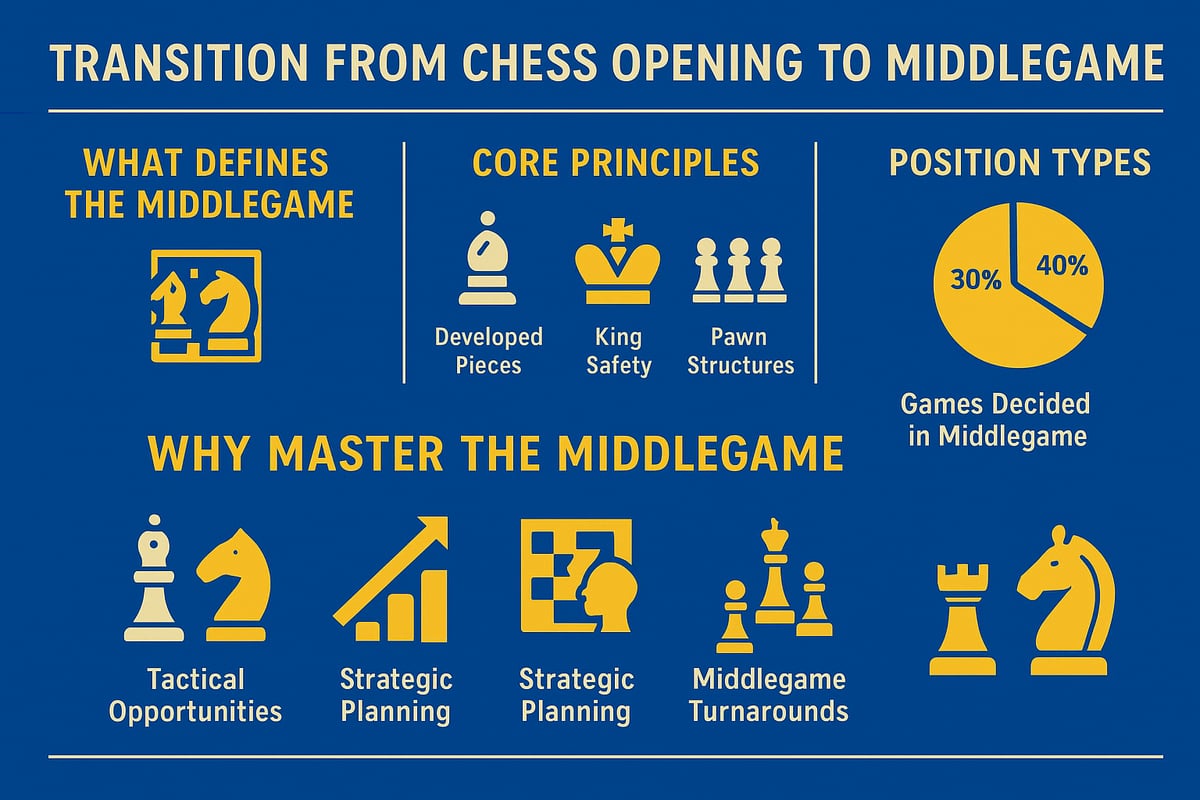
What Defines the Middlegame?
The middlegame chess phase sneaks in right after your pieces are developed and the kings are safe, but there’s rarely a clear dividing line. You’ll notice it when the opening’s theory ends and new, unique plans must be invented. Grandmasters often describe this moment as a shift from memorized moves to creative thinking.
Classic games showcase positions where both sides have castled, most pieces are out, and the pawn structure starts shaping future plans. For example, in many famous games, the middlegame begins when players must decide whether to attack, defend, or reposition their forces. Adapting your approach as the middlegame unfolds is key, since every position brings fresh challenges.
Core Aims and Principles of Middlegame Play
At its heart, middlegame chess demands attention to three main factors: king safety, material balance, and piece activity. Unlike the opening, where development is the focus, or the endgame, where conversion matters most, the middlegame is all about making your pieces work together and seizing opportunities.
Imbalances like having a bishop pair or a weak pawn can tip the balance fast. Common motifs include launching attacks, building up defenses, and maneuvering pieces for better control. If you want to dive deeper into practical advice, check out the Middlegame Chess Principles: 30 Practical Tips for Better Plans for more hands-on guidance. Recognizing these aims helps you stay focused and make smart decisions as the position evolves.
Types of Middlegame Positions
Not all middlegame chess battles look alike. Some are wide open, with files and diagonals cleared for action. Others are locked up, with pawns blocking the way and maneuvering taking center stage. Semi-open positions sit in between, offering a mix of direct and subtle play.
Pawn structure plays a huge role here. Isolated pawns, doubled pawns, or a strong central mass can dictate your strategy and where you place your pieces. For example, open positions favor bishops and rooks, while closed setups let knights shine. Understanding which type you’re facing makes it much easier to craft a strong plan.
Why Mastering the Middlegame Matters
Did you know that the majority of chess games are actually decided in the middlegame chess phase? Unlike the opening, where memorization can carry you, the middlegame rewards creativity, calculation, and strategic vision. Many players struggle here because there’s less theory to fall back on and more need for original thinking.
Improving your middlegame understanding leads to better results and real rating gains. There are countless stories of grandmasters turning games around with a clever middlegame idea or catching their opponents off guard. By focusing on this phase, you’ll not only sharpen your skills but also enjoy more victories and dramatic turnarounds in your own games.
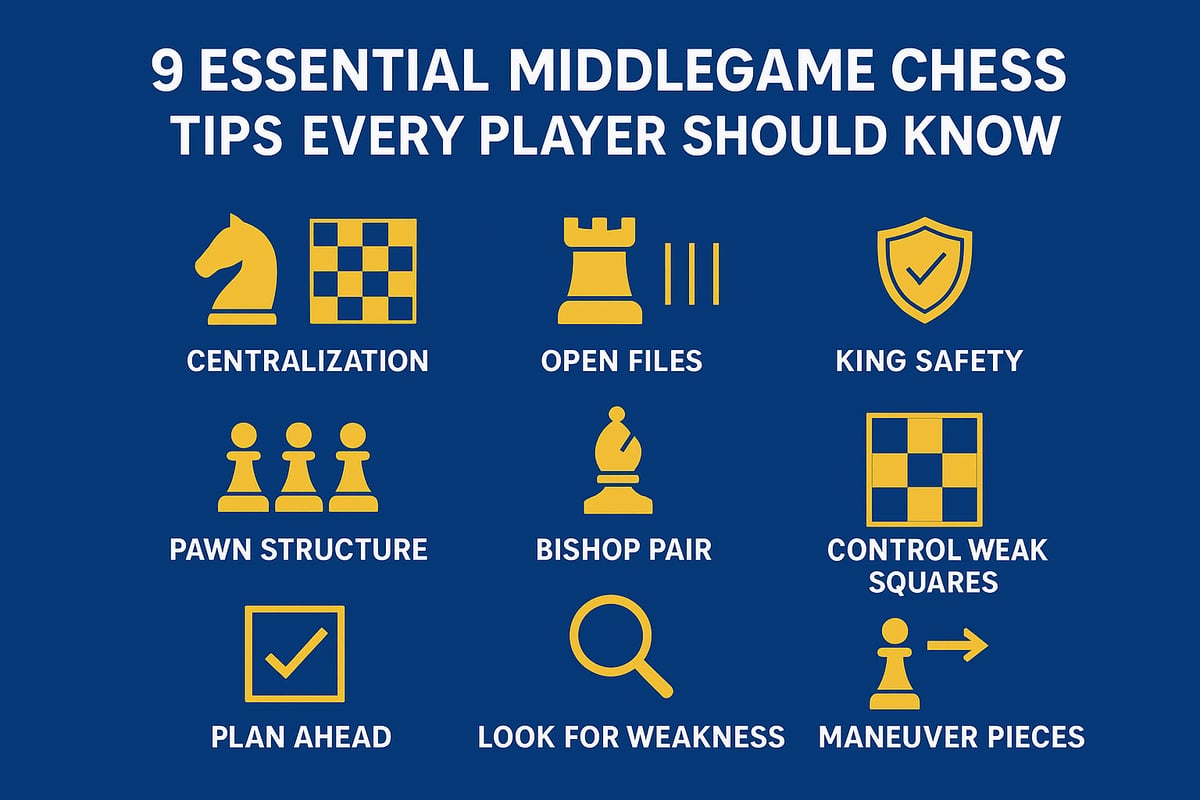
9 Essential Middlegame Chess Tips Every Player Should Know
Mastering middlegame chess is the secret sauce that separates casual players from true competitors. If you often find yourself lost after the opening, you’re not alone. The middlegame is where creativity, calculation, and strategy collide. Let’s break down nine crucial tips to help you navigate middlegame chess with confidence, clarity, and a winning edge.
1. Centralize Your Pieces
Ask yourself: where do your pieces feel most powerful? The answer in middlegame chess is nearly always the center. Central squares give your knights, bishops, and queen extra reach and maximum flexibility.
When your knight sits on d4 or e5, it controls up to eight squares. Compare that to a knight stuck on the edge—it’s like fighting with one hand behind your back. Bishops slice across the board from central posts, while a queen in the middle radiates influence.
Siegbert Tarrasch famously said, “The center is the soul of chess.” In middlegame chess, controlling the center means you can launch attacks, defend quickly, and create threats. If your pieces drift to the sidelines, you risk losing space and falling into passive positions.
Action tip: During middlegame chess, ask, “Can I reroute this piece toward the center?” Even a small move, like Nc3-d5 or Be3-d4, can transform your position. Don’t neglect centralization—the heart of middlegame chess success.
2. Occupy Open Files with Your Rooks
Spotting open files is a game-changer in middlegame chess. Open files—columns without any pawns—are highways for your rooks. Semi-open files, with only an opponent’s pawn, are almost as valuable.
Rooks shine brightest when they control these lanes. Doubling your rooks (stacking them on the same file) multiplies their power and creates threats your opponent must respect. Think of classic middlegame chess games where rooks invade the seventh or eighth rank, tying down the enemy king and pawns.
A classic example: doubling rooks on the d-file, then swinging one to the seventh rank for a decisive attack. But beware—rooks trapped behind your own pawns are just spectators.
How to apply: In middlegame chess, scan the board for open files. Can you contest or seize them? Don’t leave your rooks idle; bring them to the action, and your middlegame chess play will leap forward.
3. Avoid Creating Pawn Weaknesses
Pawns may be small, but in middlegame chess, their structure shapes the entire battle. Philidor called pawns “the soul of chess” for a reason. Weak pawns—doubled, isolated, or backward—can become magnets for enemy attacks.
Let’s say you double your pawns on the c-file. Suddenly, your opponent’s rooks and bishops have clear targets. Isolated pawns stand alone, often needing constant defense. Backward pawns lag behind, blocking your own pieces.
In middlegame chess, these weaknesses rarely go away. They can haunt you into the endgame. Look for positions where a single pawn move created a permanent target and led to a slow defeat.
Practical tip: Avoid unnecessary pawn moves in middlegame chess. If you spot a weakness, see if you can defend or trade it off. Sometimes, you can fix a weakness by advancing or exchanging pawns, but prevention is always best.

4. Keep Your King Safe
King safety is non-negotiable in middlegame chess. With queens, rooks, and bishops still on the board, a single slip can spell disaster. But when should you castle, and when is it safe to push pawns in front of your king?
Premature attacks can backfire if your king is exposed. Open files or diagonals aimed at your king invite tactics from your opponent. In classic middlegame chess games, players who neglected their king often lost quickly—even with a material lead.
Castling early is usually wise, but always check for lurking threats. Sometimes, creating “luft” (a small pawn move for breathing room) keeps your king from back-rank mates. But advancing too many pawns can weaken your defenses.
Best practices: In middlegame chess, balance king safety with piece activity. Ask yourself, “Is my king safe if I attack?” Don’t chase an attack at the expense of your monarch’s security.
5. Exploit and Occupy Weak Squares
What’s a weak square? In middlegame chess, it’s a square that can’t be defended by an opponent’s pawn. These are gold mines for your pieces, especially knights.
Imagine creating an outpost on d5 or e5—a safe haven where your knight can’t be chased away. Tarrasch advised occupying weak points with pieces, not pawns. A knight on a weak square can paralyze your opponent’s plans and dominate the board.
How do weak squares appear? Often, careless pawn moves leave them behind. In middlegame chess, if you see your opponent advance a pawn, ask what squares are now up for grabs.
How to use this: Hunt for weak squares in every middlegame chess position. Plan to maneuver your pieces onto them, and watch as your opponent struggles to dislodge you.
6. Trade Flank Pawns for Central Pawns
Did you know central pawns are worth more than their flank counterparts? In middlegame chess, pawns on the d and e files dominate space and open lines for your pieces.
If you can trade an a, b, g, or h pawn for a central pawn, you often gain control of the board. Nimzowitsch taught that central pawns fuel both attack and defense. Losing central control for a quick gain on the edge is rarely worth it.
Classic games show how a strong central pawn duo can squeeze the life out of an opponent. Conversely, lack of central pawns leaves you vulnerable and short on space.
Advice for you: In middlegame chess, think twice before exchanging central pawns for flank ones. Evaluate every pawn trade—does it strengthen your center or leave you weak?
7. Blockade Isolated Pawns with a Knight
Isolated pawns are a double-edged sword in middlegame chess. They can give open lines and attacking chances, but they’re also permanent weaknesses.
Nimzowitsch described the “gloom” of isolated pawns, especially when blockaded by a knight. Knights are perfect blockaders—they sit in front of the pawn, control key squares, and can’t be chased away by another pawn.
Look for classic middlegame chess positions where a knight on d5 or e5 blocks an isolated pawn, shutting down the opponent’s attack. The blockade often lasts into the endgame, where the pawn becomes a liability.
Your plan: In middlegame chess, identify isolated pawns and think about placing a knight in front. Coordinate with other pieces to increase pressure and limit your opponent’s activity.
8. Preserve the Bishop Pair When Possible
The bishop pair is a powerful asset in open middlegame chess positions. Two bishops can dominate long diagonals, coordinate attacks, and switch flanks quickly.
Steinitz said, “The bishop pair is worth at least half a pawn.” Modern grandmasters often keep both bishops unless forced to trade. But there are exceptions—if your pawn structure is closed or you gain a concrete advantage, it can be correct to exchange.
Study games where the bishop pair cut through defenses in middlegame chess, leading to decisive victories. Bishops excel in both attack and defense, so value them carefully.
What to remember: In middlegame chess, keep your bishops if the position is open. If you must trade, make sure you get real benefits in return.
9. Activate All Your Pieces Before Launching an Attack
Ever tried attacking with just one or two pieces? In middlegame chess, that’s a recipe for failure. Full piece coordination is the key to successful tactics.
Many players rush attacks without bringing all their pieces into play. Classic games show that, before launching an assault, top players reposition every piece for maximum impact. This harmonization often spells the difference between a crushing win and a blunder.
Before you attack in middlegame chess, scan your army. Are any pieces sleeping on the back rank? Is your queen stuck behind pawns? Activate everything first.
Step-by-step: Improve middlegame chess play by developing all your pieces. If you want visual help, check out Chess Cheat Sheets visual guides for diagrams and quick-reference tips.
Practical Middlegame Training and Resources
Looking to supercharge your middlegame chess skills? The right training and resources can make all the difference. Whether you’re just starting or aiming for club level, focusing on practical, hands-on learning will help you see real improvement. Let’s break down four ways to train smarter and boost your results.
Study Classic Middlegame Positions
One of the fastest ways to improve your middlegame chess understanding is by reviewing classic positions. Grandmaster games are packed with instructive moments that reveal recurring themes like pawn structure, piece activity, and king safety.
Focus on positions that showcase typical middlegame motifs. For example, look at how legends like Capablanca or Karpov maneuvered their pieces in quiet positions, or how Tal created fireworks with tactical middlegame chess ideas.
Key resources include annotated game collections, online databases, and classic books. If you want a head start, check out free chess books and learning resources that cover middlegame strategy and essentials.
Solve Middlegame Puzzles and Tactical Exercises
Sharpening your tactical vision is critical for middlegame chess success. Regularly solving puzzles improves your calculation skills, helps you recognize patterns, and builds confidence when facing complex positions.
Set aside time each day to tackle tactical exercises. Focus on themes such as forks, pins, discovered attacks, and combinations that often arise during middlegame chess battles.
For quality practice, explore chess puzzle collections for practice designed specifically to target key middlegame calculation skills. Integrating puzzles into your routine will help you react faster and spot winning opportunities.
Analyze Your Own Games for Middlegame Mistakes
Nothing beats learning from your own middlegame chess experiences. After each game, take a few minutes to review critical moments. Ask yourself, “Where did my plan go off track?” or “Did I miss a tactical shot?”
Use chess engines for feedback, but don’t rely solely on them. Write down your thoughts and compare them with computer analysis. Over time, you’ll notice patterns in your middlegame chess play, such as recurring weaknesses or missed opportunities.
Keep a checklist: Did you activate all your pieces? Was your king safe? Did you control the center? Honest self-review is one of the most reliable ways to grow.
How Visual Resources Can Accelerate Your Middlegame Improvement
Visual learning tools, like cheat sheets and diagrams, can give you a quick boost in middlegame chess understanding. These resources break down complex ideas into bite-sized visuals, making it easier to remember key concepts.

If you’re a busy learner or prefer plug-and-play solutions, visual guides can help you grasp strategic points quickly. Platforms like Chess Cheat Sheets offer practical guides, opening toolkits, and puzzle sets tailored for middlegame chess mastery.
Beginners and club players especially benefit from these visual aids, as they turn abstract theory into actionable steps. Explore free resources and try sample kits to see immediate progress.
Common Middlegame Mistakes to Avoid
Navigating the middlegame chess phase can feel like walking a tightrope. Even seasoned players stumble over common mistakes that sabotage their plans. By spotting these pitfalls early, you can turn your middlegame chess into a powerful weapon instead of a liability.
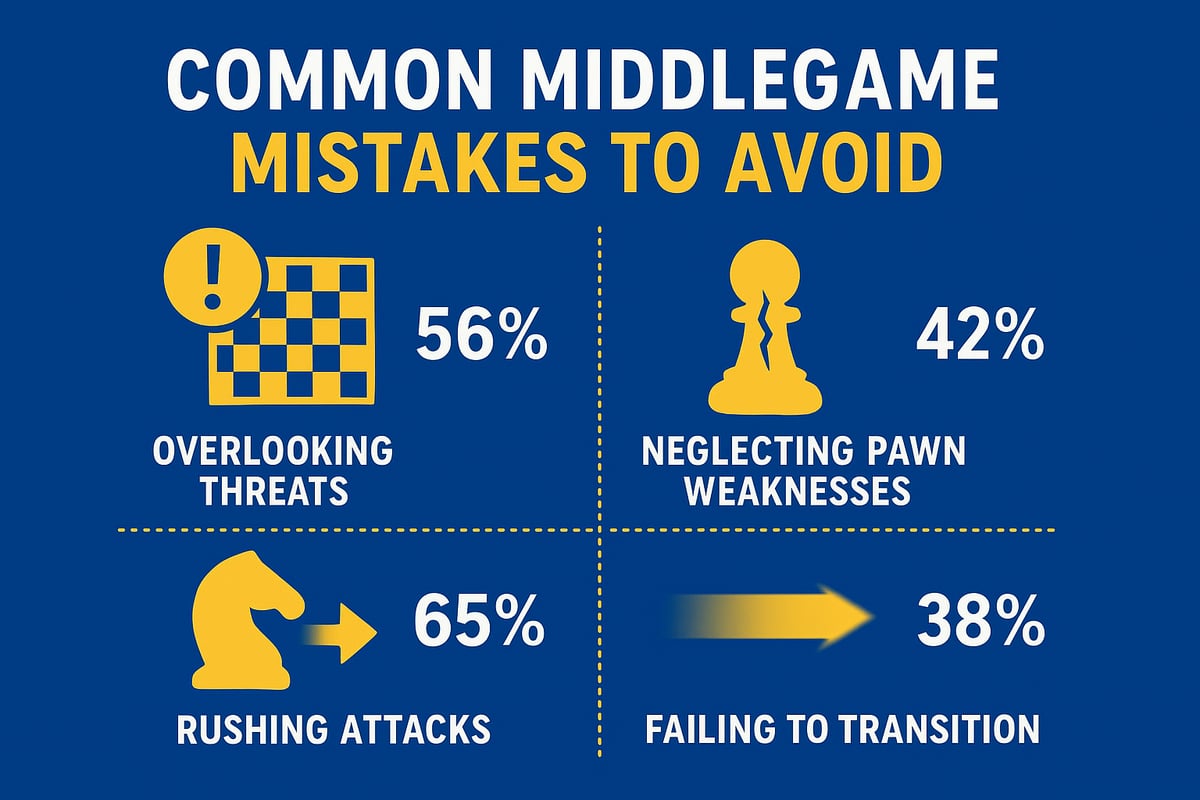
Overlooking Opponent’s Threats and Counterplay
How often do you get so wrapped up in your own ideas that you miss what your opponent is cooking up? This is one of the most frequent middlegame chess mistakes. It is easy to focus on your own plans, but the board is a two-way street.
A single overlooked check or tactical shot can flip the game in an instant. Grandmasters constantly scan for both threats and hidden resources. Ask yourself, “What is my opponent threatening?” on every move. If you want to dive deeper into these practical ideas, check out Mastering the Middlegame: Strategies to Elevate Your Chess Play for more actionable tips.
Try making it a habit: before every move, pause and look at your opponent’s last decision. Is there a fork, pin, or discovered attack lurking? Staying vigilant keeps you in control of your middlegame chess battles.
Neglecting Pawn Structure and Long-Term Weaknesses
Have you ever made a pawn move that haunted you for the rest of the game? In middlegame chess, careless pawn pushes can create doubled, isolated, or backward pawns, leaving permanent scars on your position.
A strong pawn structure is like the foundation of a house. If it is shaky, everything else collapses. Many games are lost not because of immediate blunders, but because weak pawns become targets over time. Take a moment before advancing a pawn, and ask: “Will this create a weakness I cannot defend?”
Use this quick checklist to avoid trouble:
- Avoid unnecessary pawn moves.
- Defend weak pawns with pieces.
- Repair weaknesses by trading or blockading.
Solid pawn structure is your silent defender in middlegame chess.
Rushing Attacks Without Sufficient Preparation
Do you ever feel tempted to launch an all-out attack, only to watch it fizzle? In middlegame chess, many players rush forward before their pieces are ready, leaving their position disjointed.
Imagine trying to bake a cake without all the ingredients. Attacks need preparation. Before sacrificing material or opening lines, ensure your army is coordinated. Classic games show that the best attacks use every piece, not just one or two.
A practical tip: pause and count how many of your pieces are participating. If you are attacking with just a knight and queen, ask if the others can join in. Well-timed attacks in middlegame chess often start with small, quiet moves that bring the whole team together.
Failing to Transition Smoothly to the Endgame
How do you know when to shift gears from middlegame chess to the endgame? Many players miss the signs and end up with awkward, passive pieces or bad pawn structures.
Recognizing the transition is key. Are queens coming off the board? Are pawns getting traded? Start thinking about king activity, pawn promotion, and piece placement for the endgame. Using resources like Opening toolkits for better transitions can help you bridge the gap and keep your position solid as the game evolves.
A smooth transition means you enter the endgame with momentum, not regret. Make endgame readiness a part of your middlegame chess routine.
So, now that you’ve got these nine middlegame tips in your toolkit, are you already picturing yourself making smarter moves and winning more games? Honestly, the real magic happens when you combine solid middlegame skills with a strong foundation right from the opening. If you ever feel like your games slip away before you even reach the fun tactical battles, maybe it’s time to give your opening play a boost too. Why not take the next step and Start Improving Your Openings? You’ll set yourself up for middlegame success every single time!


