

You've probably found yourself in countless chess games where you knew the basic rules, understood tactical combinations, but felt completely lost about what to do next. That frustrating moment when you've completed your development, castled your king, and then... nothing. You stare at the board, wondering what your actual plan should be. This is where mastering chess strategy transforms you from someone who simply reacts to threats into a player who controls the entire flow of the game. Strategy isn't about memorising opening variations or spotting tactical tricks-it's about understanding the deeper patterns that make strong positions and knowing how to create them deliberately.
Understanding What Chess Strategy Actually Means
Before we dive into specific techniques, let's clear up a common confusion. Many players use "strategy" and "tactics" interchangeably, but they're fundamentally different concepts.
Chess strategy involves long-term planning and positional understanding. It's about evaluating positions, identifying strengths and weaknesses, and formulating plans that might take ten or twenty moves to execute. Tactics, on the other hand, are the short-term combinations-forks, pins, skewers-that win material or deliver checkmate.
Think of it this way: strategy is deciding you want to attack on the kingside, whilst tactics are the specific knight fork that wins a pawn during that attack. You need both, but without strategic understanding, you're just hoping tactics appear randomly.
The Five Pillars of Strategic Understanding
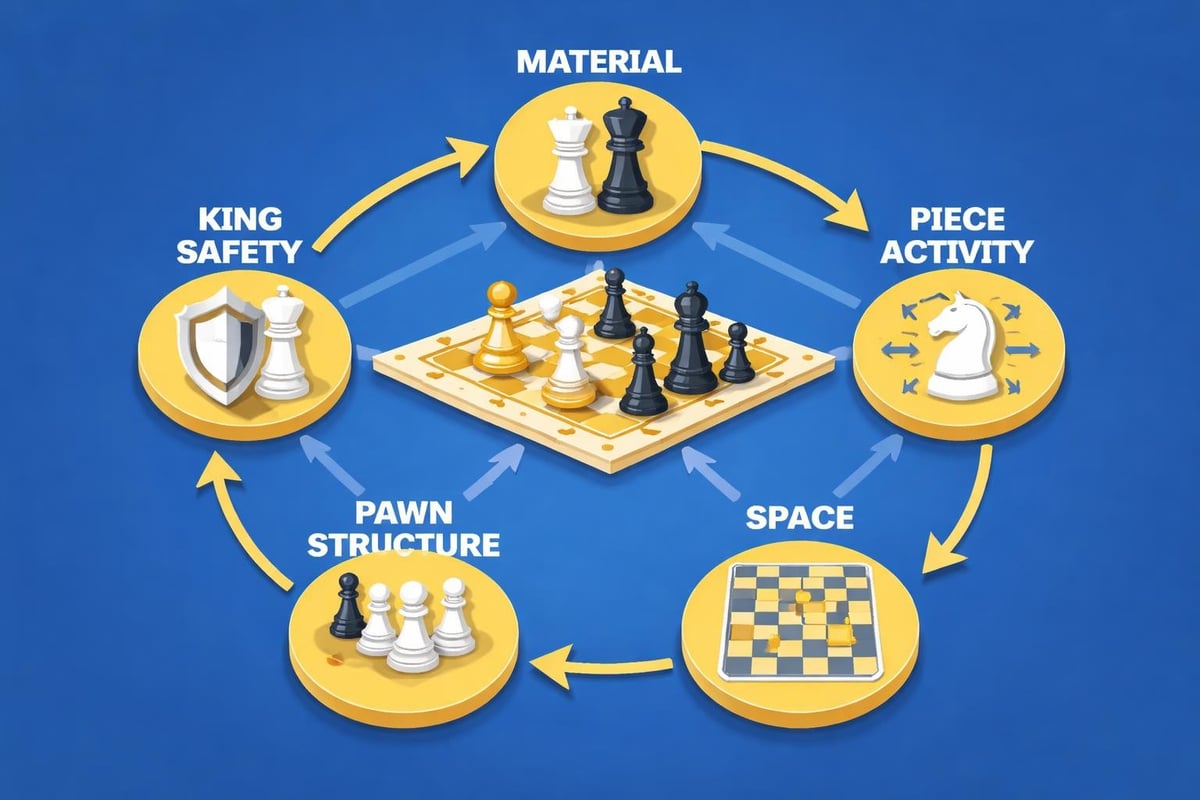
When you're mastering chess strategy, you'll want to evaluate every position through these fundamental lenses:
- Material balance: Who has more pieces, and what's their relative value?
- Piece activity: Which pieces are working effectively, and which are passive?
- Pawn structure: What weaknesses or strengths do the pawn formations create?
- King safety: How secure is each king, both now and in the middlegame?
- Space advantage: Who controls more of the board and has greater flexibility?
These aren't isolated concepts-they interact constantly. A space advantage might compensate for being down a pawn. Superior piece activity can outweigh a slightly worse pawn structure. The art of strategy lies in weighing these factors against each other.
Building Your Strategic Foundation Through Pawn Structure
Here's something that separates club players from experts: the ability to read pawn structures like a language. Your pawns are the skeleton of your position, and unlike pieces, they can't move backwards. Every pawn move is a permanent commitment.
Common Pawn Structures You Must Recognise
| Structure Type | Characteristics | Strategic Plans |
|---|---|---|
| Isolated Queen's Pawn | Single d-pawn with no neighbouring pawns | Active piece play, kingside attacks, avoid exchanges |
| Hanging Pawns | Two adjacent pawns (often c4/d4) with no support | Dynamic play, space advantage, watch for blockades |
| Backward Pawn | Pawn that can't advance safely | Target for opponent, restrict piece mobility |
| Pawn Chains | Diagonal pawn formations | Attack the base, play on the side with more space |
When you're studying chess openings for intermediate players, you'll notice that each opening creates characteristic pawn structures. The London System, for instance, typically builds a solid pawn triangle on d4, e3, and f4, giving White a stable but less dynamic position.
Understanding these structures helps you formulate plans even in unfamiliar positions. See an isolated queen's pawn? You know immediately that the player with the isolani should seek active piece play and avoid simplifications, whilst their opponent should blockade the pawn and trade pieces.

Piece Activity: Making Every Piece Pull Its Weight
A grandmaster once told me something that completely changed my chess: "A well-placed knight on the edge of the board is better than a poorly-placed queen in the centre." Piece activity isn't about where pieces sit abstractly-it's about what they're actually accomplishing.
Evaluating Piece Quality
Good pieces control key squares, support your plans, and create threats. Bad pieces are blocked by your own pawns, have no good squares to move to, or sit passively defending weaknesses.
Consider this practical example: In the Caro-Kann Defense, Black often accepts a slightly passive light-squared bishop in exchange for a rock-solid pawn structure. This trade-off is the essence of strategic thinking-accepting one positional concession to gain another advantage.
Key questions to ask about each piece:
- What important squares does it control or attack?
- Can it improve its position in the next few moves?
- Is it defending something that could be defended more efficiently?
- Does it support my overall plan for this position?
This systematic evaluation prevents that common mistake where you've developed all your pieces but they're not actually coordinating toward any objective. Mastering chess strategy means ensuring every piece contributes to a coherent plan.
Formulating Plans: The Heart of Strategic Play
Right, this is where everything comes together. You've evaluated the position, identified the pawn structure, assessed piece activity-now what? This is the moment many players freeze because they don't know how to translate evaluation into action.
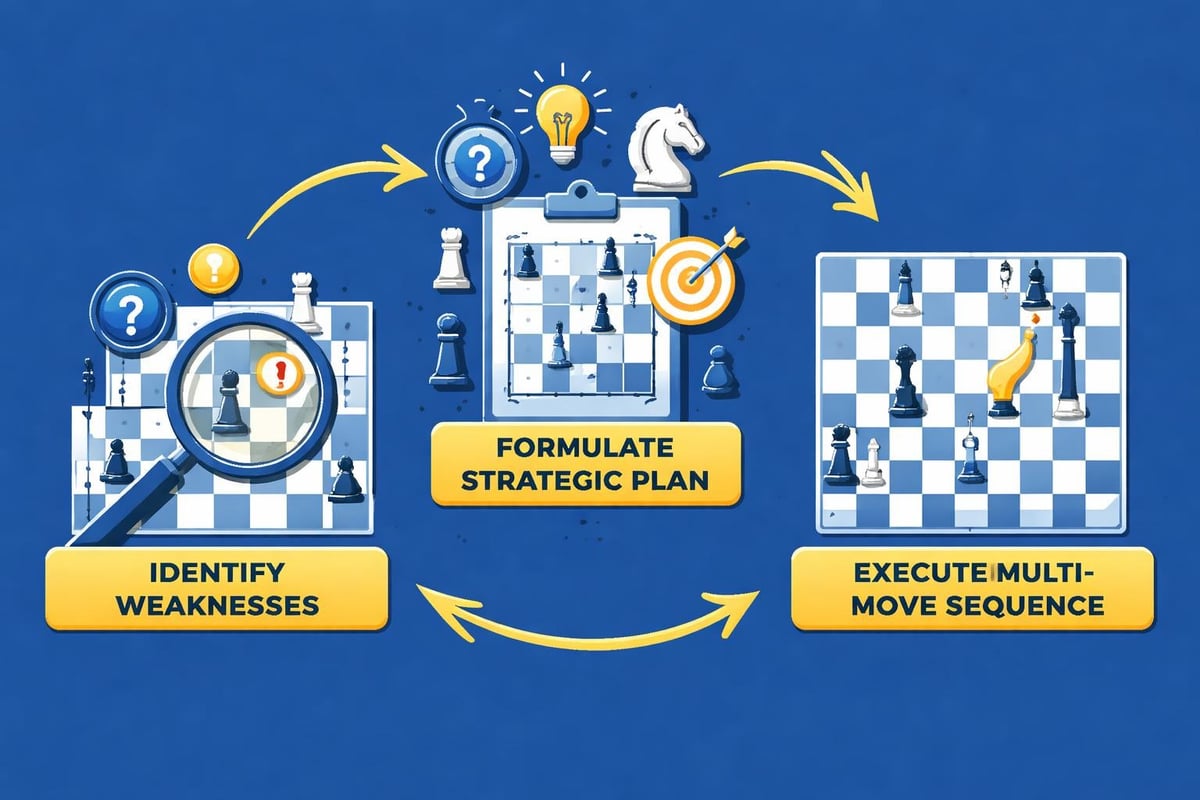
Strategic planning follows a logical process. First, identify the specific features of the position. Is there a weak square? A bad piece? An exposed king? A pawn majority on one flank? Then, formulate a plan that either exploits your opponent's weakness or improves your position's best features.
The Three-Step Planning Process
- Identify the critical positional features (weak squares, pawn breaks, piece placements)
- Determine which feature to target (prioritise based on what's most exploitable)
- Create a move sequence (not just one move, but a multi-move plan)
Let me give you a concrete example. You're playing White in a position where Black has doubled pawns on the c-file. Your plan might be:
- Reroute your knight to b5 to attack the c7 pawn
- Place a rook on the c-file to add pressure
- Advance your b-pawn to b4-b5 to fix Black's pawns
- Potentially sacrifice the exchange to destroy Black's pawn structure
Notice how this isn't one move-it's a coordinated sequence. That's strategic thinking in action.
Space Advantage and Central Control
You've heard it since your first chess lesson: control the centre. But why, exactly? And what do you do with central control once you've got it?
Why Space Matters
Space advantage gives you flexibility. More space means your pieces have more squares to choose from, better coordination possibilities, and greater ability to regroup when needed. Your opponent, cramped in a smaller area, struggles to improve their pieces or create counterplay.
The fundamental concepts of chess strategy emphasise central control because the centre provides access to both flanks. A centralized piece can quickly switch from kingside to queenside operations, whilst a piece on the edge of the board has limited scope.
Practical ways to exploit space advantage:
- Restrict your opponent's piece mobility
- Prepare pawn breaks on the flanks where you have more room
- Trade pieces when ahead in space (making their cramped position even more uncomfortable)
- Avoid opening the position if your opponent lacks space (keep them cramped)
In openings like the Italian Game, the battle for central control happens immediately with both sides contesting the e4 and e5 squares. Understanding these space dynamics helps you choose which pieces to develop and where to develop them.
King Safety: The Foundation of Long-Term Strategy
Here's a harsh truth: brilliant strategic play means nothing if your king gets checkmated. King safety isn't just about the opening-it's a constant strategic consideration throughout the entire game.
Evaluating King Safety Strategically
| Factor | Safe King | Dangerous King |
|---|---|---|
| Pawn Shield | Three pawns (f7, g7, h7 for Black) | Weakened pawns or missing shield |
| Open Files | No open files near king | Half-open or open files pointing at king |
| Piece Defenders | Several pieces within two moves | Pieces committed elsewhere |
| Attacking Pieces | Opponent's pieces far from king | Multiple attackers near king zone |
When you're mastering chess strategy, you'll learn to assess these factors dynamically. Sometimes you deliberately weaken your king's position to seize the initiative elsewhere. Other times, you refuse winning material because it would expose your king dangerously.
Consider how different openings approach king safety. The Sicilian Defense often leads to opposite-side castling, where both players launch pawn storms at each other's kings. Compare this to the solid, symmetrical positions arising from the Caro-Kann Classical Variation, where king safety is prioritised and attacking chances develop more slowly.
The Concept of Weaknesses and How to Exploit Them
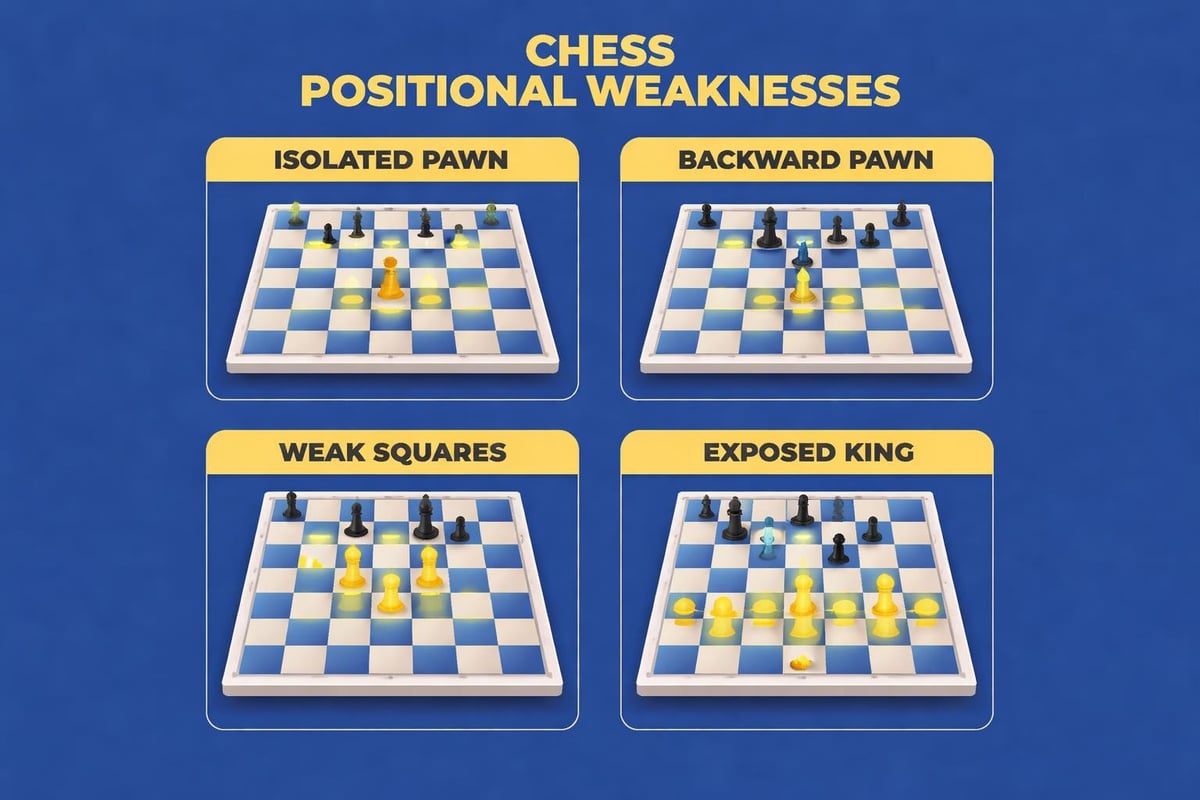
A weakness in chess is any feature of your position that can't easily be defended and requires constant attention. Weak squares, backward pawns, exposed kings-these are the targets around which you build your entire strategic plan.
Types of Positional Weaknesses
Permanent weaknesses can't be repaired:
- Isolated pawns
- Backward pawns
- Weak colour complexes (when you've traded your light-squared bishop and have weak light squares)
- Holes (squares that can't be defended by pawns)
Temporary weaknesses can potentially be fixed:
- Poorly placed pieces
- Uncastled king
- Lack of development
- Overextended pawns that might be supported later
Your strategic approach differs based on weakness type. Permanent weaknesses allow patient manoeuvring-they're not going anywhere, so you can take time building the perfect attack. Temporary weaknesses demand immediate action before your opponent corrects them.
Prophylactic Thinking: Preventing Your Opponent's Plans
Most players focus entirely on their own plans. But mastering chess strategy requires understanding what your opponent wants to do and preventing it. This is called prophylactic thinking, and it's perhaps the most sophisticated strategic concept you'll develop.
Advanced strategic understanding separates masters from club players primarily through this ability to think prophylactically. Strong players don't just execute their plans-they constantly ask, "What is my opponent threatening? What would they like to do if given the chance?"
Implementing Prophylactic Strategy
- After each opponent move, ask: "What does this enable them to do next?"
- Identify their best possible plan in the position
- Take measures to prevent or discourage that plan
- Only then proceed with your own offensive ideas
This doesn't mean playing purely defensively. It means strategic awareness-knowing when to push forward and when to consolidate. Sometimes the best prophylactic move is an aggressive counter-attack that forces your opponent to respond to your threats rather than executing theirs.
Exchanging Pieces Strategically
Here's a question that reveals strategic understanding: should you trade pieces or avoid exchanges? Many players grab any trade available, but strategic players calculate whether exchanges help or hinder their plans.
When to exchange pieces:
- You're ahead in material (simplify toward an endgame)
- You have less space (trades relieve cramping)
- You want to eliminate your opponent's best piece
- The exchange damages your opponent's pawn structure
- You're under attack (fewer pieces mean fewer attackers)
When to avoid exchanges:
- You have the initiative and want to maintain complexity
- You have better piece activity (keep your advantage)
- You're behind in material (complications offer drawing chances)
- Your pieces are better coordinated than your opponent's
For instance, if you're studying the London System middlegame plans, you'll notice White often avoids trading the dark-squared bishop because it's a key attacking piece aimed at Black's kingside.
Practical Training Methods for Strategic Improvement
Knowledge without practice remains theoretical. How do you actually improve your strategic understanding beyond reading articles like this one?
Structured Training Approaches
Study master games with strategic themes:
- Focus on games featuring specific pawn structures
- Follow games by players known for strategic mastery (Karpov, Petrosian, Carlsen)
- Don't just replay moves-pause and predict the plan
Work through strategic puzzles: Unlike tactical puzzles with forced winning sequences, strategic puzzles ask you to find the best plan. They might involve improving piece placement, choosing the right pawn break, or identifying which pieces to exchange. The puzzles and resources designed specifically for strategic development can accelerate your understanding significantly.
Analyse your own games strategically:
- Identify the critical moments where you needed a plan
- Evaluate what you did versus what you should have done
- Note recurring strategic mistakes (weak squares you repeatedly create, trades you shouldn't make)
Play training positions: Set up classic strategic positions and play them against engines or stronger players. Positions like the "good knight versus bad bishop" endgame teach strategic principles more effectively than scattered casual games.
Connecting Opening Knowledge to Strategic Understanding
Your opening repertoire and strategic understanding should complement each other seamlessly. When you choose openings, you're actually choosing the types of strategic positions you'll encounter.
The best openings for Black aren't universally "best"-they're best for certain playing styles and strategic preferences. If you love closed, manoeuvring games with clear strategic plans, you might prefer the Caro-Kann or French Defense. If you thrive in sharp, unbalanced positions requiring precise calculation, the Sicilian might suit you better.
Aligning Your Repertoire with Strategic Goals
Ask yourself these questions about each opening you play:
- What pawn structures typically arise?
- What are the common strategic plans for both sides?
- Which piece becomes particularly important?
- What type of middlegame positions do you reach?
This alignment between opening choice and strategic comfort zone accelerates improvement. You're not learning opening moves in isolation-you're learning opening moves that lead to middlegames where you understand the plans and patterns.
The Role of Imbalances in Strategic Chess
Perfectly balanced positions are rare and often boring. Most interesting chess happens in imbalanced positions where each side has different advantages. Mastering chess strategy means learning to navigate and exploit these imbalances.
Types of Strategic Imbalances
| Your Advantage | Opponent's Advantage | Strategic Approach |
|---|---|---|
| Two bishops | Better pawn structure | Open the position, create threats on both wings |
| Material (extra pawn) | Lead in development | Consolidate, return material if needed to neutralise attack |
| Space advantage | Solid, compact position | Avoid opening the position until you've maximized piece placement |
| Active pieces | Safer king | Attack before opponent consolidates and activates their pieces |
Understanding imbalances helps you evaluate unfamiliar positions accurately. You might be down a pawn but have overwhelming piece activity-is that enough compensation? Strategic understanding provides the framework for answering these questions.
Transitioning Between Game Phases Strategically
The transition from opening to middlegame, and later from middlegame to endgame, represents critical strategic moments. Many games are decided not by tactical blunders but by mishandling these transitions.
Opening to Middlegame Transition
As your opening preparation ends, ask yourself:
- Have I completed development?
- Is my king safe?
- What's the key pawn structure feature?
- What's my first middlegame plan?
This is where studying comprehensive strategic resources becomes valuable. You learn not just opening moves but the typical plans that follow them.
Middlegame to Endgame Transition
As pieces come off the board, strategic priorities shift:
- King safety matters less; king activity matters more
- Pawn structure becomes increasingly critical
- Minor piece differences (knight vs. bishop) grow in importance
- Concrete calculation often outweighs abstract strategic considerations
Recognising when to simplify into a favourable endgame versus maintaining middlegame complexity is a strategic skill that improves with experience and study.
Mastering chess strategy transforms how you approach every position, giving you the frameworks to formulate clear plans rather than hoping for tactical opportunities. The journey from tactical player to strategic thinker takes dedication, but the rewards-deeper understanding, more consistent results, and genuine chess improvement-make it worthwhile. Whether you're working on pawn structures, piece activity, or long-term planning, Chess Cheat Sheets provides the streamlined guides and resources you need to accelerate your strategic development without drowning in theory, helping you apply these concepts immediately in your games.


