

Have you noticed how chess is making headlines again? The world is experiencing a true chess renaissance, with players of all ages diving into the thrill of mastering chess in 2026.
If you are looking for a clear path to improvement, you are in the right place. This guide gives you expert strategies and practical steps to help anyone succeed, whether you are a beginner or seasoned competitor.
We will explore the essential building blocks of mastering chess, from understanding fundamentals and building a winning mindset, to opening mastery, strategic middlegame play, endgame excellence, and harnessing the latest technology.
Ready to take control of your chess journey? Let’s unlock your full potential and make mastering chess your reality this year.
The Foundations of Chess Mastery in 2026
Curious about what it takes to start truly mastering chess in today’s world? Let’s dig into the foundations you need to succeed in 2026. Whether you’re just getting started or you’ve been playing for years, understanding the modern chess landscape, the core principles, and how to build your skills will set you on the right path.
The Evolving Chess Landscape
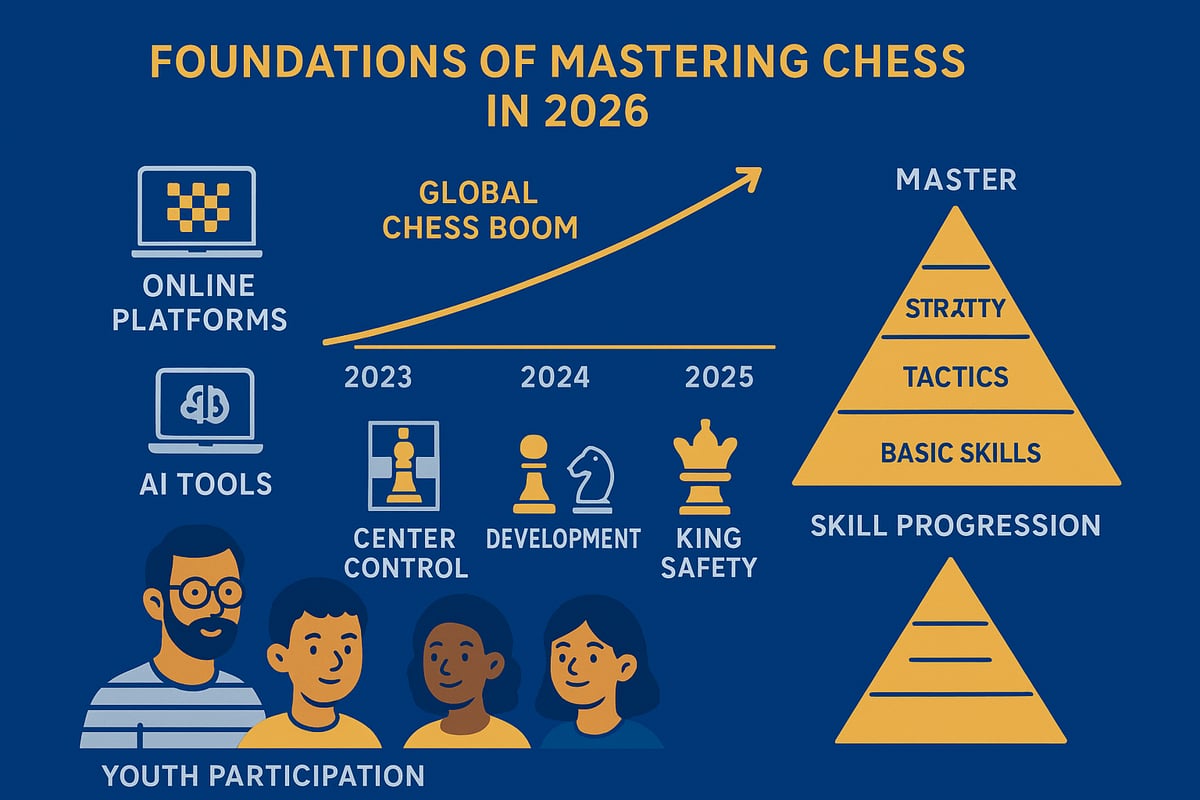
Have you noticed more people talking about chess lately? That’s because the game has exploded in popularity, with platforms like Chess.com surpassing 100 million users in 2024. This surge comes from streaming, online tournaments, and a wave of new players of all ages.
AI and powerful engines are changing how players approach mastering chess. You can now analyze your games instantly or get tailored lessons from bots. The competitive scene is also evolving, with FIDE rating inflation and more diverse events making things more dynamic. Youth participation is at an all-time high, and the chess community is more global and inclusive than ever. If you’re curious about the numbers behind this boom, check out the recent Global Chess Market Growth report.
Essential Chess Principles
When it comes to mastering chess, the basics never go out of style. You still need to control the center, develop your pieces quickly, and keep your king safe. These classical principles are the backbone of every strong game, even as new ideas emerge.
Take a look at recent Grandmaster games, and you’ll see these fundamentals in action. For example, top players often fight for the center right from the start, then coordinate their pieces for maximum impact. No matter how advanced the theory gets, sticking to these principles gives you a solid foundation to build on.
Key Principles Table:
| Principle | Why It Matters | Example |
|---|---|---|
| Center Control | Space and mobility | e4, d4 openings |
| Piece Development | Fast activation | Knights before bishops |
| King Safety | Avoids threats | Early castling |
Understanding Chess Skill Levels
As you work on mastering chess, it helps to know where you stand and what to focus on next. There are clear stages of progress, each with its own strengths and challenges.
Here’s a quick breakdown:
| Level | Typical Strengths | Common Weaknesses |
|---|---|---|
| Beginner | Basic moves, checkmate rules | Misses tactics, blunders |
| Intermediate | Simple tactics, openings | Weak endgames, planning |
| Advanced | Calculation, strategy | Missed nuances, time use |
| Expert | Deep plans, consistency | Occasional errors |
| Master | Precision, adaptability | Subtle mistakes |
The real difference between stages is how well you apply theory to actual games. For example, advanced players are better at calculation and planning than intermediates, but true experts turn those skills into practical results.
The Role of Intuition and Pattern Recognition
Intuition is your secret weapon in mastering chess. It’s that gut feeling you get when a move just looks right, even if you can’t explain it immediately. This comes from seeing thousands of positions and motifs over time.
Grandmasters like Magnus Carlsen are famous for their intuitive play, especially in fast games. Studies show they recall patterns almost instantly, letting them make quick, strong decisions. The more you expose yourself to different positions, the sharper your intuition and pattern recognition become.
Building this skill means solving puzzles, reviewing classic games, and challenging yourself with new scenarios. Over time, you’ll start to “see” the board like the masters do.
Building a Growth Mindset for Chess
The journey to mastering chess is all about mindset. Top players aren’t just talented—they’re resilient, always learning, and never afraid to make mistakes. Embracing a growth mindset means viewing every loss as a chance to improve.
Research shows that players who regularly review their games improve 30% faster. Try keeping a chess journal or making post-game analysis a habit. By reflecting on your decisions and celebrating small wins, you’ll keep growing and stay motivated.
Remember, every grandmaster started as a beginner. Staying curious, being honest about your weaknesses, and putting in steady effort will make all the difference in your progress.
Step 1: Mastering Chess Openings for Competitive Play
Opening mastery is your ticket to a confident start in any chess battle. In 2026, learning openings is about much more than memorizing move orders. Whether you’re new to mastering chess or already a seasoned player, a strategic approach to openings will set the stage for every game.
Building a Versatile Opening Repertoire
A well-rounded opening repertoire is essential for mastering chess in the modern era. You need reliable openings as both White and Black, but don’t just memorize—they should fit your playing style and help you understand the plans behind each move.
Think about why the Italian Game and Sicilian Defense still dominate in 2026. They balance classical roots with adaptability and have endless depth for exploration. The trick? Avoid rote learning. Instead, focus on the ideas and patterns each opening creates.
If you’re looking to quickly expand your options, resources like the Ultimate Chess Openings Bundle can streamline your journey, offering curated lines and in-depth explanations. Building a diverse repertoire means you’re ready for anything, whether you’re facing aggressive attackers or strategic defenders.
Understanding Opening Principles vs. Memorization
It’s tempting to memorize long sequences, but true mastering chess means understanding why you’re making each move. The timeless principles—developing pieces, controlling the center, and ensuring king safety—never go out of style.
Competitors often warn against falling into the trap of memorizing without understanding. For example, an over-memorized line can leave you lost if your opponent plays an unusual move. Focus on learning the plans behind your favorite openings, so you can adapt on the fly when something unexpected happens.

Analyzing Master Games and Model Repertoires
Studying annotated Grandmaster games is a secret weapon for mastering chess openings. By watching how top players handle your favorite lines, you’ll spot recurring themes and understand how opening ideas evolve into middlegame plans.
Use databases and books to dig deeper. Sites like ChessBase and Lichess studies offer a treasure trove of instructive games. Look for recurring pawn structures, typical piece placements, and how masters react to early surprises. This pattern recognition will pay off as your opening play becomes more intuitive.
Adapting to Opponents and Modern Trends
Chess is always evolving, and so should your approach to mastering chess openings. In recent years, trendy lines like the London System have surged in popularity, while engines introduce fresh ideas that challenge the old playbook.
Use online tools to scout your opponents’ favorite openings or spot new trends. Preparing for rare systems or offbeat moves ensures you’re never caught off guard. Staying current with the latest engine-inspired lines keeps your repertoire sharp and relevant.
Practice and Review: The Key to Retaining Openings
It’s one thing to study openings, but real progress in mastering chess comes from consistent practice and review. Play slow games to really absorb the ideas behind your lines.
After each game, review your opening phase. Did you stick to your plan? Were there any surprises? Adjust your repertoire as you encounter new ideas or fall into traps. Club players who regularly review and tweak their openings find themselves far more confident and flexible in future games.
Streamlining Opening Study with Visual Resources
Modern players crave efficiency, and that’s where visual tools come in. Chess Cheat Sheets offer practical, visual guides and puzzle packs designed for mastering chess openings fast.
These resources break down complex lines into easy-to-remember patterns, making them perfect for beginners and intermediates aiming for rapid improvement. With visual aids and targeted practice, you’ll find yourself recalling key lines and plans naturally—so you can spend less time memorizing and more time winning.
Step 2: Developing Advanced Middlegame Strategies
Unlocking the secrets of the middlegame is where mastering chess truly becomes an adventure. You leave the safety of opening theory and enter a world where plans, ideas, and creativity shape every move. Whether you dream of dazzling combinations or outmaneuvering your rivals, this step is your bridge to expert play.
Identifying Middlegame Plans and Structures
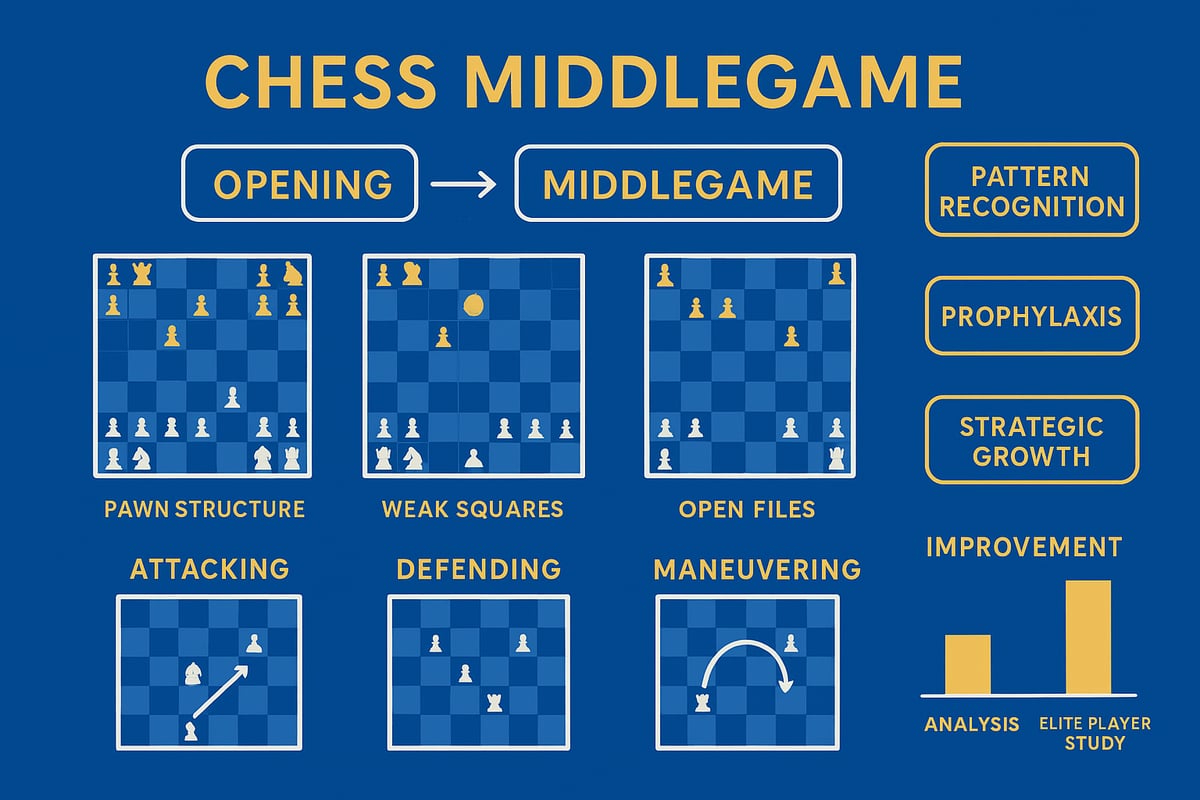
When you reach the middlegame, everything revolves around understanding the landscape of the board. The shape of the pawns, known as the pawn structure, offers important clues. Are you facing an isolated pawn, doubled pawns, or a locked center? Each structure demands its own unique plan.
Let’s break it down with a simple table:
| Pawn Structure | Common Plan | Example Motif |
|---|---|---|
| Isolated Pawn | Attack on open files | Use of rooks |
| Doubled Pawns | Control open lines | Pressure on weaknesses |
| Locked Center | Wing attacks | Pawn storms |
Mastering chess here means spotting these patterns and knowing what plans work best. Recognize weak squares and open files, and coordinate your pieces to target them. For instance, if you see a backward pawn, ask yourself: How can I attack it? By linking your moves to the board’s structure, you’ll always have a roadmap forward.
Strategic Thinking: Prophylaxis and Maneuvering
Ever wonder how top players seem to anticipate every threat? This is where prophylaxis comes in. Prophylactic moves block your opponent’s plans before they even get started. Imagine you’re building a wall while your rival looks for a way around.
Nimzowitsch’s classic games are filled with such moves, but modern players blend defense and offense seamlessly. Today, engines and AI have pushed this further, sustaining higher levels of strategic tension and uncovering new defensive ideas. If you’re curious about how artificial intelligence is shaping these advanced strategies, check out this AI's Impact on Chess Strategy article for a deeper dive.
To keep mastering chess, challenge yourself: Before every move, pause and ask, “What does my opponent want to do? How can I prevent it?” This habit will sharpen your strategic instincts and help you stay a step ahead.
Tactical Awareness and Calculation
While strategy sets your direction, tactics are your tools for getting there. The heart of mastering chess in the middlegame is seeing and seizing opportunities—pins, forks, skewers, and those sneaky discovered attacks.
Build your tactical awareness with daily puzzle drills. Spotting patterns isn’t just for prodigies; it’s a skill you can train. Top players make puzzle-solving a habit, often aiming for ten or more a day. This keeps their minds sharp and teaches them to recognize tactical motifs instantly.
Try this: After your games, review positions where you missed shots. By connecting puzzles to your own play, you’ll turn calculation into a natural part of your decision-making.
Transitioning from Opening to Middlegame
How do you know when the opening is over and the middlegame has begun? Look for signs: your pieces are developed, your king is safe, and the pawn structure is set. This is your cue to shift from memorized moves to creative plans.
For example, in the King’s Indian or Queen’s Gambit, typical plans emerge based on structure. In the King’s Indian, Black often prepares a kingside pawn storm, while White may expand on the queenside. Recognizing these triggers is a key part of mastering chess.
After the transition, pause and ask: What has changed? Where are my strengths? This reflection helps you craft middlegame plans tailored to the unique features of each game.
Analyzing Your Own Games for Strategic Growth
Improvement thrives on honest self-reflection. After each game, take time to review your choices. Did you miss a tactical shot or overlook a strategic plan? Balanced analysis, using both engines and your own reasoning, reveals patterns in your play.
Create a simple checklist:
- Were my plans consistent with the pawn structure?
- Did I anticipate my opponent’s ideas?
- Where did I spend too much time?
Mastering chess means learning from your mistakes and tracking recurring errors. Over time, you’ll notice your decision-making becoming clearer, and your confidence in the middlegame will soar.
Learning from Elite Players and Coaches
The fastest way to grow is to stand on the shoulders of giants. Study instructive games by Grandmasters like Carlsen or Ding Liren. Annotated games and expert commentary reveal the thinking behind each move.
Many top players recommend choosing a favorite master and emulating their style. This approach helps you internalize advanced concepts and makes mastering chess an ongoing, enjoyable journey.
Seek out coaches or join group study sessions to get personal feedback. With guidance from those who’ve walked the path, you’ll see your middlegame skills transform.
Step 3: Achieving Tactical and Calculation Excellence
Unlocking your true potential in mastering chess means becoming a tactical powerhouse and sharpening your calculation skills. No matter your rating, tactical vision and calculation are the engines that drive improvement. In this step, you'll discover how to train like the pros, turn puzzles into practical results, and develop the kind of sharpness that wins games.
Training Tactics: Motifs, Puzzles, and Pattern Recognition
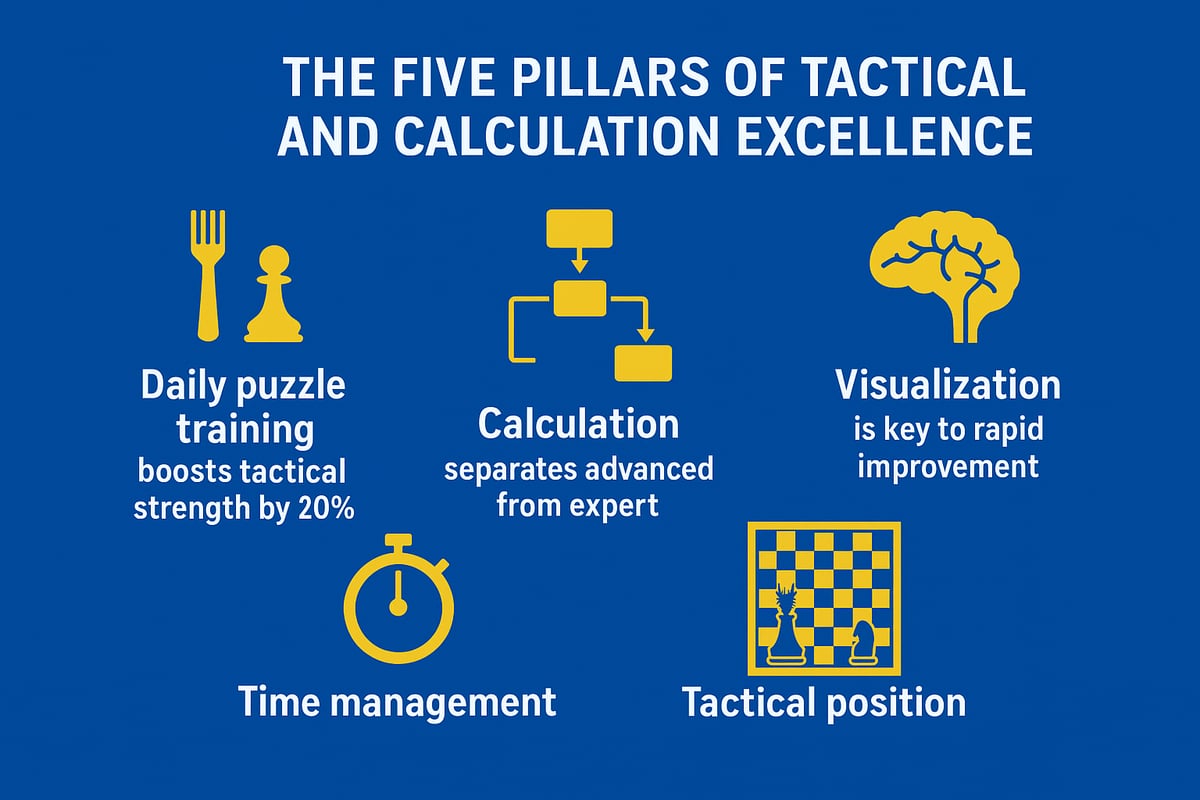
Building tactical muscle is a must for mastering chess. Start by drilling all the classic motifs—forks, pins, skewers, discovered attacks, and mating nets. Use online puzzle rushes or books to encounter these patterns repeatedly.
Daily tactical exercises help you spot opportunities faster in real games. Try to solve a mix of easy and challenging puzzles, and focus on understanding why each solution works. The more motifs you master, the more confident you'll feel when a critical moment appears on the board.
- Forks and pins: Practice simple two-move tactics.
- Sacrifices: Look for bold moves that disrupt your opponent's plans.
- Mating nets: Study common checkmating patterns.
With each session, you'll notice themes repeating. Over time, these patterns will become second nature, a crucial milestone in mastering chess.
Calculation Techniques for All Levels
Calculation is the backbone of mastering chess, separating casual play from expert maneuvering. Begin by identifying all candidate moves in a position. Visualize each sequence, move by move, ruling out lines that don't work.
A proven method is to verbalize your thought process: "If I play this, what is my opponent’s best reply?" Write down possibilities or use a simple table to track branches if you get stuck. Blindfold chess and endgame studies are also excellent drills for calculation.
| Step | Action |
|---|---|
| 1 | List candidate moves |
| 2 | Visualize each sequence |
| 3 | Eliminate weak options |
| 4 | Double-check for tactics |
With steady practice, you'll notice your ability to calculate deeper and faster—an essential skill for mastering chess.
Blindfold and Visualization Training
Visualization is a secret weapon for mastering chess. Grandmasters often replay entire games in their minds, picturing the board without sight. You can develop this skill too.
Start with mini-exercises: close your eyes and replay simple positions, or try solving a puzzle without moving the pieces. Gradually increase the complexity as you improve. Visualization not only boosts calculation but also helps you anticipate threats and opportunities in advance.
Some players keep a visualization journal, jotting down positions and replaying them mentally later. Little by little, your mind's eye will become sharper, giving you a real edge in mastering chess.
Time Management and Calculation Under Pressure
The clock is a constant companion in mastering chess. Whether you're playing blitz or classical, balancing speed and accuracy is vital. Elite players allocate more time to critical positions and trust their instincts in straightforward ones.
To avoid blunders in time trouble, practice quick calculation drills. Set a timer for 30 seconds per puzzle, then review your results. Learn to recognize when to trust your intuition and when to slow down for deeper analysis.
- Use time wisely: Spend extra moments on tactical hotspots.
- Stay calm: Deep breaths help clear your mind.
- Review: After each game, check if time pressure caused errors.
With mindful time management, you'll make better decisions and find tactical shots even when the clock is ticking in mastering chess.
Integrating Tactics into Real Games
All the tactical training in the world means little if you can't apply it when it matters. After every game, review missed tactics—did you spot the fork you practiced, or overlook a familiar motif?
Use puzzles that mirror real-game positions, not just composed problems. This helps bridge the gap between training and practical play. Set a goal to solve at least ten puzzles daily, focusing on scenarios you commonly encounter in your games.
Over time, your tactical awareness will flow naturally into your decision-making. This seamless integration is the hallmark of mastering chess and turning study into success on the board.
Step 4: Endgame Mastery for Consistent Wins
Mastering chess isn’t just about flashy openings or tactical fireworks. The endgame is where your true skill often shines, separating average players from consistent winners. In 2026, understanding and applying endgame principles is essential if you want to convert small advantages into full points and avoid heartbreaking draws.
Core Endgame Principles Every Player Must Know
If you are serious about mastering chess, you need to build your foundation on the most vital endgame concepts. Start with the “50 most common endgames,” which include elementary king and pawn scenarios, opposition, triangulation, and zugzwang. These are the building blocks that every expert relies on.
Opposition teaches you how to outmaneuver your opponent’s king. Triangulation helps you lose a tempo and gain the upper hand. Zugzwang, the art of forcing your rival into a losing move, is a powerful weapon in your arsenal. Promotion races test your calculation and nerves.
You’ll see these themes appear repeatedly, no matter how complicated your games become. Grandmasters spend countless hours drilling these basics because, without them, even a material advantage can slip away.
Essential Pawn, Rook, and Minor Piece Endgames
When it comes to mastering chess, you’ll encounter pawn, rook, and minor piece endings far more often than you might expect. King and pawn endgames are deceptively simple, yet one misstep can cost you the game. Rook endgames, like the Lucena and Philidor positions, are especially common at all levels.
Let’s break it down:
- King and pawn endgames: Learn opposition, outside passed pawns, and breakthrough motifs.
- Rook and pawn endgames: Know the Lucena and Philidor positions, as well as active defense techniques.
- Minor piece endgames: Bishop versus knight, same-color bishops, and opposite-color bishops each have their own tactical nuances.
- Queen endgames: Master perpetual check patterns and pawn race calculations.
By focusing on these practical endings, you’ll be ready for the positions that appear most in real games.
Practical Endgame Training Methods
The secret to mastering chess endgames is structured and targeted practice. Solve endgame puzzle packs to sharpen your skills, and review instructive master games to see key ideas in action. Many players benefit from checklists that track which endgame types they’ve mastered.
If you’re looking for visual guides and practical resources, the Endgame Expertise Collection offers curated materials designed to help you internalize essential endings quickly. These resources break down complex ideas into digestible, actionable steps.
Make endgame study a regular habit, not just an afterthought. Use slow games, analyze your results, and challenge yourself with new positions every week.
Endgame Calculation and Decision-Making
A huge part of mastering chess is learning to calculate long endgame variations with clarity and confidence. Unlike the middlegame, where tactics can be chaotic, endgames demand precision and patience.
Here’s how you can improve:
- Visualize key lines in your head, especially in reduced-piece scenarios.
- Practice solving endgame studies that require multiple-move calculations.
- Break down each position step-by-step, always checking for promotion threats and stalemate tricks.
Calculation in endgames is less about brute force and more about understanding critical moments where a single move changes the outcome. This skill will raise your conversion rate dramatically.
Applying Endgame Knowledge in Tournament Play
Taking your endgame skills from theory to practice is the final step in mastering chess. Recognize when to trade into a favorable endgame, and don’t shy away from simplifying when you’re ahead.
Avoid common pitfalls like rushing or missing drawing resources for your opponent. Stay calm under pressure, and trust your training. Statistics show that club players with strong endgame knowledge score 15 percent more wins in balanced games.
Ultimately, your ability to apply what you’ve learned in real tournament situations will set you apart. Make endgame mastery your secret weapon, and you’ll find yourself finishing games with confidence and precision.
Step 5: Leveraging Technology and Modern Training Tools
Today's digital world has made mastering chess more accessible than ever. With powerful engines, interactive platforms, and vibrant online communities, you can supercharge your chess journey right from home. Let's explore how these tools can help you reach new heights in mastering chess.
Using Chess Engines and Analysis Software
Chess engines like Stockfish and Leela have transformed how players approach mastering chess. These tools analyze your games, reveal tactical opportunities, and suggest improvements. The real magic, though, comes from understanding their insights, not just copying moves.
Recent developments in AI, such as those highlighted in the AI in Chess Education Study, show how generative AI can personalize feedback and suggest targeted lessons. Try reviewing your games after every match, focusing on the reasoning behind engine recommendations. This habit builds intuition and strengthens your overall play.
Online Platforms and Training Resources
Online platforms are the heart of modern mastering chess. Sites like Chess.com, Lichess, and Chessable offer everything from live play to structured lessons and interactive puzzles. Each platform has unique features, so experiment to find your favorite.
Here’s a quick comparison:
| Platform | Best For | Notable Feature |
|---|---|---|
| Chess.com | All-round learning | Tactics Trainer |
| Lichess | Free resources | Open-source studies |
| Chessable | Memorization drills | Spaced repetition |
Using multiple platforms lets you blend strengths and customize your learning.
Tracking Progress with Digital Tools
Tracking your journey is essential for mastering chess. Most platforms provide rating graphs, performance stats, and achievement badges. These features help you set goals and measure growth over time.
Try creating a simple spreadsheet or using built-in trackers to log your progress. Celebrate small milestones, like breaking a rating barrier or solving a tough puzzle streak. This approach keeps motivation high and highlights areas for focused improvement.
Community, Coaching, and Collaboration
No one masters chess in isolation. Joining online clubs, discussion forums, and group lessons connects you with others who share your passion. Many players find that regular coaching or peer analysis sessions speed up their improvement.
Consider finding a study partner or joining a club challenge. Group study exposes you to diverse strategies and keeps learning fun. Remember, sharing insights and friendly competition are key parts of the mastering chess experience.
Staying Updated with Chess Trends and Innovations
Chess evolves quickly, especially with engines and elite players introducing new ideas. Keep up by following top tournaments, grandmaster streams, and news updates. Watching how modern masters adapt can inspire you to innovate in your own games.
Pay attention to trends like AlphaZero-inspired sacrifices or the latest opening novelties. Staying informed ensures your mastering chess journey stays current and effective, no matter how the game changes.
You’ve just explored some of the most effective strategies for mastering chess in 2026—pretty exciting, right? But here’s the thing: even with the best plans, having the right resources can make all the difference. If you’re serious about turning these expert tips into real improvement (without endless hours of study), why not give yourself every advantage? I honestly recommend checking out the Get The FULL Chess Mastery Bundle. You’ll get instant access to streamlined cheat sheets, puzzle packs, and endgame guides, making your chess journey smoother and way more fun. Ready to level up your game?


