

Ready to unlock the secrets of the london system chess opening and take your chess to the next level in 2026? This guide delivers a step-by-step approach to mastering the london system chess opening, perfectly tuned for today’s trends and tomorrow’s games. You’ll discover the fundamentals, move orders, strategic plans, advanced traps, and expert tips you need to dominate. The london system is more popular than ever, trusted by world champions and club players alike. Imagine navigating every opponent’s response with confidence. Dive in now and start building your unstoppable 2026 London System repertoire.

Understanding the London System: Origins, Popularity, and Core Concepts
Curious why the london system chess opening has become a favorite for both new and seasoned players? Let’s peel back the layers and see what makes this “system” approach so unique.

What Makes the London System a “System” Opening?
The london system chess opening is called a “system” because it’s based on a set structure rather than memorizing endless move sequences. You start with 1.d4 and quickly develop your bishop to f4, then support the center with pawns on c3 and e3. This setup works against almost any black defense, letting you focus on plans instead of tricky theory.
If you like the idea of building a strong house with reliable bricks, this opening is for you. You can play it by understanding ideas, not by memorizing tons of lines.
From London 1922 to Modern Mastery
The roots of the london system chess opening trace back to the 1922 London Congress, where top players experimented with flexible queen’s pawn setups. For decades, it was seen as a solid but quiet choice, often used by club players who wanted to avoid sharp lines.
Fast forward to the 21st century, and the London System has undergone a renaissance. Grandmasters like Gata Kamsky and Magnus Carlsen have shown that this opening is anything but dull. They use it to outmaneuver opponents, even at the highest levels.
The Popularity Boom: Club to Elite
Why has the london system chess opening exploded in popularity? Simply put, it’s easy to learn, tough to crack, and works at every level. Club players like it because it avoids heavy theory. Elite grandmasters use it to sidestep deep computer preparation.
Recent years have seen a surge in adoption. According to London System's Popularity and Statistics, the opening’s win rates and usage have soared, making it one of the most played choices globally. If you want a reliable weapon for your own games, you’re in good company.
Core Principles, Advantages, and Drawbacks
The heart of the london system chess opening is early bishop development (Bf4), a sturdy pawn triangle (c3, e3, d4), and flexible move orders. You can castle early and connect your rooks, keeping your position safe and adaptable.
Here’s a quick comparison of why so many players love (and sometimes struggle with) the London:
| Strengths | Drawbacks |
|---|---|
| Less memorization needed | Can be too passive if mishandled |
| Works vs. many black defenses | Lower immediate pressure |
| Solid structure, few weaknesses | Requires patience and planning |
| Flexible move orders | Bishop can get trapped if careless |
If you play with purpose, you can avoid the common pitfalls and keep the initiative.
Stats and Why It’s Perfect for 2026
Let’s talk numbers. In recent online and over-the-board play, the london system chess opening has a balanced win/draw/loss record. For example, Black wins about 49% in early c5 lines, but White’s results are solid across the board.
Why is it so effective in 2026? Chess is evolving. Players want openings that are simple, flexible, and less vulnerable to deep computer prep. The London System fits this trend perfectly. It’s adaptable, easy to prepare, and gives you a stable foundation no matter what your opponent throws at you.
Ready to make the london system chess opening your own secret weapon? In the next section, you’ll see exactly how to set it up and unleash its power.
Step-by-Step London System Setup: Move Orders and Key Plans
Mastering the london system chess opening starts with understanding its logical, step-by-step setup. Whether you're a beginner or a club player aiming to climb the ranks in 2026, getting these details right can make all the difference. Ready to explore the building blocks of a system that lets you play with confidence against almost any defense?
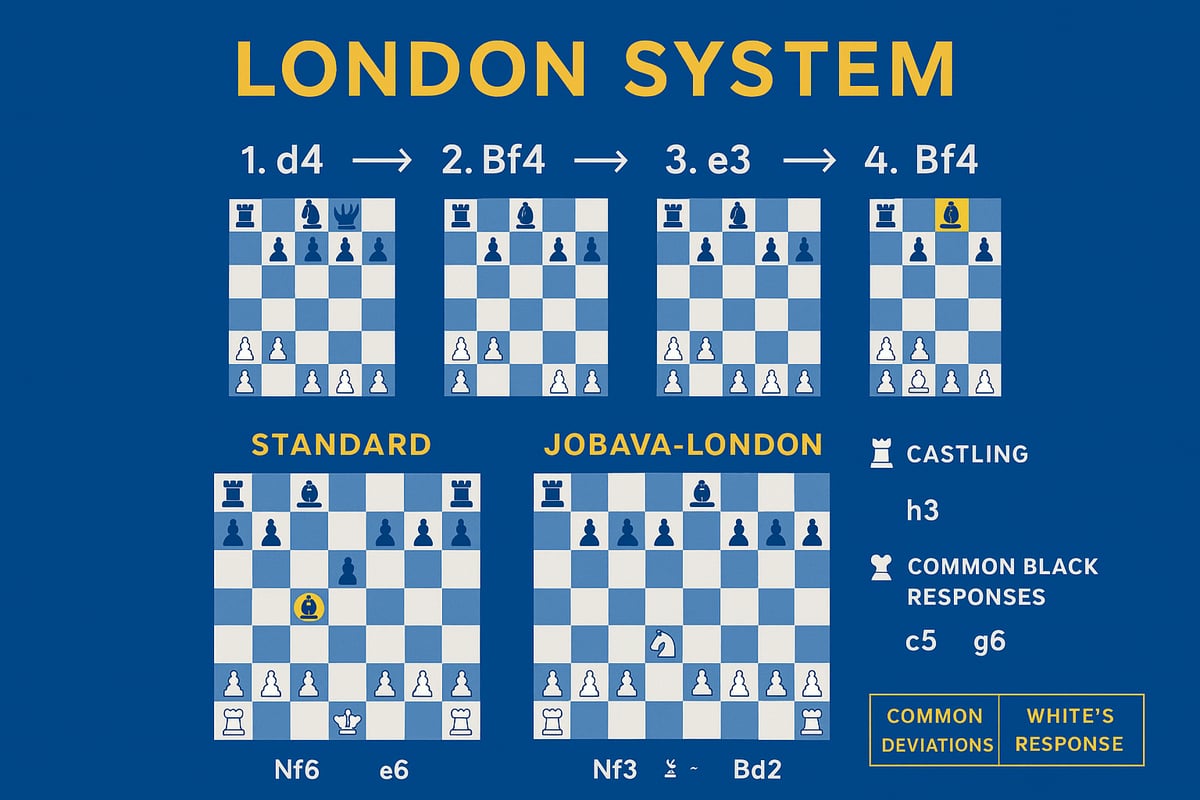
Chronological Guide to the London System Setup
Let's break down the london system chess opening move order. The most widely used starting sequence is:
1. d4 d5
2. Nf3 Nf6
3. Bf4 (or 2. Bf4)
Notice the early bishop development before locking in your pawns. This is a signature of the london system chess opening and gives you flexibility.
Early priorities:
- Develop your dark-squared bishop to f4 right away. This keeps options open.
- Support the center with c3 and e3, creating a solid pawn triangle.
- Hold off on e3 until the bishop is out, or you might block your own piece.
Castling is usually safe after you've developed both knights and your bishop. Connect your rooks by moving the queen to e2 or c2, depending on your plan.
When should you play h3? If Black threatens ...Nh5, h3 prevents your bishop from being chased away. It's also useful before you launch kingside attacks.
Piece development often follows:
- Knights: Nbd2, sometimes Nc3 in Jobava-London setups.
- Bishop: Bd3 if you want to aim for attacks on h7, or Be2 for a quieter setup.
Here's a typical setup:
| Move | White | Black |
|---|---|---|
| 1 | d4 | d5 |
| 2 | Nf3 | Nf6 |
| 3 | Bf4 | c5 |
| 4 | e3 | Nc6 |
| 5 | c3 | e6 |
| 6 | Bd3 | Be7 |
| 7 | Nbd2 | O-O |
| 8 | h3 | b6 |
| 9 | O-O | Bb7 |
| 10 | Qe2 |
What if Black tries early ...g6, ...c5, or ...Qb6? Just adjust:
- Against ...g6: Keep your pawn structure solid, and consider playing Nc3 or Bd3.
- Against ...Qb6: Defend b2 with Qc1 or Qb3, or ignore it if your center is strong.
Want even more details on move orders, traps, and how to handle creative opponents? Check out this London System chess opening guide for a thorough walkthrough.
Core Strategic Plans for White
The london system chess opening is more than just memorizing moves. It's about understanding your strategic options and knowing when to switch gears.
Kingside Attack:
Love launching attacks? Plan for Ne5 and f4, creating threats on the kingside. Sometimes, a pawn storm with g4-h4 is possible if Black castles short.
Central Expansion:
Prepare e4 with moves like Rfe1 and Qe2. This helps you grab more space and opens lines for your pieces.
Queenside Play:
If Black blocks the center or delays kingside castling, look to shift your focus. Moves like a4 and b4 can help you create weaknesses on the queenside.
Typical Middlegame Themes:
- Minority attacks: Push b4-b5 to undermine Black's queenside.
- Piece maneuvers: Knights often reroute to e5 or c5, targeting weak squares.
- Exploit light squares: Especially when Black fianchettos, use your bishop pair to pressure h7/h2.
Transpositions:
Sometimes your opening morphs into related systems. The Colle or Jobava-London setups can arise, depending on your knight placement and pawn structure.
Sample plans from top games:
- Carlsen vs Ding Liren: Carlsen used a slow build-up, then exploded with a central pawn break.
- Kamsky vs Shankland: A classic kingside attack, showing the power of piece coordination in the london system chess opening.
Build your plans around your opponent's setup, and don't be afraid to shift strategies midgame.
Common Mistakes and How to Avoid Them
Even experienced players can fall into traps with the london system chess opening if they get too comfortable.
Overly Passive Setup:
Don't just shuffle pieces—always look for ways to challenge Black. If you only defend, Black will grab the initiative.
Misplacing the Light-Squared Bishop:
Bd3 is aggressive, aiming at h7. Be2 is quieter but sometimes too passive. Choose based on Black's setup and your middlegame goals.
Ignoring Black’s Counterplay:
Watch out for queenside pressure, especially after ...Qb6 or ...c5. Don't rush pawn pushes without considering your opponent's threats.
Pawn Structure Errors:
Avoid creating weaknesses on c3 and e3. If you push e4 too early, your center might collapse.
Example Pitfalls:
- Falling for ...Qb6: If you ignore the b2 pawn, you might lose material.
- Early ...cxd4: If you recapture poorly, Black can seize the center.
Here's a quick checklist to avoid common errors:
- Develop pieces actively.
- Check your opponent's resources before attacking.
- Keep your pawn structure solid.
- Be ready to adapt if Black plays an unusual move.
Remember, the london system chess opening rewards players who combine structure with flexibility. Stay alert, and you'll sidestep most traps.
Key Variations and Modern Trends in the London System
Curious how the london system chess opening has evolved to stay at the cutting edge of chess in 2026? Let’s break down its most important variations, see what’s trending among club and elite players, and help you choose setups that fit your style.

Mainline London System
The mainline of the london system chess opening is all about structure and reliability. You’ll usually see something like 1.d4 d5 2.Bf4 Nf6 3.e3 c5 4.c3 Nc6 5.Nd2 e6 6.Ngf3 Bd6 7.Bg3 O-O 8.Bd3 b6 9.Qe2 Bb7. In this setup, White develops smoothly, aiming for a solid center and harmonious piece placement.
This variation creates a balanced fight. White’s bishop on f4 or g3 is often the star, pressuring Black’s queenside and supporting future attacks. Black, on the other hand, tries to break the symmetry with ...c5 and ...b6, sometimes seeking play on the queenside.
Let’s look at some quick stats from recent databases:
| Result | White Win | Draw | Black Win |
|---|---|---|---|
| Mainline (%) | 34 | 40 | 26 |
While the london system chess opening may look calm, don’t be fooled. It hides deep tactics, like the classic Bxh7+ sacrifice or clever pawn breaks with e4. Both sides must stay alert, especially as games often enter middlegames with all pieces on the board.
If you want a deep dive into move orders, ideas, and statistical trends, check out this London System Opening Guide, which covers everything from setup diagrams to advanced plans.
Indian Setup and Anti-London Approaches
Facing the london system chess opening, many Black players go for the Indian Setup, starting with 1.d4 Nf6 2.Bf4 g6 3.Nf3 Bg7 4.e3 d6. This structure is flexible, allowing Black to fianchetto and prepare moves like ...c5 or ...e5 for counterplay.
As White, you have options. You can stick with the classic system, keeping your knights flexible and preparing e4. Or, for sharper play, try Nc3 early to challenge Black’s central control. The key is to watch for Black’s queenside expansion—moves like ...a6, ...b5, or ...c5 can quickly shift the balance.
Here’s how this variation stacks up statistically:
| Result | White Win | Draw | Black Win |
|---|---|---|---|
| Indian Setup | 31 | 31 | 38 |
What makes the london system chess opening so resilient is its adaptability. You can pivot your plans based on Black’s setup, either building for a kingside attack or switching to a more positional approach. Watch out for traps, though—premature pawn pushes or ignoring Black’s pressure can lead to quick trouble.
Don’t underestimate the subtlety of these lines. Many games can look drawish but turn sharp after one inaccurate move. Following games by Kamsky or Carlsen is a great way to see how the pros handle these anti-London structures.
Jobava-London and Other Aggressive Variations
Looking to surprise your opponent? The Jobava-London is a twist on the classic london system chess opening, starting with 1.d4 Nf6 2.Nc3 d5 3.Bf4. The early Nc3 brings new tactical resources—think quick Ne5 jumps, threats on the kingside, and the option to launch a pawn storm with f3 and g4.
This aggressive setup throws many players off balance. The positions get unbalanced fast, and you’ll often see wild attacks or creative sacrifices. It’s popular with attacking players who want to avoid slow maneuvering battles.
Of course, the Jobava-London has its risks. If Black knows the right responses, White can end up with a weak pawn structure or a misplaced bishop. But the surprise value and sharp play are often worth it, especially in rapid or online games.
Famous games, like Nakamura vs Carlsen 2025, showcase how top players use the london system chess opening’s aggressive side to outplay even the best. Watching these battles is a great way to pick up new tricks and ideas for your own games.
No matter which variation you choose, the london system chess opening continues to evolve—adapting to new ideas, computers, and the ever-changing chess landscape.
Countering the London System: Best Practices for Black
Struggling to crack the london system chess opening as Black? You’re not alone. This setup has become one of the most popular and resilient openings, so knowing how to challenge it is essential in 2026. Let’s break down the best strategies to disrupt White’s plans and tilt the board in your favor.
Early c5 and Qb6 Approaches
One of the most direct ways to counter the london system chess opening is by playing an early ...c5 or ...Qb6. These moves aim to put immediate pressure on White’s queenside, especially the b2 pawn, and disrupt their comfortable setup.
For example, after 1.d4 Nf6 2.Bf4 c5, Black is signaling an aggressive intent. White can choose 3.d5 to grab space or 3.e3 to maintain flexibility, but both have their own risks and rewards. The ...Qb6 move is another key weapon, directly targeting b2 and sometimes provoking weaknesses if White tries to defend passively.
| Move Order | Black's Aim | White's Response | Result Trends |
|---|---|---|---|
| ...c5 | Queenside pressure, quick play | d5 or e3 | Black wins 49% |
| ...Qb6 | Attack b2, provoke weaknesses | Qc1, Nc3, b3, or Qb3 | Balanced |
Why is this so important now? The rise in popularity of the london system chess opening means you’ll face it often. Learning these counters is almost mandatory in modern play. If you’re curious about why this opening is everywhere, check out What is the most popular opening in chess for a deeper dive.
Watch out, though—overextending on the queenside can backfire if White is well prepared. Study master games to see where players go wrong, and always be ready to adapt your plan if White responds creatively.
Indian Setup (...g6) and Fianchetto Systems
The Indian setup, featuring ...g6 and a kingside fianchetto, is another solid way to meet the london system chess opening. The typical sequence goes 1.d4 Nf6 2.Bf4 g6 3.Nf3 Bg7 4.e3 d6. This structure gives Black a flexible, resilient formation.
Black’s plan is to complete development calmly and look for central breaks or queenside expansion. White may stick to their system or opt for sharper play with Nc3. While these lines can feel drawish, they’re a great way to avoid early pitfalls and wait for White to overextend.
Key tips for this approach:
- Develop pieces harmoniously before committing to pawn breaks.
- Watch for White’s e4 push—be ready with ...Re8 or ...Nc6.
- Use the double fianchetto (adding ...b6 and ...Bb7) if you want a slow, maneuvering game.
Statistically, Black wins about 38% of games in these lines, with draws making up a significant portion. The london system chess opening can morph if White changes plans, so stay alert for transpositions into other queen’s pawn systems.
Remember, patience is key. Let White show their hand first, then strike in the center or on the queenside when the opportunity arises. Analyze recent games at the top level to see how the best players handle these setups.
Other Anti-London Weapons
Besides the main lines, there are several creative options for dismantling the london system chess opening. Moves like ...e6 and ...Bd6 challenge White’s prized light-squared bishop early, sometimes forcing it to retreat or exchange.
The ...b6 idea is another practical weapon, letting Black expand on the queenside while keeping options open for ...Bb7 or ...a6. Some players even try unorthodox moves like ...a6 or ...h6, aiming to take White out of their comfort zone right away.
Tips for using these weapons:
- Don’t be afraid to deviate from the main system if you sense your opponent is unprepared.
- Watch out for early traps—study common pitfalls like premature pawn breaks or awkward piece placements.
- Flexibility is your ally; switch gears quickly if White tries to steer the game into a different opening family.
The london system chess opening rewards players who understand its nuances, so the more anti-London weapons you have, the better your results will be. Mix up your responses, stay unpredictable, and you’ll keep White guessing from move one.
Advanced Tactics, Traps, and Famous Games in the London System
Unlocking the hidden tactics of the London System chess opening can elevate your play from solid to spectacular. Whether you are a club player or an aspiring master, understanding these advanced ideas will help you turn quiet positions into winning opportunities.
Tactical Themes and Common Traps
The London System chess opening is best known for its sturdy structure, but it also hides some of the trickiest tactical shots in modern chess. Recognizing these ideas can catch opponents off guard and swing the momentum in your favor.
One classic tactic is the Bxh7+ sacrifice. This bishop sacrifice on h7, followed by Ng5, can rip open Black’s kingside if they neglect defense. It works best when Black’s knight is not on f6 or if their queen is far from the action.
Another recurring theme is the queen and bishop battery targeting the h7 or h2 square. By lining up your queen and bishop, you threaten mate or force awkward pawn moves from Black. This is especially dangerous if Black fianchettos their bishop and weakens the light squares.
Don't forget about exploiting weak light squares. If Black plays g6 and fianchettoes, keeping your bishop active on f4 or g3 can create long-term pressure.
Here are some common traps you should know:
- If Black plays an early ...Qb6, don’t rush b3. Instead, develop calmly or defend b2 with your queen.
- Watch for traps involving ...cxd4. If you recapture with a pawn, be wary of sudden queen or bishop attacks.
- Sometimes, Black’s premature ...h6 or ...a6 can be punished by rapid central play or kingside expansion.
Mastering these tactical ideas in the London System chess opening gives you more than just safety. It arms you with surprise weapons for any opponent.
Illustrative Master Games and Analysis
Studying grandmaster games is one of the fastest ways to internalize advanced tactics in the London System chess opening. Let’s look at a couple of classics.
Gata Kamsky vs. Sam Shankland (2014) is a textbook example. Kamsky patiently built pressure, then launched a kingside attack using the Bxh7+ sacrifice, showing how even solid setups can explode into sharp tactics.
In Magnus Carlsen vs. Ding Liren (2020), Carlsen sacrificed a pawn to open lines, demonstrating the flexibility and dynamism of the London System chess opening at the highest level.
Modern innovations are everywhere. The Jobava-London, for instance, has become a favorite weapon for aggressive players. If you want to see this in action, check out the Nakamura vs Carlsen 2025 Analysis, which breaks down a high-level clash featuring bold Jobava-London ideas.
What can you learn from these games? Top players use patience, flexible pawn moves, and timely tactical strikes. They know when to switch from defense to offense, and they’re always alert for tactical chances in the London System chess opening.
Using Visual Resources for London System Mastery
Learning tactics is easier when you can see patterns in action. Visual resources like cheat sheets help you quickly recognize move orders, typical plans, and common traps in the London System chess opening.

Cheat sheets condense complex ideas into simple diagrams and step-by-step guides. For hands-on practice, you can try London System chess opening puzzles to sharpen your tactical vision.
By using these visual tools, you cut down on memorization and accelerate your improvement. Whether you are a beginner or an intermediate player, visual learning makes the London System chess opening more accessible and effective.
Building Your 2026 London System Repertoire: Practical Tips and Training Methods
Ready to take your london system chess opening skills to the next level in 2026? Building a repertoire is not just about memorizing moves, but tailoring your setup, training effectively, and staying sharp as the chess world evolves. Let’s break down how you can make the london system chess opening your secret weapon.
Creating a Personalized London System Move Order
The beauty of the london system chess opening is how flexible it can be. Choosing between 2.Bf4 and 2.Nf3 is your first big decision. If you prefer a direct approach, 2.Bf4 gets your bishop out early and keeps your plans transparent. Going with 2.Nf3 can help you stay flexible, waiting to see how Black responds before showing your hand.
What works best? That depends on your opponents. If you face club players who love early ...c5 or ...g6 setups, you might want to sharpen things with an aggressive move order. Against more solid players, sticking to the classic structure makes sense. Here’s a quick comparison:
| Approach | Pros | Cons |
|---|---|---|
| 2.Bf4 | Fast bishop development, direct plans | Less flexible vs. rare lines |
| 2.Nf3 | Wait-and-see, adapts to deviations | Can delay main plans |
| Hybrid Approach | Mixes both for surprise value | Requires more study |
No matter which path you choose, remember the london system chess opening is all about adaptability. Use opening databases and chess engines to explore recent games. Build a small, reliable repertoire for each Black response. By doing this, you’ll always know what to do when the board gets complicated.
Training for Mastery: Drills, Puzzles, and Study Tools
Mastering the london system chess opening isn’t just about theory. You need to practice patterns, tactics, and common endgames. Start with tactical puzzles that focus on the typical tricks, like the Bxh7+ sacrifice or exploiting weak squares on the kingside.
Set up key positions from master games and play them out against the computer. Many online chess platforms let you drill the london system chess opening with custom puzzles and move trainers. This helps you recognize patterns faster and react confidently in real games.
Don’t forget to review annotated games from top players. By seeing how grandmasters handle middlegames and transitions, you’ll pick up ideas you can use yourself. Here’s a simple training routine:
- Solve 5 london system chess opening-themed puzzles daily.
- Play out 3 key middlegame positions vs. an engine each week.
- Watch annotated master games and jot down the main plans.
- Track your progress with a spreadsheet or app.
If you stick with these habits, you’ll find your london system chess opening skills improving rapidly. It’s all about deliberate practice and reviewing your own games to spot recurring mistakes.
Staying Ahead of the Meta: Trends and Updates for 2026
Chess never stands still. The london system chess opening is constantly evolving, with new ideas appearing in top tournaments and online blitz games. To keep your edge, you need to watch for the latest novelties and adapt your repertoire as the meta shifts.
Follow elite events to see how the london system chess opening is being used at the highest level. The London Chess Classic 2025 Results are a great resource for studying how grandmasters approach the opening, spot trends, and adjust to new defenses.
Stay active in online communities, forums, and coaching groups. Discussing the london system chess opening with others helps you find new resources, get feedback, and stay motivated. Books, online courses, and updated databases are all valuable tools for keeping your repertoire fresh.
Finally, don’t be afraid to experiment. Try out new move orders, surprise your opponents, and keep an eye on statistical trends. With the right attitude and a willingness to learn, your london system chess opening will always be one step ahead.
So, now that you’ve got a solid grasp of the London System’s ins and outs for 2026, are you ready to put it all into practice and actually see results on the board? The best part is, you don’t have to memorize endless lines or spend hours sifting through complicated theory. With Chess Cheat Sheets, you can streamline your opening prep, get clear visual guides, and build confidence every step of the way. If you want to keep improving and expand your repertoire even further, why not Start Improving Your Openings? It’s your next move—let’s make it a strong one!


