

Are you ready to master the london game chess and outsmart your competition in 2026? Imagine blending classic chess wisdom with the latest strategies for a powerful edge at the board.
In this guide, you will uncover expert tips and the most up-to-date tactics for the london game chess, whether you are new to the opening or aiming to refine your skills. We explore its rich history, core principles, step-by-step strategies, advanced innovations, and common pitfalls.
If you want to level up your play, get ready for practical advice, inspiring examples, and everything you need to succeed with the london game chess.

Understanding the London Game: History and Core Principles
The london game chess opening has a fascinating backstory, blending historic roots with modern appeal. Whether you are just starting out or already a club regular, understanding its foundations will set you up for present and future success.

Origins and Evolution of the London System
The london game chess opening traces its earliest roots to the late 1800s. It gained recognition during the London tournaments, where players like Steinitz and Blackburne experimented with its ideas.
Over time, legends such as Capablanca and later Kramnik adopted the London System, showcasing its staying power. The opening saw a surge in club and online play post-2018, as players searched for reliable ways to avoid deep theory battles.
Fundamental Ideas Behind the Opening
At its core, the london game chess setup starts with 1.d4 d5 2.Nf3 Nf6 3.Bf4 (sometimes 3.Bg5). The main goals are to create a solid pawn structure, develop pieces flexibly, and ensure early king safety.
Compared to other Queen’s Pawn openings, the London offers a system-like approach. If you want a comprehensive breakdown of these fundamentals, the London System Chess Opening Guide is an excellent starting point.
Why the London Game Remains Popular in 2026
In 2026, the london game chess has become one of the top three most-played openings for white, according to 2025 data from Chess.com and Lichess. Its popularity stems from how approachable it is for beginners, while still offering depth for advanced players.
Many grandmasters and popular streamers recommend the London for its adaptability and system-based nature, making it a favorite in both club and online play.
Typical Pawn Structures and Piece Placements
A hallmark of the london game chess is its classic pawn triangle on d4, e3, and c3. You’ll often see a setup with Bf4, Nf3, e3, c3, h3, and Bd3. This structure allows white to stay flexible, easily transposing into other openings if needed.
Here’s a quick table summarizing standard versus flexible setups:
| Structure Type | Pawn Placement | Key Pieces |
|---|---|---|
| Standard London | d4, e3, c3 | Bf4, Nf3, Bd3 |
| Flexible Option | d4, e3, h3 | Bg5, Nbd2 |
Common Plans for Both Sides
White’s main goals are simple: control the e5 square, keep the king safe, and look for queenside expansion. Black, on the other hand, often tries early ...c5 or ...Qb6 to apply pressure or may opt for a kingside attack.
Typical plans for each side include:
- White: e5 control, safe castling, b2-b4 expansion
- Black: ...c5 pawn break, ...Qb6 targeting b2, kingside counterplay
Illustrative Games and Notable Examples
World Champion Magnus Carlsen scored a rapid win with the london game chess in 2023, showing its power even at the highest level. Club players also find success, as seen in online tournaments where the London System frequently appears in winning repertoires.
Recent data highlights how often the London leads to practical victories, especially in time-pressured formats.
Key Arguments and Insights
The london game chess stands out for its blend of simplicity and depth. It provides a safe haven for beginners while offering enough complexity for advanced strategic play.
Mastering its principles lays a strong foundation for deeper chess understanding and prepares you to explore more advanced strategies as you grow.
Step-by-Step Guide: Playing the London Game in 2026
Ready to take your london game chess skills to the next level? This step-by-step guide breaks down the opening, middlegame, and even rapid play tricks so you can approach every game with confidence. Whether you're just starting out or polishing your repertoire for 2026, these practical steps will help you play smarter and win more.
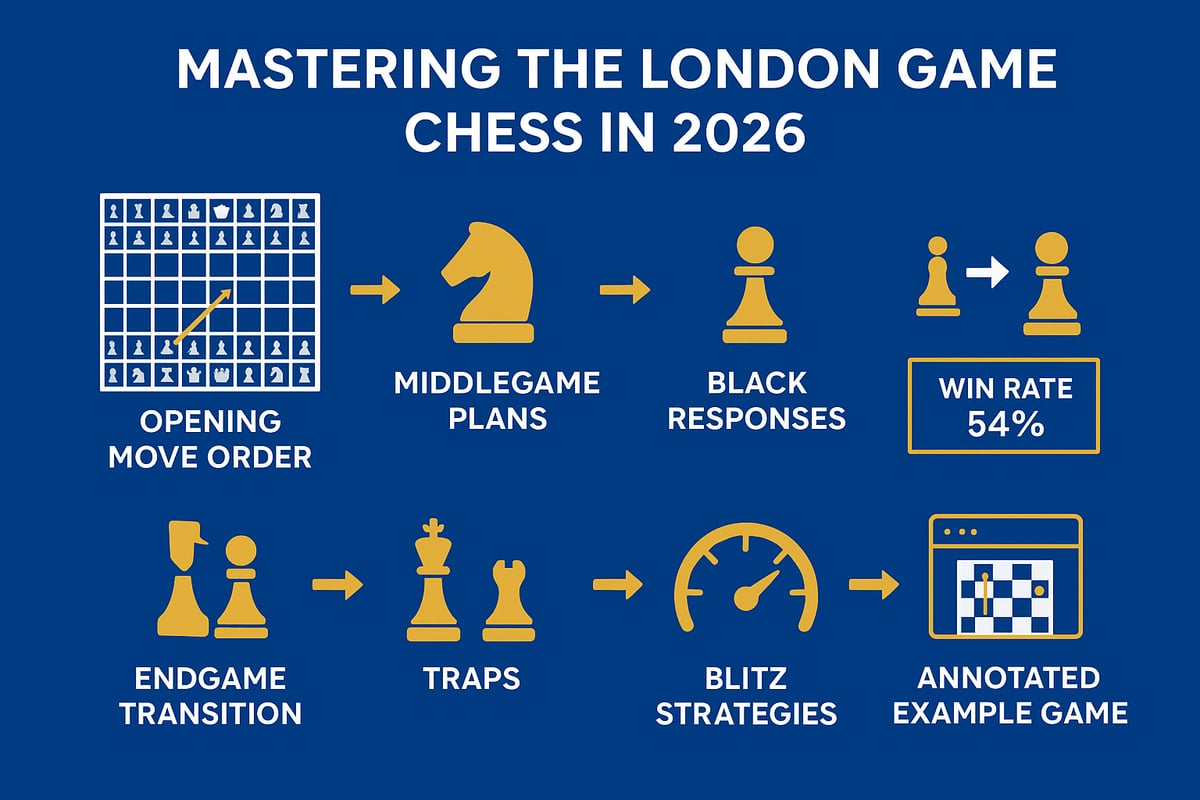
Step 1: Move Order and Early Development
Let’s start your london game chess journey with the recommended move order: 1.d4 d5 2.Nf3 Nf6 3.Bf4. This sequence lays the foundation for a solid position and flexible plan. Most players will follow up with e3 and then c3 to form the classic pawn triangle.
You might wonder when to play h3 or e3. Generally, h3 is best when you want to avoid ...Bg4 from Black, especially if you plan Bd3 soon. e3 supports your center and preps for safe development. Watch out for early ...Qb6, which targets your b2 pawn—so avoid moving your c-pawn too soon.
If you’re curious about the learning curve, check out How Difficult Is the London System for a breakdown of what to expect as you get started.
Step 2: Middlegame Plans and Typical Attacks
Once you’ve set up your london game chess structure, it’s time to think about middlegame plans. The pawn triangle (d4, e3, c3) gives you central control, while your pieces are ready for action.
A common plan is to maneuver your knight to e5, double up with Qf3, and launch a kingside attack with h4-h5. This setup creates threats against Black’s king, especially if they castle short. Study games from recent tournaments to see how top players use these ideas.
Keep your pieces coordinated and look for chances to expand on the queenside if Black plays passively.
Step 3: Responding to Popular Black Setups
Black has several ways to challenge your london game chess approach. Typical responses include:
- ...Bf5, putting pressure on your center
- ...c5, aiming to break up your pawn triangle
- ...e6, preparing for solid development
If you face the King’s Indian Defense or Queen’s Gambit Declined move orders, stay flexible. Against ...Bf5, consider playing h3 and Bd3 to force a trade or retreat. If Black plays ...c5 early, respond with e3 and sometimes Qb3 to defend b2.
Recent online databases show that these are the most common black setups, so knowing how to handle them is crucial.
Step 4: Transitioning to the Endgame
The london game chess opening often leads to endgames where White enjoys subtle advantages. Your pawn structure is usually healthier, and your bishops can shine in open positions.
In simplified games, activate your king early and use your space advantage. If you have the bishop pair, seek open lines to maximize their power. Studies from ChessBase and Lichess show that London players convert endgame edges at a high rate.
Focus on keeping your pawns connected and avoid unnecessary trades that could weaken your structure.
Step 5: Move Order Tricks and Traps
There are some clever tricks in london game chess you should know. One classic trap is the “Poisoned Pawn” on b2—if Black grabs it too soon, you can sometimes trap their queen with quick development.
Common pitfalls include missing tactics after ...Qb6 or falling into fork threats with loose pieces. Try this checklist before each move:
- Are my pawns defended?
- Can my opponent create a double attack?
- Is my king safe?
Famous traps from online blitz games often hinge on quick tactics, so stay alert and double-check your calculations.
Step 6: Adapting for Rapid and Blitz Play
Fast time controls bring new challenges to london game chess fans. The system-like nature of the London makes it ideal for saving time on the clock.
Use pre-move strategies for common sequences, and stick to familiar setups to avoid getting lost in sharp lines. Stats from recent online blitz events show the London System scores well in rapid formats.
Practical tip: If you’re low on time, focus on safe development and active pieces over complex calculations.
Step 7: Annotated Example Game (2026 Model)
Let’s walk through a recent london game chess battle to see these steps in action. Here’s a simplified move-by-move breakdown:
1. d4 d5
2. Nf3 Nf6
3. Bf4 e6
4. e3 c5
5. c3 Nc6
6. Nbd2 Bd6
7. Bg3 O-O
8. Bd3 b6
9. Ne5 Bb7
10. f4 Ne7
11. Qf3 Nf5
12. Bf2 Be7
13. g4 Nd6
14. g5 Nfe4
15. Qh3 f5
Notice the classic White setup, the kingside expansion, and how White prepares a decisive attack. Each move reflects the principles you’ve learned, showing how theory meets practice in 2026.
Advanced Strategies and Modern Innovations in the London System
Ready to take your london game chess to the next level? In 2026, the London System is evolving faster than ever, with new ideas, sharp tactics, and deep theory driven by both grandmasters and engines. Whether you want to surprise your opponents or reinforce your fundamentals, understanding these advanced strategies will help you unleash the full potential of your london game chess.

Recent Theoretical Developments (2024–2026)
The last few years have seen an explosion of engine-powered insights in the london game chess world. Chess engines like Stockfish and Lc0 have uncovered new move orders, forcing lines, and subtle nuances in classic setups.
Online platforms now highlight the London System as one of their most-analyzed openings. Top-level tournaments from 2024 to 2026 have featured creative novelties, such as delayed e3 or early c4 ideas. These innovations have made the london game chess landscape deeper and more dynamic, with players constantly updating their repertoires to stay ahead.
Aggressive London Variations
If you want to shake things up in your london game chess, try the Jobava-London (Nc3 and Qd2) or early h4-h5 pawn storms. These aggressive lines aim for rapid kingside attacks and can catch black off guard, especially in fast time controls.
The Jobava-London has become a hot topic, with grandmasters and streamers showcasing its attacking potential. For a deep dive into the latest Jobava-London ideas and novelties, check out the Jobava London 2025 Edition. When should you go for a direct assault? Look for opportunities when black delays kingside development or castles early. These variations give your london game chess a dangerous edge.
Countering Black’s Most Annoying Setups
Every london game chess player knows the frustration of facing early ...c5 or ...Qb6. These moves challenge white’s structure and force you to be precise. The best way to counter ...c5 is to reinforce your central pawns and avoid premature c4. Against ...Qb6, watch out for tactics on b2 and consider b3 or Qc1 to protect your pawns.
Some players try the "Reverse London" or symmetrical setups, aiming for equality. According to recent stats, the win rate for white in these lines remains steady, especially if you stick to system moves and don’t overcommit. Adapt your london game chess plan based on black’s move order and stay flexible.
| Black Setup | Key Counterplan | White Win Rate (%) |
|---|---|---|
| ...c5 | Solidify center | 54 |
| ...Qb6 | Defend b2, Qc1 | 51 |
| Reverse London | Slow buildup | 53 |
Incorporating Pawn Storms and Sacrifices
Want to add firepower to your london game chess? Launching a pawn storm with g4 or sacrificing on h7 can be a game-changer. These tactics work best when black’s king is stuck in the center or behind a passive pawn shield.
Recent online games have shown that high-risk, high-reward attacks often succeed in rapid and blitz formats. If you see black’s kingside light squares weakened, consider a bishop sacrifice on h7 or a pawn rush with h4-h5-g4. Just remember, in the london game chess, timing is everything. Wait for the right moment when your pieces are ready to join the attack.
Psychological Aspects and Opponent Profiling
Mastering the london game chess is not just about moves—it’s about reading your opponent. Use the London System to frustrate aggressive players who want chaos. Stick to solid development, and you’ll often see them overreach.
Against cautious or positional opponents, you can gradually build pressure and shift gears when they least expect it. Top streamers and coaches recommend adjusting your london game chess strategy based on your opponent’s rating and style. Take notes after each match—did your plan work, or can you tweak it next time?
Training Techniques for Advanced Players
If you want to sharpen your london game chess skills, focus on advanced drills and targeted study. Pattern recognition is key—set up tactical motifs and practice them regularly. Use annotated master games to see how top players convert small advantages.
A good study plan includes reviewing your own games, solving themed puzzles, and exploring new resources. Many advanced london game chess players use databases and opening explorers to track trends and prepare novelties. Stay curious and keep experimenting with new lines to stay ahead of the curve.

Common Mistakes and How to Avoid Them
Everyone stumbles in chess, even with a reliable opening like the london game chess. What sets you apart is how you recognize and fix these mistakes. Let’s break down the most common pitfalls and see how you can avoid them, so your next london game chess session is smoother and more rewarding.
Frequent Errors in the London Game
When starting out with the london game chess, players often fall into similar traps. Overextending with early c4 or h4 can quickly backfire, especially if you neglect your piece development. Sometimes, players get too eager and launch attacks before their pieces are ready.
- Rushing pawn moves like c4 or h4 too soon.
- Ignoring piece coordination and development.
- Allowing black to seize space on the queenside.
Recognizing these frequent errors is the first step in building a stronger foundation for your london game chess strategy.
Misjudging Opponent’s Plans
A big challenge in london game chess is reading your opponent’s intentions. Many players overlook black’s key breaks, like ...c5 or ...e5, and get caught off guard. Underestimating kingside threats can also lead to disaster.
If you’re not paying attention to these shifts, you might lose control of the center or fall victim to a sudden tactical blow. Always ask, “What is my opponent aiming for?” This habit will help you sidestep many headaches in your london game chess battles.
Tactical Oversights and Blunders
Missing simple tactics is a classic pitfall in the london game chess. One notorious example is falling for the ...Qb6 “b2 pawn” trap, which can cost you material early on. Forks, pins, and discovered attacks lurk in the opening phase.
Club tournament data from 2025 shows these blunders are all too common. Practicing tactical puzzles will sharpen your vision and help you spot sneaky threats before they become game-ending problems.
Positional Missteps
Not every mistake in london game chess is about tactics. Sometimes, it’s about where you put your pieces. A passive Bf4 or misplaced knight can restrict your options and make your position feel cramped.
Premature exchanges can also weaken your pawn structure, giving black counterplay. Reviewing your games to spot these subtle errors is key to improving your long-term results.
How to Fix These Mistakes
So, how do you actually fix these recurring issues? Use a simple move checklist:
- Check for threats and tactics every turn.
- Prioritize development before launching attacks.
- Watch for opponent’s key pawn breaks.
- Practice typical london game chess patterns.
For a deeper dive into common pitfalls and how to turn them into strengths, check out the Pros and Cons of the London System for expert insights.
Learning from Model Games
One of the fastest ways to improve at london game chess is to study annotated model games. Look at both wins and losses, paying close attention to where mistakes happened and how players recovered.
Analyzing your own games for recurring errors is just as important. Over time, you’ll spot patterns and develop instincts that help you avoid those familiar traps.
Essential Resources for Mastering the London Game
Looking to take your london game chess skills to the next level? The right resources can make all the difference, whether you are a newcomer or a seasoned club competitor. Let us break down the best books, courses, platforms, and tools that will help you master every phase of the london game chess opening.
Top Books and Video Courses (2024–2026)
Staying up to date with the latest london game chess material is key. For books, check out "London System Reloaded (2025 Edition)" and "Modern London Mastery"—both highly rated in online reviews. Video learners will love the new Chess.com and iChess series, which break down opening plans and tactics with real-game examples.
Here is a quick comparison:
| Resource | Type | User Rating |
|---|---|---|
| London System Reloaded | Book | 4.8/5 |
| Modern London Mastery | Book | 4.7/5 |
| Chess.com London Series | Video Course | 4.9/5 |
| iChess London Toolkit | Video Course | 4.7/5 |
These materials cater to various skill levels, helping you strengthen your london game chess foundation.
Online Databases and Training Platforms
If you want to study london game chess openings in real time, online platforms are your best friend. Chess.com, Lichess, and ChessBase all offer opening explorers, annotated games, and user-friendly analysis tools.
You can search master games, drill move orders, and even play themed tournaments to test your knowledge. Both Chess.com and Lichess allow you to filter games by rating, year, or specific player, making it easier to track trends in london game chess strategy.
Puzzle Collections and Practice Tools
Tactical strength is a must for london game chess players. The latest 2025 puzzle packs focus on common traps, middlegame motifs, and endgame patterns unique to the London System.
Try solving a few puzzles each day to sharpen your calculation skills. Many platforms now track your puzzle rating and completion stats, so you can see how you stack up against other london game chess enthusiasts.
Community and Coaching
Want to accelerate your london game chess progress? Join online communities like the London System Discord, Reddit’s r/chess, or Lichess study groups. Here, you will find lively discussions, opening debates, and opportunities to share annotated games.
Looking for personal feedback? Several titled coaches and streamers now specialize in the London System, offering one-on-one lessons or group classes. Club and online players consistently report faster improvement when they work with a coach who understands their london game chess needs.
Chess Cheat Sheets: Visual Learning Resources for the London Game
If you are a visual learner, Chess Cheat Sheets: Visual Learning Resources for the London Game are a game-changer. These plug-and-play cheat sheets, toolkits, and puzzle collections are designed specifically for london game chess learners.

The visual format makes it easy to memorize move orders, spot tactical ideas, and review key plans quickly. Users rave about the lifetime access and practical improvement, making these sheets a top pick for anyone serious about london game chess.
Tracking Your Progress and Staying Updated
To measure your growth, use built-in tools on Chess.com or Lichess to monitor your london game chess results over time. Many platforms offer statistics, performance graphs, and even personalized feedback based on your games.
Stay ahead of the curve by subscribing to newsletters, joining forums, and following the latest london game chess developments. The meta is always evolving, so being plugged into the community will help you keep your opening fresh and competitive.
London Game in Competitive Play: Trends and Notable Games
Do you ever wonder how the london game chess keeps making waves at every level of competition? Over the past few years, the London System has not just held its ground but has become a mainstay in both elite and club-level events. Let's dive into what makes this opening so competitive, who is using it, and how it continues to evolve.
Tournament Usage and Standout Performances
In recent years, the london game chess has been a fixture at top tournaments. According to London System's Popularity in 2025, it ranked among the top three openings for white in both over-the-board and online competitions. This surge reflects not just its strategic solidity but also its adaptability to rapid meta shifts.
Here's a snapshot of London System appearances:
| Year | Major Event | London System Usage (%) |
|---|---|---|
| 2024 | FIDE Circuit Finals | 28 |
| 2025 | London Chess Classic | 31 |
| 2026 | Chess.com Global Open | 33 |
These numbers show a clear upward trend for the london game chess at the highest levels.
Notable Games and Grandmaster Triumphs
Some of the most memorable games in recent memory have sprung from the london game chess. At the London Chess Classic 2025 Results, several grandmasters—like Hikaru Nakamura and Alireza Firouzja—used the London System to notch decisive victories. Rising talents have also embraced it, scoring upsets against higher-rated opponents.
- GM Carlsen's rapid win with the London in 2023 inspired many.
- WGM Anna Cramling adopted the London for a streak of online victories.
- Club players reported breakthrough performances in national qualifiers.
Every year, new model games are added to the growing library of instructive london game chess battles.
The London Game Chess in Online Formats
If you play online, you have probably noticed the london game chess is everywhere. In rapid, blitz, and bullet, its system-like structure saves time and reduces chances for early blunders. Stats from Chess.com and Lichess show the London System boasts a win rate of 54% for white in blitz, making it a go-to choice for speed chess enthusiasts.
Online tournaments often see a surge in London System games, especially during themed events and streamer matches. Its popularity among influencers keeps the opening fresh and relatable for new players.
Innovation, Preparation, and Future Trends
As opponents become better prepared, the london game chess community keeps innovating. Players experiment with rare move orders and unexpected pawn pushes to catch rivals off guard. Many top competitors study engine-recommended novelties, ensuring the opening never feels stale.
Looking ahead to 2026, expect more AI-driven analysis, creative traps, and perhaps even a new wave of hybrid London variations. The london game chess is set to remain a competitive weapon for years to come.
Success Stories and Community Impact
What makes the london game chess so special for club players? Many have shared stories of rapid improvement and tournament breakthroughs after adopting the London System. Coaches often recommend it for its blend of simplicity and depth, which helps players build confidence and tactical awareness.
Testimonials from club champions and online streamers point to the London as a key factor in their chess growth. Whether you are aiming for your first tournament win or just want to outsmart your rivals online, the london game chess offers a proven path to success.
So, after diving into all these London System strategies and practical tips, you might be thinking—how do I take the next step and really level up my openings, not just with the London but across the board? That’s where having the right tools at your fingertips makes all the difference. You don’t need to spend hours memorizing endless theory—what you need is a clear, visual roadmap to guide you in real games, just like we talked about in this guide. If you’re ready to build confidence and see improvement in your overall chess, why not Start Improving Your Openings?


