

You've just decided to learn chess, and you're staring at that 64-square grid wondering where to even begin. A learning chess board isn't just about knowing where the pieces go - it's about understanding the battlefield where every game unfolds. Whether you're picking up the game for the first time or helping someone else discover it, mastering the board itself is your essential first step. Let's explore how to make that checkered square your training ground for chess excellence.
Understanding Your Learning Chess Board Layout
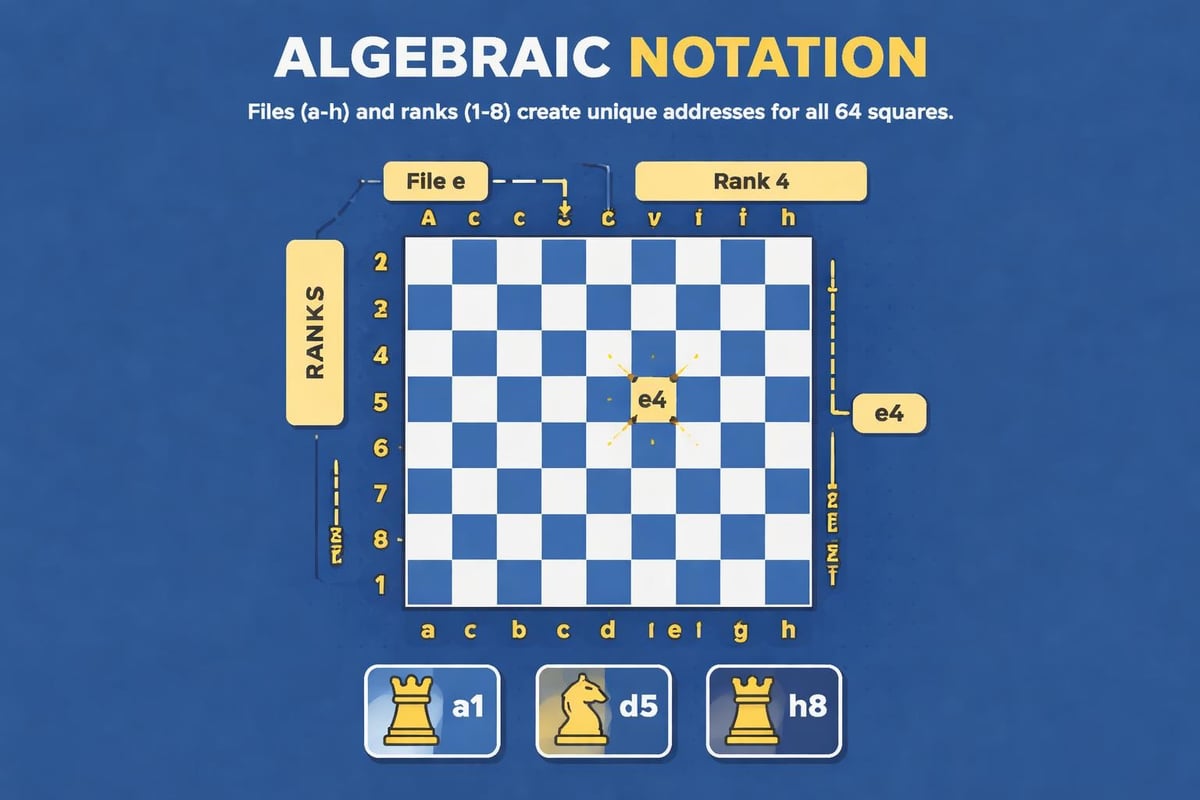
The chessboard might look simple at first glance, but there's remarkable logic built into its design. You're looking at 64 squares arranged in an 8x8 grid, alternating between light and dark colours. Here's what makes this layout brilliant for learning: every square has its own unique address.
Think of the board like a street map. Files (columns) run vertically from a to h, whilst ranks (rows) run horizontally from 1 to 8. When you combine these coordinates, square e4 becomes as specific as a postal code. This system, called algebraic notation, is how chess players around the world communicate moves.
Setting Up Your Board Correctly
Before you place a single piece, check this crucial detail: there must always be a light square in the bottom right corner from each player's perspective. The old saying "white on right" has saved countless players from embarrassing setup mistakes.
Here's your quick setup checklist:
- Light square sits in each player's bottom right corner
- Rooks occupy the corner squares (a1, h1, a8, h8)
- Knights stand next to rooks
- Bishops come next, towards the centre
- Queen goes on her own colour (white queen on light square, black queen on dark square)
- King takes the remaining central square
Physical vs Digital Learning Chess Boards
You've got choices when selecting your learning chess board, and each format offers distinct advantages. Physical boards provide that tactile experience - you can feel the pieces, physically make your moves, and naturally develop board awareness through touch. Many players find this sensory connection helps cement concepts more effectively.
Digital boards, meanwhile, bring interactive features that traditional sets simply can't match. Platforms like those listed on Gateway Chess's resource page offer instant feedback, built-in tutorials, and the ability to undo moves without disrupting your setup. You can practise anywhere with your phone or tablet.
| Board Type | Best For | Key Advantages | Limitations |
|---|---|---|---|
| Physical wooden set | Home study, clubs | Tactile learning, no screen time | Requires space, limited feedback |
| Tournament-sized board | Serious practice | Regulation experience | Bulky, expensive |
| Digital app | On-the-go learning | Interactive lessons, instant analysis | Requires device, battery dependent |
| Magnetic travel board | Commuting practice | Portable, pieces stay put | Smaller squares, cramped |
Essential Board Concepts Every Beginner Needs
When you're working with a learning chess board, certain concepts become your foundation. Let's start with something fundamental: controlling the centre. Those four squares (d4, e4, d5, e5) are worth fighting for because pieces placed there exert maximum influence across the board.
Diagonals matter tremendously. Your bishops travel along these slanted paths, and understanding long diagonals (like a1 to h8) helps you spot tactical opportunities. The Kentucky Chess Association's learning resources include excellent exercises for diagonal awareness.
The Four Board Zones
The centre (those middle 16 squares) is where most opening battles occur. Controlling this territory gives your pieces room to manoeuvre and restricts your opponent's options.
The flanks (queenside and kingside edges) often become critical in the middlegame. Pawn storms on the flanks can break open defensive positions, especially when kings have castled.
The back ranks (your first and eighth ranks) house your major pieces initially and become potential weaknesses if left undefended. Back rank mate is one of the most common tactical patterns you'll encounter.
The promotion zone (your opponent's back rank) represents where your pawns transform into more powerful pieces - usually queens. Every pawn advance carries this distant promise.

Training Methods with Your Learning Chess Board
Right, so you've got your board set up correctly and you understand the geography. How do you actually use it to improve? Start with visualization exercises. Set up a position, study it for thirty seconds, then try to recreate it from memory. This trains your board vision remarkably quickly.
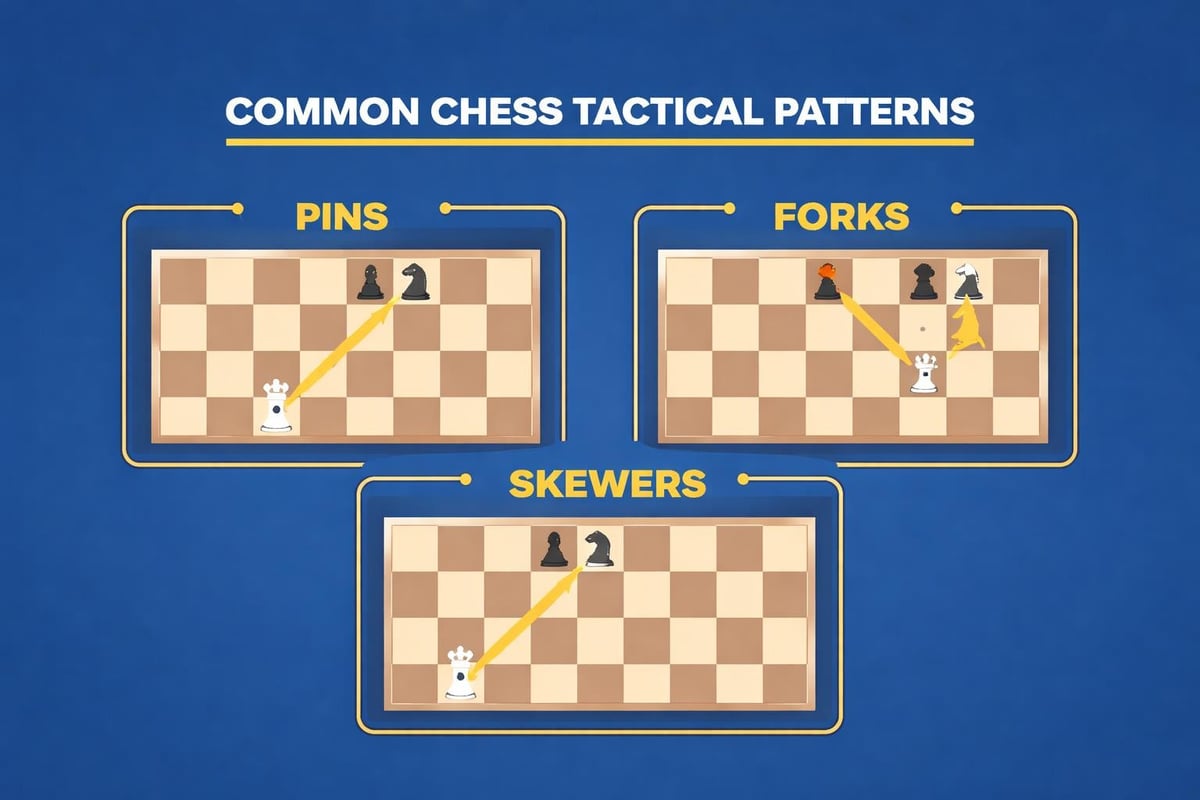
Pattern recognition becomes second nature when you work through tactical puzzles on your board. The Chess Cheat Sheets puzzle collection offers positions you can set up physically and solve without immediately checking answers. This active problem-solving builds genuine understanding.
Creating a Structured Learning Routine
Your learning chess board works best with consistent, focused practice rather than marathon sessions. Try this approach:
- Warm up with coordinate drills (5 minutes): Call out random squares and touch them quickly
- Review one opening line (10 minutes): Play through the moves, understanding each purpose
- Solve tactical puzzles (15 minutes): Set up positions and find the winning moves
- Study an endgame pattern (10 minutes): Learn crucial techniques like king and pawn endings
- Play through a master game (20 minutes): Follow along with annotations, predicting moves
This hour-long routine gives you varied practice that keeps engagement high whilst building complementary skills. The Illinois Chess Coaches Association teaching resources provide structured lesson plans that align perfectly with this type of systematic approach.
Specialized Learning Chess Boards and Tools
Standard boards work brilliantly for most learners, but specialized options can accelerate specific aspects of your development. Teaching boards - larger demonstration boards used in chess clubs - help you visualize positions during lessons. They're expensive for individual purchase, but worth seeking out at local clubs.
Printable boards offer surprising versatility. The head start chessboard resource from TES provides boards designed specifically for educational settings, making them perfect for home practice sessions with children.
Electronic boards with engines provide immediate feedback on move quality. These boards connect to chess engines and show you when you've missed better alternatives. They're investment pieces, but for serious students, the instant analysis proves invaluable.
3D training boards help some learners visualize spatial relationships more effectively. Though unconventional, three-dimensional boards where pieces actually stand at different heights based on their value can aid certain learning styles.
Common Learning Chess Board Mistakes to Avoid
You'll waste considerable time if you fall into these traps. First mistake: neglecting to learn algebraic notation from day one. Yes, it feels like extra work initially, but every chess resource, book, and online tool uses this system. Fighting it only delays your progress.
Second trap: always playing from the same side of the board. Rotate your perspective regularly - play games from Black's side, set up positions backwards, and practise seeing the board from your opponent's viewpoint. This develops crucial empathy for opponent plans.
Here's a mistake I see constantly: treating the board as flat rather than dynamic. Chess isn't checkers - pieces interact across multiple dimensions simultaneously. When you learn about chess openings for intermediate players, you discover how coordinated piece activity creates threats that multiply geometrically.
Board Blindness and How to Cure It
Board blindness happens when you literally don't see pieces or squares during play. It's shockingly common and frustrating. Combat it through deliberate scanning routines. Before every move, systematically check:
- All potential checks and captures
- Hanging pieces (yours and theirs)
- Backward moves (we naturally focus forward)
- Edge squares (corners and sides get overlooked)
The Chess House learning resources include specific exercises addressing this common challenge, helping you develop comprehensive board awareness rather than tunnel vision.
Integrating Technology with Physical Boards
You don't need to choose between traditional and digital learning tools - the most effective approach combines both. Use physical boards for deep study and serious practice, whilst leveraging apps for quick tactical sessions during spare moments.
One powerful hybrid method: set up positions from online games on your physical board. When you watch instructional videos or follow games on platforms that teach chess effectively, pause frequently and recreate critical positions on your real board. This dual processing - visual and kinaesthetic - dramatically improves retention.
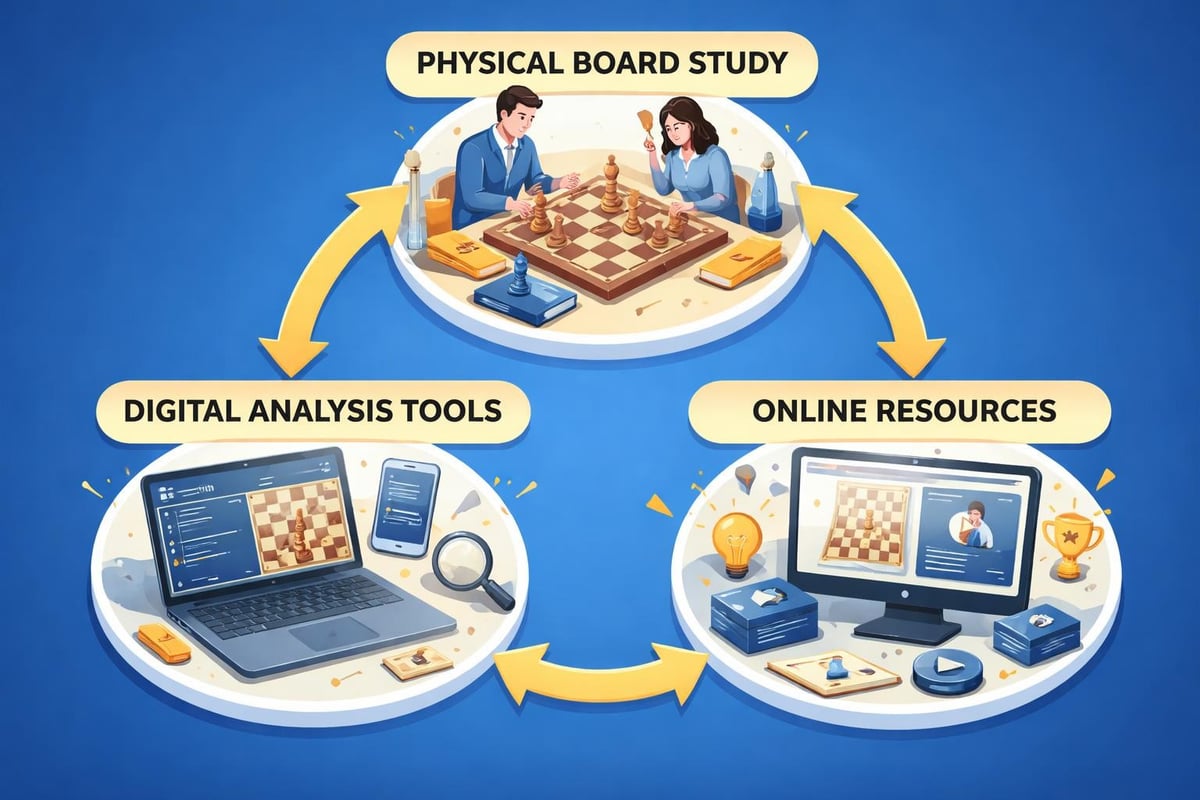
Analysis boards - both physical and digital - deserve special mention. After playing games, whether online or over the board, recreate them on your learning chess board and analyse without computer assistance first. This trains your calculation and evaluation skills authentically. Only afterwards should you check your analysis against engines like Stockfish.
Advanced Board Awareness Techniques
Once you're comfortable with basics, push your board understanding further through advanced exercises. Blindfold chess (playing without seeing the board) represents the ultimate board awareness challenge. Start small - try playing just the opening moves blindfolded, then gradually extend.
Knight tour problems develop your ability to calculate complex piece paths. Can you move a knight to every square on the board exactly once? This classic puzzle strengthens your visualization tremendously.
Simultaneous visualization: Set up two different positions and alternate thinking about them. This mirrors tournament scenarios where you might analyse your adjourned game whilst playing another.
Coordinate speed drills: Have someone call out squares rapidly while you point to them instantly. Competitive players can identify any square in under half a second - this speed comes from dedicated practice.
Building Opening Repertoire on Your Board
Your learning chess board becomes particularly valuable when developing opening knowledge. Rather than mindlessly memorizing moves, physically play through your chosen openings repeatedly, understanding the strategic ideas behind each move. Resources like the Italian Game complete opening guide provide structured systems worth ingraining through physical repetition.
Create opening flashcards using positions rather than moves. Set up a critical position from your repertoire, then without looking at notes, play the correct continuation. This active recall strengthens memory more effectively than passive reading.
When studying best openings for Black, use your board to explore the differences between similar systems. What makes the Caro-Kann different from the French Defence? Setting up parallel positions reveals nuances that reading alone misses.
| Opening Study Method | Time Investment | Retention Rate | Best For |
|---|---|---|---|
| Reading opening books | Low | Moderate | Quick overview |
| Playing through moves on board | Moderate | High | Deep understanding |
| Solving opening puzzles | Moderate | Very high | Tactical alertness |
| Playing practice games | High | Highest | Practical application |
Maintaining and Upgrading Your Learning Setup
Your relationship with your learning chess board evolves as you improve. Beginners benefit from boards with coordinates printed on borders, whilst intermediate players should graduate to boards without these training wheels. This forces genuine square memorization rather than constant reference checking.
Consider quality as you progress. Wikipedia's chessboard article details various materials and construction methods. Tournament-standard wooden boards with weighted pieces provide superior tactile feedback compared to basic plastic sets, making extended study sessions more pleasant.
Rotation keeps practice fresh. If you own multiple sets, alternate between them. Different board colours and piece styles prevent you from relying on visual shortcuts specific to one set. This flexibility proves valuable when playing in tournaments or unfamiliar venues.
Resources That Complement Your Board Work
Your learning chess board reaches its full potential when paired with quality instructional materials. Classic programmed learning books like Bobby Fischer Teaches Chess use incremental challenges perfectly suited to board-based practice.
The comprehensive chess study methods outlined by ChessWorld recommend balancing tactical puzzles, opening study, endgame practice, and game analysis. Your physical board serves all these areas effectively when you approach each systematically.
For openings specifically, having chess resources that break down complex systems into manageable chunks transforms your board from a static object into an interactive learning laboratory. Play through variations, test your memory, and discover improvements through hands-on exploration.
Free materials shouldn't be overlooked. The availability of free chess books means you can access master-level instruction without financial barriers, setting up and studying classic games and positions on your board at no cost beyond your initial board investment.
Tracking Progress Through Board Mastery
How do you know your work with your learning chess board is paying off? Set measurable benchmarks. Time yourself on coordinate recognition - can you accurately identify any square within one second? Can you set up the starting position in under thirty seconds without reference?
Tactical vision provides another measurable metric. When you first start solving puzzles, you might need several minutes per position. Track how this time decreases - many intermediate players can spot basic tactical patterns within 10-15 seconds on familiar board positions.
Creating a progress journal transforms abstract improvement into concrete achievements. After each study session, note:
- Positions studied and understood
- Tactical patterns recognized
- Opening variations learned
- Mistakes identified and corrected
- Questions arising for future investigation
This documentation reveals your development trajectory clearly. You'll notice concepts that once seemed impossibly complex become second nature through consistent board work.
Mastering your learning chess board forms the foundation for everything else in chess - from opening theory to endgame technique, it all happens on those 64 squares. By understanding board geography, practising consistently with both physical and digital tools, and integrating structured learning methods, you transform simple pattern recognition into genuine chess understanding. Whether you're working through tactical puzzles or building your opening repertoire, Chess Cheat Sheets provides the streamlined guides and resources that complement your board work perfectly, helping you improve efficiently without overwhelming study demands. Start with the fundamentals, stay consistent, and watch your board awareness become your competitive advantage.


