

You're staring at the board, clock ticking, and you know there's a winning move somewhere in the position. But how do you actually find it? Whether you're a club player looking to break through to the next level or a dedicated beginner tired of missing obvious tactics, learning to find the best chess move consistently is the skill that separates decent players from strong ones. The good news? This isn't some mystical talent reserved for grandmasters. It's a systematic process you can learn, practice, and master with the right approach.
Understanding What Makes a Move "Best"
Before we dive into the how, let's talk about the what. What exactly makes a move the best move in a given position?
The answer isn't always straightforward. In some positions, the best move delivers checkmate or wins material immediately. In others, it's a subtle positional improvement that gives you a tiny edge. Sometimes the best move is simply the one that doesn't lose.
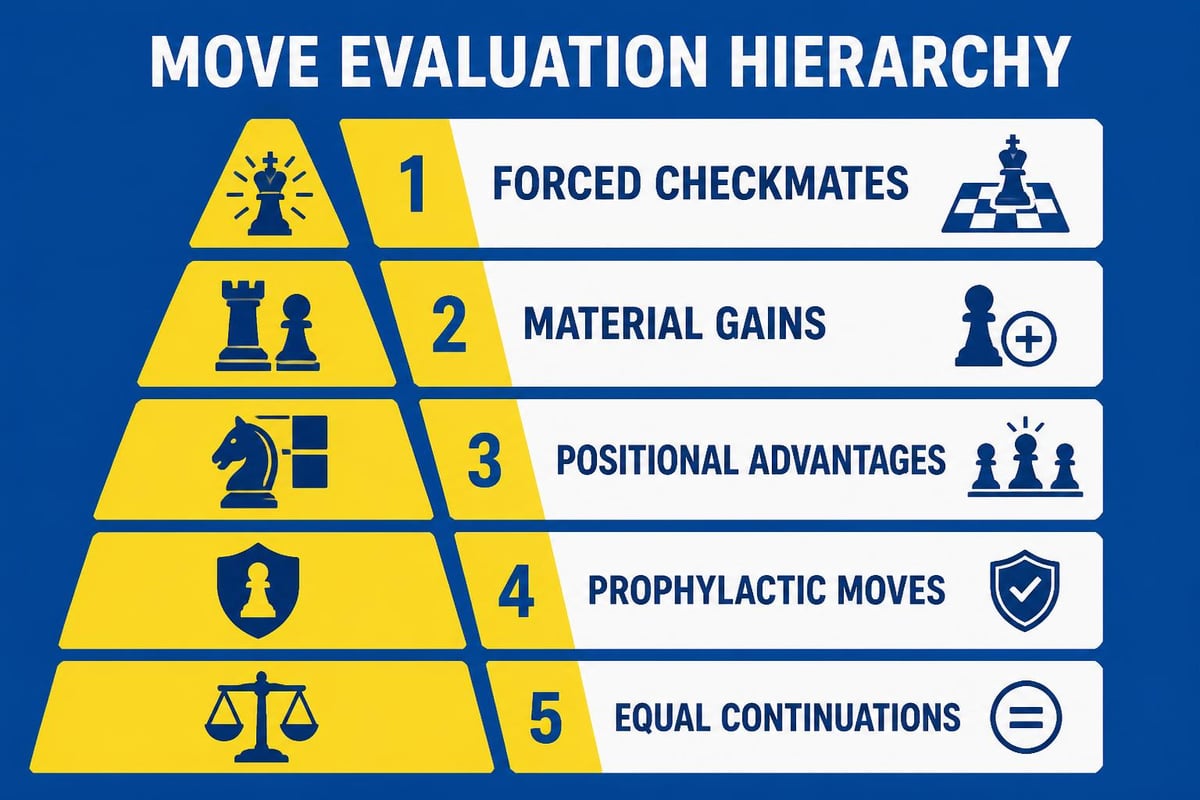
The Hierarchy of Move Quality
Here's how chess players typically rank moves:
- Forced checkmate (nothing beats this)
- Winning material with a sound continuation
- Creating unstoppable threats your opponent can't adequately defend
- Improving your position whilst maintaining balance
- Maintaining equality when you're in a difficult spot
- Damage limitation in losing positions
Understanding this hierarchy helps you prioritise what to look for when you learn to play the game of chess strategically. A beginner might immediately grab a free pawn whilst missing a checkmate in two. An intermediate player learns to check for forcing moves first.
The Candidate Move System
Right, let's get practical. How do you actually find the best chess move when you're sitting at the board?
The candidate move system has been used by strong players for decades, and it works because it gives your thinking structure. Rather than randomly analysing every possible move, you narrow down to the most promising options.
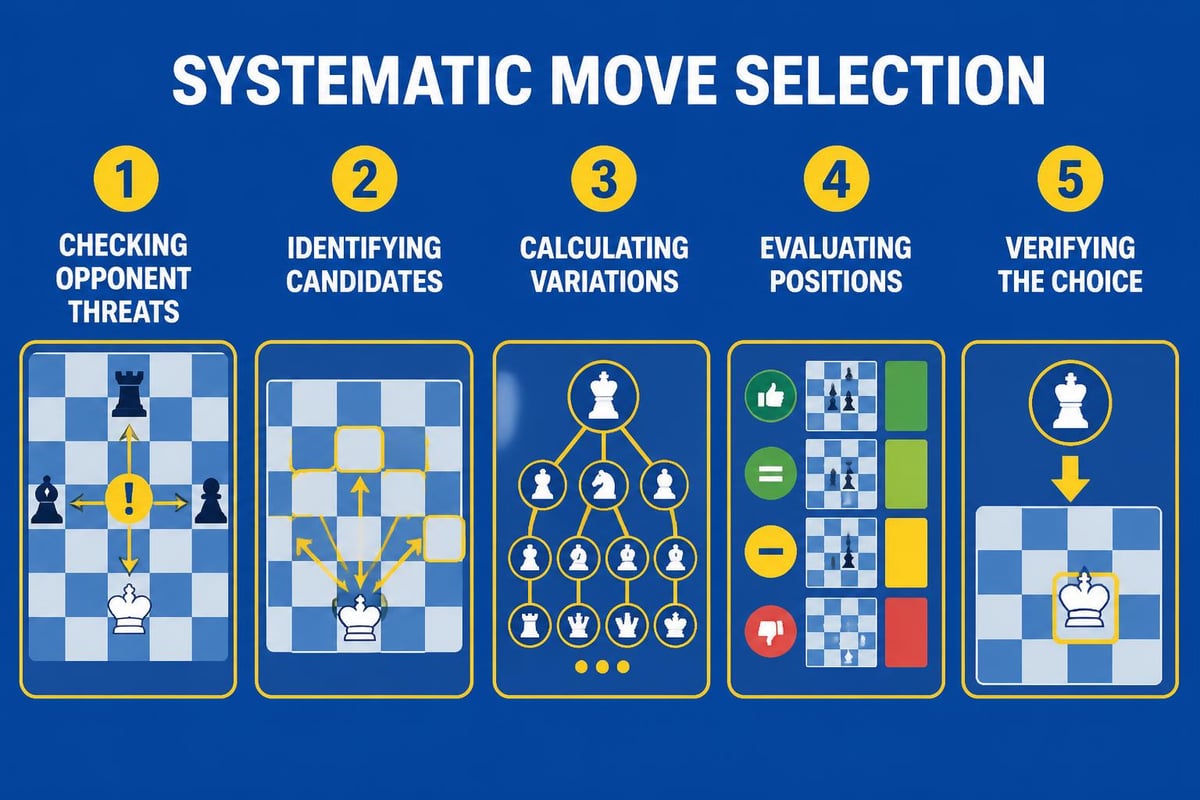
Step One: Identify Candidate Moves
Start by looking at the position and asking yourself specific questions:
- What checks are available?
- What captures can I make?
- What immediate threats can I create?
- What moves improve my worst-placed piece?
- What does my opponent's last move threaten?
You should typically identify three to five candidate moves for deeper analysis. More than that and you're wasting time. Fewer than that and you might miss something important.
Step Two: Calculate Each Candidate
Now comes the hard work. For each candidate move, you need to calculate the likely responses and variations. The chess calculation and evaluation process involves visualising the position after your move, your opponent's best response, and several moves ahead.
| Calculation Depth | Player Level | Typical Positions |
|---|---|---|
| 1-2 moves | Beginner | Tactical exercises |
| 3-4 moves | Intermediate | Most middle games |
| 5-7 moves | Advanced | Complex positions |
| 8+ moves | Expert/Master | Forced variations |
Don't feel pressured to calculate ten moves deep every time. Most positions don't require it, and you'll simply run out of time.
Step Three: Evaluate the Resulting Positions
After calculating each candidate move, you need to evaluate which resulting position is best. This is where positional understanding comes in. Consider:
- Material balance: Who has more pieces and pawns?
- King safety: Is either king exposed to attack?
- Piece activity: Which pieces are working effectively?
- Pawn structure: Are there weaknesses to exploit?
- Control of key squares: Who dominates the centre and important files?

Pattern Recognition: Your Secret Weapon
Here's something they don't tell you enough: the best players don't calculate everything from scratch. They recognise patterns they've seen before and instantly know the likely best moves.
Think about it. When you see a back-rank checkmate pattern, you don't need to calculate whether moving your rook to the eighth rank works. You recognise the pattern and verify it's sound.
Building Your Pattern Library
The fastest way to build pattern recognition is solving puzzles. Lots of them. When you work through tactical puzzles systematically, you're training your brain to spot these patterns instantly in your games.
Common tactical patterns to memorise include:
- Forks: One piece attacks two targets
- Pins: A piece can't move without exposing something valuable
- Skewers: Like pins, but the more valuable piece is in front
- Discovered attacks: Moving one piece reveals an attack from another
- Double attacks: Creating two threats simultaneously
- Deflection: Forcing a piece away from defending something
The more patterns you know, the faster you'll find the best chess move in practical play. It becomes almost instinctive.
Using Chess Engines Wisely
Let's address the elephant in the room: chess engines. Modern engines can find the best chess move in virtually any position within seconds. But how should you use them in your training?
The key is using engines as learning tools, not crutches. Understanding how chess engines think helps you grasp what strong play actually looks like. These programs rely on sophisticated evaluation functions and search algorithms to assess millions of positions.
The Right Way to Analyse with Engines
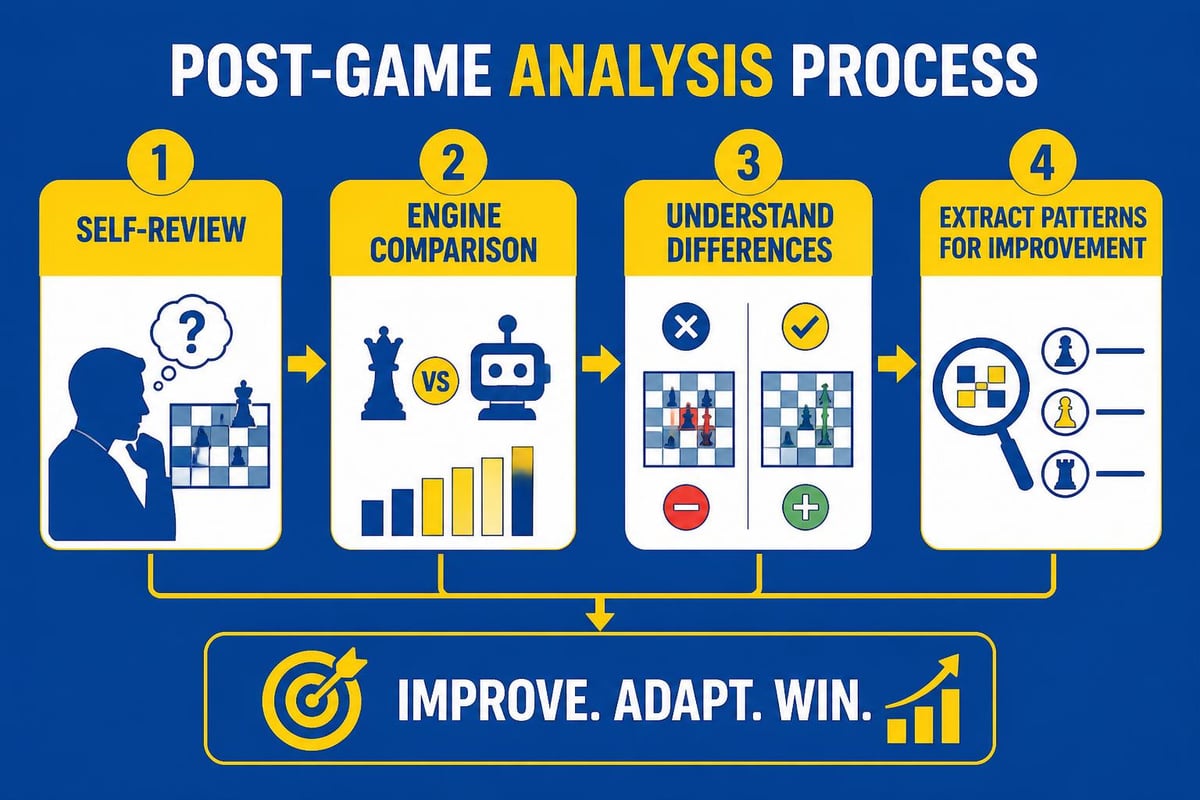
After you've played a game, here's an effective analysis routine:
- Review the game yourself first and mark the positions where you were uncertain
- Try to find the best moves in those positions without engine assistance
- Compare your analysis to what the engine suggests
- Understand why the engine's move is better (don't just accept it)
- Look for patterns you can apply to future games
Stockfish's evaluation methods are particularly instructive because they weight various positional factors similarly to how strong human players think. When Stockfish prefers a move that looks odd, there's usually a concrete reason worth understanding.
Opening Principles That Guide Early Moves
Finding the best move is easier when you understand fundamental opening principles. In the opening phase, strong players follow guidelines that have stood the test of time.
Core Opening Objectives
Your first 10-15 moves typically aim to accomplish these goals:
- Control the centre with pawns and pieces
- Develop your pieces to active squares
- Ensure king safety (usually by castling)
- Connect your rooks by completing development
- Avoid moving the same piece twice unless necessary
When you're following these principles, finding the best chess move becomes clearer because you have concrete objectives. Should you develop your knight or bishop first? It depends on which piece can reach a better square.
If you're looking for structured guidance on specific systems, resources like the London System guide or Italian Game fundamentals provide frameworks that simplify your opening decisions.
Middle Game Decision-Making
The middle game is where chess gets complicated. The board is full of pieces, there are multiple plans to consider, and finding the best chess move requires balancing tactical sharpness with strategic understanding.
Creating and Executing Plans
Strong middle game play revolves around making plans based on the position's characteristics. Ask yourself:
- What's my opponent's main weakness?
- What's preventing me from improving my position?
- Should I attack, defend, or improve my pieces?
- Is there a breakthrough possible?
Your plan guides your move selection. If you're planning a kingside attack, moves that reposition pieces toward your opponent's king become candidates. If you're exploiting a weak pawn, moves that increase pressure on that pawn make sense.
When Tactics Trump Strategy
Sometimes positional plans go out the window because there's a forcing tactical sequence available. Always check for tactical shots before making "quiet" positional moves. You might spend five minutes planning a lovely regrouping manoeuvre, only to miss a simple knight fork that wins material immediately.
The hierarchy matters: tactics beat strategy in the short term. Find the forced winning moves first, then consider strategic improvements if nothing forcing exists.
Practical Time Management
Finding the best chess move is partly about chess skill and partly about time management. You could probably find brilliant moves in every position if you had unlimited time, but you don't.
The 40/90 Rule
Here's a practical guideline many strong players follow: spend roughly 40% of your time on 90% of your moves, and 60% of your time on the 10% of moves that are critical.
Critical positions include:
- When your opponent has just created a threat
- When you have multiple plausible plans
- When tactics appear on the board
- When you're choosing between quiet development and sharp continuations
- Transitions between opening and middle game
In routine positions where you're simply developing or following your plan, move relatively quickly. Save your time for when it truly matters.
| Position Type | Time Allocation | Typical Examples |
|---|---|---|
| Routine development | 10-30 seconds | Standard opening moves |
| Normal middle game | 1-3 minutes | Positional manoeuvring |
| Complex tactics | 5-10 minutes | Calculating combinations |
| Critical decisions | 10-20 minutes | Game-defining moments |
Avoiding Common Mistakes
Let's talk about what stops players from finding good moves. Understanding these pitfalls helps you avoid them.
The First Decent Move Trap
One of the biggest mistakes? Finding a reasonable move and playing it immediately without considering alternatives. That move might be decent, but is it the best? Always identify at least two or three candidates before deciding.
Confirmation Bias in Calculation
You see a move you like and calculate variations that support it, ignoring lines that refute it. Combat this by specifically looking for your move's weaknesses. What's your opponent's best response? If you can't find a good defence against your move, your opponent probably can.
Neglecting Opponent Threats
Before making any move, ask yourself: "What is my opponent threatening?" Ignoring this question leads to hanging pieces, missed checkmates, and lost games. The calculation techniques used by strong players always include checking opponent threats first.
Improving Your Move Selection Through Study
Finding better moves consistently requires deliberate practice. Here's how to structure your improvement:
Daily Tactical Training
Spend 15-30 minutes daily solving tactical puzzles. This sharpens your pattern recognition and calculation. Focus on getting them right rather than solving them quickly. Quality trumps quantity.
Analysing Master Games
Study how strong players find moves in positions similar to ones you face. When reviewing games from finding the best chess learning resources, pay attention to critical moments where multiple plans were possible. Why did the master choose their move?
Slow Games with Analysis
Play longer time control games (30 minutes or more per side) and analyse them thoroughly afterwards. This combination of practical play and deep analysis accelerates improvement more than anything else.
The beauty of structured learning is that you're building mental frameworks. Each pattern you learn, each principle you understand, and each mistake you analyse makes future decisions clearer. You're not just memorising moves but developing chess intuition.
Advanced Concepts for Serious Improvers
Once you've mastered the basics, you can explore more sophisticated approaches to finding strong moves.
Multi-Variation Thinking
Strong players don't just calculate one line deeply. They consider multiple principal variations simultaneously, understanding how different plans might unfold. This flexibility helps you find the best move even when there's no single forced variation.
Prophylactic Thinking
Sometimes the best move doesn't create immediate threats but prevents your opponent's plans. This prophylactic approach (preventing opponent ideas before they happen) is subtle but powerful. Ask yourself: "What would I play if it were my opponent's turn?" Then prevent it.
Understanding Imbalances
Every position has imbalances: differences in material, pawn structure, piece activity, king safety, or space. The best move often addresses the position's key imbalance. If your opponent has a bishop pair but you have a strong knight outpost, finding moves that maintain your knight whilst limiting their bishops makes sense.
Training Exercises You Can Start Today
Want to improve your move-finding ability immediately? Try these exercises:
Exercise One: Three Candidates
In your next game, force yourself to identify three candidate moves before choosing one, even in simple positions. This builds the habit of considering alternatives.
Exercise Two: Explain Your Move
After making each move, mentally explain why it's best. If you can't articulate a clear reason, you might be moving too quickly.
Exercise Three: Guess the Master Move
Find annotated master games and pause at critical moments. Guess the move before looking, then understand why the master chose differently if you were wrong.
Exercise Four: Blunder Check
Before playing each move, spend five seconds asking: "Does this hang anything?" This simple habit prevents countless blunders.
Finding the best chess move is a skill that develops through systematic study, deliberate practice, and honest self-analysis. By combining tactical pattern recognition, positional understanding, structured calculation, and effective time management, you'll make stronger moves more consistently. Chess Cheat Sheets provides the tools you need to accelerate this journey, with comprehensive guides, opening systems, and thousands of puzzles designed to sharpen your tactical vision and deepen your strategic understanding without overwhelming you with theory.


