

Have you ever wondered why the English Opening remains a favourite among grandmasters and club players alike? Its rich history, strategic depth, and adaptability have made it a must-have in every chess enthusiast’s toolkit.
In this comprehensive english opening book guide for 2026, you’ll discover everything you need to master this fascinating opening. We’ll take you through its evolution, core strategies, the best books and resources, practical study routines, and expert tips for both White and Black.
Ready to elevate your game and outsmart your opponents? Dive in and unlock the secrets of the English Opening.

The English Opening: History, Evolution, and Modern Relevance
The English Opening has captivated chess minds for generations, but how did it go from a quirky sideline to a staple of modern strategy? If you have ever wondered why so many players reach for an english opening book, you are not alone. To understand its staying power, let us travel through its fascinating history and see why it remains a top choice in 2026.

Origins and Early Development
The story of the English Opening begins in the 19th century. Howard Staunton, a British chess legend, championed 1.c4 as a fresh way to start the game. At first, many saw this move as a quirky detour from the direct centre battles of e4 or d4. It was grouped with other Flank Openings, considered more experimental than essential.
However, as time passed, players realised that 1.c4 offered hidden depths. Early adopters began to see the potential for flexible pawn structures and creative play. Chess books from the era started to mention the opening, though few gave it the detailed treatment you would find in a modern english opening book.
Rise to Mainstream and Grandmaster Adoption
The English Opening’s reputation changed dramatically in the late 20th century. World champions like Anatoly Karpov, Garry Kasparov, and Magnus Carlsen used it in critical games. Their success proved that 1.c4 could be a weapon at the very highest level.
Part of its appeal lies in adaptability. Whether you prefer slow, strategic battles or sharp, tactical fireworks, an english opening book can help you tailor the system to your style. The opening’s flexibility means it fits both cautious and aggressive players, making it a favourite for club enthusiasts and professionals alike.
Current Trends and Theoretical Advances
In recent years, computer analysis has transformed opening theory. Powerful engines and vast databases have reshaped how players prepare for the English Opening. You will now find entire sections in any up-to-date english opening book devoted to ideas discovered through engine analysis.
Tournament statistics show a steady rise in the use of 1.c4 at all levels. The number of new books and resources has surged since 2020, reflecting this popularity. Annotated games, online courses, and interactive tools make it easier than ever to keep pace with the latest developments.
Why the English Opening Remains Relevant in 2026
So, what keeps players returning to 1.c4 in 2026? The English Opening allows you to sidestep heavily analysed main lines, inviting original play and creative solutions. It is suitable for both club players and elite competitors, offering practical chances in every game.
Recent international tournaments have seen impressive win rates for 1.c4. If you are curious about the latest statistics, check out this English Opening statistics 2025 page for up-to-date performance data. Whether you are a beginner seeking your first english opening book or a seasoned competitor refining your repertoire, the English Opening’s legacy and flexibility make it a timeless choice.
Core Strategic Concepts of the English Opening
Mastering the English Opening means understanding its unique strategic backbone. This section will break down the vital ideas every player needs, whether you are just picking up your first english opening book or aiming for tournament success. Let’s explore the core strategies, typical plans for both sides, essential middlegame themes, and see how the theory holds up in real games.

Flank Play and Central Control
What makes the English Opening so fascinating? It is the way you begin on the flanks, using the c4 pawn to challenge the centre from the sides. Unlike direct e4 or d4 openings, English games often start with less central tension, allowing you to build up quietly before striking.
You will see two main pawn structures: symmetrical, with both players mirroring each other, and asymmetrical, which leads to richer, more dynamic play. The c4 pawn controls d5 and e5, helping shape the battleground. If you want a deep dive into these structures and more, the English Opening chess guide is a fantastic supplement to any english opening book.
Typical Plans for White
If you are playing White, your english opening book will guide you to develop the kingside bishop via g3 and Bg2. This fianchetto setup is a signature move, giving you long-term control of the centre and kingside safety.
Building pressure on the queenside is another key plan. Moves like Nc3, Nf3, Rb1, and b4 are common, helping you expand and challenge Black’s setup. Do not forget the central d3-d4 break, which allows you to switch gears and grab space when the moment is right.
Typical Plans for Black
Black has a choice: mirror White’s moves with a symmetrical approach or create imbalances with asymmetrical responses. In the symmetrical English, Black aims for solid equality, but with a twist, as small move order differences can lead to unique positions.
Asymmetrical play opens doors to systems like the Hedgehog, Reversed Sicilian, or Indian Defences. Your english opening book will walk you through these setups, teaching you how to stay flexible and pounce when White overextends or hesitates.
Key Middlegame Themes
Once both sides have settled their pieces, the middlegame is where the English Opening shines. Minority attacks with b4 or d4 are common, letting you challenge your opponent’s pawns and create weaknesses.
Piece activity is crucial, especially using open c- and b-files for rooks. Timing the transition from opening to middlegame is an art. A solid english opening book will help you recognise when to launch an attack or consolidate your advantage, keeping you one step ahead.
Example Games and Statistics
Want proof the English Opening works? Look at classic battles like Karpov vs Kasparov, where deep strategy trumped brute tactics. Recent database stats show that lines covered in a modern english opening book hold impressive win rates at club and grandmaster levels.
Tournament data from the past few years confirms that 1.c4 is not just a sideline, but a mainstay in elite play. These numbers and examples underline why so many players trust the English Opening as their weapon of choice.
Book Guide: The Best English Opening Books for 2026
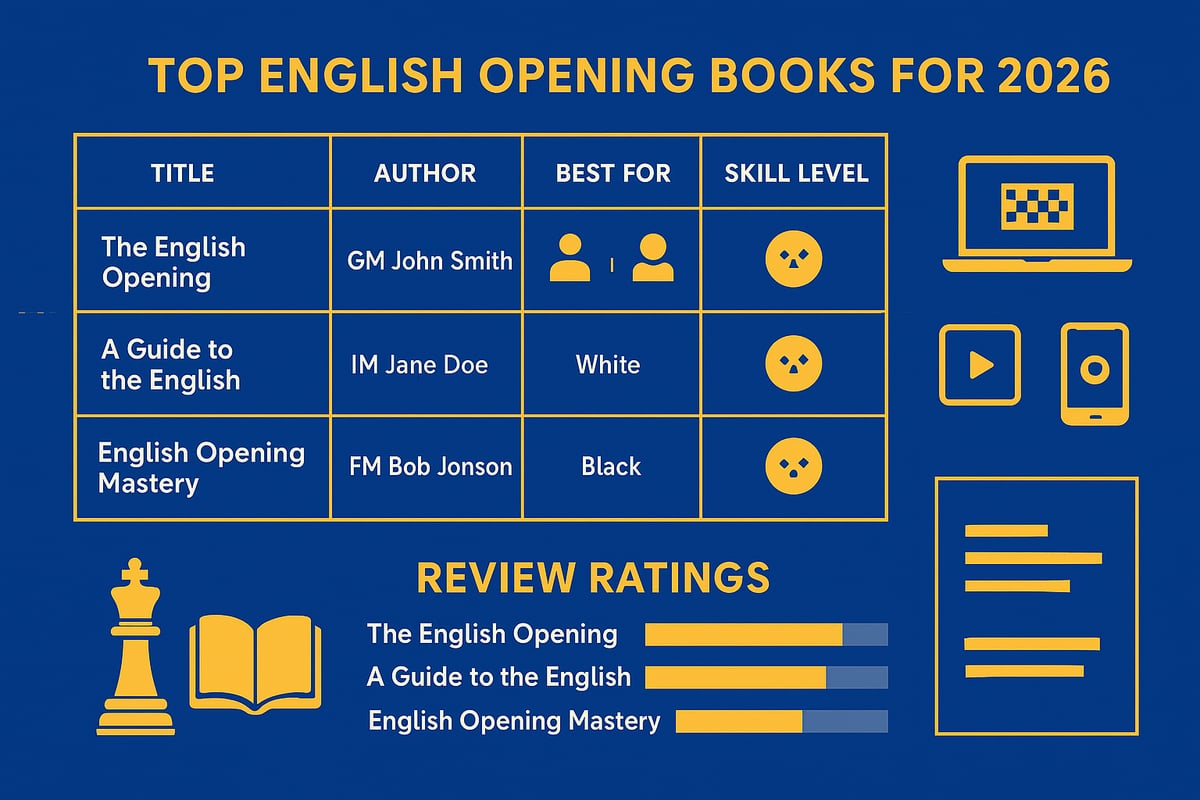
Looking for the perfect english opening book to elevate your chess? With so many options, it can feel overwhelming to know where to start. Let’s break down what matters, highlight the top picks for both sides, and help you find a resource that matches your needs.
Criteria for Selecting the Best Books
When evaluating an english opening book, you want to consider several key factors. First, check the author’s credentials. Are they a grandmaster or a respected coach? Next, look at the depth of coverage. Some books are dense with theory, while others focus on practical plans or exercises.
You’ll also want to pick a book that fits your skill level. Beginners may prefer a gentle introduction, while advanced players might crave deep analysis. Don’t forget, a good english opening book should include both mainlines and less common systems, so you’re prepared for anything.
Top Recommendations for White
If you play 1.c4 as White, you’ll be spoilt for choice in 2026. A standout english opening book is “Win with the English!” by Nikolaos Ntirlis, released in 2025. This fresh guide offers a complete and practical repertoire, blending modern theory with clear explanations. You can find more about it in the Win with the English! book details.
Other solid choices include system-based guides focusing on lines like the Botvinnik System or the Four Knights Variation, as well as puzzle books that help reinforce typical English Opening tactics.
Top Recommendations for Black
Choosing an english opening book for Black means finding comprehensive coverage against 1.c4. “Beating the Flank Openings” by Kotronias remains a classic, offering solid plans and detailed analysis. You might also want to explore books dedicated to the Hedgehog, Symmetrical English, or Reversed Sicilian setups.
For those facing anti-English systems, specialised resources covering the Dutch or Slav defences can be invaluable. Look for books that combine theoretical knowledge with practical advice, so you can confidently face any English Opening variation.
Notable Digital and Interactive Resources
In today’s digital age, sometimes the best english opening book is actually an online course or interactive tool. Platforms like Chessable offer video series and move-trainer courses tailored for the English Opening. The Opening Encyclopedia 2025 also features extensive theoretical databases and multimedia lessons.
Interactive eBooks and online practice platforms are great for reinforcing what you learn in print. These tools make it easier to keep your repertoire current and test yourself against new ideas.

How to Choose the Right English Opening Book
Picking the right english opening book depends on your goals and playing style. Are you a club player seeking practical ideas, or a tournament competitor needing deep theory? Beginners might lean towards accessible guides, while advanced players will benefit from detailed repertoires and annotated games.
Make a list of what you need: mainline coverage, system options, exercises, or digital access. Balance depth with usability, and don’t be afraid to sample different resources before settling on your favourite.
Key Insights from Recent Book Reviews and Player Feedback
What do players say about their favourite english opening book? Recent reviews highlight the value of clear explanations, up-to-date analysis, and practical examples. Books that blend annotated games with puzzle sections receive high marks for making study more engaging.
Forum discussions and chess community surveys reveal that the most popular English Opening books in the past two years are those that offer a mix of theory, strategy, and interactive elements. Listening to real player feedback can help you avoid common pitfalls and find a book that truly helps you improve.
Navigating the Main Variations and Systems in the English Opening
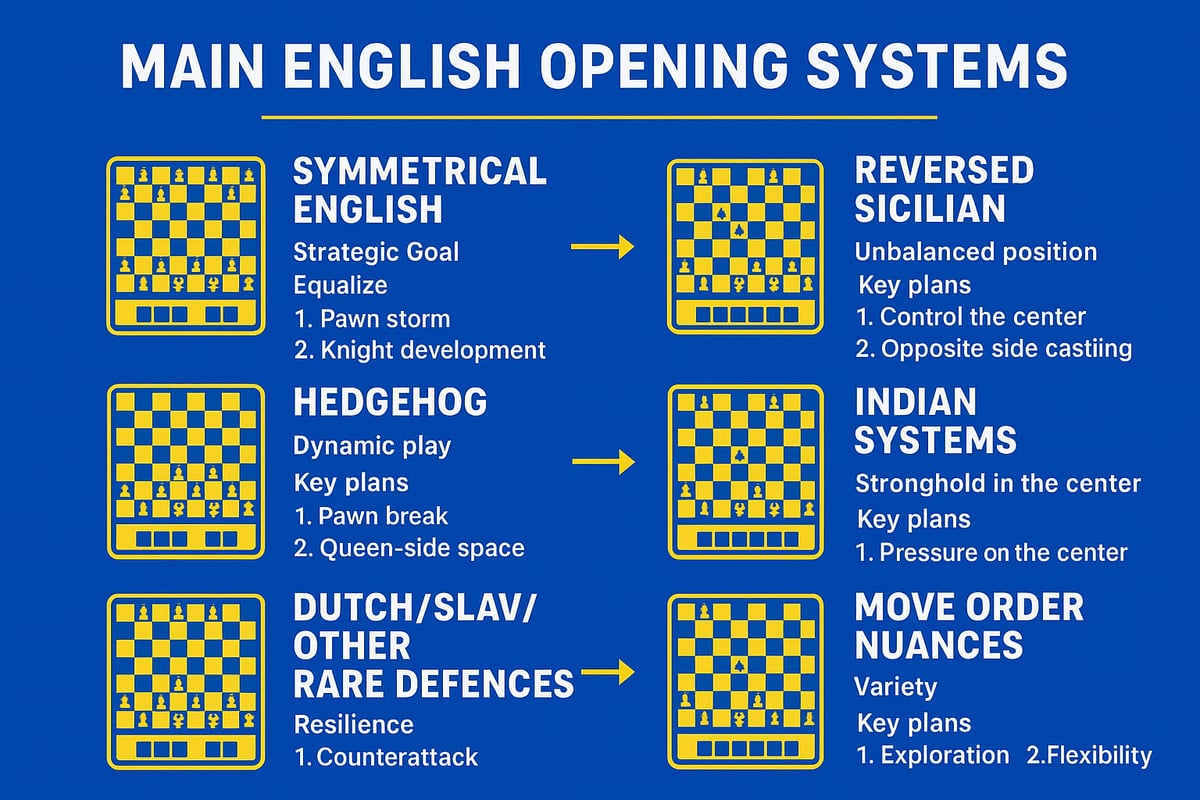
If you have ever opened an english opening book and felt a bit lost in a maze of move orders, you are not alone. The English Opening is famously flexible, branching into a forest of systems. Let's take a guided tour through the main variations, so you can approach your next english opening book with confidence and purpose.
Symmetrical English (1.c4 c5)
The Symmetrical English is the most direct response to 1.c4, with both sides mirroring each other. If you flip open an english opening book, you will likely see this covered first. The struggle here is for central control without exposing weaknesses.
White often aims for a kingside fianchetto, while Black tries to equalise with symmetrical pawn structures. Both players must watch for subtle move order tricks that can shift the balance. Key lines include early Nc3, g3, and d4 breaks.
A table comparison can help clarify the plans:
| White's Plan | Black's Plan |
|---|---|
| Fianchetto Bg2 | Fianchetto Bg7 |
| Pressure on queenside | Counter queenside |
| Delayed d4 break | Timely ...d5 |
When you look for an english opening book, make sure it covers the nuances of these symmetrical battles.
Reversed Sicilian (1.c4 e5)
The Reversed Sicilian is like playing the Sicilian Defence with an extra move as White. Most english opening book guides highlight how this gives White a small but meaningful edge, which you can use to steer the game away from well-trodden paths.
Here, you will see lines like the Four Knights, Botvinnik, and Smyslov Systems. White can dictate the pace with early Nc3 and g3, while Black looks for counterplay with ...Bb4 and ...f5.
A great english opening book will show you how to use your extra tempo to seize the initiative. Watch for tactical patterns borrowed from the Sicilian, but adapted for the English.
Hedgehog System
The Hedgehog is a favourite among players who love deep strategy and patient play. In this system, Black builds a pawn wall with a6, b6, d6, and e6. It looks passive at first, but a good english opening book will reveal the hidden bite.
White usually fianchettos the kingside bishop, expands on the queenside, and prepares for a central break. Black waits for the perfect moment to strike with ...b5 or ...d5, often unleashing surprising counterattacks.
Lists of common themes in the Hedgehog:
- Flexible pawn structure
- Delayed central breaks
- Sudden piece activity
If your english opening book covers the Hedgehog in depth, you will be ready for both sides of this psychological battle.
Indian Systems (King’s Indian, Queen’s Indian, Nimzo-Indian set-ups)
Many opponents try to steer the English Opening into familiar Indian Defence territory. An advanced english opening book will explain how White can keep an edge or how Black can transpose comfortably.
White can play anti-Indian systems, like quick g3 and Bg2, or avoid certain lines with move order tricks. Black might aim for a King’s Indian structure, hoping for kingside activity, or a Queen’s Indian to neutralise White’s plans.
If you enjoy flexibility, an english opening book that explores these transpositions will help you tailor your approach to your opponent’s style.
Dutch, Slav, and Other Rare Defences
Some players throw a curveball with rare moves like 1...f5 (Dutch) or 1...c6 (Slav). An english opening book worth its salt will prepare you for these offbeat choices.
White must be ready to adapt, keeping a central presence while seeking queenside play. Black, on the other hand, aims for surprise and early imbalances.
For a deeper dive into the strategic tradeoffs, check out this Pros and cons of the English Opening guide, which breaks down the strengths and weaknesses these rare lines can bring.
Move Order Nuances and Transpositions
The magic of the English Opening lies in its move order trickery. A top english opening book will show you how 1.c4 can morph into Catalan, Reti, or even Queen’s Gambit positions, depending on your and your opponent’s choices.
Learning these transpositions is key to staying a step ahead. You can avoid your opponent’s favourite lines, spring a surprise, or guide the game into territory where you feel most at home.
Keep notes on typical transpositions as you study your english opening book, and you will find yourself outfoxing opponents before they even realise what is happening.
Step-by-Step: Building and Mastering Your English Opening Repertoire
Ready to build your English Opening skills but not sure where to start? Here’s a step-by-step guide to help you turn that stack of notes or your favourite english opening book into a winning, practical repertoire.
- Assess Your Chess Style and Goals
Are you a positional player who loves slow manoeuvring, or do you thrive in sharp, tactical chaos? Before you pick up any english opening book, take a moment to reflect on your strengths and ambitions. Do you want a system that avoids deep theory, or are you happy to dive into the main lines?
If you’re unsure how challenging the English can be, the article How difficult is the English Opening breaks down its learning curve for different levels. Knowing your style makes it much easier to choose the right path forward.
- Select Your Core English Opening Lines
Now that you’ve got a sense of your style, it’s time to choose the lines that suit you best. With so many systems in every english opening book, picking one can feel daunting. Do you want to play the symmetrical English, go for the sharp Reversed Sicilian, or try a system like the Botvinnik?
Write down your preferred move orders and setups. If you’re unsure, look at a few recent games from top players and see which ideas resonate with you. Remember, there’s no “one size fits all” approach, so tailor your choices to your comfort level.
- Study Model Games and Annotated Examples
Don’t just memorise moves from your english opening book. Dig into annotated games played by masters and modern stars. Understanding the ideas behind the moves will help you adapt when opponents leave theory early.
A curated list of chess resources for opening study can point you to databases, books, and online platforms packed with instructive games. Watching how experts handle the opening in real games brings the theory to life.
- Practise Key Tactical and Strategic Themes
Every english opening book highlights common tactical motifs and strategic plans, but it’s hands-on practice that cements them. Set up typical pawn structures on your board and run through puzzles related to b4 breaks, minority attacks, or c-file pressure.
Make it a habit to solve a handful of themed puzzles each week. This approach builds muscle memory so you can spot tactics and plans quickly in your own games.
- Build a Personal Opening File or Notebook
To really master what you learn from your english opening book, create a personalised notebook or digital file. Record your chosen lines, main plans, and any traps you encounter. Update it regularly after each study session or game.
A table can help you track positions, key plans, and results:
| Line/Variation | Main Plan | Common Traps | Results |
|---|---|---|---|
| Symmetrical | Queenside expansion | Early ...d5 push | +2, =1, -1 |
| Botvinnik System | Central control | Pawn snatch on d4 | +1, =2, -2 |
- Test Your Lines in Practice
Theory is only half the battle. Take your lines from your english opening book and try them out in online games, club matches, or tournaments. Keep track of which ideas work and which ones need tweaking.
Don’t be afraid to experiment. Sometimes, practical play reveals gaps in your knowledge or uncovers new tricks your opponents might try.
- Stay Updated with New Theory and Resources
Chess is always evolving, and so is every english opening book. Follow top tournaments, read recent book reviews, and check for new digital resources or updates. Join forums or online communities to discuss your favourite lines with others.
Refresh your repertoire every few months to stay sharp. That way, you’ll always be prepared for new trends and surprises at the board.
Advanced Tips, Common Pitfalls, and Practical Advice for English Opening Players
Mastering the English Opening means more than memorising lines. It’s about understanding the typical traps, preparing for surprises, and using every available resource to sharpen your edge. Whether you’re new to the english opening book or looking to refine your strategy, these advanced tips will help you stay ahead of the competition.
Avoiding Typical Mistakes
Even seasoned players fall into familiar traps in the English. The most common? Misjudging move orders or getting creative with pawn advances too soon. If you’re following an english opening book, pay close attention to recommended move sequences.
- Don’t push queenside pawns without support.
- Avoid locking your own bishop behind pawn chains.
- Watch for tactics on the c4 and d5 squares.
If you notice your centre is neglected or the queenside crumbles, pause and reassess. Minor slip-ups early on can become major headaches later.
Adapting to Opponent’s Repertoire Choices
Some opponents will throw you off with rare lines or early deviations. That’s where your preparation pays off. A solid english opening book will cover the main systems, but make sure to study how to adjust on the fly.
- Recognise early f5, c6, or g6 moves.
- Prepare ideas against Dutch and Slav setups.
- Stay flexible with your pawn structure.
Remember, adaptability is key. If your opponent leaves theory, rely on principles and stay calm.
Time Management and Preparation
You don’t need to spend hours every day to master the English. Instead, set aside focused study sessions, using your english opening book and digital tools. Set a routine: review a system for 15 minutes, then solve a few tactical puzzles.
- Use databases to check recent trends.
- Annotate your games to spot recurring mistakes.
- Practise typical tactical motifs for the English.
Efficient prep means you’ll always feel ready for the next challenge.
Transitioning from Opening to Middlegame
Knowing when to leave the book and start thinking on your own is a skill. Once you’re out of your english opening book, shift to general middlegame principles.
Look for clear signals: your opponent has finished development, or the centre is defined. Then, decide whether to launch an attack or consolidate your position. Trust your instincts and don’t be afraid to play creatively.
Learning from the Masters
There’s no substitute for studying top-level games. Grandmasters often reveal new ideas and subtle plans in the English. For up-to-date inspiration, check out statistical deep dives like the FIDE World Cup 2025 opening analysis. You’ll see how the english opening book recommendations hold up under real tournament pressure.
Take notes on move order tricks and how champions handle unfamiliar setups. Apply these lessons in your own games for steady improvement.
Using Technology to Accelerate Learning
Modern chess training is powered by tech. From interactive databases to spaced repetition apps, there’s a tool for every learning style. Many players now supplement their english opening book with online courses or eBooks.
- Try Chessable for move-by-move training.
- Use Lichess or ChessBase to explore databases.
- Check out the Opening Encyclopedia 2025 overview for a broad, regularly updated resource.
Mixing traditional study with digital practice keeps your preparation fresh and effective.
Understanding the Psychological Side of the English Opening
Confidence is half the battle. The English Opening can unsettle even experienced opponents, especially if you steer the game into less familiar lines. Use your preparation to dictate the pace and put pressure on your rival from move one.
Remember, every game is a new opportunity to learn. With the right mindset, your english opening book study translates into practical results and a growing sense of control at the board.
So, after diving into the ins and outs of the English Opening, you’re probably wondering what’s next—how do you actually put all this into practice without getting overwhelmed? That’s where things get exciting. Imagine having a shortcut for your opening prep, with cheat sheets and guides that make every move feel second nature. Why not take the next step and start seeing results in your own games? If you’re keen to streamline your chess learning and really master your repertoire, you’ll want to Start Improving Your Openings. Give it a go—you might be surprised how quickly your confidence grows!


