

You've probably heard the saying "all roads lead to the endgame" in chess circles, and it's absolutely true. Whether you're playing brilliant openings or executing tactical masterpieces in the middlegame, every single game eventually boils down to those final critical moments. That's precisely why investing time in quality endgame books chess players recommend can transform your results overnight. The endgame might seem less exciting than flashy opening traps or spectacular middlegame combinations, but it's where games are truly won and lost. Let's explore the world of endgame literature and discover which resources will actually make a difference to your game.
Why Endgame Study Matters More Than You Think
Have you ever had a winning position slip through your fingers because you weren't sure how to convert it? You're not alone. Most players spend countless hours memorising opening variations whilst neglecting the phase of the game where precise knowledge matters most.
The endgame rewards preparation differently than other phases. In the opening, theory changes constantly and you need to remember dozens of variations. In the endgame, fundamental principles remain constant. Learn a technique once, and it stays with you for life.
The Reality Check for Club Players
Here's something interesting: studies show that club-level games are more often decided by endgame mistakes than opening blunders. Think about your last ten losses. How many were because you didn't know an opening variation versus how many were because you couldn't win a rook endgame or defended poorly with limited material?
- Converting advantages: Knowing exactly how to win with an extra pawn
- Defensive resources: Understanding when positions are drawn despite material disadvantage
- Time management: Playing endgames confidently means using less clock time
- Psychological edge: Your opponents feel the pressure when you demonstrate endgame mastery
The beauty of endgame books chess educators create is that they break down complex positions into learnable patterns. You're not memorising every possible position - you're understanding principles that apply across hundreds of similar situations.
Essential Categories of Endgame Books
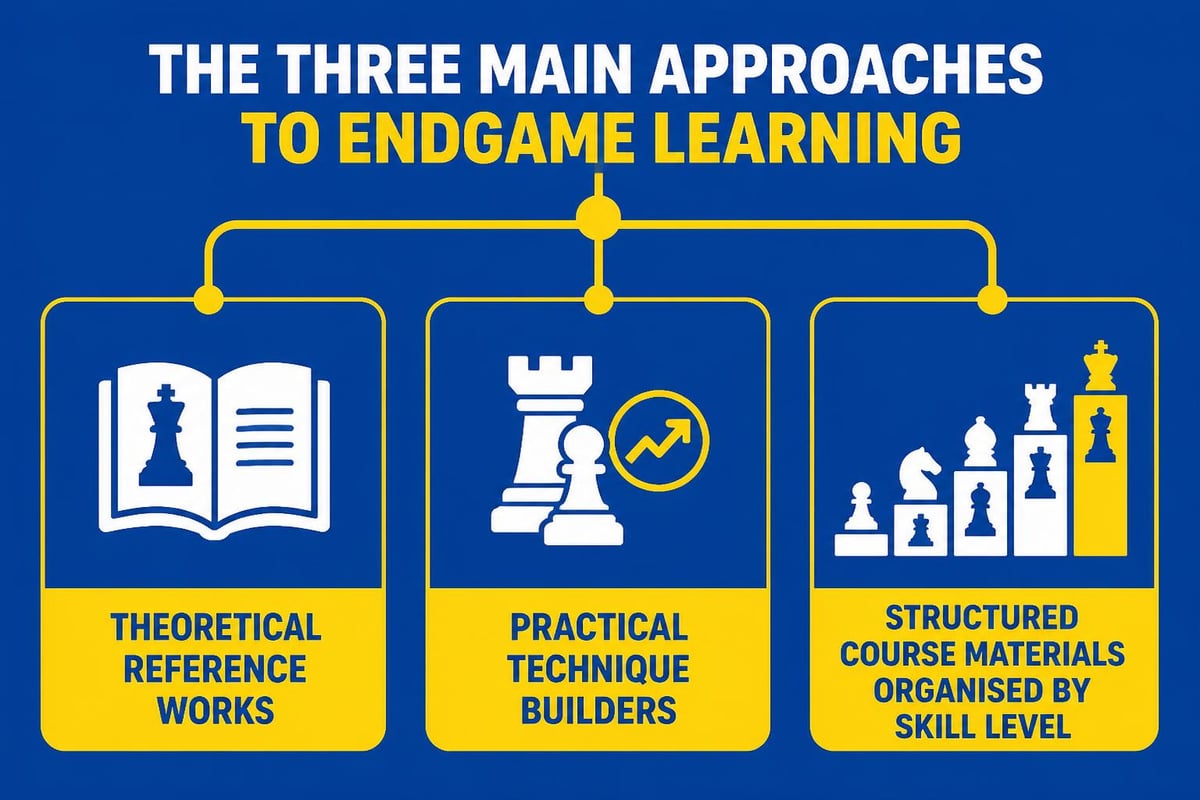
Not all endgame books serve the same purpose. Some focus on theoretical positions, others on practical play, and some bridge both worlds. Understanding these categories helps you choose resources that match your current level and learning style.
Systematic Courses vs Reference Manuals
There's a fundamental difference between books designed to be read cover-to-cover and those meant for looking up specific positions. Silman's Complete Endgame Course exemplifies the structured approach, organising material by rating level from beginner through master.
Reference manuals like Dvoretsky's Endgame Manual take a different approach entirely. These comprehensive works serve as encyclopaedic resources you'll consult throughout your chess career.
| Book Type | Best For | Learning Method | Skill Level |
|---|---|---|---|
| Structured Courses | Progressive learning | Read sequentially | Beginner to Intermediate |
| Reference Manuals | Deep study, lookup | Consult as needed | Intermediate to Advanced |
| Pattern Collections | Pattern recognition | Repeated practice | All levels |
| Strategic Guides | Conceptual understanding | Study and apply | Intermediate+ |
The Most Recommended Endgame Books Chess Players Trust
Let's cut through the noise. The chess publishing world produces dozens of endgame books annually, but only a handful have stood the test of time. These are the works that appear on every serious player's bookshelf.
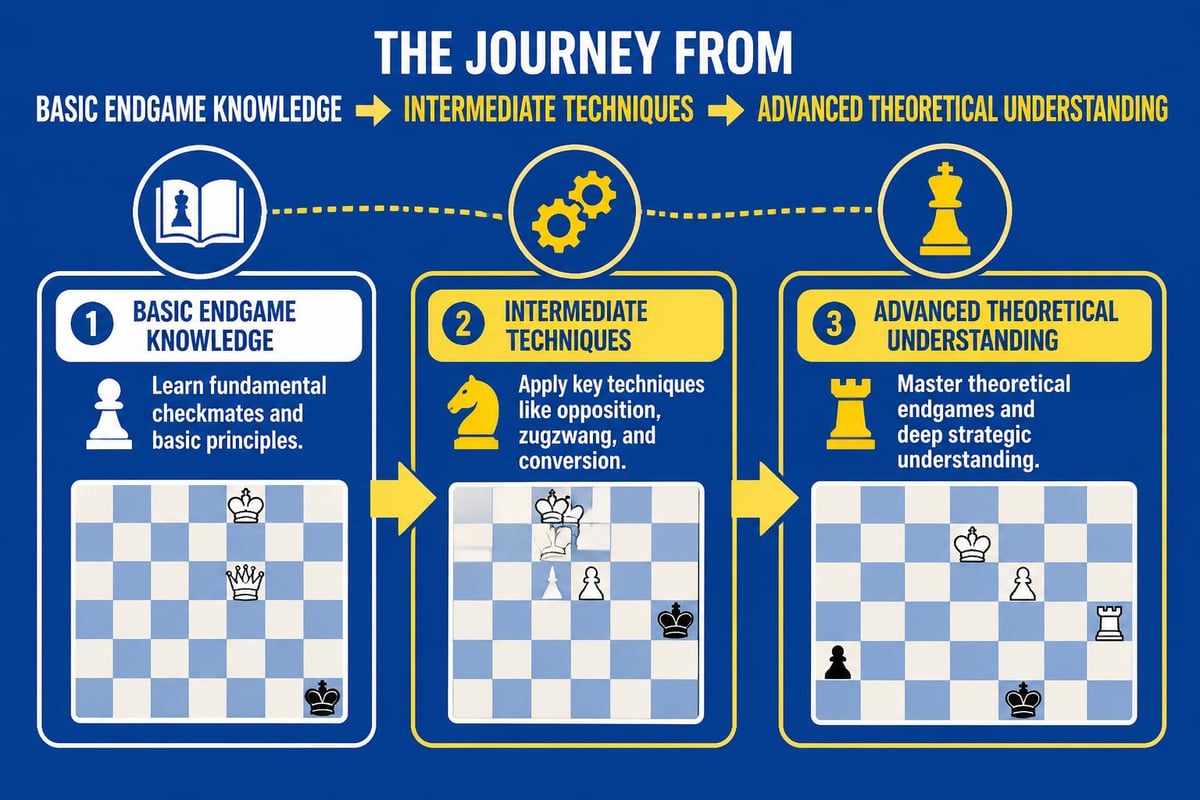
For Beginners Building Foundations
Starting your endgame education requires books that explain concepts clearly without overwhelming you with complexity. Jesus de la Villa's work stands out here - his practical approach focuses on positions you'll actually encounter in your games.
The key is finding resources that match your current playing strength. Just as you wouldn't study advanced chess books before mastering fundamentals, you shouldn't dive into theoretical endgame texts before understanding basic techniques.
What beginners need to master first:
- Basic checkmates (king and queen, king and rook)
- Elementary pawn endgames (opposition, square rule)
- Simple rook endgames (Lucena and Philidor positions)
- Basic piece vs pawn positions

Intermediate Players: Taking the Next Step
Once you've mastered fundamentals, you're ready for more sophisticated material. This is where endgame books chess coaches frequently recommend start introducing strategic concepts alongside tactical precision.
Understanding Chess Endgames by John Nunn distills endgame knowledge into 100 essential concepts. Rather than overwhelming you with every theoretical position, Nunn focuses on what you genuinely need for practical play.
Another excellent choice focuses on the most crucial positions. As reviewed on ChessReads, "100 Endgames You Must Know" covers vital endgame lessons every improving player should study.
Advanced Study for Serious Competitors
When you're ready for serious endgame work, you need books that challenge your understanding and expand your technical repertoire. The sixth edition of Dvoretsky's Endgame Manual represents the gold standard for comprehensive endgame study.
How to Actually Study Endgame Books (Not Just Read Them)
Here's where most players go wrong: they read endgame books like novels, nodding along, thinking they understand, then wondering why they still blunder these positions in games. Effective endgame study requires active engagement.
The Three-Pass Method
I've found this approach transforms passive reading into active learning. First pass: read through the chapter to grasp the main concepts. Second pass: set up each position on a board and work through the variations yourself before reading the solution. Third pass, a week later: test yourself on the key positions without looking at the text.
- Physical board vs digital: Use an actual board whenever possible for better retention
- Annotation habit: Write notes in the margins about patterns you notice
- Spaced repetition: Return to difficult positions after increasing intervals
- Position reconstruction: Try to recreate key positions from memory
Similar to how you might explore opening puzzles, endgame study benefits enormously from puzzle-based practice. The difference is that endgame puzzles often require longer, more precise calculation.
Creating Your Personal Reference System
As you study multiple endgame books chess literature offers, you'll encounter the same positions explained differently. This is actually beneficial. Create a personal reference document where you note which explanations clicked for you.
Strategic vs Tactical Endgame Approaches
There's an interesting division in how endgame books chess authors write present material. Some emphasise calculation and concrete variations, whilst others focus on strategic understanding and general principles.
Endgame Strategy by Mikhail Shereshevsky teaches strategic principles through classic grandmaster examples. Rather than memorising exact move sequences, you learn to evaluate positions and formulate winning plans.
When You Need Precision vs When You Need Principles
Certain endgames demand exact knowledge. King and pawn versus king? You must know the critical squares and opposition principles precisely. Rook and pawn versus rook? The Lucena and Philidor positions have specific winning and drawing techniques.
Other endgames reward strategic understanding more than memorisation. Complex rook endgames with multiple pawns rarely follow theoretical patterns exactly. Here, understanding principles like rook activity, pawn weaknesses, and king positioning matters more than remembering specific variations.
| Endgame Type | Approach Needed | Study Method |
|---|---|---|
| K+P vs K | Exact technique | Memorise patterns |
| R+P vs R | Theoretical positions | Learn key setups |
| R vs P | Calculation | Practice drawing zones |
| Q vs P | Mostly theoretical | Study exceptions |
| Complex R endings | Strategic principles | Understand themes |
| Minor piece endings | Mixed approach | Patterns + evaluation |
Supplementing Books with Modern Resources
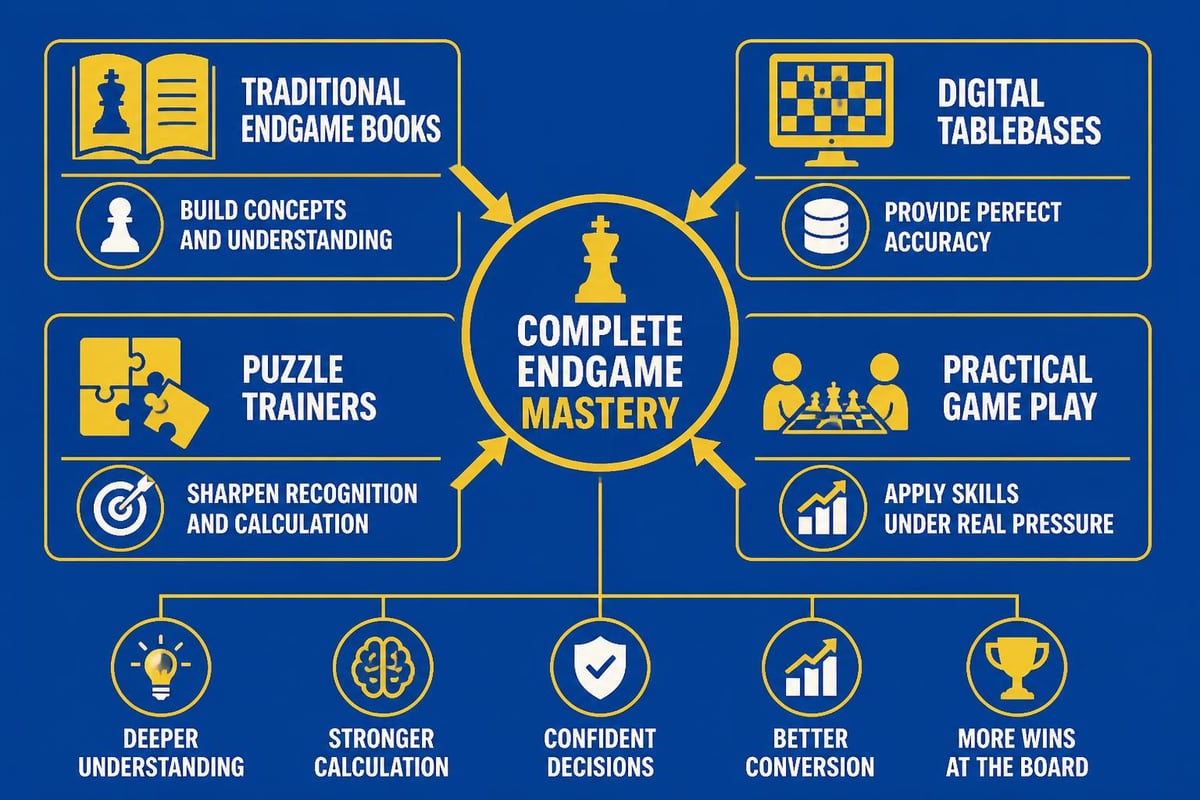
Whilst endgame books chess masters have written remain invaluable, we're fortunate to have additional tools in 2026. Tablebases, for instance, provide perfect play for all positions with seven pieces or fewer. Recent research, including work on endgame tablebase verification, continues advancing our understanding.
Combining Books with Digital Tools
You don't need to choose between traditional books and modern technology. Use them together. Study a position in your book, then check it against a tablebase to see alternative winning methods. Watch video explanations, like IM Thomas Engqvist's overview of 87 instructive endgame books, to hear how different instructors explain the same concepts.
The Chess Cheat Sheets endgame collection exemplifies this modern approach - condensing essential endgame knowledge into accessible formats that complement traditional book study.
Digital resources that enhance book learning:
- Endgame tablebases for perfect reference
- Position trainers for deliberate practice
- Video courses for visual learners
- Mobile apps for studying on-the-go
- Online endgame databases for pattern recognition
Common Mistakes When Choosing Endgame Books
I've watched countless players buy the wrong endgame books for their level. A 1200-rated player purchasing Dvoretsky's manual is like a beginning runner buying professional marathon training plans. It's not that the content is bad - it's simply not appropriate yet.
The "More Advanced Means Better" Trap
Publishers love promoting books as "comprehensive" and "complete," which often translates to "overwhelming" for most players. You'll learn more from a simpler book you actually complete than from an advanced text you abandon after three chapters.
Consider your realistic study capacity. How much time can you genuinely dedicate to endgame study weekly? If it's two hours, you need different resources than someone committing ten hours.
Overlooking Practical vs Theoretical Value
Some endgame books chess theoreticians write contain fascinating analysis of positions you'll never see in actual play. That's fine if you're studying for pure enjoyment, but if you want to improve your results, prioritise positions that occur frequently.
A comprehensive collection of endgame books can help you browse options, but remember: the best book is the one you'll actually study thoroughly, not the one sitting unread on your shelf.
Building Your Endgame Library Strategically
You don't need dozens of endgame books. Most players benefit from three well-chosen volumes: a beginner-friendly systematic course, a practical pattern collection, and eventually a comprehensive reference manual.
The Three-Book Foundation
Start with a structured course appropriate to your level. This becomes your primary study text. Add a practical pattern book focusing on positions you'll encounter frequently. Finally, when you're comfortable with fundamentals, invest in a detailed reference work.
Recommended progression timeline:
- Months 1-6: Complete one beginner-friendly course
- Months 7-12: Study practical pattern collection, start applying in games
- Year 2: Begin working through intermediate material
- Year 3+: Tackle advanced reference works selectively
This measured approach prevents the overwhelm that causes many players to abandon endgame study entirely. Much like choosing the best openings for black requires matching systems to your style, selecting endgame books demands honest self-assessment of your current level and learning preferences.
Tracking Your Endgame Improvement
How do you know if studying endgame books chess literature provides is actually improving your play? You need measurable feedback beyond just "feeling more confident."
Concrete Metrics That Matter
Keep a simple log of your games, noting endgames reached and their outcomes. After six months of consistent study, compare your endgame conversion rate. Are you winning more games from advantageous positions? Making fewer mistakes in defensive endgames?
Another revealing metric: time usage in endgames. As your knowledge deepens, you'll spend less time calculating familiar positions, giving you more clock time for critical decisions.
Specialising in Specific Endgame Types
Once you've mastered fundamentals, you might focus on endgame types that arise from your preferred openings. If you frequently play positions that lead to rook endgames, prioritising that specialisation makes practical sense.
For instance, understanding what opening Stockfish uses can inform which endgames you should study if you play similar systems. The same logic applies to studying what openings Magnus Carlsen favours - his opening choices often lead to specific endgame types where precise knowledge proves decisive.
Matching Endgame Study to Opening Repertoire
This targeted approach accelerates improvement because you're studying positions you'll actually reach. Play the French Defence regularly? Prioritise pawn structure endgames with specific characteristics. Prefer the English Opening? Focus on endgames arising from symmetrical pawn structures.
Making Endgame Study Enjoyable
Let's be honest - endgame study has a reputation for being dry. King and pawn versus king doesn't have the immediate appeal of a brilliant kingside attack. But here's the thing: understanding changes everything.
Finding the Beauty in Simplicity
When you truly understand an endgame position - when you see why one move wins and another only draws - there's genuine aesthetic pleasure. It's like appreciating minimalist art: the beauty lies in precision and economy of means.
Many players find endgame study more enjoyable when they immediately test their knowledge in practice games. Study a technique in the morning, then deliberately steer your blitz games toward those endgames in the evening. The reinforcement makes learning feel purposeful rather than abstract.
Ways to make endgame study more engaging:
- Study with a partner and quiz each other
- Set weekly challenges for specific endgame types
- Create flashcards of critical positions
- Join online endgame tournaments
- Share interesting positions you discover with chess friends
The Resources You Already Have
Before buying more books, you might have untapped endgame resources already. Many comprehensive opening books include endgame sections explaining typical endings arising from those systems. Even resources focused primarily on tactics often contain endgame puzzles.
The free chess books available online sometimes include classic endgame texts now in the public domain. These older works may lack modern touches, but the fundamental positions they teach remain unchanged since Philidor's time.
Similarly, exploring free online chess courses might reveal endgame content you can study before investing in specialised books.
Mastering the endgame transforms your chess by giving you the confidence to convert advantages and save difficult positions that would otherwise be losses. The endgame books chess players trust provide roadmaps for this journey, but remember - the best resource is worthless without consistent study and practical application. Whether you're just starting with basic checkmates or ready to tackle advanced theoretical positions, Chess Cheat Sheets offers streamlined endgame guides and resources designed to accelerate your learning without overwhelming you with unnecessary complexity.


