

You've probably watched chess streams online or followed tournament broadcasts and wondered how those moves appear on screen instantaneously. That's the magic of an electronic chess set at work. These sophisticated boards have revolutionised how we play, study, and analyse chess, combining the tactile satisfaction of physical pieces with the analytical power of modern technology. Whether you're looking to improve your opening preparation, track your progress, or simply enjoy a more connected chess experience, understanding what makes these boards special will help you choose the right one for your journey.
What Exactly Is an Electronic Chess Set?
An electronic chess set is a physical chessboard with built-in sensors that detect piece movements and communicate with computers or mobile devices. Unlike traditional boards, these smart systems can record every move you make, allowing for instant analysis, online play with physical pieces, and even automatic game notation.
The technology has come remarkably far since its inception. The history of electronic chess boards reveals how early experiments evolved into the standardised tournament equipment we see today. Modern boards use various sensor technologies-from magnetic reed switches to infrared detection-to register piece positions with impressive accuracy.
How These Boards Actually Work
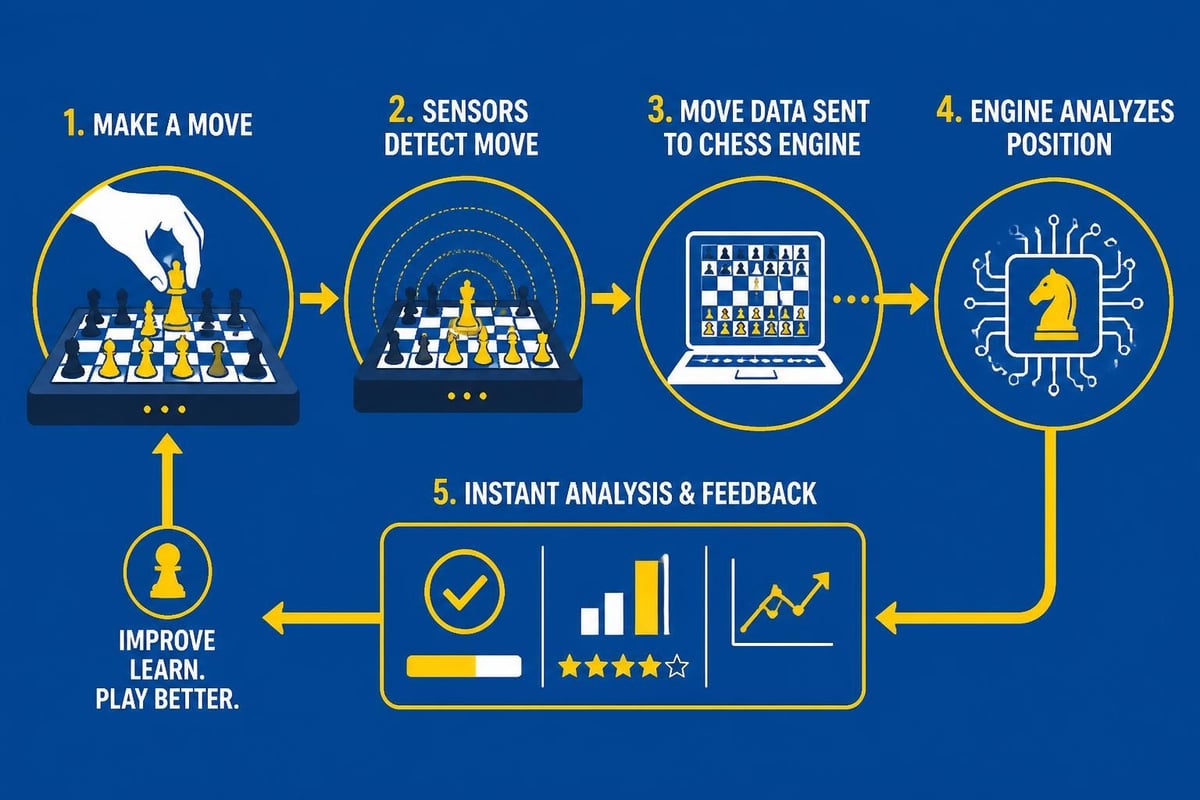
At their core, electronic chess sets contain sensors beneath each square that detect when pieces are moved. Here's what happens in those split seconds:
- The sensor registers that a piece has left one square
- Another sensor detects the piece arriving at its destination square
- The board's internal processor interprets this as a legal move
- The information transmits to connected devices via USB, Bluetooth, or WiFi
- Your chosen software displays the move and can provide instant feedback
This seamless integration means you're never interrupting your thought process to input moves manually. You play naturally, and the technology works invisibly in the background.
Why Choose an Electronic Chess Set Over Traditional Boards?
You might be wondering whether the investment is worth it. After all, traditional boards have served players well for centuries. But an electronic chess set offers distinct advantages that can accelerate your improvement.
For Training and Analysis
When you're working through chess openings, having instant feedback changes everything. Make a move, and your connected engine can immediately flag inaccuracies or suggest improvements. This real-time learning reinforces good habits far more effectively than post-game analysis alone.
For Online Play
Playing online with a physical board feels dramatically different from clicking squares on a screen. You maintain the tactical awareness that comes from seeing actual pieces whilst enjoying the convenience of playing opponents worldwide. It's the best of both worlds.
For Tournament Preparation
Many serious players use electronic boards to simulate tournament conditions at home. You can practice with time controls, record your games automatically, and review them later-all whilst developing the muscle memory of moving physical pieces.
Key Features to Consider When Choosing Your Board
Not all electronic chess sets are created equal. The expert guide for 2026 highlights several crucial factors that separate excellent boards from mediocre ones.
Sensor Technology and Accuracy
The heart of any electronic chess set is its sensing mechanism. Poor sensor responsiveness leads to frustrating misregistrations and interrupted play. Quality boards detect pieces reliably, even during rapid play.
| Sensor Type | Accuracy | Best For | Cost Range |
|---|---|---|---|
| Reed switches | Excellent | Tournament play | £300-£800 |
| Pressure sensors | Good | Home use | £150-£400 |
| Infrared | Very good | Training | £250-£600 |
| Capacitive | Good | Casual play | £100-£300 |
Connectivity Options
Modern electronic chess sets offer various ways to connect:
- USB connectivity - Most reliable for tournament play and serious training
- Bluetooth - Convenient for mobile devices and tablet integration
- WiFi - Enables cloud-based features and remote play
- Multi-protocol boards - Offer flexibility across different setups
Consider how you'll primarily use your board. If you're mainly training at home with a laptop, USB might suffice. For more mobile practice sessions, Bluetooth becomes essential.
Build Quality and Piece Recognition
Premium boards feature weighted pieces with precise identification systems. Cheaper models sometimes struggle to distinguish between different pieces, requiring manual correction. This becomes particularly annoying when you're deep in calculation and the board misidentifies your knight as a bishop.
The Millennium Supreme T2 Electronic Chessboard exemplifies high-end construction, with its wireless capabilities and beautiful wood finish. But even mid-range boards can offer excellent performance if they nail the fundamentals.

Popular Electronic Chess Set Options in 2026
You've got more choices than ever in today's market. Let's break down the landscape from budget-friendly to professional-grade equipment.
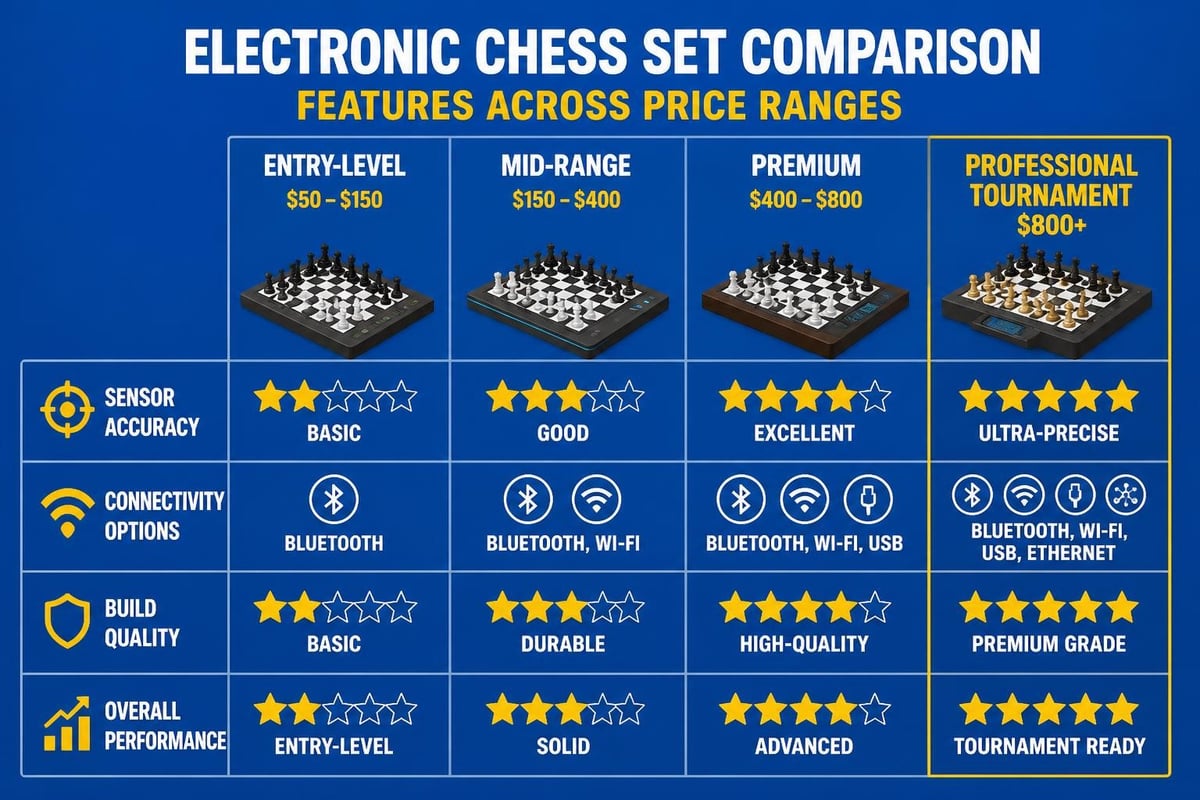
Entry-Level Boards (£100-£250)
Perfect for beginners or casual players testing the waters. These boards typically offer:
- Basic USB connectivity
- Compatible with popular chess software
- Plastic or composite materials
- Limited or no onboard engines
- Good piece detection for normal play speeds
They're ideal if you're primarily interested in recording games or playing online with a physical board whilst working through resources like opening guides.
Mid-Range Options (£250-£500)
This sweet spot offers serious value. You'll find:
- Multiple connectivity options (USB and Bluetooth)
- Better build quality with wooden boards available
- Improved sensor accuracy
- Some models include basic onboard engines
- Tournament-compatible in many cases
Professional Tournament Boards (£500+)
These represent the pinnacle of electronic chess set technology. DGT e-Boards dominate this category, and their features and tournament use explain why they've become the standard in professional play.
What You're Paying For:
- Flawless piece detection at any speed
- Official tournament approval
- Premium materials and craftsmanship
- Advanced connectivity and broadcasting capabilities
- Long-term durability and manufacturer support
Integrating Your Electronic Chess Set Into Training
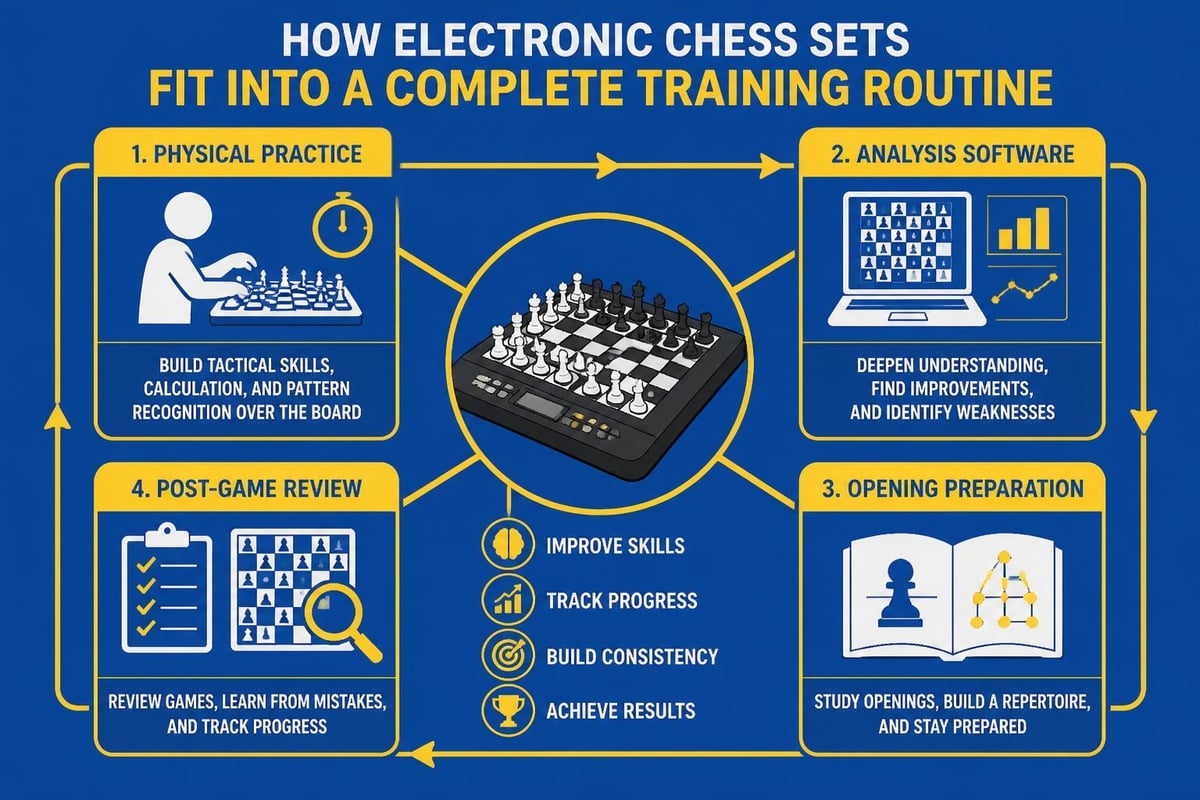
Owning an electronic chess set is one thing; maximising its potential is another. Here's how to get the most from your investment.
Setting Up Your Analysis Workflow
Your board becomes most powerful when integrated into a structured practice routine:
- Choose your analysis software - ChessBase, Lichess, or chess.com all support electronic boards
- Configure piece recognition - Spend time ensuring your board registers pieces accurately
- Establish training protocols - Decide when you'll use computer assistance versus pure play
- Record everything - Your board can automatically save games for later review
When you're studying specific lines from the Ruy Lopez or Caro-Kann Defense, having your moves automatically recorded creates an invaluable database of your actual over-the-board attempts.
Balancing Technology and Traditional Study
Here's an important consideration: don't let the technology become a crutch. Your electronic chess set should enhance traditional study methods, not replace them.
Use the board for:
- Testing your opening preparation in realistic conditions
- Playing against engines at appropriate levels
- Recording blitz and rapid games for pattern recognition
- Simulating tournament pressure with clock and notation
Continue traditional methods for:
- Deep positional study without computer interference
- Endgame practice where calculation trumps evaluation
- Blindfold visualisation exercises
- Working through chess puzzles independently
Common Challenges and Solutions
Even the best electronic chess set can present occasional frustrations. Let's address the most common issues you're likely to encounter.
Misregistered Moves
This happens to everyone eventually. Your knight move registers as a pawn advance, or the board doesn't detect a capture. Solutions include:
- Ensuring pieces are centred on squares
- Cleaning sensors regularly (dust accumulation affects accuracy)
- Updating firmware when manufacturers release improvements
- Learning your specific board's quirks (some require slightly firmer piece placement)
The comprehensive review of electronic chess sets emphasises how sensor responsiveness varies significantly between models, making this a crucial consideration during purchase.
Software Compatibility Issues
Not all boards work seamlessly with all software. Before purchasing:
- Verify compatibility with your preferred analysis platforms
- Check whether drivers are regularly updated
- Read user reviews specifically mentioning your operating system
- Consider future-proofing with widely-supported protocols
Calibration and Maintenance
Your electronic chess set requires occasional attention:
| Maintenance Task | Frequency | Difficulty | Impact |
|---|---|---|---|
| Sensor calibration | Monthly | Easy | High |
| Firmware updates | As released | Medium | High |
| Piece cleaning | Weekly | Easy | Medium |
| Connection check | Before sessions | Easy | High |
| Battery replacement | 6-12 months | Easy | Critical |
Regular maintenance prevents frustrating mid-game issues and extends your board's lifespan considerably.
Making Your Purchase Decision
You've absorbed all this information, but how do you actually choose? Start by honestly assessing your needs and budget.
Questions to Ask Yourself
About Your Playing Level:
- Am I a beginner exploring chess or an intermediate player seeking serious improvement?
- Do I need tournament-grade equipment, or will good recreational quality suffice?
- How important is rapid piece detection for my playing speed?
About Your Usage:
- Will I primarily train alone or play against others?
- Do I need portability, or will the board stay in one location?
- How often will I realistically use the electronic features?
About Your Budget:
- What's my absolute maximum spending limit?
- Would I benefit more from a mid-range board plus quality training materials?
- Is this a long-term investment or an experiment?
Where to Buy
Purchase from reputable chess retailers who understand the products they sell. They can provide:
- Expert guidance on choosing the right model
- Proper warranty support
- Help with initial setup and calibration
- Access to compatible accessories
Avoid marketplace sellers offering suspiciously cheap prices on premium brands. Counterfeit electronic chess sets exist and they're universally terrible.
Advanced Uses for Serious Players
Beyond basic training, electronic chess sets enable sophisticated practice methods that were previously impossible.
Creating Opening Repertoire Databases
Your board can help build a personalised database of your actual play. When you're developing your understanding of the London System middlegame plans, recording every practice game creates patterns you can analyse later.
This becomes particularly valuable when you notice you're consistently struggling in specific positions. Your database reveals these weaknesses objectively.
Engine Training Protocols
Modern chess engines have revolutionised training, and research on technological advancements in chess engines demonstrates their impact on player development. Your electronic chess set makes engine training more effective by:
- Allowing natural piece movement whilst engine analyses
- Enabling rapid position setup for studying specific structures
- Providing immediate feedback on tactical oversights
- Simulating opponents at precisely calibrated strengths
Tournament Simulation
Nothing prepares you for tournament pressure like realistic practice. Set up your electronic chess set with:
- Proper time controls matching your target tournaments
- Automatic game recording (no manual notation distractions)
- Post-game analysis protocols
- Regular scheduling to build consistency
This transforms casual practice into genuine preparation.
The Future of Electronic Chess Sets
Technology continues advancing rapidly. What can you expect in coming years?
Emerging Trends:
- Improved AI integration for personalised coaching
- Better battery life and wireless performance
- More affordable entry points for budget-conscious players
- Enhanced mobile device integration
- Cloud-based features enabling remote coaching
Some manufacturers are exploring augmented reality overlays and voice-activated features. Whether these become mainstream or remain novelties depends largely on whether they genuinely improve the playing experience.
The key is choosing an electronic chess set that meets your current needs whilst offering reasonable future-proofing through software updates and standard connectivity protocols.
Maximising Your Investment
You've made the purchase. Now ensure you actually use it effectively.
First Week Setup
- Unbox carefully and read the manual thoroughly (yes, actually read it)
- Complete full calibration before your first serious game
- Install and configure all necessary software
- Play several casual games to familiarise yourself with the board's response
- Experiment with different connectivity options
Building Consistent Habits
The most expensive electronic chess set becomes worthless if it gathers dust. Integrate it into your routine:
- Schedule specific training sessions using the board
- Combine electronic board practice with studying materials from Chess Cheat Sheets
- Track your progress through automatically recorded games
- Regularly review your database for improvement patterns
- Share interesting games with fellow players or coaches
Avoiding Common Mistakes
Don't fall into these traps that reduce the value of your electronic chess set:
- Relying too heavily on instant computer feedback during play
- Neglecting regular maintenance and calibration
- Using inappropriate engine strength settings (too strong creates dependency, too weak doesn't challenge)
- Forgetting to back up your game database
- Ignoring firmware updates that improve performance
An electronic chess set represents more than just a gadget-it's a bridge between traditional chess study and modern analytical power. By choosing the right board for your level and budget, maintaining it properly, and integrating it into a structured training routine, you'll accelerate your improvement significantly. Whether you're working through tactical puzzles, refining your opening repertoire, or preparing for your next tournament, combining physical practice with digital analysis creates a powerful learning environment. Ready to take your chess to the next level? Explore the comprehensive guides and resources at Chess Cheat Sheets to complement your new electronic board and build a complete training system that delivers real results.


