

Have you ever wondered how the ancient game of Xiangqi compares to the Western chess you might already know? Chinese chess pieces operate in fascinating ways that both mirror and diverge from their Western counterparts, creating a strategic landscape that's been captivating players for over a thousand years. Understanding these pieces opens up an entirely new dimension of chess strategy, one that can actually enhance your appreciation for playing the game of chess in all its forms. Whether you're a beginner looking to expand your chess knowledge or an intermediate player seeking fresh strategic challenges, exploring Chinese chess pieces offers valuable insights into positional play and tactical thinking.
Understanding the Fundamentals of Chinese Chess Pieces
Chinese chess pieces, known as Xiangqi pieces, represent military units in a battle simulation that dates back to ancient China. Unlike Western chess, where pieces sit on squares, these pieces sit on the intersection points of lines on the board, creating a unique spatial relationship that affects movement patterns.
The game uses 32 pieces total, with 16 on each side, typically differentiated by colour: red and black (or sometimes red and green). What makes these pieces particularly interesting is that they're usually marked with Chinese characters rather than figurative shapes. This means each side has pieces with different characters, even though they perform the same functions.
The Seven Types of Pieces
Here's what makes the piece structure distinctive:
- General (King) - The commander of your forces
- Advisor (Guard) - Protectors of the General
- Elephant (Bishop) - Defensive pieces with limited range
- Horse (Knight) - Similar to Western chess but with a crucial difference
- Chariot (Rook) - The most powerful attacking piece
- Cannon - A unique piece with no Western equivalent
- Soldier (Pawn) - Infantry units with asymmetric movement
Each player controls one General, two Advisors, two Elephants, two Horses, two Chariots, two Cannons, and five Soldiers. The arrangement creates a balanced but strategically rich environment where understanding piece coordination becomes essential.
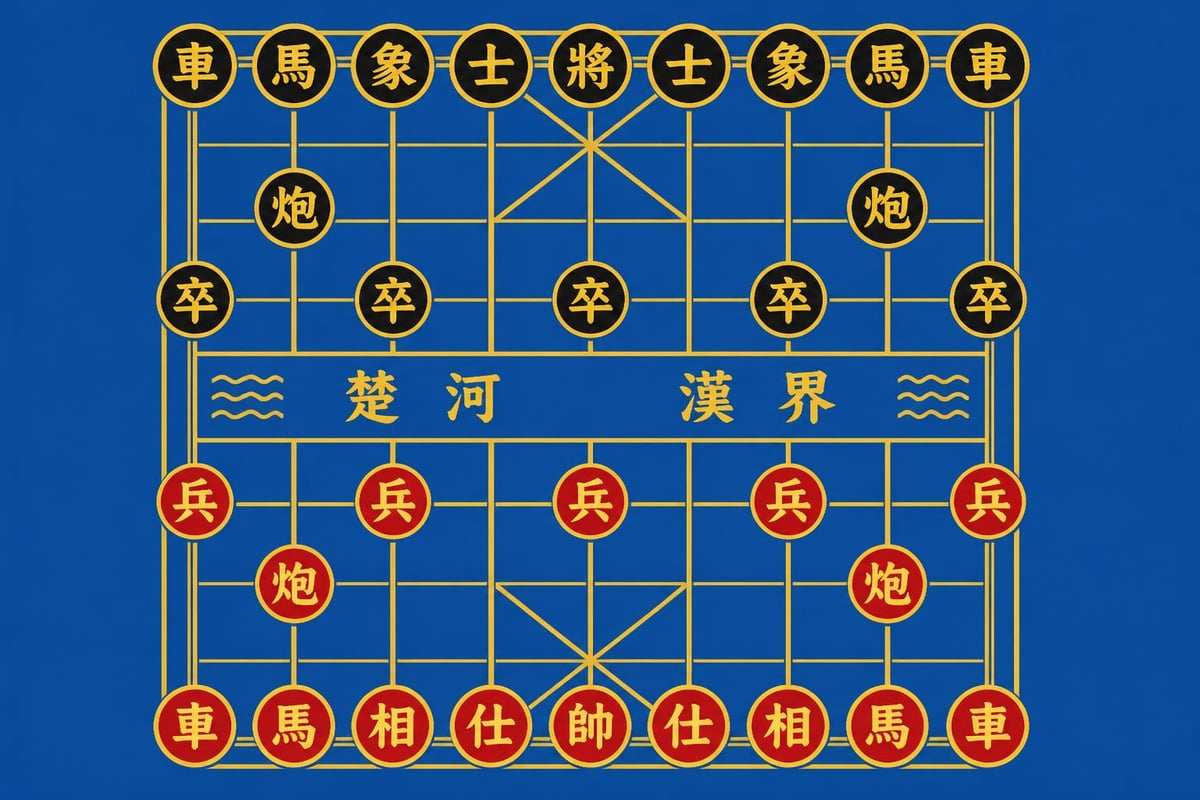
The General and Advisors: Your Palace Defenders
The General, equivalent to the King in Western chess, is confined to a special area called the palace. This 3x3 zone is marked on the board, and the General can only move one point orthogonally (up, down, left, or right) within this space. You'll never see your General wandering into enemy territory!
What's particularly fascinating about Chinese chess is the "flying general" rule. If the two Generals face each other on the same file with no pieces between them, the side whose turn it is loses immediately. This creates unique tactical opportunities that simply don't exist in Western chess.
The two Advisors move one point diagonally and are also confined to the palace. They work alongside the General to create a defensive structure that's remarkably difficult to penetrate. Think of them as creating a protective shield that must be dismantled piece by piece.
Palace Confinement Strategy
| Piece | Movement | Confined Area | Primary Role |
|---|---|---|---|
| General | 1 point orthogonally | 3x3 Palace | Command/Victory condition |
| Advisor | 1 point diagonally | 3x3 Palace | General protection |
This confinement creates a strategic dynamic where attacking the palace requires careful preparation. You can't simply march your General up the board like in Western chess endgames!
Elephants and Horses: Restricted Mobility with Strategic Depth
The Elephant moves exactly two points diagonally, but here's the catch - it can be blocked if there's a piece on the intervening point. Even more limiting, Elephants cannot cross the river that divides the board in half. This makes them purely defensive pieces, unable to participate in attacks on the enemy palace.
Why does this matter for your chess development? Understanding pieces with restricted mobility teaches you about chess strategy in confined spaces. The principles you learn apply even when you return to Western chess.
The Horse moves similarly to the Western Knight - one point orthogonally followed by one point diagonally outward. However, unlike the Knight, the Horse can be blocked if there's a piece adjacent to it in the initial direction of movement. This "hobbling" mechanic creates fascinating tactical possibilities where you can actually trap an opponent's Horse.

Key Movement Differences
Consider these crucial distinctions that affect chinese chess pieces:
- The Horse's vulnerability - Can be blocked, unlike the jumping Knight
- The Elephant's limitation - River boundary creates defensive specialists
- Spatial awareness - Pieces exist on intersections, not squares
- Blocking mechanics - Many pieces can be obstructed mid-move
Chariots and Cannons: The Power Pieces
The Chariot (or Rook) is the most straightforward piece for Western chess players to understand. It moves any number of points orthogonally along ranks or files, just like the Western Rook. In fact, according to chess programming sources, the Chariot is generally considered the most valuable piece in Chinese chess, much like the Rook in Western chess.
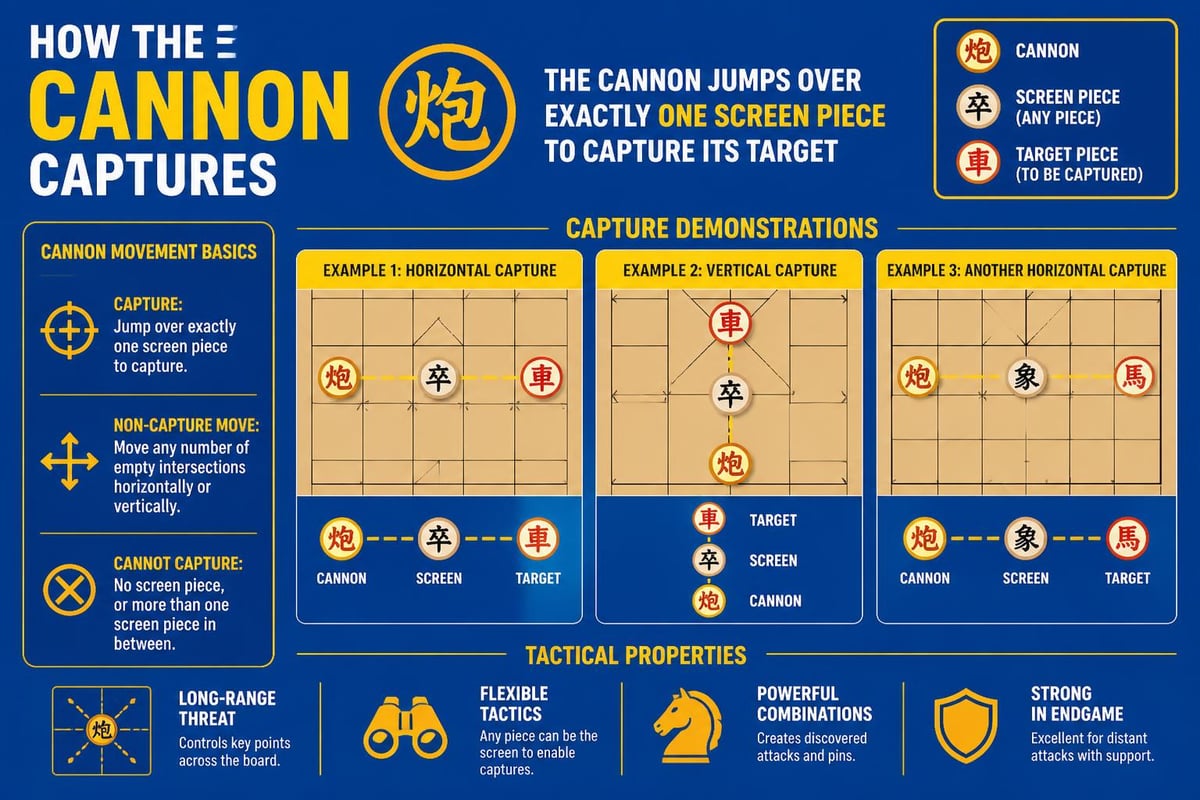
But the Cannon? Now that's where things get genuinely unique. The Cannon moves like a Chariot when not capturing - sliding along ranks and files. However, to capture, it must jump over exactly one piece (of either colour), called a "screen," and land on the enemy piece beyond it.
This jumping mechanism creates extraordinary tactical complexity. Your opponent's pieces can actually help you attack them! A well-placed screen can turn a seemingly safe position into a tactical catastrophe.
Comparative Power Analysis
| Piece Type | Movement Freedom | Capture Method | Strategic Value |
|---|---|---|---|
| Chariot | Unlimited orthogonal | Direct | Highest |
| Cannon | Unlimited orthogonal | Jump one piece | High (early game) |
| Horse | L-shape (blockable) | Direct | Medium-High |
| Elephant | 2 diagonally | Direct | Medium (defense) |
The interplay between these pieces creates combinations that would be impossible in Western chess. Learning to coordinate Chariots and Cannons teaches you about piece cooperation in ways that translate back to improving your standard chess tactics.
Soldiers: The Asymmetric Infantry
Chinese chess pieces include Soldiers (Pawns) that behave quite differently from their Western counterparts. Before crossing the river, a Soldier can only move forward one point. Once it crosses into enemy territory, it gains the ability to move sideways as well, but never backward.
Unlike Western Pawns, Soldiers never promote. What you see is what you get throughout the entire game. This creates an interesting strategic consideration - each Soldier represents a fixed amount of combat power that gradually works its way up the board.
The asymmetric movement pattern means crossed Soldiers become significantly more valuable. They can attack along ranks, creating threats against multiple pieces simultaneously. In the endgame, advanced Soldiers can be devastating, particularly when coordinating with Chariots.
Soldier Progression
Pre-River Movement:
- Forward only (1 point)
- Limited tactical flexibility
- Gradual advancement
Post-River Movement:
- Forward or sideways (1 point)
- Enhanced tactical options
- Significant attacking potential
This mirrors principles you'd learn about pawn structure in Western chess, where controlling key squares and advancing carefully determines your success. The best chess learning sites emphasise these positional concepts regardless of which variant you're studying.
Historical Context and Cultural Significance
The evolution of Chinese chess reflects military strategy from ancient Chinese warfare. Each piece type corresponds to actual military units, making Xiangqi not just a game but a cultural artefact that's preserved strategic thinking across centuries.
Ancient Chinese chess pieces were crafted from various materials - wood, bone, ivory, and even precious stones for wealthy families. The characters inscribed on them weren't just identifiers; they represented philosophical concepts about warfare, hierarchy, and governance.
What's particularly relevant for modern chess players is how these cultural elements influenced strategic thinking. The restriction of certain pieces to defensive roles, the river as a boundary, and the palace confinement all reflect historical military doctrine. Understanding this context deepens your appreciation for how chess games evolve from cultural roots.
Practical Differences That Affect Your Game
When you first encounter chinese chess pieces on a board, several practical differences immediately impact your play style. The point-based movement system means you're thinking about intersections rather than squares. This shift in spatial reasoning can actually improve your visualization skills when you return to Western chess.
The river creates a natural division that doesn't exist in Western chess. It's not just a visual element - it fundamentally affects piece mobility and strategic planning. Elephants can't cross it, Soldiers change behaviour when crossing it, and controlling river crossings becomes a strategic objective similar to controlling the centre in Western chess.
Setup and Starting Position
Starting positions for chinese chess pieces follow a specific pattern:
- Chariots occupy the corners
- Horses stand next to Chariots
- Elephants position inside the Horses
- Advisors flank the General in the palace
- Cannons sit two points in front of the Horses
- Soldiers line up across the fourth rank
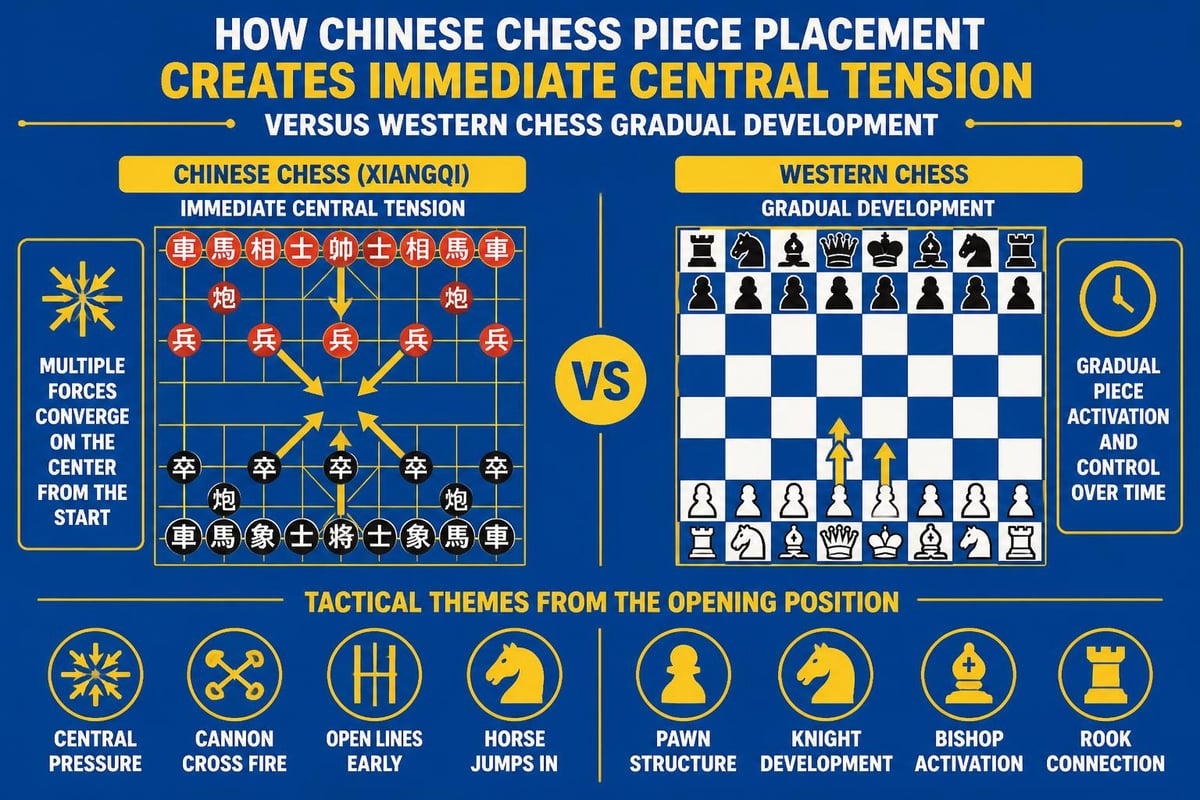
This setup creates immediate tension in the centre, unlike Western chess where pieces develop gradually. From move one, you're dealing with active piece play and tactical threats.
Learning Resources and Getting Started
If you're interested in exploring chinese chess pieces firsthand, several guides explain how to play with detailed piece descriptions and movement rules. The learning curve isn't as steep as you might imagine, especially if you already understand Western chess concepts.
Many chess education platforms now include Xiangqi as part of comprehensive chess training. The strategic principles overlap significantly with Western chess, making it an excellent supplementary learning tool. You'll find that concepts like piece coordination, space control, and tactical patterns exist in both games, just expressed differently.
Key Learning Benefits:
- Enhanced spatial awareness from point-based movement
- Tactical pattern recognition through unique piece interactions
- Strategic flexibility from managing restricted pieces
- Cultural enrichment through historical context
For players working through chess resources to improve their game, Xiangqi offers a refreshing perspective that can break through plateaus. When you understand how different rule sets create different strategic priorities, you develop adaptability that serves you in any chess variant.
Strategic Principles Across Chess Variants
The beauty of studying chinese chess pieces lies in how they reinforce universal chess principles. Piece coordination matters whether you're moving a Western Rook or a Chinese Chariot. Controlling key squares (or points) determines your positional advantage in both games.
Consider how the Cannon's unique capturing method teaches you about using your opponent's pieces against them. This concept appears in Western chess too - pinning pieces, using them as shields, or forcing them into positions where they block their own side's mobility. The Cannon just makes this principle explicit and central to gameplay.
Similarly, the palace restrictions on the General and Advisors teach you about king safety in a compressed format. You can't ignore defending your king in either variant, but Chinese chess makes the defensive zone explicitly defined, helping you visualize protective structures more clearly.
Universal Chess Concepts
| Concept | Western Chess Expression | Chinese Chess Expression |
|---|---|---|
| King Safety | Castle early, pawn shield | Palace confinement, Advisor support |
| Piece Activity | Control centre, open files | Control river, crossing points |
| Tactical Motifs | Pins, forks, skewers | Cannons screens, Horse blocks |
| Endgame Technique | King activation, pawn promotion | Soldier advancement, Chariot domination |
These parallels mean that time spent learning Xiangqi isn't separate from improving at Western chess. You're developing the same fundamental skills through a different lens, which can actually accelerate your overall chess understanding.
The Modern Renaissance of Chinese Chess
In 2026, we're seeing renewed interest in chinese chess pieces and Xiangqi generally, driven partly by digital platforms that make the game accessible worldwide. Online servers host thousands of players, and AI engines have achieved superhuman strength, much like in Western chess.
This revival creates opportunities for cross-pollination between chess communities. Western chess players exploring Xiangqi bring fresh perspectives, while traditional Xiangqi players adopting Western chess contribute unique strategic insights. The exchange enriches both communities.
For chess educators and learners, this means more resources than ever before. Understanding different chess variants helps develop a comprehensive chess education that goes beyond memorizing opening lines. It's about understanding why moves work, not just what moves to make.
The analytical tools available today let you study chinese chess pieces with the same rigour as Western chess. Database software, puzzle collections, and training programs exist for serious students. This democratization of chess knowledge applies across all variants.
Practical Applications for Your Chess Improvement
How does learning about chinese chess pieces actually help your Western chess? The connection might not be immediately obvious, but the benefits are real and measurable. When you study a different rule set, you're forced to think about chess from first principles rather than relying on memorized patterns.
The spatial reasoning required for point-based movement enhances your board vision. You start seeing connections between pieces more clearly because you've trained your brain to think in a different geometric framework. This translates to better calculation when you return to Western chess.
The tactical patterns involving blockable pieces (like the Horse) teach you to look for piece interference possibilities in Western chess too. While the Knight can't be blocked, other pieces can interfere with each other's lines or restrict mobility. Training with chinese chess pieces makes you more alert to these subtleties.
Transferable Skills Include:
- Improved visualization from different movement patterns
- Better defensive awareness from palace-based play
- Enhanced tactical alertness from unique capturing methods
- Stronger endgame technique from fixed piece values
Working through chess puzzles in both variants creates a comprehensive tactical foundation. Each variant highlights different aspects of piece coordination, and together they build a more complete chess understanding than either alone could provide.
Common Misconceptions About Chinese Chess
Many Western chess players assume chinese chess pieces operate on completely alien principles, but the reality is more nuanced. Yes, the rules differ, but the underlying strategic framework overlaps considerably. Both games reward planning, calculation, and pattern recognition.
Another misconception is that Chinese chess is somehow simpler or less sophisticated than Western chess. In fact, the tactical complexity created by pieces like the Cannon and the restricted movement of several piece types generates positions every bit as intricate as Western chess. Different doesn't mean simpler.
Some players worry that learning Chinese chess will confuse their Western chess understanding. Experience suggests the opposite - exposure to multiple rule sets actually clarifies your understanding of chess principles. You learn what's universal versus what's variant-specific, which deepens your overall chess knowledge.
The character-based pieces intimidate some learners, but this is easily overcome. After a few games, you'll recognize the characters as quickly as you recognize Western chess piece symbols. The initial learning curve is brief, especially with modern resources that include English translations and diagrams.
Understanding chinese chess pieces enriches your overall chess education by exposing you to different strategic frameworks while reinforcing universal chess principles. Whether you're a beginner building foundational skills or an intermediate player seeking fresh perspectives, exploring Xiangqi offers valuable insights that transfer directly to your Western chess improvement. At Chess Cheat Sheets, we provide comprehensive guides, puzzles, and resources that help you master chess strategy across all its forms, giving you the tools to improve efficiently without overwhelming study sessions.


