

If you've ever wondered where you stand in the grand scheme of chess players worldwide, you're not alone. Your chess rating is more than just a number-it's a snapshot of your current skill level, a benchmark for improvement, and a tool for finding opponents who'll challenge you appropriately. Whether you're just starting out or looking to break through to the next level, understanding how ratings work can transform how you approach the game. Let's explore what these numbers really mean and how you can use them to accelerate your progress.

What Is a Chess Rating and Why Does It Matter?
At its core, a chess rating is a numerical representation of your playing strength. Think of it as a universal language that allows players from different clubs, countries, and backgrounds to compare their abilities objectively. Rather than claiming you're "pretty good" or "intermediate," you can simply state your rating-and anyone familiar with chess will know exactly where you stand.
The beauty of rating systems lies in their predictive power. They don't just tell you how strong you are now; they can also estimate your chances of winning against any other rated player. This makes organizing tournaments fair, finding suitable practice partners easier, and tracking your improvement quantifiable.
The Foundation: Understanding the Elo System
The most famous chess rating system is the Elo rating, developed by physicist Arpad Elo in the 1960s. This elegant mathematical model revolutionized how we measure chess skill, and it's still the foundation of most rating systems today.
Here's how it works in practice:
- Starting point: New players typically begin around 1200-1500, depending on the organization
- Rating changes: You gain points by winning and lose points by losing
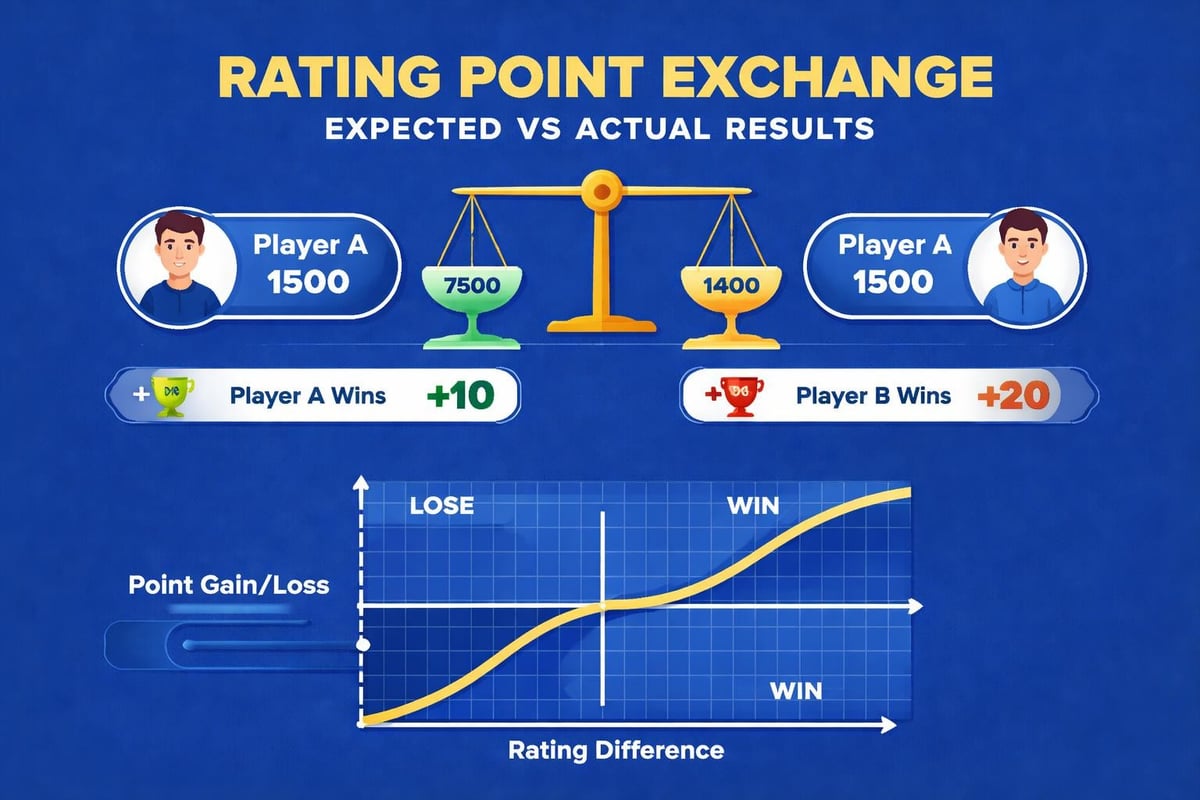
- Expected performance: The system predicts your likelihood of winning based on rating differences
- Self-correcting: Over time, your rating converges toward your true playing strength
The Elo rating chess system uses a simple principle: beating higher-rated opponents earns you more points than defeating lower-rated ones. Similarly, losing to a weaker player costs you more than losing to someone stronger.
Different Rating Systems Across the Chess World
Whilst Elo provides the foundation, you'll encounter several different rating systems depending on where you play. Each has its quirks and calculation methods, which can be confusing when you're trying to understand your true strength.
FIDE Ratings: The International Standard
The World Chess Federation (FIDE) maintains the official international rating system. These are the ratings you'll see next to grandmaster names in major tournaments. FIDE ratings update monthly and require playing in FIDE-rated events to establish and maintain your rating.
| Rating Range | Title/Category | Skill Level |
|---|---|---|
| 2500+ | Grandmaster territory | Elite professional |
| 2200-2499 | Expert to Master | Very strong club player |
| 1800-2199 | Class A to Candidate Master | Strong amateur |
| 1400-1799 | Class B to C | Intermediate player |
| Below 1400 | Class D and below | Beginner to developing |
National Federation Ratings
Many countries operate their own systems. The United States Chess Federation (USCF) runs one of the most established national rating systems, which updates more frequently than FIDE and includes more amateur players. Similarly, the Deutsche Wertungszahl serves German chess players with its own calculation methodology.
These national systems often allow beginners to establish ratings more easily than the international FIDE system, making them perfect for tracking your early chess journey.
Online Chess Ratings
In 2026, most chess players spend significant time on digital platforms, each with its own rating pool. Chess.com, Lichess, and other platforms use Elo-based systems but with different starting points and player pools. Understanding Chess.com's rating system helps you interpret your online results accurately.
Important distinctions between online and over-the-board ratings:
- Online pools tend to be larger and more diverse
- Time controls affect ratings differently online
- Online ratings often run higher than FIDE equivalents
- Multiple rating categories exist for different game types
How Chess Ratings Are Calculated
You don't need to be a mathematician to grasp the basics of rating calculations, but understanding the mechanics helps you make strategic decisions about which games to play and when.
The fundamental equation considers three variables: your current rating, your opponent's rating, and the actual result. When you perform better than expected, your rating increases proportionally. When you underperform, it decreases.
The K-Factor and Rating Volatility
The "K-factor" determines how much your rating can change after each game. Think of it as the system's sensitivity to new results. Newer players have higher K-factors (often 40), meaning their ratings fluctuate more dramatically as the system attempts to find their true level quickly.
Established players have lower K-factors (10-20), so their ratings change more gradually. This makes sense-a grandmaster's single bad day shouldn't drastically alter their rating, whilst a beginner's rapid improvement should be reflected quickly.
Expected Score and Performance Ratings
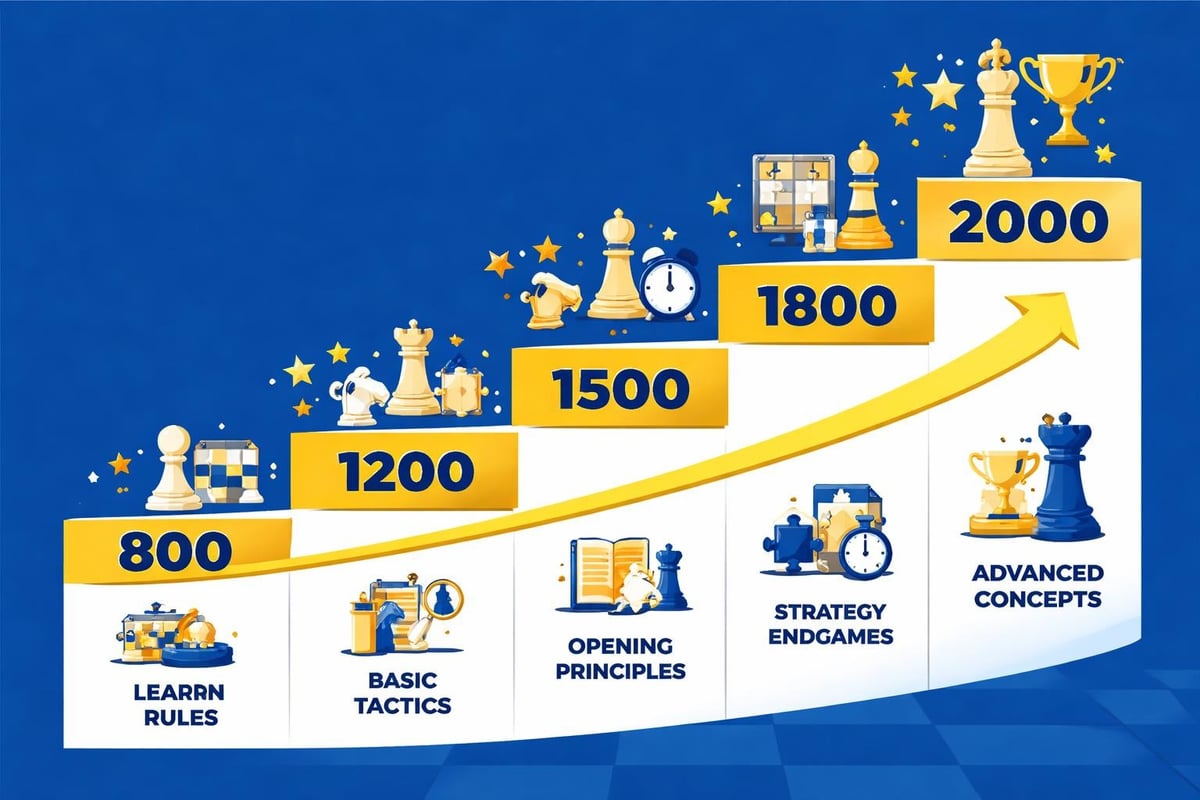
Before each game, the system calculates your expected score-essentially, your probability of winning. Against an equally rated opponent, you're expected to score 0.5 points (50% chance). Against someone 200 points higher, you're expected to score about 0.24 points (24% chance of winning).
Performance ratings take this concept further by measuring your actual results against a field of opponents and calculating what rating would produce those results. This is particularly useful in tournaments where you face multiple opponents of varying strengths.
What Your Rating Reveals About Your Play
Your chess rating isn't just a trophy number to display-it's a diagnostic tool that reveals specific strengths and weaknesses in your game. Players at different rating levels share common characteristics and face predictable challenges.
Beginner Level (Under 1200)
At this stage, games are typically decided by tactical blunders rather than strategic superiority. You're still learning fundamental principles like piece development, king safety, and basic tactical patterns. The focus should be on reducing mistakes rather than executing brilliant plans.
Common areas for improvement:
- Avoiding one-move blunders and hanging pieces
- Completing development before launching attacks
- Recognizing basic tactical motifs (forks, pins, skewers)
- Understanding fundamental endgames
Resources like opening puzzles can help you recognize common patterns and avoid early-game disasters that derail your position before the middlegame even begins.
Intermediate Level (1200-1800)
You've mastered the basics and rarely hang pieces outright. Games are decided by who better understands positional principles and can execute multi-move tactical sequences. Your opening knowledge is growing, and you're developing a repertoire.
This is where structured learning accelerates progress. Understanding comprehensive chess resources helps you build a solid foundation rather than collecting random facts.
Key skills to develop:
- Calculating forcing variations accurately
- Recognizing positional imbalances
- Developing a coherent opening repertoire
- Converting advantages in the endgame
Advanced Level (1800+)
At this level, you're playing genuinely strong chess. Mistakes are subtle-slight inaccuracies in move order, missing the most precise continuation, or misassessing complex positions. Continuing to improve requires focused study and objective analysis of your games.

Using Your Rating to Improve Strategically
Your chess rating isn't just a measure of where you are-it's a compass pointing toward where you need to go. Smart players use their rating to guide their study decisions and practice choices.
Setting Realistic Rating Goals
Breaking through to the next rating level requires different skills at different stages. A player stuck at 1400 needs different study material than someone plateaued at 1800. The best websites to learn chess can help you find resources matched to your current level.
Effective goal-setting approach:
- Aim for 100-point increases rather than unrealistic jumps
- Focus on addressing your weakest area first
- Track your progress monthly, not daily
- Celebrate consistency, not just rating peaks
Rating-Based Training Strategies
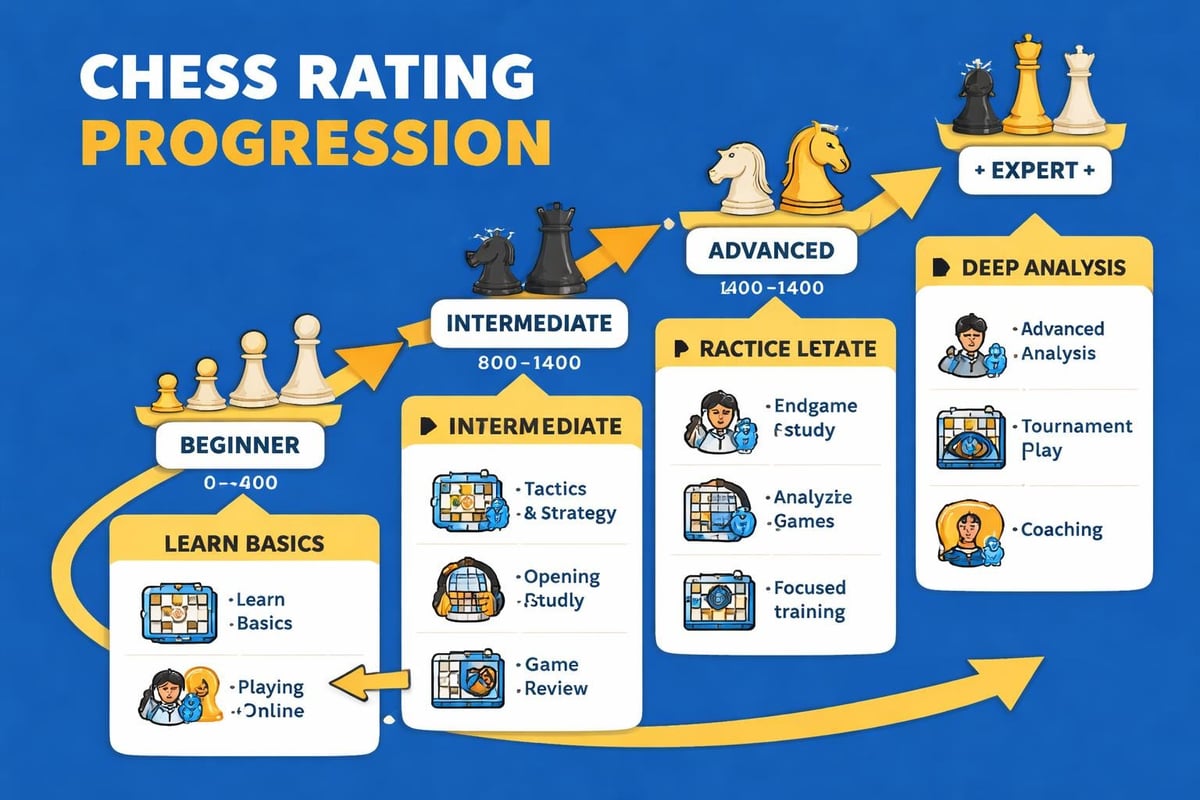
Your training should evolve with your rating. Beginners benefit from basic tactics trainers and simplified positions. Intermediate players need opening repertoires and strategic understanding. Advanced players require deep analysis and specialized study.
| Current Rating | Priority Focus | Training Method |
|---|---|---|
| Under 1200 | Tactics and piece safety | Daily tactical puzzles, basic endgames |
| 1200-1600 | Opening principles and planning | Structured openings, annotated games |
| 1600-2000 | Calculation and evaluation | Complex tactics, strategic themes |
| 2000+ | Deep preparation and refinement | Engine analysis, specialized study |
Rating Myths and Misconceptions
Let's clear up some common misunderstandings that might be holding you back. The internet is full of contradictory advice about ratings, and separating fact from fiction saves you time and frustration.
"Online Ratings Don't Matter"
Whilst it's true that online and over-the-board ratings use different player pools, online ratings absolutely matter for tracking improvement and measuring your current strength. The principles of how chess ratings work remain consistent whether you're playing on a physical board or a digital one.
Online chess offers immediate feedback, abundant opponents at any hour, and detailed statistics that over-the-board play can't match. Your online rating might differ numerically from your FIDE rating, but both measure the same underlying skill.
"Rating Inflation Makes Modern Ratings Meaningless"
Some argue that ratings have inflated over time, making today's 2000 player weaker than historical 2000-rated players. Systems like Chessmetrics attempt to create historically comparable ratings, but for practical purposes, you should focus on your improvement relative to current players.
The Universal Rating System represents a modern approach to combining different time controls into comprehensive player assessments, acknowledging that chess strength isn't one-dimensional.
"You Need to Study Openings to Improve Your Rating"
Here's a nuanced truth: opening study alone won't dramatically raise your rating, but playing better openings absolutely helps. The difference is understanding versus memorizing. Simply memorizing moves from the Italian Game won't help if you don't understand the resulting positions.
Effective opening study should:
- Build on strategic principles you already understand
- Lead to middlegame positions that suit your style
- Avoid early tactical disasters that cost games
- Provide consistent, playable positions without excessive memorization
Practical Steps to Raise Your Chess Rating
Understanding rating systems is useful, but you're probably wondering how to actually improve that number next to your name. Let's get specific about actionable steps that work at every level.
Analyze Your Losses Systematically
Every lost game contains lessons, but only if you extract them properly. Don't just glance at where you went wrong-dig deeper to understand why your thinking process failed.
Effective loss analysis method:
- Identify the critical moment where the game turned
- Understand what you missed or miscalculated
- Determine if it's a pattern you've seen before
- Practice similar positions until the pattern becomes automatic
The endgame expertise collection can help you shore up weaknesses in the phase where many games are decided but few players study systematically.
Play Longer Time Controls
Blitz chess is fun, but it won't raise your classical rating as effectively as thoughtful, slower games. When you have time to calculate variations properly and consider multiple candidate moves, you develop the thinking patterns that translate to rating improvement.
Consider this progression:
- Rapid (15+10): Good for applying new concepts without exhausting time
- Classical (30+0 or longer): Essential for developing calculation accuracy
- Correspondence: Excellent for understanding positions deeply
Balance Study and Practice
You can't think your way to a higher rating-you need to play games. But you also can't blindly play thousands of games expecting automatic improvement. The optimal ratio varies by player, but most benefit from roughly 70% playing and 30% studying.
Your study time should address specific weaknesses revealed in your games. Lost to a Scandinavian Defense because you didn't know the main ideas? Study it specifically, then test your knowledge in real games.
Time Controls and Multiple Ratings
Modern chess players don't have a single rating-they have several, each reflecting performance at different time controls. Understanding how these relate helps you develop a complete chess skillset.
Classical, Rapid, and Blitz Ratings
Your classical rating typically represents your "truest" chess strength because it gives you time to think deeply. Rapid ratings tend to run 100-200 points higher on most platforms, whilst blitz ratings vary more widely based on your tactical speed and time management skills.
Typical rating relationships:
- Classical: Your baseline rating
- Rapid: Usually 50-150 points higher
- Blitz: Highly variable, often 100-300 points above classical
- Bullet: Reflects mouse speed as much as chess skill
Which Time Control Should You Prioritize?
If you're serious about improvement, prioritize longer time controls for at least 50% of your games. The thinking habits you develop in classical games transfer to faster formats, but blitz habits often create problems in slower games when you have time to overthink.
That said, faster games have value for:
- Testing opening preparation quickly
- Maintaining pattern recognition sharpness
- Having fun and staying motivated
- Playing when you have limited time
How to Handle Rating Anxiety
Let's address something rarely discussed in chess improvement guides: the psychological pressure that ratings create. That number becomes part of your identity, and watching it drop can feel devastating.
The Temporary Setback Mindset
Rating drops are inevitable. Everyone experiences them, from beginners to super-grandmasters. The difference between players who push through and those who quit often comes down to mindset, not talent.
When your rating drops:
- Remember it's temporary: Ratings fluctuate naturally around your true strength
- Avoid tilt-playing: Taking a break is better than playing frustrated
- Review objectively: Learn from losses without emotional attachment
- Trust the process: Focus on playing good chess, not protecting your rating
Playing "Rating-Appropriate" Opponents
Some players only want to face lower-rated opponents to protect their rating. This is counterproductive. You improve fastest by playing opponents slightly stronger than you-people who exploit your weaknesses and force you to raise your game.
Optimal opponent selection:
- 30% against lower-rated players (to practice converting advantages)
- 40% against similarly rated players (balanced competition)
- 30% against higher-rated players (stretch yourself and learn)
Understanding your chess rating transforms it from a mysterious number into a useful tool for measuring progress and guiding your improvement journey. Whether you're trying to break through your first rating barrier or pushing toward expert level, the principles remain the same: play thoughtful chess, learn from your mistakes, and focus on continuous improvement rather than short-term rating fluctuations. Ready to take your game to the next level? Chess Cheat Sheets offers streamlined guides, comprehensive puzzle collections, and practical resources designed specifically for players looking to improve efficiently without getting lost in endless study material.


