

You've probably experienced that moment in a game where you just couldn't see the winning move. It was right there on the board, but your brain simply didn't register the pattern. This happens to every chess player, and it's exactly why chess puzzle books have remained one of the most effective training tools for over a century. Unlike passive learning methods, puzzle books force you to actively search for solutions, building the tactical muscle memory that separates strong players from weak ones.
Why Chess Puzzle Books Still Matter in 2026
With countless digital platforms and AI-powered training apps available today, you might wonder whether physical puzzle books still have a place in your chess education. The answer is absolutely yes, and here's why.
When you work through puzzles on paper, you're eliminating the temptation to click through solutions prematurely or rely on hints. This builds genuine problem-solving resilience. Chess puzzle books create a focused environment where you can't accidentally hover over the answer or get distracted by notifications.
Research shows that handwritten notes and physical interaction with problems improve retention by up to 34% compared to digital-only learning. When you mark up a puzzle book, circle key squares, or draw arrows showing piece movement, you're engaging multiple learning pathways simultaneously.
The Cognitive Benefits You're Actually Getting
- Pattern recognition speed increases dramatically with regular puzzle practice
- Calculation depth improves as you work through complex tactical sequences
- Board vision expands when you regularly search for hidden combinations
- Time management skills develop as you learn to spot tactical themes quickly
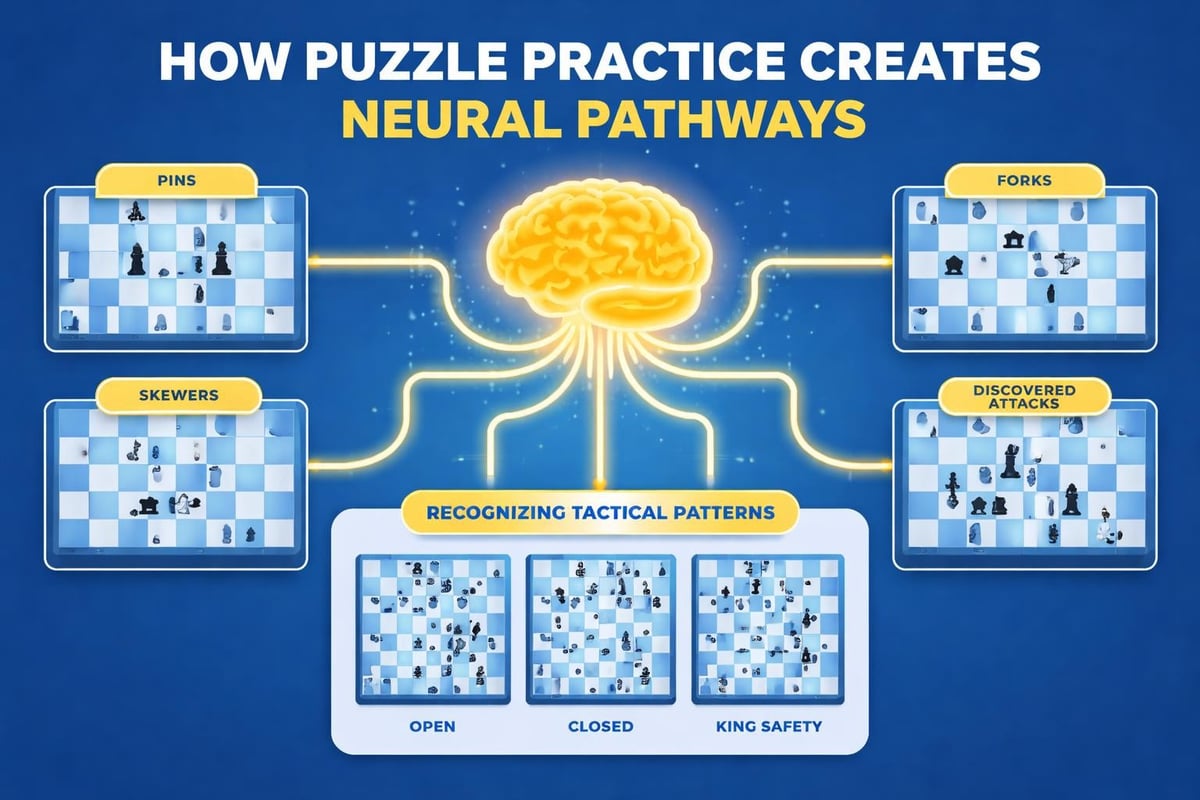
Modern neuroscience confirms what chess masters have known intuitively: tactical training through puzzles creates lasting neural pathways. You're not just memorizing positions; you're rewiring your brain to recognize opportunities faster.
Choosing the Right Puzzle Book for Your Level
Not all chess puzzle books are created equal, and selecting one that matches your current strength is crucial. Too easy, and you're wasting time on patterns you've already mastered. Too difficult, and you'll become frustrated and abandon the practice altogether.
Beginner players (rated below 1200) should focus on single-theme tactical books. These collections group similar patterns together, allowing you to recognize forks, pins, and skewers systematically. The World's Easiest Chess Puzzle Book offers an excellent starting point, with clear diagrams and straightforward solutions.
Intermediate players (1200-1800) benefit from mixed tactical problems that combine multiple themes. You need to identify both what type of tactic exists and how to execute it properly. At this stage, books like John Nunn's Chess Puzzle Book provide exactly the right challenge level.
| Skill Level | Puzzle Complexity | Recommended Focus | Daily Practice Time |
|---|---|---|---|
| Beginner (Under 1200) | 1-2 move combinations | Single-theme patterns | 15-20 minutes |
| Intermediate (1200-1800) | 3-4 move sequences | Mixed tactical themes | 20-30 minutes |
| Advanced (1800+) | 5+ move combinations | Strategic puzzles | 30-45 minutes |
If you're working on specific openings, combining tactical training with opening-specific puzzles creates powerful synergy. The 1.5 million chess openings puzzles pack from Chess Cheat Sheets allows you to practice tactics that emerge from your actual repertoire.

Strategic vs Tactical Puzzle Books
Here's something many players don't realize: there's a fundamental difference between tactical and strategic puzzle books, and you need both for complete chess development.
Tactical puzzles focus on immediate, forcing sequences. You're looking for checks, captures, and threats that lead to material gain or checkmate. These are the exciting, satisfying puzzles where you spot the brilliant sacrifice or the crushing combination.
Strategic puzzles, on the other hand, ask different questions. Which piece should you improve? Where should your knight be placed? How do you create long-term weaknesses in your opponent's position? 400 Chess Strategy Puzzles by Martyn Kravtsiv specifically addresses this often-neglected aspect of puzzle training.
What Each Type Develops
Tactical puzzle books strengthen:
- Immediate threat recognition
- Forcing move calculation
- Combination visualization
- Defensive resource finding
Strategic puzzle books improve:
- Positional judgment
- Long-term planning
- Piece coordination
- Pawn structure understanding
Most players over-emphasize tactics because they're more immediately gratifying. You see a fork, you win a piece, you feel smart. Strategic improvement is subtler but equally important, especially as you advance beyond intermediate level.
How to Actually Use Chess Puzzle Books Effectively
Simply buying a puzzle book and working through it randomly won't maximize your improvement. You need a systematic approach that builds on each session's learning.
Start by setting realistic daily targets. Fifteen minutes of focused puzzle work beats an hour of distracted scrolling through positions. Consistency matters more than volume when you're building pattern recognition.
When you encounter a puzzle, give yourself a genuine thinking period before looking at the solution. This isn't about pride; it's about training your brain to search systematically. Set a timer for 5-10 minutes per puzzle initially, adjusting based on difficulty.
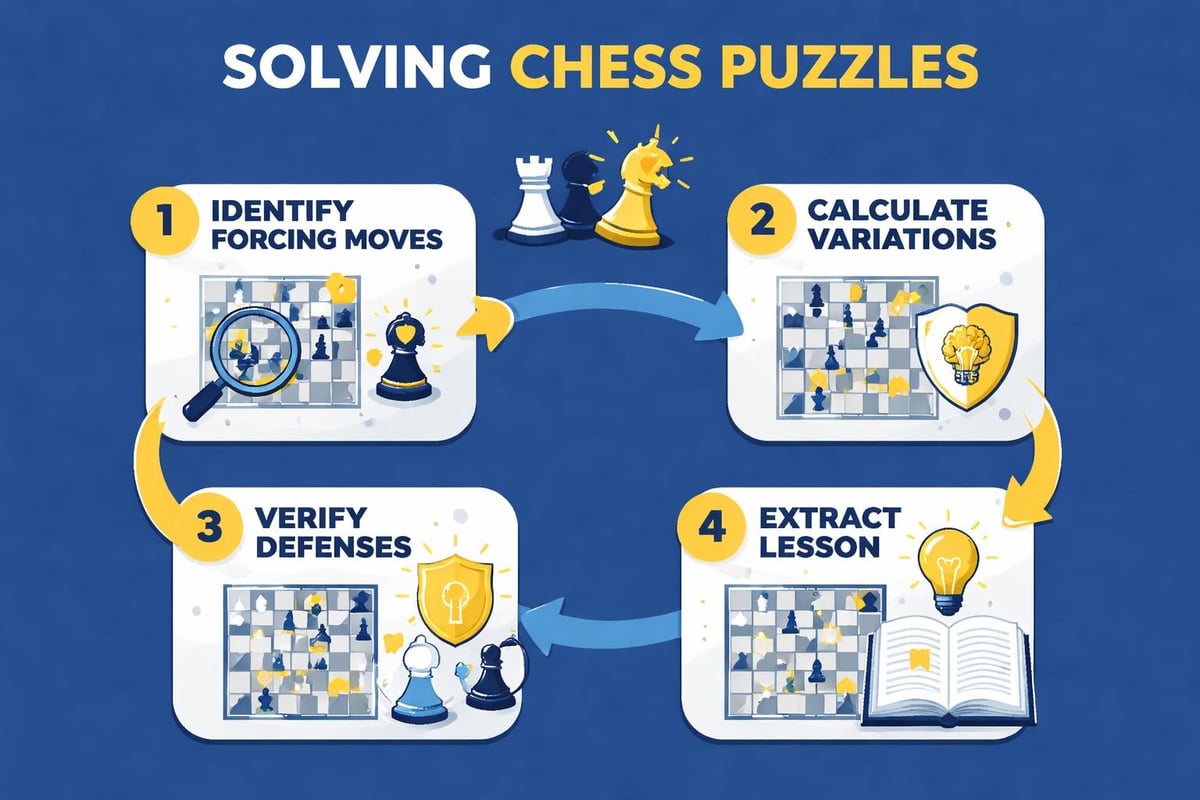
The Four-Step Solution Process
- Identify forcing moves: Look for checks, captures, and threats first
- Calculate candidate moves: Work through the top 2-3 options deeply
- Verify the solution: Ensure you've seen all opponent defenses
- Review the lesson: What pattern or theme did this puzzle teach?
If you solve the puzzle correctly, mark it with a tick. If you get it wrong, mark it differently and return to it in a week. This spaced repetition approach, proven effective across all learning domains, ensures patterns stick in your long-term memory.
Top Features to Look for in Quality Puzzle Books
Not every chess puzzle book deserves shelf space in your training library. Quality varies enormously, and knowing what separates excellent collections from mediocre ones saves you money and frustration.
Clear diagram quality is non-negotiable. You shouldn't squint to determine whether a piece is a knight or a bishop. Professional publishing standards matter, especially if you're working through hundreds of positions.
Accurate solutions sound obvious, but you'd be surprised how many puzzle books contain errors. Established authors and reputable publishers generally maintain higher quality control. The Giant Chess Puzzle Book by Zenon Franco is known for its thorough verification process.
Progressive difficulty structuring helps maintain motivation. The best books start manageable and gradually increase complexity, allowing you to build confidence while stretching your abilities.
Essential Quality Indicators
- Detailed explanations beyond just listing moves
- Alternative variations showing what happens if you go wrong
- Thematic organization for targeted pattern training
- Difficulty ratings so you know what you're attempting
- Index by tactical theme allowing focused study sessions
Books that explain why a solution works, not just what moves execute it, provide deeper learning. Understanding the underlying principles allows you to apply patterns to novel positions.
Integrating Puzzle Practice with Your Overall Training
Chess puzzle books shouldn't exist in isolation from the rest of your chess education. The most effective improvement comes when you weave tactical training into a comprehensive development plan.
If you're studying best openings for black, for instance, look for puzzle books featuring positions from those openings. This creates powerful reinforcement loops where theoretical knowledge and tactical awareness support each other.
Many players separate their opening study from tactical training, but this misses a crucial connection. When you understand the typical tactical patterns in your openings, you play them more confidently and accurately. The Sicilian Defense guide becomes far more useful when combined with Sicilian-specific tactical exercises.
| Training Component | Weekly Time | Integration Strategy |
|---|---|---|
| Puzzle books | 90-120 minutes | Focus on patterns from your openings |
| Opening study | 60-90 minutes | Note tactical themes that arise |
| Game analysis | 60 minutes | Compare missed tactics to puzzle patterns |
| Endgame training | 45-60 minutes | Practice tactical endgame positions |
Consider keeping a training journal where you note patterns you're struggling with. If you consistently miss knight forks, you know where to focus your puzzle selection.
Digital Supplements to Physical Puzzle Books
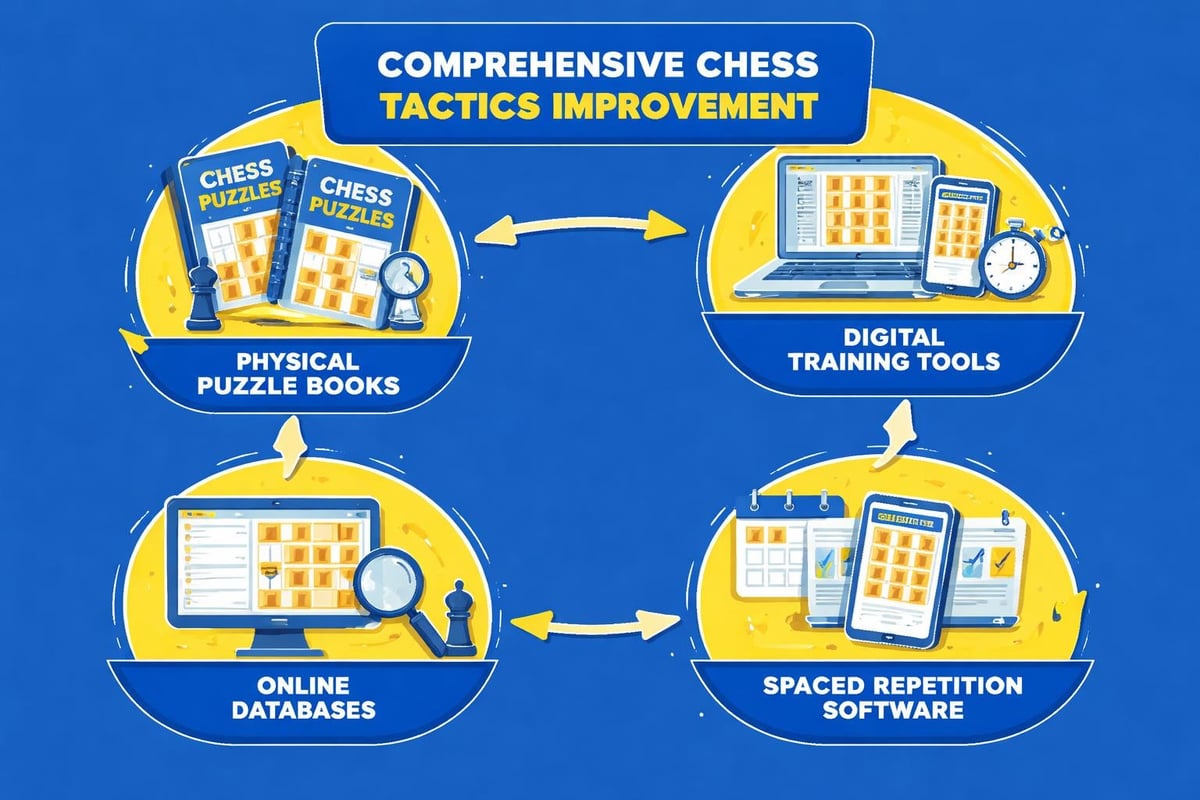
While we've emphasized the benefits of physical books, combining them with digital resources creates the most powerful training environment. This isn't about replacing books; it's about strategic enhancement.
Use online databases to verify solutions when you're uncertain about variations. Sometimes a puzzle book's answer feels wrong, and checking with an engine confirms your intuition or reveals why the book solution works.
Digital spaced repetition systems can track which puzzles you've mastered and which need review. Input positions you found particularly instructive into training software for automated review scheduling.
Many players find success alternating between physical puzzle work in the morning and digital tactical trainers in the evening. The variety prevents mental fatigue while reinforcing the same patterns through different mediums.
Classic Puzzle Books That Stand the Test of Time
Some chess puzzle books have remained relevant for decades, continuously helping new generations of players improve. These classics earn their status through thoughtful position selection and instructive content.
Bobby Fischer Teaches Chess pioneered the programmed learning approach in chess education. Though published in 1966, its systematic method of building pattern recognition remains effective sixty years later. The book doesn't just show you tactics; it trains you to find them independently.
Understanding what chess puzzles are in the broader context of chess literature helps you appreciate why certain collections achieve classic status. They typically share common characteristics: carefully vetted positions, progressive difficulty, and positions that teach transferable patterns rather than obscure tricks.
The Ultimate Chess Puzzle Book by John Emms represents modern puzzle collection at its best. With 1001 positions covering all major tactical themes, it provides years of training material in a single volume.
What Makes a Puzzle Book a Classic
- Timeless positions that remain instructive regardless of theoretical fashions
- Clear pedagogical structure that builds skills systematically
- Positions from real games rather than artificial constructions
- Appropriate difficulty curve that challenges without overwhelming
When building your puzzle book library, starting with proven classics ensures you're learning from positions that have helped thousands of players before you.
Specialized Puzzle Collections for Specific Improvement
Beyond general tactical training, specialized puzzle books target specific aspects of chess skill. These focused collections accelerate improvement in particular areas where you might be struggling.
Endgame puzzle books concentrate on the technical phase where precision matters most. Unlike middlegame tactics that involve multiple pieces, endgame puzzles often revolve around exact move orders and zugzwang positions. The Endgame Expertise Collection provides comprehensive training in this critical phase.
Defensive puzzle books flip the script, asking you to find the best defense rather than the winning attack. This develops a crucial skill most players neglect: calculating your opponent's threats before they occur.
Opening-specific puzzle collections help you understand tactical patterns in your repertoire. If you play the Caro-Kann, for instance, working through 1000 Caro-Kann Defense puzzles builds intuitive understanding of the positions you'll actually face.
Specialized Categories Worth Exploring
- Checkmate pattern collections
- Positional sacrifice puzzles
- Pawn breakthrough exercises
- Piece coordination problems
- Prophylaxis and prevention puzzles
Rotating through different specialized collections prevents training monotony while ensuring balanced skill development.
Building Your Personal Puzzle Book Library
You don't need dozens of puzzle books cluttering your shelves. A carefully curated collection of 4-6 high-quality books serves you better than 20 mediocre ones gathering dust.
Start with one comprehensive general tactics book matching your level. This forms your foundation. Add one strategic puzzle collection to balance your tactical focus. Then include one or two opening-specific books for your main repertoire.
Budget allocation matters. High-quality puzzle books typically cost £15-25, and they provide thousands of hours of training value. Compare this to a single session with a chess coach, and puzzle books represent exceptional value.
Consider books' physical quality when building your library. Wire-bound books lay flat on your board, making them easier to use during solo training sessions. Hardcover books survive years of repeated use better than paperbacks.
Many players benefit from having both a "main" puzzle book they're working through systematically and a "browsing" book for casual sessions. The best chess puzzle books serve different purposes in your training ecosystem.
Common Mistakes When Working with Puzzle Books
Even experienced players sabotage their puzzle training through common errors. Avoiding these pitfalls accelerates your improvement significantly.
Moving pieces on the board is the biggest training mistake. Puzzle books develop visualization and calculation skills. If you physically move pieces to check variations, you're not training the mental skills that matter during actual games. Force yourself to calculate in your head, no matter how uncomfortable initially.
Looking at solutions too quickly robs you of the struggle that creates learning. Your brain grows strongest when wrestling with difficult problems, not when passively consuming answers. Set a minimum thinking time before allowing yourself to check the solution.
Skipping difficult puzzles creates gaps in your pattern library. The positions you find hardest are often exactly where you need the most work. Mark challenging puzzles and return to them rather than avoiding them.
Training Pitfalls to Avoid
- Doing puzzles while distracted by phones or television
- Focusing only on tactics you already understand
- Neglecting to review incorrect solutions
- Working through books too quickly without retention
- Ignoring the explanations and just checking moves
Remember that quality always trumps quantity. Twenty deeply understood puzzles teach more than a hundred positions you rushed through without genuine comprehension.
Tracking Your Puzzle Training Progress
Measuring improvement keeps you motivated and reveals which areas need additional focus. Simple tracking methods provide valuable insights without requiring complex systems.
Create a basic spreadsheet or notebook tracking dates, positions attempted, success rate, and patterns you struggled with. Over weeks and months, you'll see definite trends emerging.
Success rate monitoring tells you when you've outgrown a puzzle book. If you're solving 90%+ of positions correctly on first attempt, you need a more challenging collection. Conversely, below 30% suggests you've jumped to difficulty too advanced for current skills.
Many players find that combining puzzle book work with online tactical rating tracking provides motivation. As your puzzle-solving ability improves, your online tactical rating should increase correspondingly, validating your training approach.
The correlation between puzzle training and over-the-board performance isn't immediate. Expect a 2-3 month lag before consistent puzzle work translates into improved game results. Trust the process during this development period.
How Puzzle Books Complement Other Training Resources
Your chess improvement journey benefits from multiple training approaches working in concert. Puzzle books form one pillar of comprehensive development alongside other critical resources.
While puzzle books excel at tactical pattern training, they can't replace studying complete games or working with quality opening materials. The Italian Game guide teaches strategic concepts that tactical puzzles alone cannot convey.
Think of your training ecosystem as a balanced diet. Puzzles provide tactical protein, opening study offers strategic carbohydrates, endgame training supplies technical vitamins, and game analysis delivers practical minerals. Each component plays a distinct role in your chess nutrition.
Free resources like chess books in PDF format supplement your core training materials, offering additional perspective without financial investment. However, quality commercial puzzle books typically offer better organization and instruction than free alternatives.
The comprehensive chess resources available in 2026 mean you can customize your training precisely to your needs, combining puzzle books with video lessons, databases, and interactive training platforms.
Chess puzzle books remain one of the most efficient and effective training tools available, developing the pattern recognition and tactical awareness that form the foundation of chess mastery. Whether you're just learning the basics or pushing toward expert level, systematic puzzle practice accelerates your improvement in ways that passive learning simply cannot match. Chess Cheat Sheets complements your puzzle training with streamlined opening guides, position-specific puzzle collections, and endgame resources that work together to build complete chess understanding without overwhelming you with unnecessary theory. Start building your training library today and experience the confidence that comes from genuine tactical strength.


