

You've probably noticed that chess openings can feel overwhelming, haven't you? There are hundreds of variations, countless move orders, and seemingly endless theory to memorize. That's exactly why a chess openings pdf has become such a valuable resource for players at every level. Whether you're just starting out or looking to refine your repertoire, having structured opening knowledge at your fingertips makes all the difference. In 2026, PDF resources continue to offer the perfect blend of accessibility, portability, and comprehensive coverage that chess players need to improve quickly.

Why Chess Openings PDFs Remain Essential in 2026
Let me ask you something: when was the last time you sat down with a physical chess book and actually felt comfortable carrying it everywhere? Probably never, right?
That's the beauty of digital resources. A chess openings pdf gives you instant access to opening theory without the weight, cost, or storage issues of traditional books. You can study on your phone during your commute, review variations on your tablet between games, or print specific sections when you want to annotate by hand.
The real advantage goes deeper than convenience, though. PDF resources allow you to:
- Search instantly for specific positions or move sequences
- Bookmark critical variations you want to review regularly
- Highlight key concepts without damaging expensive books
- Organize multiple opening systems in a single digital library
- Update your knowledge as new theory emerges
Think about how your study sessions typically go. You're reviewing a variation, need to check a sideline, and suddenly you're flipping through pages trying to find that one diagram you saw earlier. With a well-organized chess openings pdf, that same process takes seconds instead of minutes.
Finding Quality Chess Opening PDF Resources
Not all PDF resources are created equal, are they? You've probably downloaded a few that looked promising but turned out to be poorly formatted, outdated, or just plain confusing.
Historical and Classical Resources
Some of the most valuable opening materials come from classical chess literature that's now available in digitized formats. Henry Edward Bird's "The Chess Openings" from 1880 offers fascinating historical perspective on how opening theory developed. While you wouldn't use it as your primary study resource in 2026, understanding the evolution of opening ideas gives you deeper insight into why certain moves work.
The chess opening book concept has evolved dramatically over the past century, but the fundamental goal remains the same: giving players reliable move sequences that lead to playable positions.
Modern Digital Collections
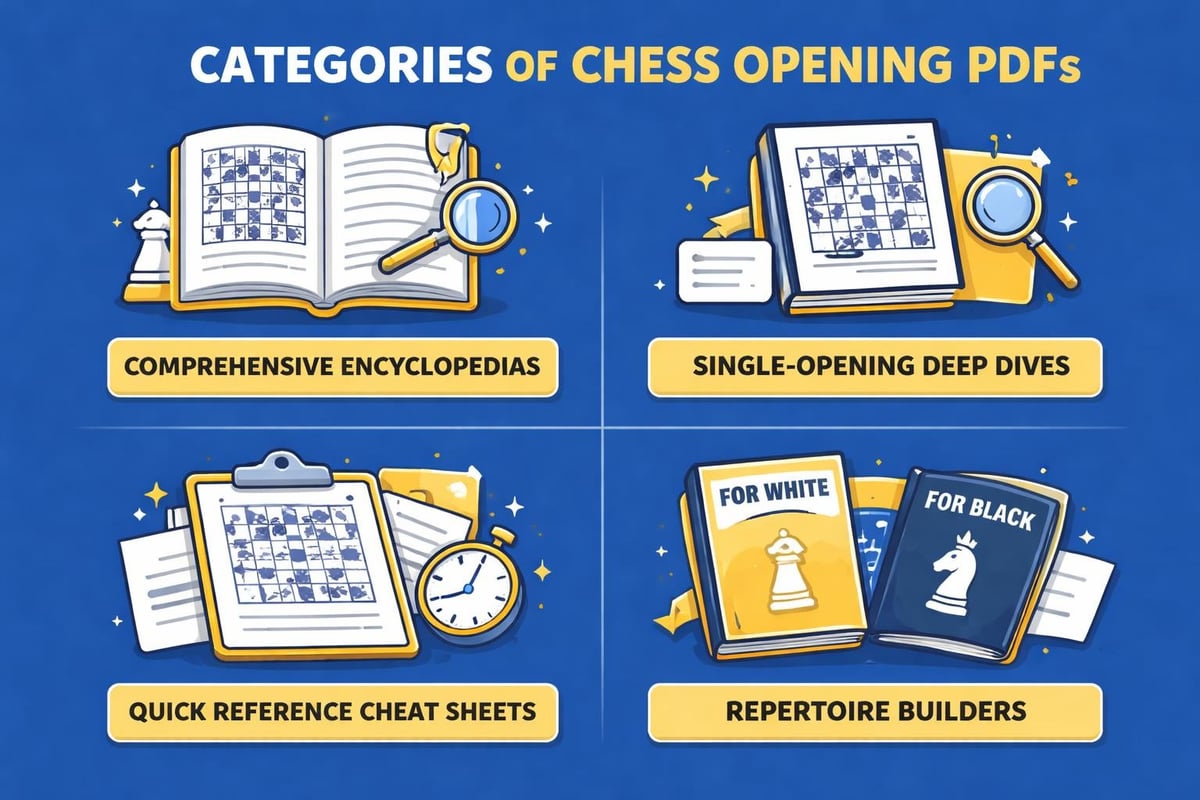
Today's chess openings pdf resources fall into several categories:
| Type | Best For | Typical Length |
|---|---|---|
| Complete Repertoires | Building your entire opening system | 100-300 pages |
| Single Opening Guides | Deep diving into one specific opening | 30-80 pages |
| Quick Reference Sheets | Tournament preparation and rapid review | 5-15 pages |
| Puzzle Collections | Practicing tactical patterns from openings | 50-200 pages |
You'll want different types for different purposes. A comprehensive repertoire guide serves as your foundation, while quick reference materials help with last-minute preparation before games.
What Makes a Chess Openings PDF Actually Useful
Here's what separates genuinely helpful resources from time-wasters: practical organization and actionable content.
Essential Features to Look For
When you're evaluating any chess openings pdf, ask yourself these questions:
Does it explain the ideas behind the moves? Simply listing move sequences without context is like giving someone a recipe without explaining why ingredients work together. You need to understand why 1.e4 controls the centre and develops pieces, not just that it's a popular first move.
Are the diagrams clear and frequent? Nothing kills your study momentum faster than trying to visualize a position eight moves deep without a diagram. Quality resources include visual aids every few moves, especially at critical junctures.
Does it address typical mistakes? Learning what not to do is often more valuable than memorizing perfect lines. The best opening PDFs highlight common errors and explain why they fail.
If you're exploring resources for Black's repertoire, you'll want materials that cover the best openings for black against various White systems.
Structure and Navigation
Think about how you actually use reference materials. You don't read them cover to cover like novels, do you? You jump to specific sections, cross-reference variations, and return to key positions repeatedly.
A well-designed chess openings pdf should include:
- Clickable table of contents with links to each section
- Consistent formatting that makes scanning easy
- Clear variation trees showing how lines branch
- Summary sections at chapter ends for quick review
- Index of positions by ECO code or opening name
Building Your Opening Repertoire with PDF Resources
You can't possibly learn every opening, can you? That's why building a focused repertoire matters so much.
Starting with a Solid Foundation
Most improving players benefit from choosing one main opening as White and one or two solid defenses as Black. Your chess openings pdf collection should reflect this focused approach rather than trying to cover everything superficially.
For White, you might choose:
- 1.e4 systems - Leading to open, tactical games
- 1.d4 systems - Creating closed, strategic positions
- Flank openings - Such as the Zukertort Opening for flexibility
For Black against 1.e4:
- Solid defenses - French, Caro-Kann, Scandinavian
- Sharp counters - Sicilian variations, Alekhine's Defense
- Classical systems - Italian Game responses, Ruy Lopez
Against 1.d4, you might focus on the King's Indian, Nimzo-Indian, or Queen's Gambit Declined.
Using PDFs for Structured Study
Here's a practical weekly study routine using chess openings pdf materials:
Monday & Tuesday: Study new variations from your main repertoire PDF (30-45 minutes each day). Focus on understanding the key ideas rather than memorizing moves.
Wednesday: Review previously learned lines. Test yourself by setting up positions and trying to recall the correct continuation before checking the PDF.
Thursday & Friday: Work through chess opening puzzles that arise from your chosen openings. This reinforces patterns you'll see in actual games.
Weekend: Play games using your repertoire, then review your opening choices against your PDF resources. Where did you deviate? Were those deviations improvements or mistakes?
Converting Chess Opening Knowledge into Results
Let's be honest: you don't study openings for fun alone, do you? You want to win more games.
From Theory to Practice
The gap between knowing opening theory and actually using it effectively trips up countless players. You might have studied a chess openings pdf thoroughly, but that doesn't automatically translate to board success.
Here's what bridges that gap:
- Pattern recognition through repeated exposure to typical positions
- Understanding critical moments where one inaccuracy changes the evaluation
- Knowing typical middlegame plans that arise from your openings
- Recognizing when to deviate from book moves based on opponent weaknesses
Consider aggressive systems like those covered in guides on how to beat the Caro-Kann Defense as White. Simply knowing the moves isn't enough - you need to understand the attacking ideas and tactical motifs that make these systems effective.
Analyzing Your Opening Performance
Track which openings give you the best results. After twenty games with your new repertoire:
| Opening | Games Played | Win Rate | Comfort Level |
|---|---|---|---|
| Italian Game | 12 | 67% | High |
| King's Gambit | 5 | 40% | Medium |
| Caro-Kann | 8 | 75% | High |
This data tells you where to invest more study time and which systems genuinely suit your playing style.
Specialized Opening Systems Worth Exploring
Some openings require dedicated PDF resources because of their unique characteristics and rich theory.
Gambit Systems
Gambits like the King's Gambit demand special attention. These sacrifice-based openings can't be played casually - you need to know the compensation for your material and how to maintain attacking pressure.
A good chess openings pdf on gambits should explain:
- Material vs. development trade-offs in each variation
- Typical attacking patterns when the gambit succeeds
- Defensive resources for opponents who decline the gambit
- Transition strategies when the attack doesn't immediately succeed
Less Common but Effective Openings
Sometimes the best practical results come from systems your opponents don't expect. The Nimzowitsch-Larsen Attack exemplifies this approach - it's theoretically sound but catches opponents off guard because they face it rarely.
Your chess openings pdf library should include at least one or two surprise weapons you can deploy when you need to unbalance positions.
Combining Multiple Learning Resources
PDFs work best as part of a broader study ecosystem, don't they?
Integrating Different Material Types
Think of your learning resources as a toolkit:
- Comprehensive opening books provide the foundation
- Chess openings pdf quick guides offer portable reference
- Video courses explain concepts with dynamic visualization
- Puzzle collections drill tactical patterns
- Database study shows how top players handle your openings
Many players find success exploring free chess books pdf resources to supplement their core materials. This approach lets you test different teaching styles before investing in premium content.
Creating Your Personal Opening Encyclopedia
Here's a powerful technique: as you study various chess openings pdf resources, create your own condensed version. This might sound like extra work, but the process of deciding what's essential and what's secondary dramatically improves retention.
Your personal encyclopedia should include:
- Main line variations with key ideas annotated
- Critical positions where you need to know precise moves
- Typical mistakes you've made or seen others make
- Model games demonstrating ideal plans
- Your own game snippets showing both successes and failures

Maximizing the Value of Chess Opening PDFs
You've invested time finding and studying these resources - let's make sure you're getting full value from them.
Active Study Techniques
Passive reading doesn't work for chess material, does it? You can't just scan through a chess openings pdf like a novel and expect the information to stick.
Instead, try these active study methods:
The Reconstruction Method: Study a variation until you think you understand it, then close the PDF and try to recreate the line on a board. Check back to see where your memory failed or understanding wavered.
The Question Method: For each position in your chess openings pdf, ask yourself specific questions: What are White's main ideas here? What's Black trying to achieve? What happens if either side deviates? Writing down answers forces deeper processing.
The Teaching Method: Explain a variation from your PDF to another player or even to yourself out loud. If you can't articulate why moves make sense, you don't really understand them yet.
Organizing Your Digital Library
By 2026, you've probably accumulated dozens of PDF files, haven't you? Without organization, this treasure trove becomes useless clutter.
Create a folder structure like this:
Chess Openings/
├── White Repertoire/
│   ├── 1.e4/
│   ├── 1.d4/
│   └── Flank Openings/
├── Black Repertoire/
│   ├── vs 1.e4/
│   └── vs 1.d4/
├── Reference/
│   ├── Opening Encyclopedias/
│   └── Historical Works/
└── Specialty Topics/
    ├── Gambits/
    └── Rare Systems/
Name files descriptively: "Caro-Kann_Advance_Variation_Complete_2026.pdf" beats "chess_openings_2.pdf" every time.

Common Mistakes When Using Opening PDFs
Let me save you from some frustration I've seen countless players experience.
The Depth vs. Breadth Trap
You know what happens when you try to learn too many openings at once? You end up knowing the first five moves of twenty systems instead of deeply understanding two or three. Your chess openings pdf might cover fifteen different defenses to 1.e4, but that doesn't mean you should study all of them simultaneously.
Focus beats variety when building opening knowledge. Master one system completely before adding another to your repertoire.
The Memorization Fallacy
Here's a hard truth: you won't remember most of what you memorize from a chess openings pdf unless you understand the underlying concepts. Those players who seem to know endless theory? They're not necessarily memorizing more than you - they're understanding the logic that makes moves natural.
When you encounter a recommendation in your PDF, always ask "why?" before moving on. Why does White play Bg5 here instead of Nf3? Why does Black prefer ...e6 over ...e5 in this position?
Ignoring Transpositions
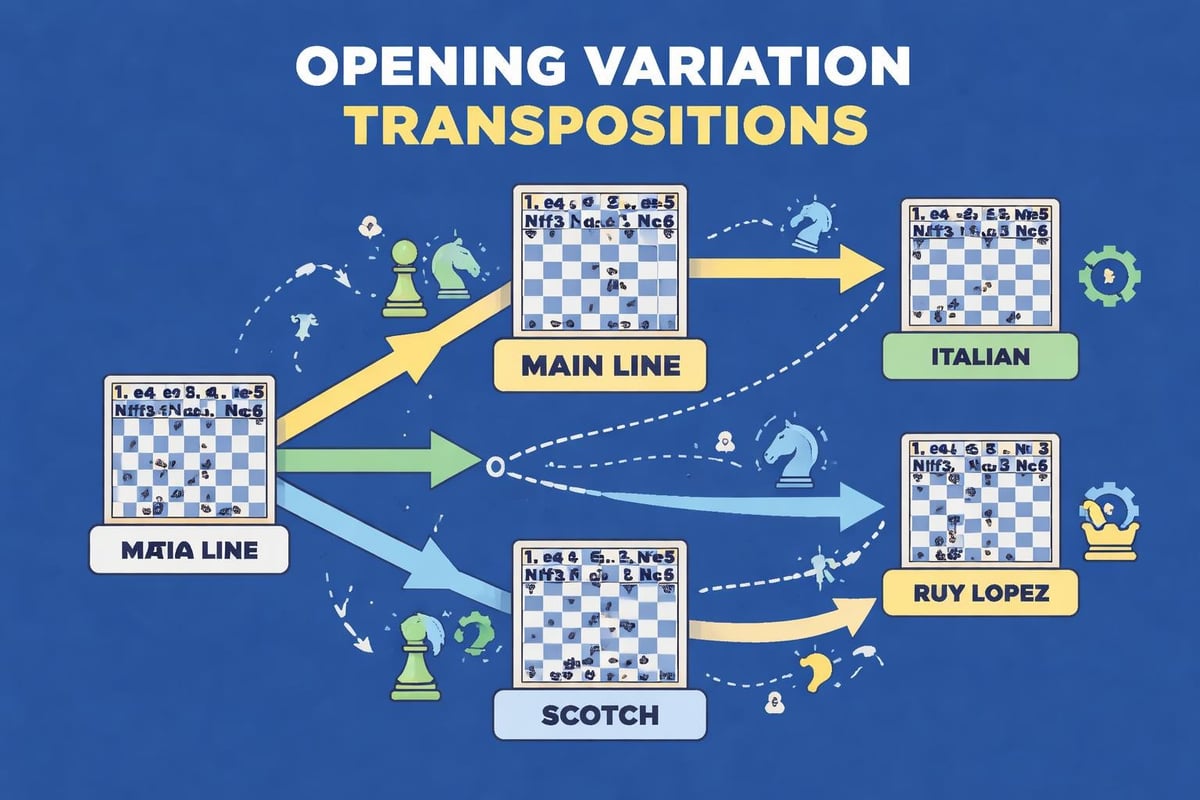
Opening theory is a web, not a tree. The same position often arises through different move orders, and your chess openings pdf might cover these transpositions separately or not at all.
Understanding transpositions helps you:
- Avoid preparation gaps where opponents reach your positions via unexpected routes
- Choose move orders that limit your opponent's options
- Connect different openings in your repertoire more efficiently
Staying Current with Opening Theory
Opening theory evolves constantly, doesn't it? A chess openings pdf from 2020 might contain lines that top players have already refuted or improved.
Following Theoretical Developments
You don't need to study every new game played by super-GMs, but you should be aware of major developments in your chosen openings. Subscribe to chess news sites, follow annotated games in your openings, and periodically check if updated PDFs are available for the systems you play.
Many opening specialists release updated editions of their chess openings pdf materials annually or biannually. Checking for updates ensures your repertoire stays sound.
Balancing Classical and Modern Resources
Historical works like those covered in Lasker's Manual of Chess offer timeless strategic wisdom, while modern PDFs provide current theory and computer-verified analysis. You benefit from both perspectives.
Classical resources excel at explaining fundamental principles. Modern materials show you how contemporary understanding has refined or sometimes overturned classical evaluations.
Making the Most of Your Opening Study Time
Time is your most valuable resource, isn't it? You probably can't spend hours daily studying openings like professional players do.
Efficient Study Schedules
Rather than marathon study sessions, consistent short sessions work better for retention. Twenty minutes daily with your chess openings pdf beats a three-hour weekend binge.
During those twenty minutes:
- First 5 minutes: Review previously studied material
- Next 10 minutes: Learn new variations or deepen existing knowledge
- Final 5 minutes: Quiz yourself on key positions
Prioritizing What Matters
Not every line in your chess openings pdf deserves equal attention. Focus your deepest study on:
- Main lines your opponents will most likely play
- Critical positions where evaluation changes drastically
- Tactical themes specific to your opening
- Common mistakes at your rating level
Obscure sidelines that appear once every hundred games? Skim them so you're not completely surprised, but don't invest serious memorization effort.
Beyond Basic Opening Knowledge
Once you've mastered fundamental opening principles using your chess openings pdf resources, where do you go next?
Developing Opening Intuition
Eventually, you want to reach a level where you don't need to consult your chess openings pdf during tournament preparation. You've internalized the ideas so thoroughly that you can handle new positions using opening principles rather than memorized sequences.
This intuition develops through:
- Playing hundreds of games in your chosen systems
- Analyzing master games in your openings
- Solving puzzles from typical positions
- Studying middlegame plans that arise from your openings
The resources available through chess education platforms can help bridge the gap between opening theory and practical middlegame understanding.
Expanding Your Repertoire Strategically
After solidifying your main openings, adding complementary systems makes sense. Your expanded chess openings pdf library should include both:
Backup systems for when you want to avoid your opponent's preparation in a critical game
Stylistic variety to develop different types of positions and improve your overall chess understanding
If you normally play solid positional openings, occasionally trying a gambit keeps your tactical skills sharp. If you typically choose sharp, theoretical lines, experimenting with quieter systems develops your strategic understanding.
Finding, organizing, and effectively using chess opening PDF resources transforms how quickly you can build a reliable repertoire and improve your practical results. The key lies not in collecting hundreds of PDFs, but in working deeply with a focused selection that matches your playing style and goals. Whether you're looking for comprehensive repertoire guides, quick reference materials, or specialized training on specific systems, Chess Cheat Sheets provides streamlined, practical resources designed to help you master openings efficiently without drowning in endless theory.


