

Have you ever felt that rush when you spot a clever trap in the opening, or the shock when you suddenly lose a piece in the blink of an eye? Chess opening traps make every game a thrilling battle of wits, and even the most seasoned players can fall victim to them in 2026.
In this article, you’ll discover seven of the sneakiest chess opening traps every player should know. You’ll learn the setups, spot the warning signs, and find out how to turn these traps to your advantage—or sidestep disaster.
Ready to boost your win rate and outsmart your opponents? Dive in, study these practical examples, and start mastering the art of chess opening traps today.

Why Chess Opening Traps Matter in 2026
Chess opening traps are more than just clever tricks, they are a fundamental part of the modern game. Have you ever wondered why even advanced players still fall into these pitfalls? In 2026, understanding the evolving landscape of chess opening traps is crucial for anyone who wants to win more games, avoid early disasters, and enjoy the thrill of outsmarting opponents.
The Evolution of Opening Traps in Modern Chess
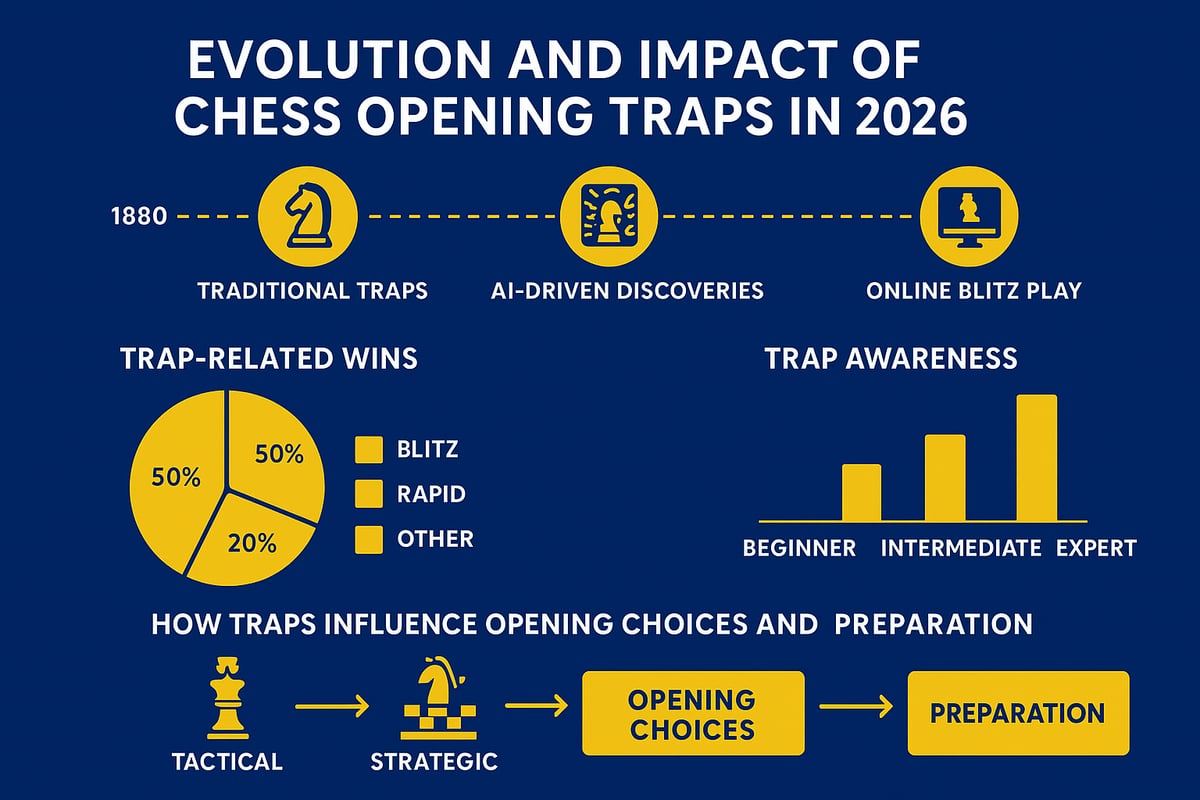
Chess opening traps have undergone a dramatic transformation in recent years. The rise of powerful chess engines and AI-driven analysis has brought never-before-seen depth to opening theory. As a result, traps that once lay dormant in dusty books are now revived, refined, and shared instantly across online communities.
Blitz and rapid chess formats, which dominate online platforms, have made chess opening traps even more frequent. According to recent data from major chess sites, a significant percentage of games under 10 minutes are often decided by traps in the first 15 moves. This rise is not just about tactics, it is also about gaining a psychological edge. When you spring a trap, you put your opponent on the back foot, forcing them to play catch-up right from the start.
Common Types of Chess Opening Traps
Not all chess opening traps are created equal. Some rely on sharp tactics, others on subtle strategy, and a few play on pure psychology. Tactical traps often involve forks, pins, or double attacks that can win material instantly. Strategic traps may lure your opponent into a bad pawn structure or awkward piece placement, while psychological traps tempt them with “free” pawns or seemingly safe moves.
Recent online tournaments show that even well-known traps still catch players off guard. For example, the classic Queen’s Gambit Declined traps appeared in high-level blitz events last year. If you want to see real-world move sequences and expert breakdowns, check out these famous chess opening traps, which highlight why these setups remain so effective.
The Importance of Trap Awareness for All Skill Levels
You might think chess opening traps only target beginners, but the truth is, players of all levels fall for them. Club players and even intermediates are frequently caught out, especially in time pressure. In fact, surveys from online chess communities show that games between players rated under 1500 are often decided by traps within the first 10 moves.
Learning to spot and set chess opening traps can dramatically improve your results. It is not just about catching your opponent, it is about avoiding embarrassment and frustration. Many players share stories of losing a winning position simply because they overlooked a trap, proving that awareness is your best defense.
How Traps Influence Opening Choices and Preparation
The presence of chess opening traps shapes the way players build their repertoires. Some choose sharp, tactical openings hoping to catch their opponents, while others prefer solid “anti-trap” lines to avoid early danger. Preparation is key, especially with so much information available online.
Players now study the latest trap trends and arm themselves with countermeasures before tournaments. In 2026, the smartest competitors use databases, cheat sheets, and even AI-generated suggestions to neutralize popular traps. This shift has led to a rise in solid systems that minimize risk, yet the allure of a well-timed trap keeps opening play as exciting as ever.
7 Sneaky Chess Opening Traps Every Player Should Know
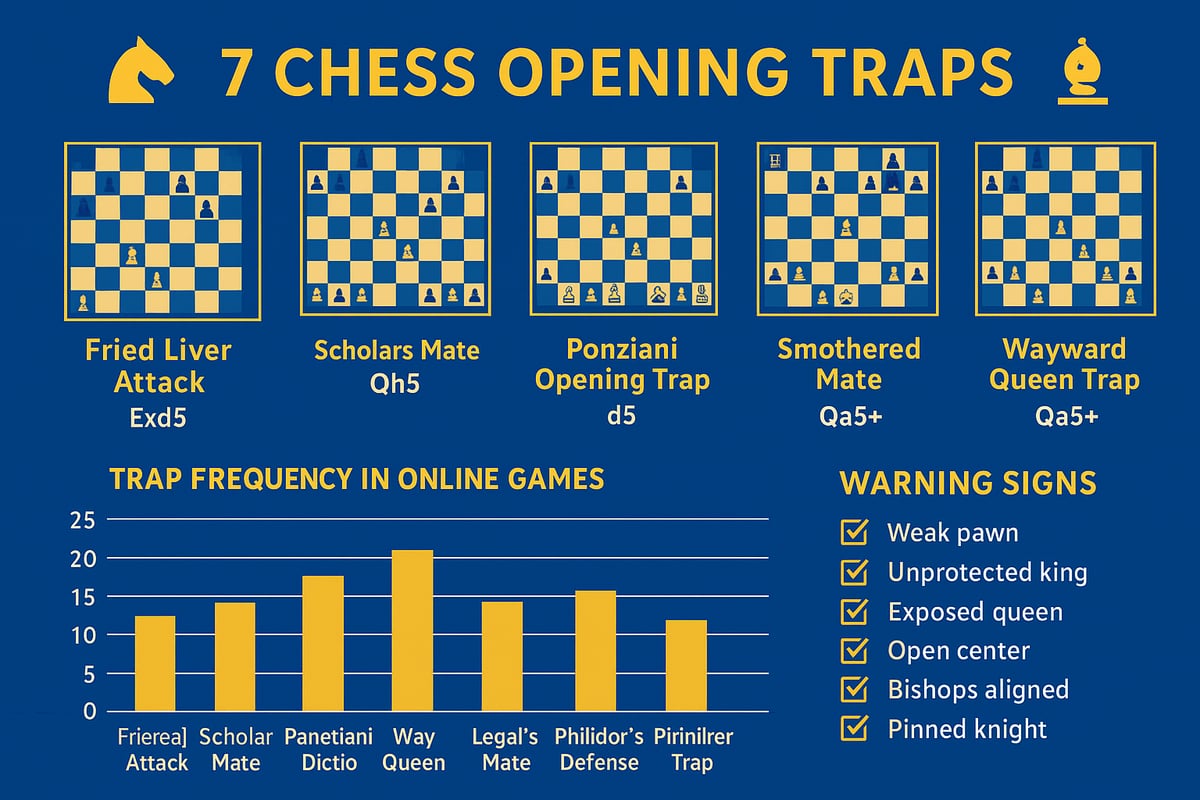
Chess opening traps are the secret weapons that can instantly turn the tide of a game, even against experienced opponents. In this section, you’ll get a front-row seat to seven of the most effective chess opening traps in 2026. For each, you’ll see how the trap unfolds, why it works, and what you can do to either set it or sidestep disaster. Ready to sharpen your tactical radar?
1. The Siberian Trap (Smith-Morra Gambit, Sicilian Defense)
The Siberian Trap is one of those chess opening traps that catches players off guard in the ever-popular Smith-Morra Gambit. It starts with 1.e4 c5 2.d4 cxd4 3.c3 dxc3 4.Nxc3 Nc6 5.Nf3 e6 6.Bc4 Qc7 7.0-0 Nf6 8.Qe2 Ng4. Now, if White gets greedy and plays 9.h3, Black’s queen and knight coordinate for a sudden strike.
The key tactical motif is the coordinated assault on f2. After 9.h3?? Nd4 10.Nxd4 Qh2#, it’s mate! Even if White tries to parry with 9.Bb3, Black’s pressure mounts. This trap often leads to either a swift checkmate or the loss of White’s queen, making it a favorite in blitz and rapid games.
A recent online example saw a 1700-rated player fall into the Siberian Trap during a bullet match, showing that chess opening traps are just as potent in fast formats. To set the trap as Black, play natural developing moves and watch for White’s early h3. As White, avoid h3 unless you’ve calculated all tactics, and keep an eye on the f2 weakness.
Why is this trap still relevant in 2026? The rise of gambit play online means more players are willing to take risks, and the Siberian Trap punishes careless aggression. For both sides, look for warning signs like Black’s knight jumping to g4 and the queen eyeing h2 or f2.
Quick Tips:
- Don’t play h3 without checking for tactical shots.
- Develop pieces with tempo, but beware of early castling if f2 is weak.
- Study common Sicilian Defense traps to boost your chess opening traps awareness.
2. The Blackburne Shilling Trap (Italian Game)
The Blackburne Shilling Trap is a classic among chess opening traps, especially deadly in the Italian Game. It begins with 1.e4 e5 2.Nf3 Nc6 3.Bc4 Nd4. Here, Black tempts White with a “free” pawn: 4.Nxe5? Qg5. Now, if White grabs another pawn with 5.Nxf7 Qxg2 6.Rf1 Qxe4+ and White’s king is doomed.
The psychology here is all about baiting White into overextending. Many players, eager to win material, don’t notice how fast their king’s safety unravels. In a recent online rapid event, a 1400-rated player snagged the “free” pawn, only to lose in under 15 moves.
If you’re playing White, the best way to sidestep this trap is to ignore the tempting pawn and instead play 4.c3 or 4.Nxd4. If you fall into it, you’ll either lose your queen or get checkmated quickly. This trap remains common at club level because it preys on natural, greedy instincts.
Common Mistakes Leading to the Trap:
- Grabbing pawns without calculating consequences.
- Ignoring Black’s rapid queen development.
- Forgetting king safety in the opening.
For Black, the Blackburne Shilling Trap is a great way to catch overzealous opponents. For White, a little caution and chess opening traps knowledge go a long way.

3. The Cambridge Springs Trap (Queen’s Gambit Declined)
The Cambridge Springs Trap is a mainstay in chess opening traps, particularly in the Queen’s Gambit Declined. The sequence goes: 1.d4 d5 2.c4 e6 3.Nc3 Nf6 4.Nf3 Nbd7 5.Bg5 c6 6.e3 Qa5 7.Nd2 Bb4. Now, if White carelessly plays 8.Qc2 or 8.Rc1, Black’s knight and queen can spring into action.
The tactical shot happens after 8...Ne4. If White plays Nxe4 dxe4, and if White’s bishop moves, Black wins the queen with ...Qxg5 or traps the bishop after ...Bxc3. In recent online tournaments, even strong club players have missed the subtlety and lost material fast.
This trap is effective because many d4 players focus on developing pieces and overlook Black’s quiet build-up. To defend, White should watch for the queen and bishop battery and avoid unnecessary piece exchanges.
Preparation in 2026 often includes “anti-trap” lines, but the Cambridge Springs Trap can still surprise. Move order and piece placement are crucial—always double-check tactics before routine moves.
Key Defensive Tips:
- Avoid moving the c1 bishop prematurely.
- Don’t allow Black’s queen and bishop to double up on the same diagonal.
- Study Queen's Gambit Declined Traps for more practical examples and puzzles to reinforce your chess opening traps skills.
4. Legal’s Mate (Italian/Philidor Defense)
Legal’s Mate is one of the most elegant chess opening traps, showcasing the power of piece coordination. It unfolds with 1.e4 e5 2.Nf3 d6 3.Bc4 Bg4 4.Nc3 g6 5.Nxe5 Bxd1 6.Bxf7+ Ke7 7.Nd5#. The critical idea is sacrificing the queen for a swift checkmate with minor pieces.
Aggressive players love this trap because it punishes opponents who pin the knight on f3 without proper defense. On online platforms, Legal’s Mate pops up in quick games where Black develops carelessly.
To spot the threat, watch for pins on the knight and the alignment of White’s bishop and knight. Defending is simple: don’t pin the knight unless it’s backed up, and be wary of early queen moves.
Legal’s Mate is a fantastic teaching tool for tactics, showing how quickly the game can end with the right sequence. For both sides, awareness of this classic example will sharpen your chess opening traps radar.
Lessons from Legal’s Mate:
- Value piece coordination over material.
- Avoid unnecessary pins in the opening.
- Practice with puzzles to recognize checkmate patterns.
5. Noah’s Ark Trap (Ruy Lopez)
Noah’s Ark Trap is a positional masterpiece among chess opening traps, especially in the Ruy Lopez. The moves are: 1.e4 e5 2.Nf3 Nc6 3.Bb5 a6 4.Ba4 d6 5.Bxc6+ bxc6 6.d4 exd4 7.Nxd4 Bd7 8.Nc3 g6 9.Be3 Bg7 10.Qd2 Nf6 11.f3 O-O 12.O-O-O Rb8 13.Bh6 Bxh6 14.Qxh6 c5. White’s bishop on b3 is suddenly trapped with pawns advancing.
The trap works because Black’s pawn structure creates a “cage” for White’s bishop. In a recent high-profile online blitz match, a 1600-rated player lost their bishop in just 14 moves.
Black can spring Noah’s Ark Trap by playing natural moves and pushing queenside pawns at the right time. White should avoid overextending and watch out for pawn advances that limit the bishop’s retreat.
This trap is especially effective in fast time controls, where players rely on intuition. To avoid it, White must be cautious with pawn pushes and keep escape squares for the bishop.
Tips for Spotting Bishop Traps:
- Monitor pawn advances that limit your piece mobility.
- Don’t commit your bishop too early without a safe retreat.
- Recognize similar motifs in other chess opening traps to stay alert.
6. The Lasker Trap (Albin Countergambit)
The Lasker Trap is a sneaky addition to the world of chess opening traps, found in the Albin Countergambit. The sequence: 1.d4 d5 2.c4 e5 3.dxe5 d4 4.Nf3 Nc6 5.a3 Be6 6.Nbd2 Qe7 7.b4 O-O-O 8.Bb2 g5 9.h3 h5 10.Ne4 Bh6. If White takes on g5, Black can underpromote a pawn to a knight, winning material.
This trap tempts White into grabbing pawns, only to fall for a rare underpromotion tactic. In a recent 2026 online event, a player was stunned after Black promoted to a knight, forking king and queen.
Black sets the trap by playing aggressively and pushing pawns on the kingside. White’s critical mistake is neglecting development and grabbing material. To defend, White should prioritize development and avoid unnecessary pawn captures.
The Lasker Trap is still effective because many players are unfamiliar with underpromotion motifs. Studying this trap boosts endgame awareness and helps you spot rare tactics in chess opening traps.
Why Study the Lasker Trap?
- Learn the power of underpromotion in practical play.
- Avoid materialism in risky positions.
- Enhance your tactical vision for both opening and endgame.
7. The Rubinstein Trap (Queen’s Gambit Declined)
The Rubinstein Trap rounds out our list of must-know chess opening traps, lurking in the Queen’s Gambit Declined. The sequence: 1.d4 d5 2.c4 e6 3.Nc3 Nf6 4.Bg5 Be7 5.e3 O-O 6.Nf3 h6 7.Bh4 b6 8.cxd5 Nxd5 9.Bxe7 Qxe7 10.Nxd5 exd5 11.Rc1 Be6 12.Qa4 c5 13.Qa3 Rc8 14.Ba6 Nxa6 15.Qxa6 c4. Suddenly, White’s queen is trapped by Black’s minor pieces and pawns.
Even strong players have fallen for this trap, especially when they play moves automatically without checking all the consequences. In recent club and online play, the Rubinstein Trap has netted quick wins for well-prepared Black players.
The key to avoiding this trap is careful calculation and attention to move order. Both sides should be wary of queen sorties that leave no escape routes.
Pattern recognition is vital for chess opening traps like this. Spotting the alignment of pawns and minor pieces can save you from a trapped queen.
Practical Advice:
- Double-check queen moves in crowded positions.
- Don’t rush to exchange pieces without a plan.
- Train with pattern recognition exercises to avoid similar pitfalls.
How to Spot and Avoid Chess Opening Traps
Have you ever wondered how some players seem to sniff out trouble before it even appears on the board? Spotting and sidestepping chess opening traps is a skill you can develop, and it pays off quickly. Let’s break down proven strategies to help you stay safe and confident in your next game.
Universal Principles for Trap Prevention
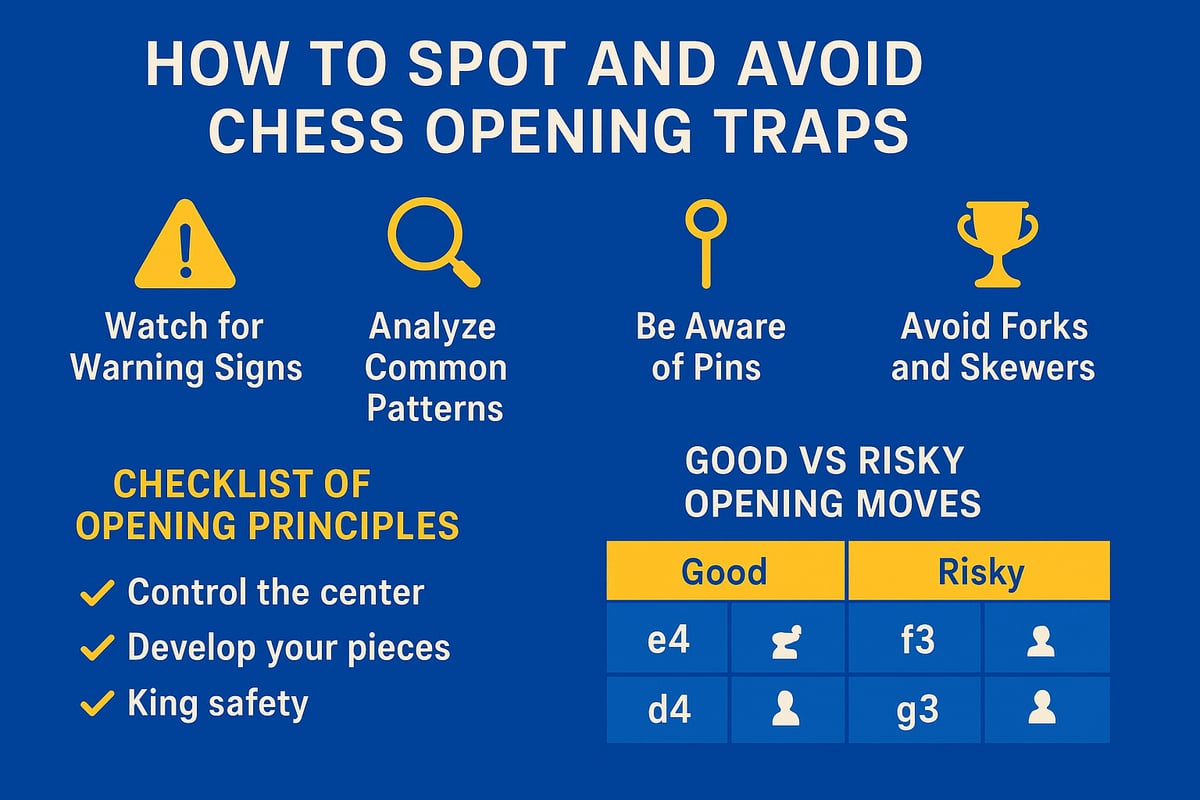
When you’re starting out or even if you’ve played for years, sticking to solid opening principles is your first line of defense against chess opening traps. Prioritize quick development, fight for the center, and keep your king safe with timely castling.
Be cautious if your opponent offers “free” material. Ask yourself, “What’s the catch?” before grabbing a pawn or piece. Many chess educators stress the value of skepticism and careful calculation in these moments.
A quick checklist can help:
- Develop pieces efficiently
- Control central squares
- Castle early when possible
- Double-check before capturing “free” pieces
These habits make you less likely to fall for common chess opening traps.
Pattern Recognition and Tactical Awareness
Recognizing patterns is like having a secret map of the chess battlefield. The more tactical motifs you know, the easier it is to spot chess opening traps as they unfold. Pins, forks, skewers, and double attacks often lurk behind sneaky moves, especially early on.
Regularly practicing puzzles strengthens your trap radar. In fact, focused study on patterns has been shown to boost performance in real games. If you want to dive deeper, resources like Mastering opening traps break down classic and modern motifs you’ll see again and again.
Stay alert for familiar setups and warning signs, and you’ll quickly become a much tougher opponent.
The Role of Preparation and Study
Preparation is your secret weapon against chess opening traps. Knowing the main lines and the most common traps in your favorite openings gives you a huge head start. Many players use cheat sheets, online courses, or databases to memorize key positions and critical moves.
A great tool for this is Chess Opening Cheat Sheets, offering visual guides and practical tips so you can learn, spot, and avoid traps without endless memorization.
With steady study, you’ll not only defend against traps but also spot opportunities to set your own. Confidence comes from knowing what to expect, so invest a little time in targeted preparation.
Adapting to New Traps in the Online Era
Chess is evolving fast, especially online. New chess opening traps appear as creative players and AI engines explore deeper into the game. Staying updated is crucial.
Review your own games and those of stronger players. Watch for trends and new tactical ideas. Many top players regularly analyze recent games to spot fresh traps and defensive resources.
Make it a habit to check for new lines, and you’ll never be caught off guard by the latest trick. Staying flexible and curious will keep your opening play sharp and resilient against all kinds of chess opening traps.
Chess Cheat Sheets: The Ultimate Resource for Mastering Traps and Openings
If you want to turn the tables on your opponents and finally stop falling for those pesky chess opening traps, you need tools that make studying simple and practical. That’s where Chess Cheat Sheets comes in. This platform is designed for players who want to master chess opening traps without drowning in endless theory books or memorizing dozens of move orders.

What makes Chess Cheat Sheets stand out? You get:
- Visual cheat sheets that lay out openings and chess opening traps in a way that's easy to digest
- Opening toolkits focused on the most popular and tricky lines
- Massive puzzle packs, like their Sicilian Defense Trap Puzzles, to drill the exact tactics you’ll face in real games
- Endgame guides tailored for beginners and intermediates
All resources are plug-and-play, so you can jump right into learning and applying new ideas with zero hassle. No need to memorize hundreds of moves. Just grab a cheat sheet, review the patterns, and you’re ready to spot or set up chess opening traps in your own games.
Chess Cheat Sheets offers affordable lifetime access, free sample toolkits to get you started, and regular updates so you’re always ahead of the latest trends and traps in 2026. Players around the world rave about how these resources have boosted their confidence and results.
If you’re serious about leveling up and want to consistently outsmart rivals, Chess Cheat Sheets is your secret weapon for mastering chess opening traps and staying one step ahead.
So, after seeing just how many sneaky traps can pop up in your chess games—even in 2026—it’s clear that getting ahead in the opening isn’t just about memorizing moves, it’s about real understanding and pattern recognition. If you’re ready to stop falling for cheap tricks and start catching your own opponents off guard, why not take action right now? You don’t have to spend hours on dense theory or endless videos. Instead, you can Start Improving Your Openings with practical, straightforward resources designed for players just like you. Your next opponent won’t know what hit them!


