

Have you noticed how the chess london opening is everywhere these days? Club players and online enthusiasts are turning to this system as we head into 2025. Why? It’s simple, flexible, and doesn’t require endless memorization.
You get a universal setup that works against almost any opponent. Mastering this opening can boost your consistency and give you real confidence at the board, no matter your rating.
Ready to upgrade your game? This step-by-step guide will walk you through everything—origins, setup, key variations, practical plans, defenses, and advanced tips—so you can master the London System with confidence.
Here’s what to expect: a look at its history, the core setup, main and side variations, typical middlegame plans, how to counter the London, and the best resources for 2025.

The London System: Origins, Fundamentals, and Appeal
If you've spent any time playing online or at your local club, you’ve probably run into the chess london opening more often lately. So, what exactly is this setup that is capturing the chess world’s attention? The London System is a Queen’s Pawn Opening, usually beginning with 1.d4, 2.Nf3, and 3.Bf4. What makes it unique is that you can use the same piece arrangement against almost any Black defense, which is why it’s known as a “system” opening.
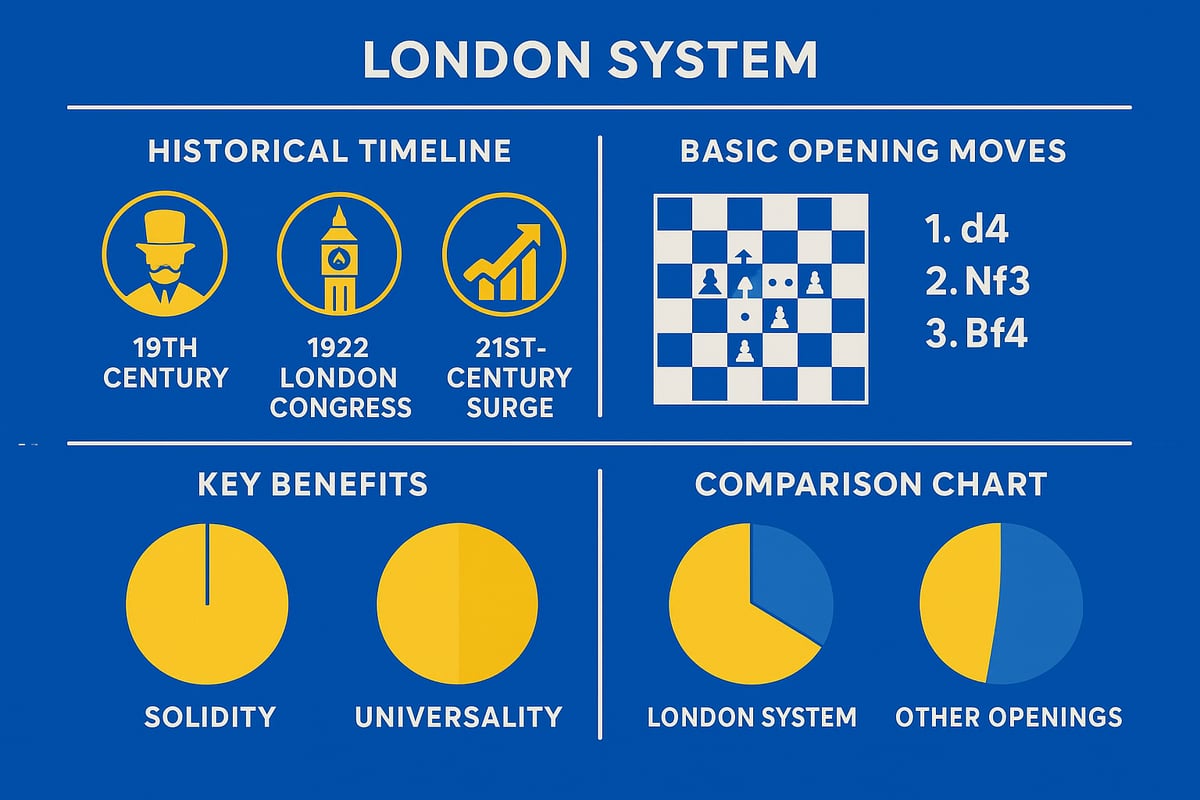
The London System traces its roots back to the late 1800s, but it truly stepped into the spotlight after the 1922 London Congress, where it was adopted by top competitors. In recent years, elite grandmasters like Magnus Carlsen and Gata Kamsky have added the chess london opening to their repertoires, showing that it’s not just for beginners. The beauty of this approach is its timelessness—you’ll find it in games from a century ago and in cutting-edge online battles today.
Compared to other popular openings, such as the Queen’s Gambit or the King’s Indian Defense, the chess london opening demands far less memorization of long theoretical lines. Instead, it emphasizes understanding clear plans and typical positions. If you want to dig deeper into the fundamentals, move orders, and strategies, check out this London System Opening Guide, which breaks down the core ideas in an accessible way.
Why do so many players, from beginners to masters, flock to the chess london opening? For one, it’s incredibly solid and hard for Black to sidestep. Statistical data from chess.com and lichess.org shows a steady increase in its use, especially from 2023 to 2025. At the club level, White often achieves consistent results with minimal risk, making it a favorite for improving players who want practical wins without memorizing hundreds of lines.
Let’s look at the main pros and cons. The chess london opening lets you follow familiar plans and structures, so you always know what you’re aiming for. However, it can sometimes be less aggressive than other openings and, if played passively, might let Black equalize too easily. Still, the list of famous players who have relied on the London System is impressive—Gata Kamsky, Magnus Carlsen, and even rising stars like Nihal Sarin have showcased its power in high-stakes games. Their victories highlight how a simple, universal approach can outplay even the best-prepared opponents.
Step-by-Step: How to Play the London System in 2025
Are you ready to bring order to your opening repertoire? The chess london opening is famous for its reliable setup and consistent results, making it a go-to choice for players who want practical strength without memorizing dozens of sharp lines. Let's walk through each step so you can confidently play the London System in your games.
Chronological Guide to the Standard Setup
The chess london opening begins with 1.d4, staking your claim in the center and laying the groundwork for a universal plan. If you want a system that delivers both flexibility and structure, this is your roadmap.
Here's the classic London move order:
1. d4   d5
2. Nf3  Nf6
3. Bf4  c5
4. e3   Nc6
5. c3   e6
6. Bd3  Be7
7. Nbd2 O-O
8. h3   b6
9. O-O  Bb7
10. Qe2
This setup is the backbone of the chess london opening because it works against nearly any Black response. Notice how the bishop develops outside the pawn chain early, giving you immediate activity. The knight comes to f3, then d2, so your minor pieces coordinate smoothly.
Why is move order so crucial? Because the London can be flexible. For example, if Black plays an early ...g6, you might develop your bishop to e2 instead of d3 to avoid awkward pins. If you see an early ...Qb6, threatening your b2 pawn, you can play Qb3 or even b3 to hold everything together.
Here's a table to help you visualize the standard setup and common Black replies:
| Move | White's Plan | Black's Response | Typical Plan |
|---|---|---|---|
| 1.d4 | Control center | 1...d5, 1...Nf6 | Mirror or challenge |
| 2.Nf3 | Develop knight | 2...Nf6 | Support d4 |
| 3.Bf4 | Active bishop | 3...c5, 3...e6 | Central tension |
| 4.e3 | Solidify | 4...Nc6 | Develop pieces |
| 5.c3 | Support d4 | 5...e6 | Prepare ...d5 break |
| 6.Nbd2 | Harmonize | 6...Be7 | Flexible setup |
| 7.Bd3 | Build attack | 7...O-O | King safety |
The chess london opening is popular because you don't need to memorize endless theory. Whether you face the Classical Defense, the Indian setups, or early ...Qb6, you can tweak your plan without losing sight of your main goals.
Key tips for success:
- Develop your light-squared bishop before playing e3. This avoids it being trapped behind your pawns.
- Play h3 before castling to stop ...Nh5, which can harass your bishop on f4.
- After castling, look for ideas like Ne5 or even a quick e4 break if Black is slow.
- Be alert to ...Qb6, which targets b2. Meet it with Qb3, b3, or develop your queen first to avoid headaches.
- Avoid developing your bishop too late, or you might lose your opening advantage.
Common mistakes:
- Delaying Bf4: If you wait too long, you miss the chance to pressure Black and risk falling behind.
- Forgetting h3: If you skip this, Black can play ...Nh5 and chase away your bishop.
- Ignoring ...Qb6: This can lead to material loss if you aren't careful.
Statistics back up the chess london opening's practical value. According to chess.com, Black scores only about 49 percent win rate with early ...c5, showing that White's structure is resilient even against aggressive plans. The draw rate is also high, which means you're less likely to fall into early traps or get blown off the board.
If you're a beginner or intermediate player, focus on understanding these plans rather than memorizing every possible move. The London is about ideas, not rote memory. For a deeper dive into move orders and advanced strategies, check out this Comprehensive London System Guide for detailed analysis and model games.
Streamline Your Learning with Chess Cheat Sheets
Learning the chess london opening doesn't have to be overwhelming. Chess Cheat Sheets offers visual guides, puzzles, and resources that make mastering the London feel like second nature.

You get instant access to opening overviews, tactical puzzles, and endgame resources, all focused on practical improvement. Beginners and intermediates can grab free samples, while the full toolkit gives you everything you need to play the London System with confidence.
Mainline Variations and Key Branches
If you want to get serious results from the chess london opening, you need to understand its mainline variations and popular side branches. Each path offers unique plans, traps, and tactical ideas, making your games more dynamic and fun. Let’s break down what you’ll face—and how you can use these lines to your advantage.
The Classical London Mainline
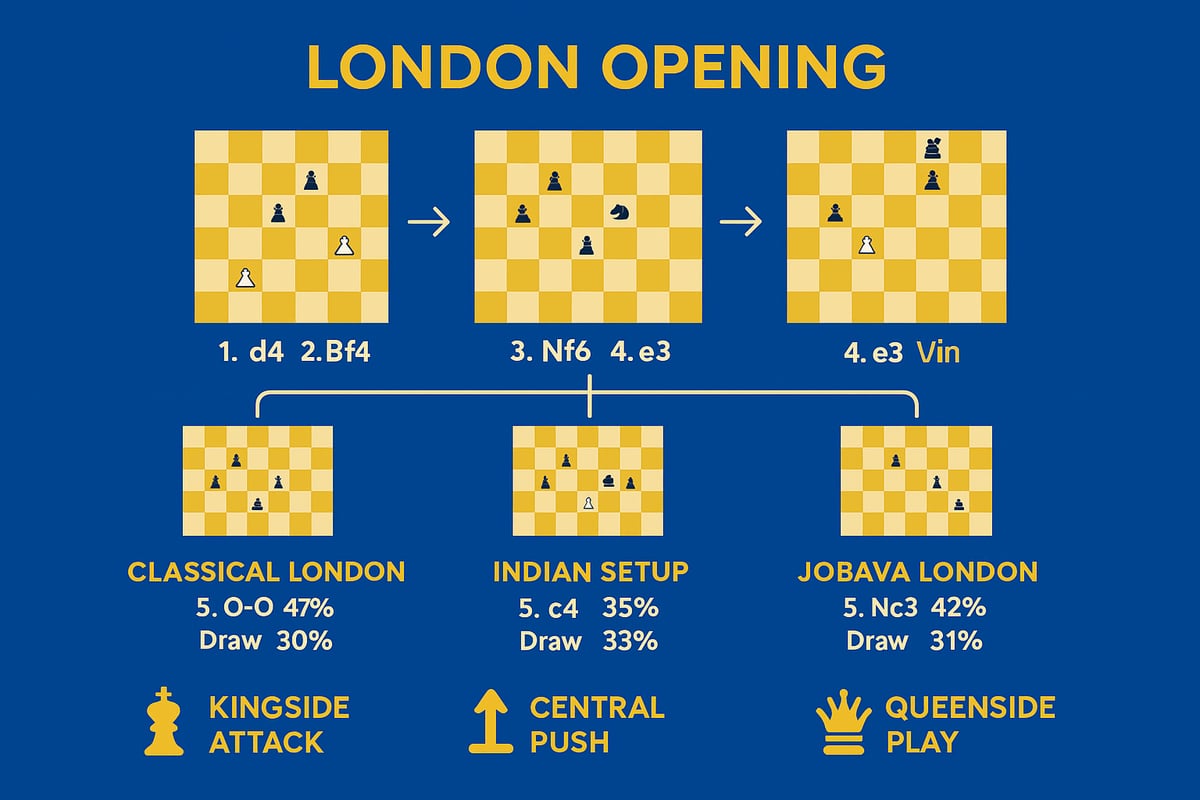
The classical mainline is the bread-and-butter of the chess london opening. This sequence usually begins with 1.d4 d5 2.Nf3 Nf6 3.Bf4 c5 4.e3 Nc6 5.c3 e6 6.Nbd2 Bd6 7.Bg3 O-O 8.Bd3 b6 9.O-O Bb7. Here, White focuses on a solid, harmonious setup while staying flexible for future plans.
So, what are your main goals here? White often aims for a kingside push with moves like Ne5 and f4, or prepares a central break with e4. Black, on the other hand, wants to create tension with ...cxd4, expand on the queenside, or challenge White’s bishop with ...Ba6.
Here’s a quick table to clarify typical plans:
| Side | Main Plan | Common Moves |
|---|---|---|
| White | Kingside attack, e4 push | Ne5, f4, e4, Qe2 |
| Black | Queenside play, center | ...cxd4, ...Ba6 |
A great example of this mainline in action is the Carlsen vs Ding Liren, 2020 game, where both sides followed the classical structure and then branched into sharp middlegame tactics.
Tactical themes you should watch for include the famous Bxh7+ sacrifice (the “Greek Gift”), timely e4 breaks, and exploiting weak squares left by Black’s piece moves. According to major databases, the mainline chess london opening sees a balanced outcome—high draw rates and steady win percentages for both sides.
If your opponent strays from the beaten path, don’t worry. The beauty of the chess london opening is its flexibility. You can adjust your plans based on their setup, keeping your pieces active and your king safe.
For a deeper dive into move sequences and statistical outcomes, check out this London System Opening Explorer to visualize common branches and results.
Popular Side Variations
Now, let’s talk about the most popular detours you’ll encounter in the chess london opening. These side branches give both you and your opponent new challenges—and opportunities for creative play.
First, the Indian Setup: Black plays ...g6 and ...Bg7, fianchettoing the bishop. Here, White often keeps the bishop on e2 instead of d3, staying ready for kingside play or a central push. This setup reduces the risk of Black’s counterplay on the diagonal.
Next, the Jobava London: This sharp variation swaps c3 for Nc3 early, leading to tactical fireworks. The typical moves are 1.d4 d5 2.Nc3 Nf6 3.Bf4, and White often goes for a quick e4 or Qd2, aiming for a kingside storm. Watch out for sneaky traps—one slip, and your opponent could be facing a quick mate or material loss.
Early ...Qb6 is another tricky response from Black, targeting your b2 pawn. Don’t panic—moves like Qb3 or even ignoring the threat with solid development can neutralize the pressure. Remember, the chess london opening is about understanding plans, not just memorizing moves.
Let’s highlight some key practitioners: Gata Kamsky is known for his deep strategic play in the London, while Nihal Sarin brings sharp tactics to the Jobava line. Each variation has its own risk and reward profile, so experiment and find what suits your style.
Here’s a quick summary table:
| Variation | Key Move Order | Style | Notable Player |
|---|---|---|---|
| Indian Setup | ...g6, ...Bg7 | Solid, flexible | Kamsky |
| Jobava London | Nc3, Qd2, e4 | Aggressive | Sarin |
| Early ...Qb6 | ...Qb6, ...c5 | Tactical | Multiple |
In each of these, keep your eyes open for classic London traps and tactical patterns. The more you play these side branches, the more confident you’ll feel facing any opponent in the chess london opening.
Typical Middlegame Plans and Strategies
The middlegame is where the chess london opening really comes to life. If you have made it through the setup, you might be wondering, "What now?" Let’s break down the key ideas and tactical patterns that make the London System such a practical weapon for players of all levels.
Core Strategic Themes in the London System
When you reach the middlegame in the chess london opening, your plan often depends on how Black has set up. Still, there are a few universal strategies you should always keep in mind.
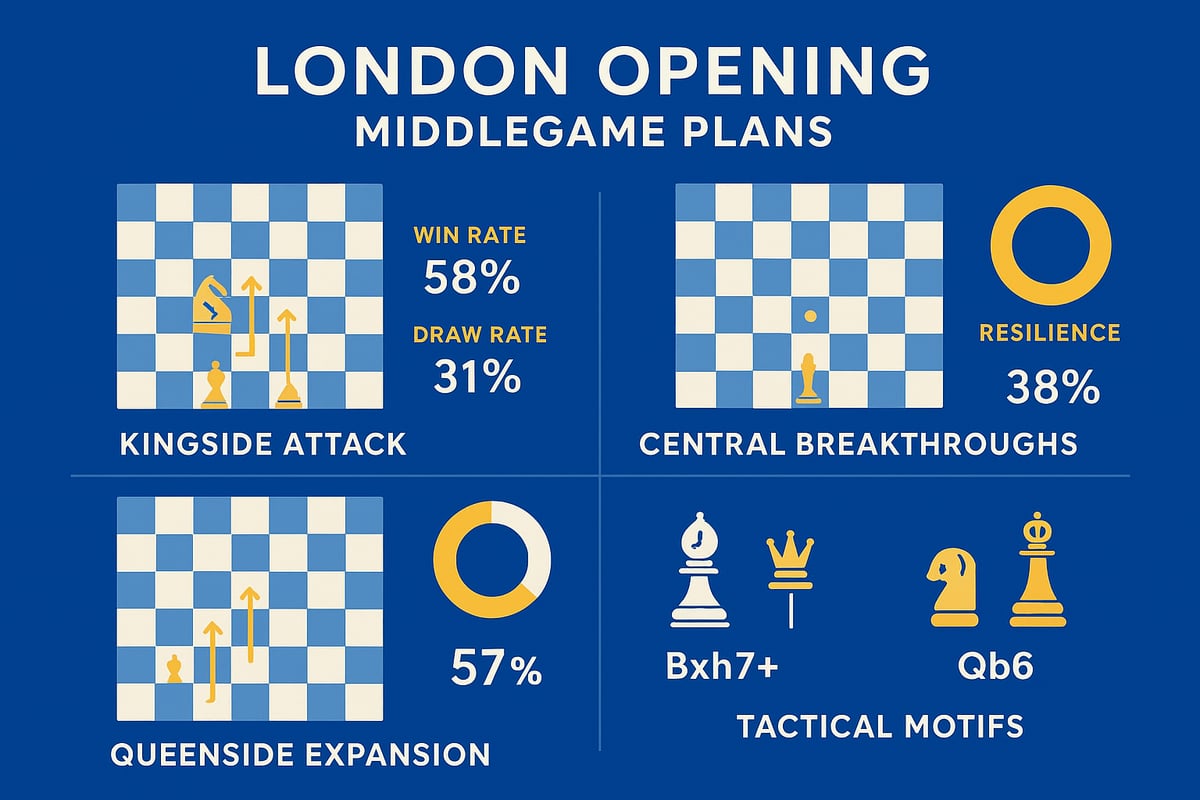
Kingside Attack
One of the most exciting aspects of the chess london opening is the potential to launch a kingside attack. Moves like Ne5 and f4 can create pressure, especially when combined with h4 and h5. The bishop pair, especially when placed on d3 and f4 (or g3), often supports these aggressive ideas.
Central Breakthroughs
A classic plan is to prepare and play e4. You might use Rfe1 or Qe2 to back up the push. Timing is everything—wait until your pieces are ready so that the center opens in your favor.
Queenside Play
If the kingside is locked, look to the other side. Moves like a4 and a5 can gain space or even open lines for your rook. Sometimes, you play a minority attack with b4-b5, targeting Black’s pawn structure.
Piece Maneuvers
Flexibility is the heart of the chess london opening. You can reposition your knights from f3 to e5 or swing your bishop between d3 and f1 to adapt to Black’s plans. This adaptability is key to maintaining the initiative.
Pawn Structure and Defense
The typical c3-d4-e3 triangle is solid but can be a double-edged sword. Watch out for moves like ...c5 or ...e5 from Black that try to undermine your center. Defending the b2 pawn after an early ...Qb6 is another important skill—sometimes Qb3 is your best response.
Transitioning to Endgames
Many players using the chess london opening find themselves with strong minor pieces as the board empties. Look for chances to trade into favorable endings, especially if your bishop is stronger than Black’s knight or vice versa.
Here’s a quick table summarizing typical plans:
| Plan | Key Moves | Typical Result |
|---|---|---|
| Kingside Attack | Ne5, f4, h4-h5 | Mating threats, pressure |
| Central Breakthrough | e4, Rfe1, Qe2 | Open center, tactics |
| Queenside Play | a4-a5, b4-b5 | Space, open files |
| Piece Maneuvers | Nf3-e5, Bd3-f1 | Flexibility, defense |
| Endgame Transition | Exchanges, trades | Superior minor pieces |
Statistics from online databases show that the chess london opening maintains balanced outcomes and high resilience, even when Black plays sharp responses.
Common Tactical Patterns and Traps
The chess london opening is not just about structure and plans. It is packed with tactical shots that can catch even experienced opponents off-guard.
Greek Gift Sacrifice (Bxh7+)
This classic tactic can appear in the chess london opening if Black castles kingside and leaves the f6-knight or g6-pawn unprotected. If the setup is right, sacrificing your bishop on h7 can lead to a devastating attack, but beware—if Black’s pieces are ready, it can backfire.
Exploiting Misplaced Pieces
If Black plays ...Ne4 or captures on d4 at the wrong moment, their pieces can become targets. Coordinated attacks on weak squares like f7 or h7 are common themes.
Opening Traps
There are plenty of opening tricks in the chess london opening. The Jobava London, for example, includes quick Nc3 and Qd2 ideas that can catch Black off guard. Watch out for early ...Qb6—if you forget to defend b2, you might lose material.
Defensive Resources
You are not always on the attack. Sometimes, you need to defend against Black’s energetic play. Moves like h3 stop ...Nh5 ideas, and Qb3 counters ...Qb6, keeping your position solid.
Want to sharpen your tactical eye? Practicing with London System Chess Puzzles is a great way to internalize these patterns and improve your practical results in the chess london opening.
The beauty of the chess london opening is that you can blend strategic plans with tactical alertness. If you are alert to these middlegame themes and tricks, you will consistently outplay your opponents and enjoy more success with this reliable system.
How to Counter the London System: Best Defenses for Black
Facing the chess london opening as Black can feel like a test of patience and preparation. The London has become so popular that every club player needs a solid plan. Thankfully, there are proven defensive systems that put White under real pressure.
Early ...c5 and ...Qb6 Approaches
When you want to disrupt the chess london opening early, the ...c5 and ...Qb6 combo is your best friend. After 1.d4 d5 2.Nf3 Nf6 3.Bf4 c5 4.e3 Qb6, Black immediately targets the b2 pawn and challenges White’s harmonious setup.
This approach puts White on the back foot. Many players underestimate the pressure on b2, and a single slip can cost material. The move ...c5 strikes at the center, making it harder for White to keep their pawn structure intact.
Let’s look at a quick summary:
| Defense | Key Moves | Result (Black win %) |
|---|---|---|
| Early ...c5 | 3...c5 4.e3 | 49% |
| ...Qb6 | 4...Qb6 | 49% |
White’s best responses are Qb3, defending b2, or sometimes dxc5 to simplify the center. Developing naturally and ignoring the threat can also work, but only if you’re careful about tactics.
If you’re facing the chess london opening, remember that these lines have a proven track record. Study a few master games, and you’ll see how quickly White can stumble if they get careless.
Indian and Fianchetto Setups
Another strong answer to the chess london opening is the Indian or Fianchetto setup. Here, you play ...g6, ...Bg7, and ...d6, aiming for a flexible, hypermodern structure. This approach avoids direct clashes, instead focusing on piece activity and controlling key squares.
White must adjust by developing the bishop to e2 instead of d3, or delay d4-d5 to avoid premature attacks. As Black, you should watch for chances to play ...e5 or ...c5, striking in the center when the time is right.
If you want to dive deeper into these setups, check out the Chess Openings Overview for a big-picture look at how the London fits into the wider world of chess openings.
Practical tips:
- Be patient, and don’t rush pawn breaks.
- Use your kingside fianchetto bishop to control central and queenside squares.
- Watch for White’s e4 push, and be ready to challenge it.
This style is solid and has stood the test of time, making it a top choice for many club players against the chess london opening.
Forcing White Out of Their Comfort Zone
Sometimes, the best way to counter the chess london opening is to make White think for themselves. Move order tricks, like early ...e6 and ...Bd6 or immediate ...Nc6, can push White into less familiar territory.
Transposing into Queen’s Gambit Declined lines is another effective strategy. By tweaking your move sequence, you can “break the system,” forcing White to play chess rather than just follow a recipe.
Here’s a quick checklist:
- Mix up move orders to keep White guessing.
- Don’t let White settle into their favorite pawn triangle.
- Look for ways to challenge their bishop on f4 or disrupt their kingside plans.
If you want to sharpen your tactical eye and spot chances to break White’s rhythm, practicing with positional puzzles can really help. For more on that, see How to Improve with Chess Puzzles.
By staying flexible and creative, you’ll make the chess london opening less comfortable for your opponent—and more rewarding for you.
Advanced Tips, Resources, and Studying the London System in 2025
Looking to take your chess london opening skills to the next level in 2025? Advanced players know that staying ahead means more than just memorizing moves. You want to truly understand the ideas behind each position, adapt quickly to new trends, and make use of the best learning tools available.
Stay Ahead with Modern Tools
The chess london opening has evolved rapidly, especially with the rise of online play and computer analysis. Make it a habit to check recent games using online databases like Lichess or Chess.com. These platforms let you track the latest trends, novelties, and statistical win rates for your favorite London lines.
Engines such as Stockfish and Leela Chess Zero can help you analyze tricky positions. Plug your games in, look for missed tactics, and see how top-level analysis compares with your own ideas. This approach keeps your repertoire fresh and competitive.
Learn from the Best
Studying model games is a proven way to deepen your understanding of the chess london opening. Focus on games played by grandmasters like Magnus Carlsen, Gata Kamsky, and Dmitry Andreikin. Notice how they handle different defenses and adapt their plans based on Black’s responses.
You might also want to analyze your own games. Look for recurring mistakes or moments where you felt unsure. Keeping a chess journal or using online annotation tools can help you spot patterns and track your progress over time.
Blend and Expand Your Repertoire
For even more flexibility, consider blending the chess london opening with other systems. Many advanced players pair the London with the Torre Attack or the Colle System, giving them options to surprise opponents and avoid predictability.
Video lessons and tactical puzzles are invaluable for reinforcing key ideas. For example, the Mastering the London System Video offers expert analysis, practical strategies, and modern tactics powered by LEELA engine insights. Visual learners will benefit from step-by-step breakdowns and real-game examples.
Here’s a quick table summarizing top resources:
| Resource Type | Example/Link | Why Use It? |
|---|---|---|
| Database | chess.com, Lichess | Latest trends, statistics |
| Engine | Stockfish, Leela Chess Zero | Deep analysis, tactical checks |
| Book | "Winning with the London System" by Nikola Sedlak | Comprehensive written guide |
| Video Course | Mastering the London System Video | Visual, practical instruction |
| Blog/Article | London System's Popularity in 2025 | Trends, player insights |
| Puzzle Trainer | Chess.com Tactics, Lichess Puzzles | Spot patterns, sharpen calculation |
Key Takeaways for 2025
Mastering the chess london opening in 2025 means combining cutting-edge study with practical experience. Use databases and engines to stay sharp, learn from the best, and always analyze your own play.
Blend your London knowledge with other systems for a versatile repertoire. Most importantly, keep your approach flexible and enjoy the journey—chess is a lifelong adventure.
So, now that you’ve got a handle on the London System’s ins and outs, are you ready to really level up your game? There’s a lot to remember, from move orders to clever traps, but you don’t have to go it alone. If you want to skip the overwhelm and focus on practical improvement, I’d recommend exploring some tools that make learning openings way easier. You can dive straight into tailored guides, puzzles, and resources that break things down step by step. Curious to see what’s out there? Why not Start Improving Your Openings and give yourself a real head start!


