

You've probably sat down to play chess hundreds of times, but have you ever stopped to think about the chess board and pieces themselves? These fundamental components are more than just tools for playing a game. They're the foundation of every brilliant combination, every tactical masterpiece, and every endgame you'll ever navigate. Whether you're just starting out or looking to deepen your understanding, knowing the ins and outs of your chess board and pieces can genuinely improve your play. Let's dive into everything you need to know about these essential elements of the game.
Understanding the Chess Board
The chess board is your battlefield, and understanding its layout is absolutely crucial. You're looking at a square board divided into 64 smaller squares, arranged in an eight-by-eight grid. These squares alternate between light and dark colours, traditionally referred to as white and black, though they can be any contrasting colours.
Here's something many beginners miss: the board must be positioned correctly. The bottom-right square from each player's perspective should always be a light square. This simple rule ensures the game is set up properly every time.
The Coordinate System
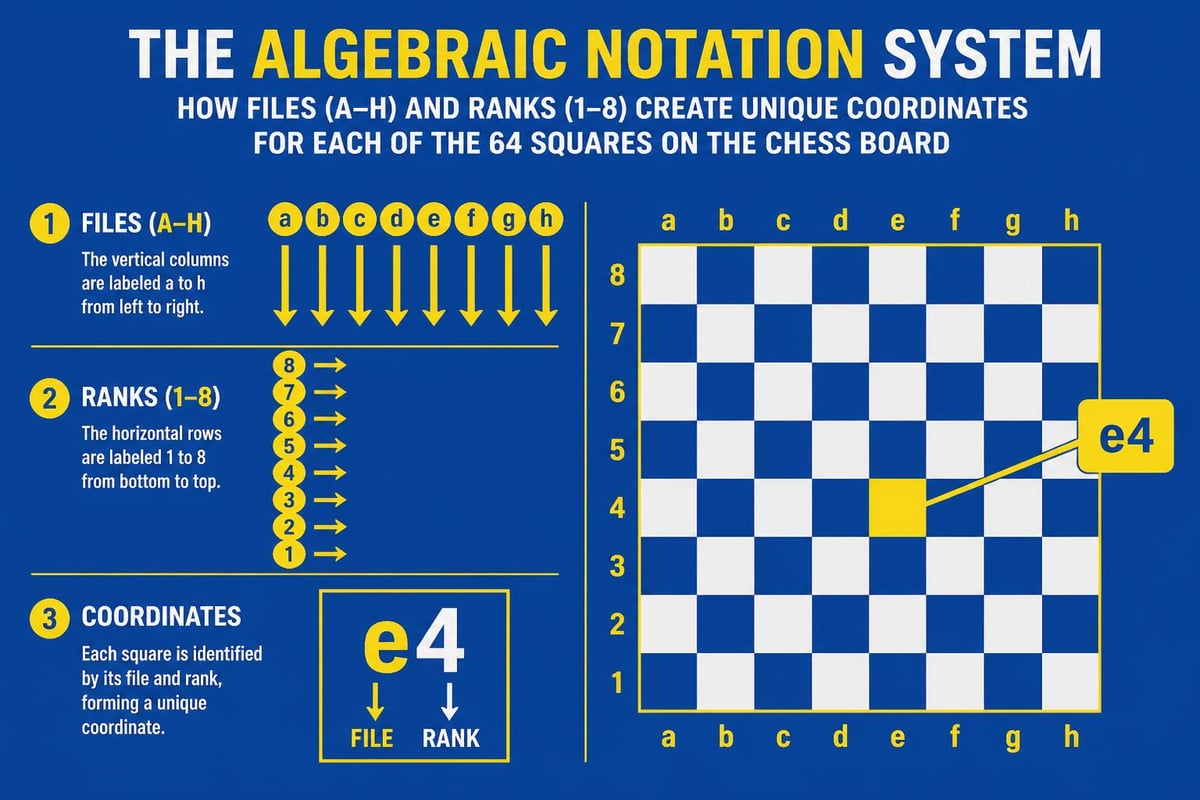
Have you ever wondered how chess players can replay games from centuries ago? That's all thanks to algebraic notation, which gives each square a unique address. The files (vertical columns) are labelled a through h from left to right (from White's perspective), whilst the ranks (horizontal rows) are numbered 1 through 8 from bottom to top.
This system transforms the chess board into a coordinate grid:
- a1 is the bottom-left corner for White
- h1 is the bottom-right corner for White
- a8 is the top-left corner for White
- h8 is the top-right corner for White
Understanding this notation is essential for following chess resources and improving your game systematically.
Board Dimensions and Materials
When you're selecting a chess board and pieces, proportions matter more than you might think. According to standard chess board dimensions, the relationship between square size and piece height is crucial for comfortable play. Tournament standards typically recommend that the king's height should be 85-105mm, with the square size being approximately twice the diameter of a pawn's base.
Common materials include:
- Wood: Classic, durable, excellent feel
- Plastic: Affordable, portable, weather-resistant
- Vinyl: Rollable, perfect for travel and clubs
- Glass: Decorative, modern aesthetic
- Marble: Luxurious, heavy, statement pieces
The Six Types of Chess Pieces
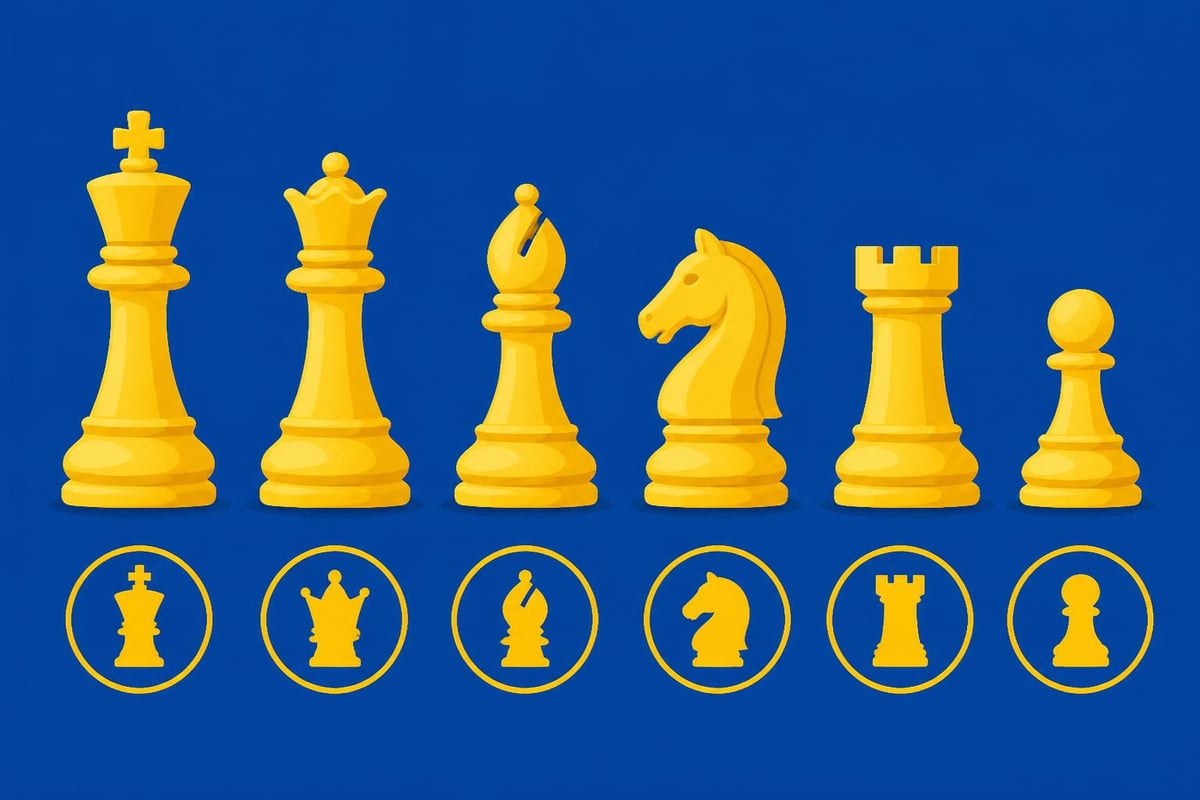
Your chess board and pieces work together as a system, and each piece type brings unique capabilities to your arsenal. The standard chess pieces have remained largely unchanged for centuries, though their designs vary across cultures and manufacturers.
The King: Your Most Important Piece
The king might not be the most powerful piece, but he's certainly the most important. Lose your king, and the game is over. He moves one square in any direction: horizontally, vertically, or diagonally. Despite his limited range, protecting your king whilst simultaneously creating threats against your opponent's king is what chess is fundamentally about.
The Queen: Maximum Firepower
Your queen combines the power of the rook and bishop, moving any number of squares horizontally, vertically, or diagonally. She's your most versatile attacking piece, worth approximately nine pawns in material value. However, don't bring her out too early, as she can become a target for your opponent's developing pieces.
Rooks: Control the Open Files
Rooks move horizontally or vertically any number of squares. They're particularly powerful on open files (vertical columns without pawns) and along the seventh rank in the endgame. You start with two rooks, and they're worth about five pawns each.
Bishops: The Long-Range Specialists
Each bishop moves diagonally any number of squares and is confined to either light or dark squares for the entire game. This creates an interesting dynamic: you have one light-squared bishop and one dark-squared bishop. Understanding how to use both bishops effectively is a key skill in advanced chess.
Knights: The Tricky Jumpers
Knights are the only pieces that can jump over other pieces. They move in an L-shape: two squares in one direction and then one square perpendicular. Knights are worth about three pawns and are particularly effective in closed positions where pawns block the long-range pieces.
Pawns: The Soul of Chess
Pawns move forward one square (or two squares from their starting position) and capture diagonally. They might seem humble, but as the chess master François-André Danican Philidor said, "Pawns are the soul of chess." Their structure determines your entire strategy, influencing everything from your opening choice to your endgame technique.
| Piece Type | Quantity per Side | Approximate Value | Special Moves |
|---|---|---|---|
| King | 1 | Infinite | Castling |
| Queen | 1 | 9 points | None |
| Rook | 2 | 5 points | Castling |
| Bishop | 2 | 3 points | None |
| Knight | 2 | 3 points | None |
| Pawn | 8 | 1 point | En passant, Promotion |

Setting Up Your Chess Board and Pieces
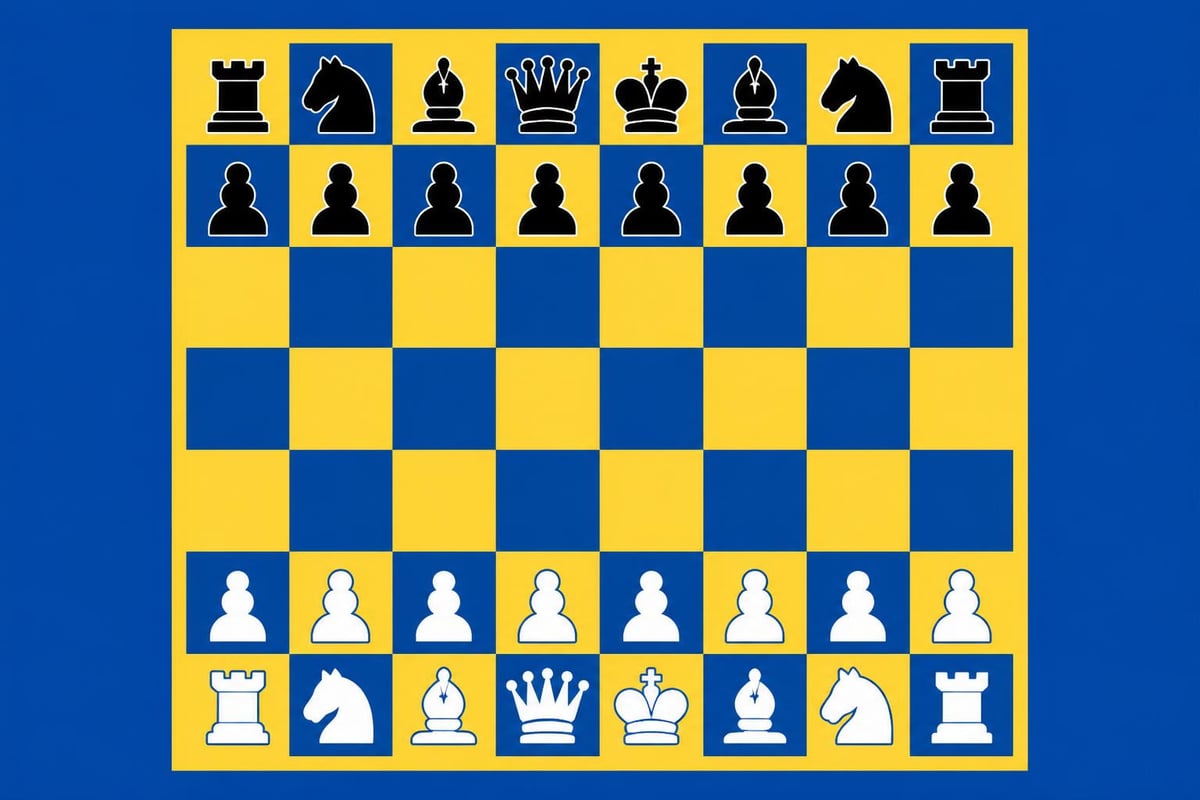
Getting the initial setup right is more important than you might think. According to FIDE's official rules, the starting position must follow a specific arrangement that ensures a fair and balanced game.
Here's the systematic approach to setting up:
- Position the board with a light square in the bottom-right corner
- Place the rooks in the corners (a1, h1 for White; a8, h8 for Black)
- Add the knights next to the rooks (b1, g1 for White; b8, g8 for Black)
- Position the bishops beside the knights (c1, f1 for White; c8, f8 for Black)
- Place the queen on her own colour (d1 for White, d8 for Black)
- Set the king on the remaining square (e1 for White, e8 for Black)
- Line up all pawns on the second rank for White and seventh rank for Black
A helpful memory aid: "Queen on her own colour." This ensures you'll never swap the king and queen positions.
Choosing the Right Chess Board and Pieces for Your Needs
Not all chess board and pieces sets are created equal, and what works perfectly for tournament play might be impractical for casual games at the park. Your choice should reflect how and where you actually play.
For Tournament Players
If you're competing in rated events, you'll want equipment that meets tournament standards. Tournament-grade chess sets typically feature Staunton-pattern pieces with specific weight and size requirements. The board should have 2-2.25 inch squares with clear contrast between light and dark squares.
For Home Study and Practice
When you're working through chess openings or solving puzzles at home, comfort matters most. A wooden board with weighted pieces provides excellent stability and a satisfying tactile experience. The slight extra cost pays dividends in enjoyment over years of use.
For Travel and Portability
Heading to the park or travelling? A vinyl rollup board paired with lightweight plastic pieces offers unbeatable convenience. Many sets come with a tube that doubles as storage, making them perfect for throwing in a backpack. You can even find magnetic sets that work well on trains or planes.
For Teaching and Learning
If you're introducing someone to chess or playing the game of chess for the first time, consider a demonstration board. These larger boards with oversized pieces make it easier to explain concepts and show tactical patterns. Some even come with algebraic notation on the squares to help beginners learn the coordinate system.
Materials Matter: Durability and Aesthetics
The materials used in your chess board and pieces dramatically affect both longevity and playing experience. Let's break down the most common options and what they offer.
Wood: The Traditional Choice
Wooden sets range from affordable beech or maple to exotic rosewood and ebony. High-quality wooden pieces have proper weight distribution, often achieved through added lead, giving them a substantial feel. The board itself might be solid wood, veneer, or inlaid with different wood types for the squares.
Advantages of wooden sets:
- Durability: Can last generations with proper care
- Aesthetics: Beautiful grain patterns and natural warmth
- Feel: Satisfying weight and tactile experience
- Stability: Weighted pieces don't tip easily
Plastic: Practical and Affordable
Modern plastic sets shouldn't be dismissed. Tournament-quality plastic pieces like the classic "club special" design are used in countless competitions worldwide. They're virtually indestructible, easy to replace if you lose a piece, and available in numerous colour combinations.
Premium Materials
For collectors and enthusiasts, chess sets are crafted from materials like bone, metal, glass, or stone. Whilst stunning to display, these aren't always practical for regular play. The chessboard's design can incorporate precious metals, intricate inlays, or thematic artistic elements.
Maintaining Your Chess Board and Pieces
You've invested in quality equipment, so keeping it in top condition makes sense. Proper maintenance extends the life of your chess board and pieces whilst ensuring they remain pleasant to handle.
For wooden boards and pieces:
- Dust regularly with a soft, dry cloth
- Apply furniture wax or wood conditioner annually
- Avoid direct sunlight to prevent fading
- Store in moderate humidity to prevent warping
For plastic and vinyl sets:
- Wipe clean with a damp cloth
- Use mild soap for stubborn marks
- Store flat or rolled (for vinyl boards)
- Keep away from extreme temperatures
The Psychology of Chess Board and Pieces Design
Have you noticed how different piece designs affect your playing experience? The Staunton pattern, designed in 1849, became the standard because its shapes are instantly recognizable and functionally distinct. Each piece's silhouette communicates its identity at a glance, reducing confusion during rapid play.
Research into chess piece classification has shown that even computer vision systems rely on these distinctive shapes for accurate recognition. This clarity benefits human players even more, allowing your brain to process positions quickly without consciously identifying each piece.
Digital vs Physical: Why Both Matter
In 2026, you're probably doing some of your chess study online. Digital platforms offer incredible convenience for training tactics, studying openings like the London System, or playing opponents worldwide. However, physical chess board and pieces still offer unique benefits.
| Aspect | Physical Board | Digital Platform |
|---|---|---|
| Tactical vision | Develops natural pattern recognition | Convenient but may rely on highlights |
| Calculation | Forces pure visualization | Can move pieces to test variations |
| Social interaction | Face-to-face experience | Global accessibility |
| Tournament preparation | Matches actual playing conditions | Unlimited practice opportunities |
| Study flexibility | Requires setup time | Instant access to positions |
Many strong players maintain a balance, using digital tools for opening preparation and tactics training whilst regularly playing over-the-board games to maintain their board vision and calculation skills.
Special Features and Accessories
Modern chess board and pieces sets often include thoughtful extras that enhance your playing experience. Coordinate notation printed or engraved on the board edges helps beginners learn the system. Storage drawers built into wooden boards keep pieces secure between games. Some sets include extra queens for pawn promotion (because let's face it, you'll almost always promote to a queen).
Consider these useful additions:
- Chess clock: Essential for timed games and tournament practice
- Score sheets: Recording your games aids improvement
- Piece bags: Protect individual pieces during storage
- Board covers: Shield wooden boards from dust and scratches
Understanding Piece Values in Context
Whilst we've mentioned the approximate point values of pieces, understanding when these values shift is crucial for improving your play. A knight on the rim might be worth less than the traditional three pawns, whilst a rook on the seventh rank in an endgame could be worth considerably more than five.
When studying openings like the Sicilian Defense or the Italian Game, you'll encounter positions where piece activity matters more than material count. Your physical chess board and pieces help you develop the intuition to recognize these nuances.
The Learning Journey Continues
Your relationship with your chess board and pieces evolves as you improve. What seemed like a confusing jumble of squares and shapes gradually transforms into a landscape of possibilities, patterns, and strategic ideas. Each piece develops character through the games you play, the tactics you solve, and the positions you study.
Whether you're working through chess openings for intermediate players or simply enjoying casual games with friends, your equipment serves as the constant companion in your chess journey. The tactile experience of moving pieces, the visual feedback of the position, and the satisfaction of executing a well-calculated combination all contribute to the enduring appeal of this ancient game.
Understanding your chess board and pieces is the foundation upon which all chess improvement builds. With the right equipment and solid knowledge of how each component works together, you're ready to dive deeper into strategy, tactics, and opening theory. Chess Cheat Sheets provides comprehensive guides and resources designed specifically to help you master chess openings and strengthen your overall game without overwhelming study requirements. Start exploring our streamlined cheat sheets, puzzles, and opening guides to accelerate your chess development today.


