

Playing the black pieces in chess presents a unique challenge. You're always responding to your opponent's first move, forced to react rather than dictate the initial direction of the game. But here's the thing: black openings aren't just defensive afterthoughts. They're sophisticated systems that can seize the initiative, create imbalances, and put White under immediate pressure. Understanding the landscape of black openings transforms you from a reactive player into someone who knows exactly how to punish imprecise play and generate winning chances from the very first move.
Why Black Openings Matter More Than You Think
You might wonder whether opening preparation really makes that much difference when you're playing second. Doesn't White have an inherent advantage?
Statistically, yes. White scores approximately 52-55% in master-level games. But here's what most players miss: the gap between White and Black narrows dramatically when Black plays principled, well-prepared openings. The difference between a solid black opening and a dubious one can mean the difference between fighting for equality and struggling from move five onwards.
Black openings serve three critical functions:
- They neutralize White's first-move advantage
- They steer the game toward positions that suit your style
- They create concrete problems White must solve accurately
Think about it this way: when you sit down with the black pieces, you're not just hoping to survive the opening. You're setting traps, creating complications, and forcing your opponent to prove they know the theory. The psychological advantage of being well-prepared cannot be overstated.
The Main Categories of Black Openings
Black openings generally fall into distinct philosophical camps, each with different strategic goals. Understanding these categories helps you choose systems that match your playing style rather than memorizing random variations.
Classical Defenses
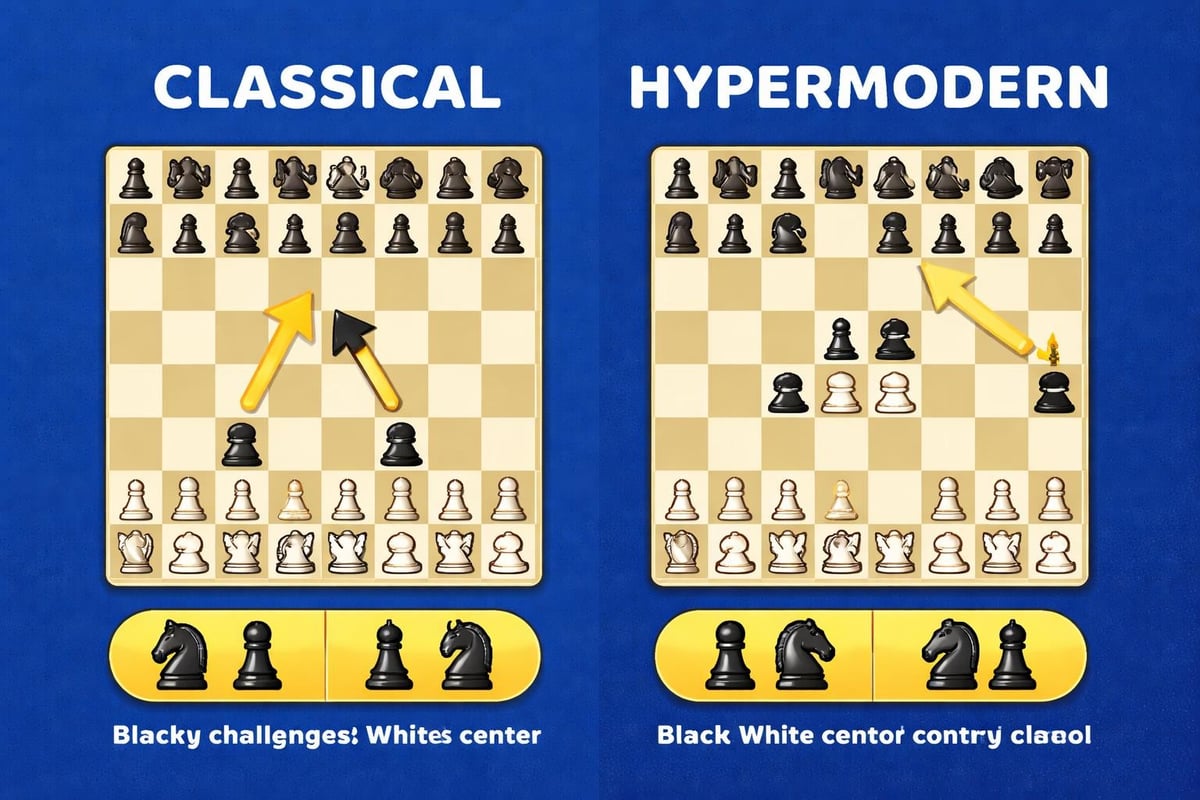
Classical black openings occupy the centre immediately, challenging White's central pawns head-on. These systems have stood the test of time precisely because they're theoretically sound and create balanced positions.
The Caro-Kann Defense (1.e4 c6) exemplifies this approach. You're preparing ...d5 to contest the centre whilst keeping your light-squared bishop free. When comparing the Caro-Kann vs French Defense, many players prefer the Caro-Kann because it avoids the potentially cramped positions that arise in the French.
Hypermodern Approaches
Hypermodern black openings deliberately allow White to establish a broad pawn centre, then undermine it from the flanks. This counter-intuitive strategy confused players when it emerged in the 1920s, but it's now thoroughly mainstream.
The Pirc Defence demonstrates hypermodern principles beautifully. After 1.e4 d6 2.d4 Nf6 3.Nc3 g6, you're inviting White to build an impressive centre, confident you can attack it later with moves like ...Bg7, ...O-O, and ...e5 or ...c5.
Similarly, the King's Indian Defense takes this approach against 1.d4, creating sharp, unbalanced positions where both sides have clear plans.
Counter-Attacking Systems
Some black openings don't just equalize-they immediately strike back at White's centre. These aggressive systems suit players who prefer complications to quiet manoeuvring.
| Opening | First Moves | Key Idea | Best For |
|---|---|---|---|
| Sicilian Defense | 1.e4 c5 | Attack d4, create asymmetry | Aggressive players |
| Scandinavian | 1.e4 d5 | Immediate central challenge | Straightforward play |
| Alekhine's Defense | 1.e4 Nf6 | Provoke White's pawns forward | Tactical players |
The Scandinavian Defense particularly appeals to players who want a clear plan. You immediately challenge e4, and after 2.exd5 Qxd5 3.Nc3 Qa5, you've created an early imbalance without requiring extensive theoretical knowledge.

The Five Most Reliable Black Openings
Let's examine the black openings that consistently deliver good results across all levels of play. These aren't necessarily the sharpest or most fashionable-they're the systems you can trust.
The Caro-Kann Defense
Why does the Caro-Kann remain so popular after more than a century? Simple: it's incredibly difficult to refute. You develop solidly, maintain flexibility, and rarely end up in clearly worse positions.
Main variations you should know:
- Classical Variation (4...Bf5)
- Advance Variation (1.e4 c6 2.d4 d5 3.e5)
- Exchange Variation (3.exd5 cxd5)
- Panov-Botvinnik Attack (3.exd5 cxd5 4.c4)
The beauty of the Caro-Kann lies in its resilience. Even if you don't know the absolute latest theory, the resulting positions make sense. You're rarely surprised by bizarre tactics or forced into uncomfortable sacrifices. For a deeper dive into this system, the Caro-Kann Defense guide provides comprehensive coverage of all major lines.
The French Defense
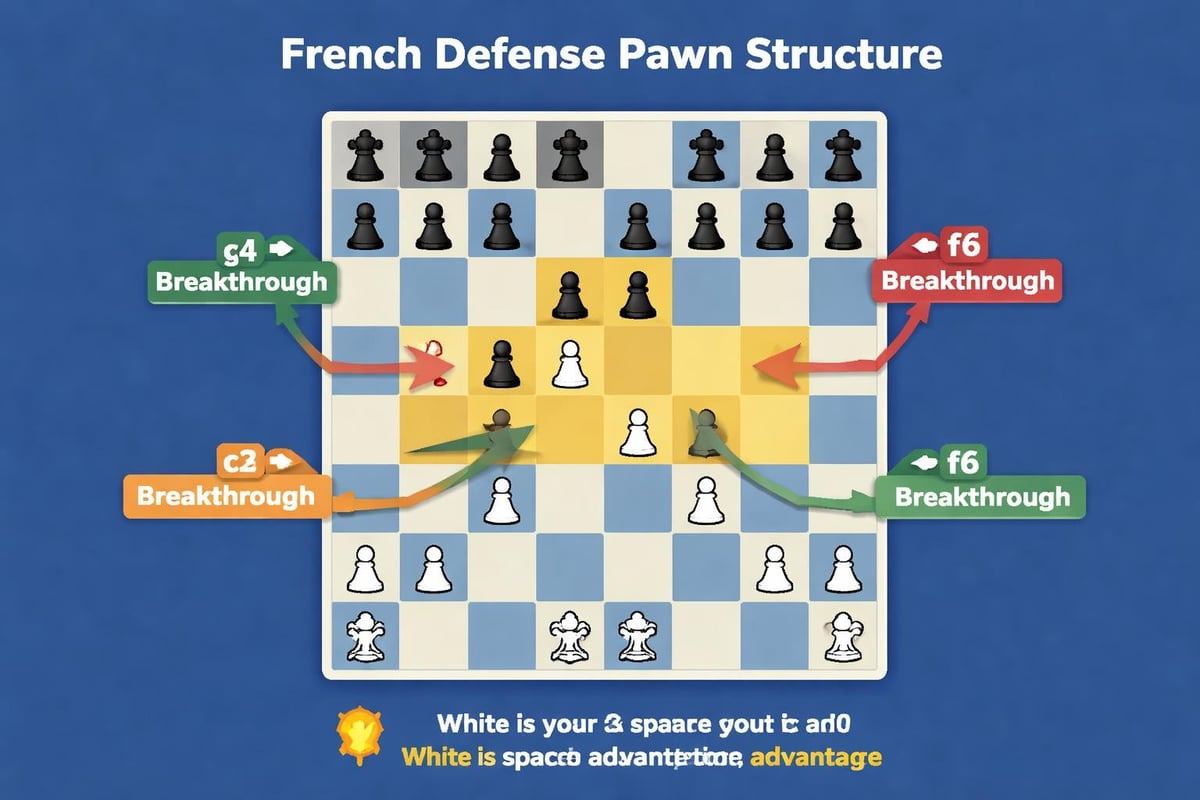
The French (1.e4 e6) creates fundamentally different positions than the Caro-Kann, though both challenge White's e4 pawn. Here, you accept a slightly cramped position in exchange for rock-solid structure and clear counter-play.
After 2.d4 d5, White faces a critical decision. The Advance Variation (3.e5) creates a space advantage but also a target. The Exchange Variation (3.exd5) simplifies toward equality. The Winawer (3.Nc3 Bb4) and Tarrasch (3.Nd2) lead to complex middlegames where both sides have chances.
The Sicilian Defense
If you're wondering which opening scores best for Black statistically, the Sicilian Defense tops the charts. After 1.e4 c5, you've already created an asymmetrical position where White cannot force a simple draw.
The Sicilian isn't one opening-it's a complex of related systems. The Najdorf, Dragon, Sveshnikov, and Classical variations all have distinct characters. This diversity means you can tailor your Sicilian repertoire to match your style perfectly. Our Sicilian Defense guide breaks down the major variations with clear, practical advice.
However, the Sicilian demands theoretical knowledge. You cannot simply play logical moves and expect good results. White has too many dangerous attacking systems, and one inaccuracy can prove fatal. Is the investment worth it? Absolutely, if you're willing to study.
The Nimzo-Indian Defense
Against 1.d4, the Nimzo-Indian (1.d4 Nf6 2.c4 e6 3.Nc3 Bb4) represents one of Black's most principled approaches. You immediately pin the knight on c3, preventing White from building the ideal pawn centre.
The strategic battle revolves around White's doubled c-pawns after ...Bxc3+. Are they a weakness or a source of central strength? The answer depends on the specific position, which is what makes the Nimzo-Indian endlessly fascinating.
World champions from Mikhail Botvinnik to Magnus Carlsen have trusted this opening in critical games. It combines soundness with winning chances-a rare combination for black openings.
The King's Indian Defense
For players who love attack, the King's Indian Defense offers unparalleled opportunities. After 1.d4 Nf6 2.c4 g6 3.Nc3 Bg7 4.e4 d6, you've set up a hypermodern structure that aims for kingside attacks whilst White expands on the queenside.
The resulting positions feature opposite-side castling, pawn storms, and tactical melees where calculation matters more than positional refinement. It's not for everyone, but King's Indian players tend to be passionate devotees.
Choosing Black Openings That Match Your Style
Here's a question many players struggle with: should you choose black openings based on what's objectively best or what suits your playing style?
The answer is both, with a heavy emphasis on style. A solid, positional player forcing themselves to learn the sharp Sicilian Dragon will achieve worse results than playing the less critical but more comfortable French Defense. Your opening should energize you, not drain your mental resources before the middlegame even begins.
Consider these factors when building your black opening repertoire:
- Time available for study: The Sicilian requires more maintenance than the Caro-Kann
- Preferred position types: Open games vs. closed positions
- Tactical vs. positional strength: Match your natural abilities
- Tolerance for risk: Sharp lines vs. solid systems
- Desired game length: Quick tactics vs. strategic grinds
Many successful players maintain a primary black opening against 1.e4 and 1.d4 each, plus a secondary option for variety. This provides flexibility without requiring encyclopedic knowledge. The best openings for Black vary by playing style and level.
Common Mistakes in Black Opening Play
Even with solid black openings, players sabotage themselves through recurring errors. Recognizing these patterns helps you avoid them.
Moving Too Quickly Without a Plan
Black openings require patience. You're responding to White's setup, which means you must understand your opponent's plan before executing your own. Rushing to attack before completing development leads to disaster.
Take the Pirc Defense. If you play ...h5 too early trying to initiate a kingside attack, you've merely weakened your king without proper preparation. The correct approach involves completing development (...Bg7, ...O-O, ...Nc6) before launching operations.
Neglecting Development for Material
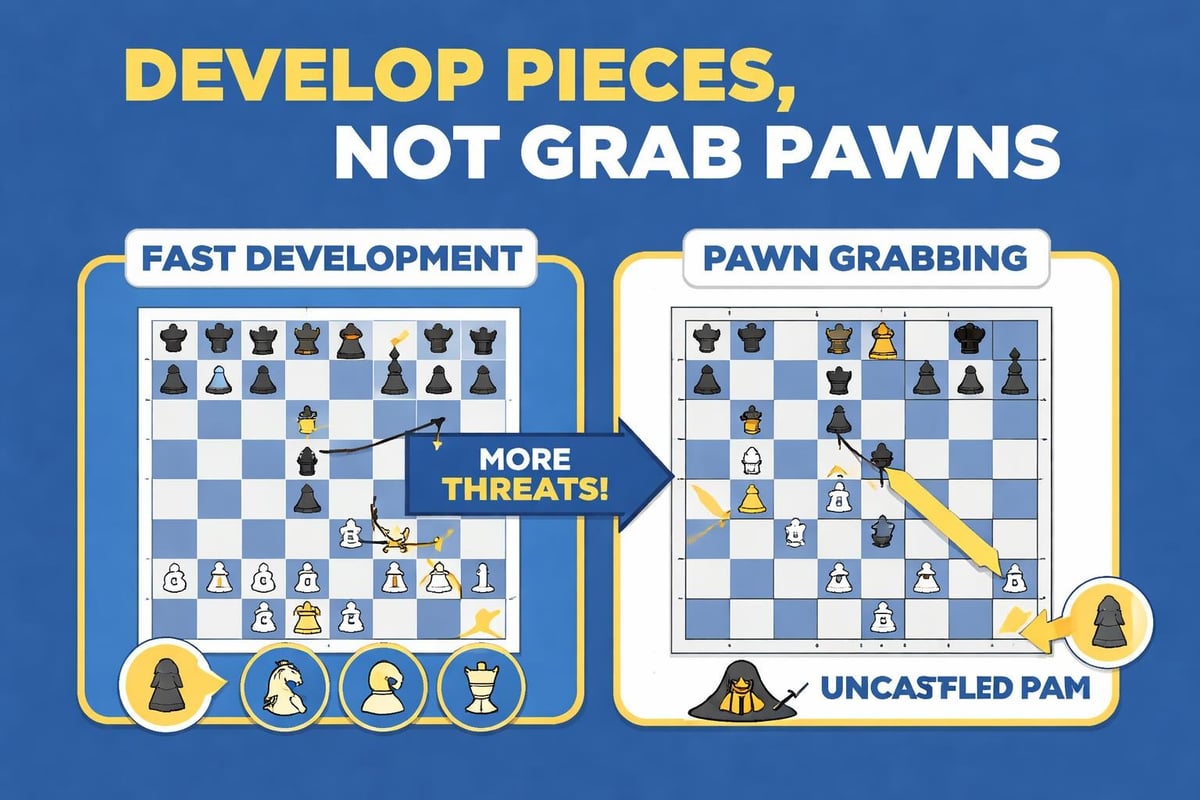
That pawn on b2 looks tempting, doesn't it? Many black openings offer opportunities to win pawns in the opening, but these gains often prove illusory. You waste time whilst White completes development and launches an attack against your exposed king.
The Scandinavian Defense guide explicitly warns against this trap. After 1.e4 d5 2.exd5 Qxd5 3.Nc3 Qa5, some players are tempted by 4.d4 Nf6 5.Nf3 Bf5 6.Bc4, eyeing b2. But grabbing the pawn with 6...Qxb2? allows 7.Rb1 Qa3 8.Nd5!, and suddenly Black's queen has no good squares.
Playing Hope Chess
"Hope chess" means making moves and hoping your opponent doesn't find the refutation. This approach proves especially dangerous in black openings where you're already on the back foot.
The Nimzowitsch Defence, for instance, is perfectly playable but requires precise understanding. Playing 1.e4 Nc6 hoping White doesn't know the theory is asking for trouble. Either commit to learning the key lines or choose a different opening.
Building Your Black Opening Repertoire
Creating a sustainable black opening repertoire requires strategic thinking. You cannot learn every variation against every White system-you'll burn out before reaching the middlegame.
| Level | Recommended Scope | Study Approach |
|---|---|---|
| Beginner | 1 opening vs e4, 1 vs d4 | Learn principles, not lines |
| Intermediate | 2 openings each, understand transpositions | Study complete games |
| Advanced | 3-4 systems each, deep theory | Computer analysis + database study |
Start with the fundamental ideas behind your chosen black openings rather than memorizing twenty moves deep. Why does Black play ...c5 in the Sicilian? What's the point of ...g6 in the King's Indian? Understanding these concepts allows you to navigate unfamiliar positions through logic rather than memory.
Chess.com's guide to openings for Black provides excellent starting points for players building their first repertoire. The key is choosing systems that complement each other rather than requiring completely different strategic understanding.
Creating a Balanced Approach
Your black opening repertoire should cover different game types. If you only play the French Defense against 1.e4, you're limiting your experience with open positions. Consider pairing it with an open game like the Petroff or Scandinavian for variety.
Against 1.d4, balance is equally important. The King's Indian provides sharp play, whilst the Queen's Gambit Declined offers solidity. Having both available makes you a more complete player and prevents opponents from preparing narrow, specific lines against you.
Advanced Concepts in Black Openings
Once you've mastered the basics of your chosen black openings, several advanced concepts separate good players from great ones.
Move Order Flexibility
Many black openings can be reached through different move orders, and choosing the optimal sequence requires subtle judgment. In the Caro-Kann, for example, some players prefer 1.e4 c6 2.d4 d5 3.Nc3 dxe4 over 3...Nf6, depending on their assessment of the resulting positions.
These transposition tricks become powerful weapons. You might reach your desired King's Indian structure through a different move order that avoids White's most dangerous system. This requires deep opening knowledge but pays dividends against well-prepared opponents.
Understanding Critical Tabiya Positions
Every black opening has "tabiya"-critical positions from which many variations branch. Deeply understanding these key positions matters more than memorizing individual lines.
In the Najdorf Sicilian, the position after 1.e4 c5 2.Nf3 d6 3.d4 cxd4 4.Nxd4 Nf6 5.Nc3 a6 is tabiya. From here, White can play the English Attack, Be3 systems, Bg5 variations, or classical development with Be2. Knowing the typical plans in each resulting position matters far more than memorizing computer-recommended moves.
Knowing When to Deviate
Paradoxically, truly understanding black openings includes knowing when to abandon your preparation. If your opponent plays an unusual fifth move, continuing with your memorized line might lead nowhere useful.
The best players recognize these moments and switch to general principles. You've studied the French Defense extensively, but if White plays an obscure sideline on move six, trust your understanding of pawn structures and piece placement rather than panicking.
Learning Resources for Black Openings
How do you efficiently learn black openings without drowning in information? The chess world offers overwhelming amounts of opening theory, but not all resources serve your needs equally.
Effective learning methods ranked by usefulness:
- Playing practice games specifically in your chosen opening
- Studying annotated master games in your opening
- Working through a structured opening guide or course
- Analyzing your own games to find where you went wrong
- Watching videos or streams covering your openings
Notice what's missing? Memorizing endless variations from a database. That approach fails because you never understand why the moves work-you're just parroting computer analysis.
Instead, use resources like the Chess Cheat Sheets collection to quickly reference key positions and plans. These condensed guides provide the essential information without the overwhelming detail that makes opening study feel like homework. For broader context, the Chess Journal's overview of effective black openings offers strategic insights that help you choose systems matching your style.
Structured Study Plans
Dedicate specific time to black opening study rather than randomly looking at positions. Spend fifteen minutes daily working through master games in your chosen opening. Notice not just the opening moves but how the middlegame plans emerge naturally from the opening setup.
After each game you play, regardless of result, briefly analyze the opening phase. Did you reach a known position? Where did you (or your opponent) deviate from theory? Was the deviation an improvement or a mistake? This active engagement cements learning far better than passive study.
Handling White's Sidelines and Gambits
Even the most carefully prepared black openings face disruption when White plays an offbeat system. The London System against your King's Indian setup, the King's Gambit against your prepared Petroff Defense-these sidelines require flexible understanding rather than memorized responses.
The good news? Most sidelines are less dangerous than main lines precisely because they're sidelines. White often trades theoretical advantage for surprise value. Your general chess understanding becomes more important than specific opening knowledge.
When facing an unfamiliar white system:
- Stick to fundamental development principles
- Don't panic and play hope chess
- Look for tactical opportunities created by unusual setups
- Accept that you might not achieve your ideal structure
- Focus on creating a playable position rather than theoretical equality
Many players actually prefer when opponents play sidelines. You escape the heavily analyzed main lines where your opponent might know theory deeper than you do. Trust your chess ability in unfamiliar territory.
Converting Opening Advantages into Wins
Here's a question that doesn't get enough attention: what do you do after successfully completing your black opening? You've neutralized White's advantage, developed all your pieces, and reached a balanced middlegame. Now what?
This transition from opening to middlegame trips up many players. They memorize twenty moves of theory but haven't studied what happens next. The resulting confusion wastes the good position you achieved.
Study complete games in your black openings, paying special attention to moves 15-25. How did Black convert equality into an advantage? What plans emerged from the opening structure? The King's Indian typically features a minority attack or central break. The French involves undermining White's pawn chain. These patterns repeat endlessly.
Understanding these middlegame themes makes your opening study immediately practical. You're not learning isolated variations-you're internalizing complete strategic systems that guide you through entire games. This holistic approach to black openings transforms your chess more effectively than memorizing computer lines ever could.
Mastering black openings requires patience, but the payoff transforms your chess completely. When you understand the strategic ideas behind your chosen systems and know the key positions inside out, you'll approach each game with confidence rather than anxiety about what your opponent might play. Whether you prefer the solid Caro-Kann or the aggressive Sicilian, committing to systematic study of your black opening repertoire provides the foundation for long-term improvement. Chess Cheat Sheets offers streamlined guides and resources that make mastering these openings accessible without overwhelming you with endless variations, helping you focus on the practical knowledge that actually wins games.


