

When you think about chess players who've truly shaped the modern game, Levon Aronian deserves a prominent spot on that list. The Armenian super-grandmaster has captivated audiences worldwide with his creative playing style, tactical brilliance, and unwavering dedication to the game. Whether you're a club player looking to improve your understanding or simply fascinated by chess mastery, studying Aronian's approach can transform how you think about chess strategy. His games offer a masterclass in balancing solid preparation with over-the-board creativity, making him an ideal model for players at all levels.
Who Is Levon Aronian?
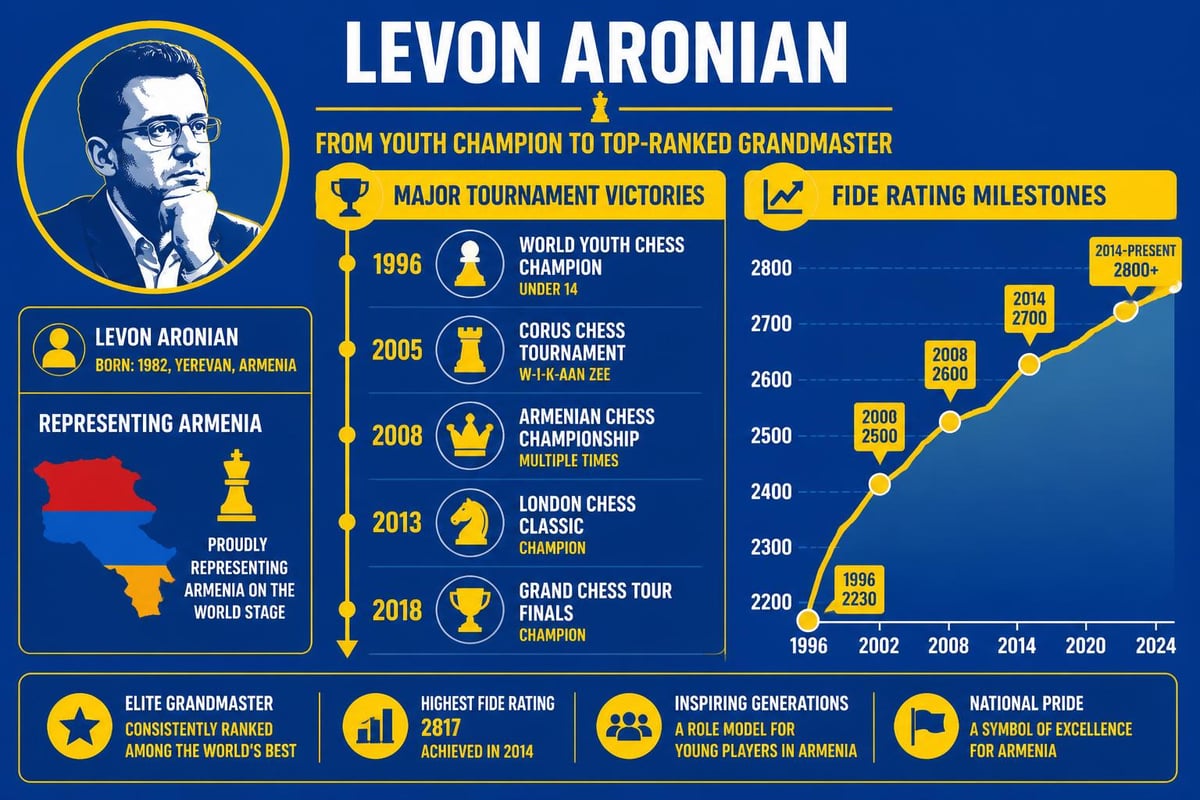
Born in Yerevan, Armenia, in 1982, Aronian quickly established himself as one of chess's most formidable competitors. His journey from local prodigy to world-class grandmaster represents a remarkable story of talent meeting dedication.
By age 17, he'd already earned his grandmaster title, and within a few years, he was competing against the world's elite. What sets Aronian apart isn't just his strength at the board but his willingness to embrace complex, uncharted positions.
Early Career and Rise to Prominence
Aronian's ascent through the chess ranks was meteoric yet methodical. He won the World Youth Chess Championship in 2002, signaling his arrival on the international stage. Throughout the 2000s, he consistently improved his rating, breaking into the world's top 10 and eventually reaching number 2 in 2014.
His tournament victories include multiple Chess Olympiad gold medals with Armenia, wins at prestigious events like Tata Steel and the World Cup, and countless other first-place finishes. Each victory showcased his versatility across different time controls and formats.
Aronian's Opening Repertoire: What Can You Learn?
One of the most fascinating aspects of studying Aronian is his opening choices. Unlike players who stick rigidly to a narrow repertoire, he's explored a vast range of systems throughout his career. This flexibility makes him unpredictable and dangerous.
With White Pieces
Aronian has experimented with virtually every major first move:
- 1.e4: He employs this occasionally, usually transitioning into open games or the Ruy Lopez
- 1.d4: Perhaps his most common choice, leading to rich middlegame positions
- 1.Nf3: The Reti approach, which he uses to sidestep heavy theory
- 1.c4: The English Opening, allowing flexible pawn structures
What's remarkable is how Aronian adapts his opening selection based on his opponent. Against stronger players, he might choose sharper, more theoretical lines. Against lower-rated opposition, he's comfortable in quieter systems where his superior understanding can gradually assert itself.
If you're looking to expand your repertoire with White, studying how top players approach the English Opening can provide valuable insights into the flexibility Aronian demonstrates.
With Black Pieces
Aronian's black repertoire is equally impressive. He's comfortable in virtually any position:
| Opening System | Frequency | Key Characteristics |
|---|---|---|
| Sicilian Defense | High | Sharp counterattacking play |
| Queen's Gambit Declined | Medium | Solid, classical structures |
| Grünfeld Defense | High | Dynamic piece play |
| Nimzo-Indian Defense | High | Strategic complexity |
Against 1.e4, he's shown willingness to play both the Sicilian and various semi-open defenses. Understanding these defenses helps you appreciate the Sicilian Defense's versatility in modern chess.
Against 1.d4, his preference for the Grünfeld and Nimzo-Indian demonstrates his comfort in asymmetrical positions where both sides have distinct plans. These aren't beginners' openings, but they reward deep understanding over rote memorization.

The Aronian Style: Creativity Meets Calculation
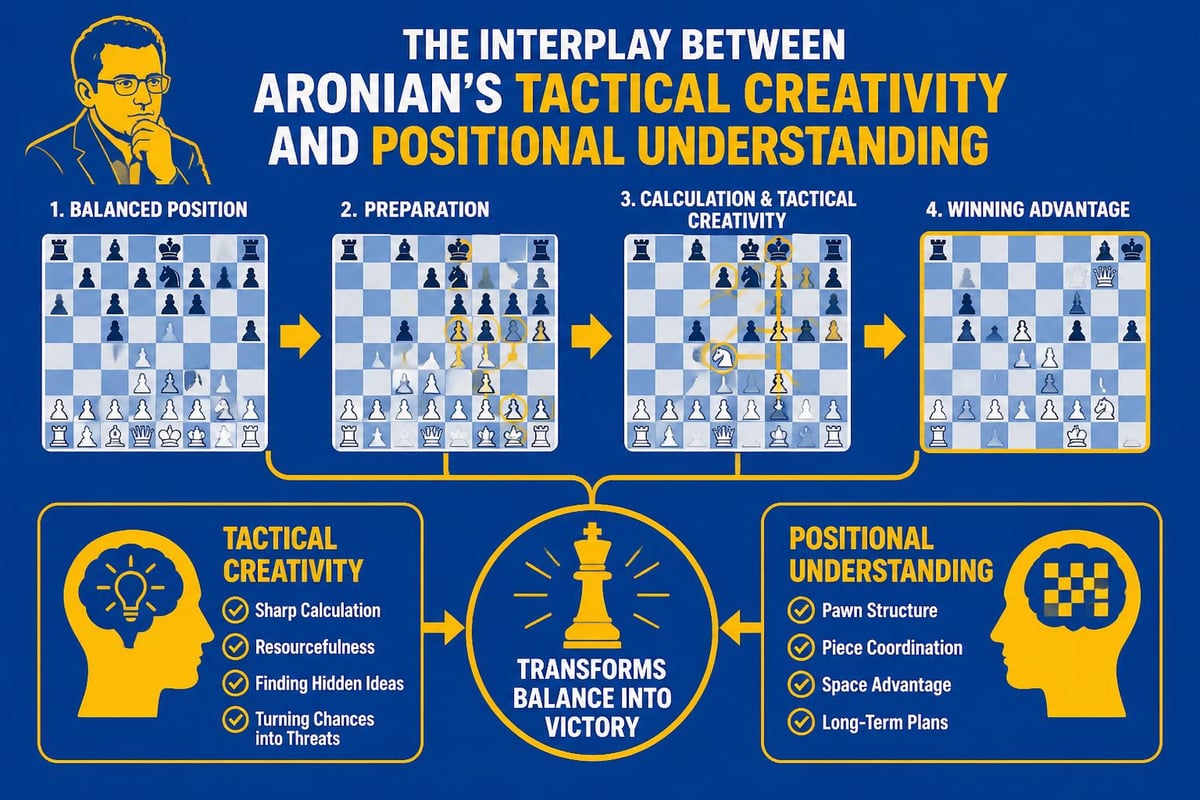
What truly distinguishes Aronian from other super-grandmasters is his playing style. He's known for finding creative solutions in positions where others might play routinely. This doesn't mean he's reckless-far from it. His creativity is built upon a foundation of precise calculation and deep positional understanding.
Tactical Brilliance
Aronian has delivered some of the most memorable tactical shots in recent chess history. His ability to calculate complex variations quickly allows him to create threats that opponents struggle to defend against. When you review his games on Chess.com, you'll notice recurring patterns in how he builds tactical opportunities.
He doesn't wait for tactics to appear-he creates the conditions where tactics become possible. This proactive approach is something every improving player should study.
Positional Understanding
Beyond tactics, Aronian demonstrates exceptional positional judgment. He knows when to maintain tension, when to release it, and how to gradually improve his position. His endgame technique is particularly instructive, showing how small advantages can be converted with patience and precision.
Watch how he handles pawn structures. Whether it's isolated pawns, hanging pawns, or pawn chains, Aronian adapts his strategy to match the position's demands. This flexibility is what separates good players from great ones.
Studying Aronian's Games: A Learning Goldmine
For players looking to improve, Aronian's games offer tremendous educational value. Unlike some top players whose preparation relies heavily on deep computer analysis, Aronian often plays in a human, understandable way. His games teach principles, not just moves.
Key Games to Study
Several of Aronian's games have become modern classics:
- Aronian vs. Anand, 2013 Candidates Tournament: A masterpiece of positional play
- Aronian vs. Nakamura, 2014 Zurich Chess Challenge: Brilliant tactical execution
- Aronian vs. Caruana, 2012 Tata Steel: Strategic domination from the opening
- Aronian vs. Kramnik, 2011 Dortmund: Perfect technique in a complex endgame
Each of these games demonstrates different aspects of chess mastery. The beauty is that you don't need to be a grandmaster to appreciate the ideas-Aronian's play often follows logical principles that intermediate players can understand and apply.
What Makes His Games Special?
When you analyze an Aronian game, you're not just seeing good moves. You're witnessing a thought process that balances multiple factors simultaneously. He considers pawn structure, piece activity, king safety, and dynamic possibilities all at once.
His games rarely feel mechanical. There's an artistic quality to how he handles the pieces, creating harmony even in the most complicated positions. This is why studying master games remains one of the best ways to improve your chess understanding.
Aronian's Tournament Performance and Achievements
The Armenian grandmaster's tournament record speaks volumes about his consistency and skill. He's been a fixture in elite tournaments for over two decades, competing against the absolute best players in history.
Major Victories
- World Cup winner (2005, 2017)
- FIDE Grand Prix winner (2008-2009, 2014-2015)
- Tata Steel Chess Tournament winner (2008, 2012, 2013, 2015)
- Multiple Chess Olympiad gold medals with Armenia
- Numerous national championship titles
These victories weren't flukes. Aronian consistently performs at the highest level, demonstrating both preparation and resilience. His ability to bounce back from losses and maintain focus through grueling tournament schedules is particularly impressive.
The Rating Journey
Aronian's peak rating exceeded 2820, placing him among the elite few to reach that stratospheric level. While ratings fluctuate, his sustained excellence over decades demonstrates genuine mastery. You can track his detailed statistics and performance patterns through his comprehensive Chess.com profile.
His rating progression wasn't linear-like all players, he experienced peaks and valleys. What's instructive is how he responded to setbacks, using them as motivation to refine his game further.
Cultural Impact and Representation
Beyond his individual achievements, Aronian represents Armenia on the world stage with pride. His success has inspired an entire generation of Armenian chess players and elevated the nation's already strong chess culture. This connection between player and country adds another dimension to his legacy.
The New Yorker's profile beautifully captures how Aronian carries his nation's hopes while maintaining his individual creative approach to the game. He's become a national hero, demonstrating how chess transcends the 64 squares.

Learning from Aronian: Practical Tips for Your Game
So how can you apply Aronian's approach to your own chess? Here are concrete strategies based on his playing philosophy:
Embrace Complexity
Don't shy away from complicated positions. Aronian thrives in chaos because he's developed his calculation skills through practice. Start solving tactical puzzles regularly and gradually increase their difficulty. The more comfortable you become with complexity, the more opportunities you'll spot.
Develop a Flexible Repertoire
While you don't need to play as many openings as Aronian, having alternatives within your repertoire helps. If your main system isn't working, having a backup prevents you from becoming predictable. Consider exploring different opening systems through resources like the London System guide or the Italian Game materials.
Study Your Losses
Aronian has spoken about learning more from defeats than victories. When you lose, don't just forget the game-analyze it deeply. Understand where your thinking went wrong, what you missed, and how you can prevent similar mistakes.
Balance Preparation with Creativity
While opening preparation matters, don't become a slave to it. Aronian prepares thoroughly but isn't afraid to deviate when the position demands it. Find the balance between knowing theory and trusting your understanding.
Modern Chess and Aronian's Evolution
As chess has evolved with computer assistance becoming ubiquitous, Aronian has adapted remarkably well. He's embraced technology for preparation while maintaining his creative spark over the board. This balance is increasingly important in modern chess.
His recent performances show he remains competitive against younger generations raised on chess engines. This longevity demonstrates that pure chess understanding and adaptability trump age when properly maintained.
The Transfer to America
In recent years, Aronian made the significant decision to represent the United States, adding another chapter to his career. This move doesn't diminish his Armenian heritage but reflects the global nature of modern chess and personal life circumstances.
His continued success representing the US Chess Federation demonstrates that elite performance transcends national boundaries. The chess community worldwide continues to appreciate his contributions regardless of the flag he represents.
Aronian's Influence on Modern Chess Theory
Beyond individual games, Aronian has contributed to chess theory through his innovative opening ideas. Several lines in the Grünfeld, Nimzo-Indian, and other openings bear his fingerprints, with novelties he introduced becoming standard practice.
When grandmasters analyze positions, they often reference "Aronian's idea" or "Aronian's treatment." This theoretical influence extends his impact beyond tournament results, shaping how future generations understand certain positions.
For players developing their opening knowledge, understanding these theoretical contributions helps appreciate the depth of grandmaster preparation. Resources like Chess Cheat Sheets' opening guides can help you build this foundation systematically.
What Sets Aronian Apart?
In a field crowded with exceptional talent, what makes Aronian special? Several factors combine:
- Unpredictability: Opponents never quite know what to expect
- Universal style: Comfortable in any position type
- Resilience: Bounces back from setbacks consistently
- Artistic approach: Makes beautiful moves, not just strong ones
- Longevity: Maintained elite status across different chess eras
These qualities create a complete player who can compete in any situation. While you might not reach Aronian's level, incorporating these principles into your approach will improve your results.
Resources for Deeper Study
Want to dive deeper into Aronian's chess? Here's how:
Game databases: Study his complete game collection systematically, focusing on one opening at a time
Video content: Many chess platforms feature analysis of his best games with detailed commentary
Tournament coverage: Follow his current games in live tournaments to see how he handles modern opposition
Historical context: Read about his career journey to understand how he developed his style over time
The beauty of studying a player like Aronian is that his games reward repeated viewing. Each time you analyze one of his classics, you'll discover new nuances you missed before.
Levon Aronian's chess career offers invaluable lessons about creativity, preparation, and resilience that players at every level can apply to their own games. By studying his opening choices, tactical patterns, and strategic approach, you'll develop a more complete understanding of chess. Whether you're working on your opening repertoire or trying to sharpen your middlegame tactics, Chess Cheat Sheets provides the streamlined guides and resources you need to improve efficiently, helping you master the principles that make champions like Aronian so successful without getting overwhelmed by excessive study.


